

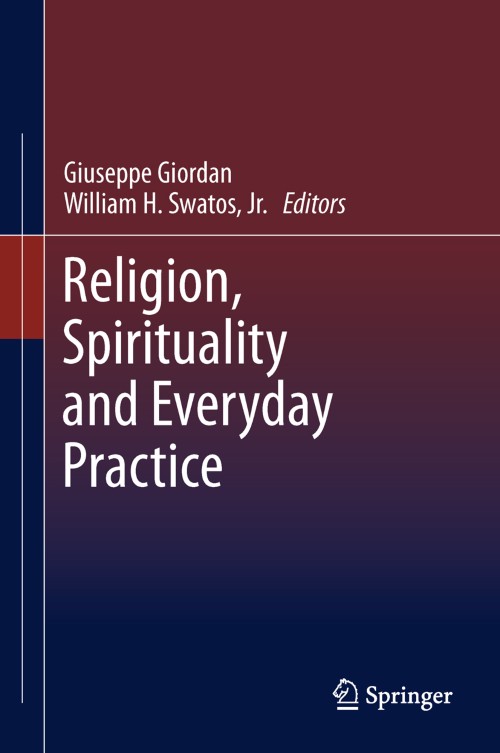
Religion, Spirituality and Everyday Practice [electronic resource] / edited by Giuseppe Giordan, William H. Swatos, Jr.
Erişim Adresi
ISBN
9789400718197
Dil Kodu
İngilizce
Yer Numarası
DK/14915
Basım Bildirimi
1st ed. 2012.
Yayın Bilgisi
Dordrecht : Springer Netherlands : Imprint: Springer, 2012.
Fiziksel Niteleme
XV, 193 p. online resource.
İçindekiler Notu
Introduction: The Spiritual “Turn” in Religion as Process and Outcome, W.H. Swatos, Jr. and G. Giordan -- Part I: Ideas and Concepts of the Spiritual Turn -- Spirituality and the Changing Religious Field, L. Woodhead -- Spirituality and Systems of Belief, E. Pace -- Religious Pilgrimage, Pilgrimage Spirituality and Everyday Life, w.H. Swatos, Jr -- Lived Religion: Signposts of Where We Have Been and Where We Can Go from Here, M.J. Neitz -- Religious Lifestyles, L. Berzano -- Part II: Case Studies in the New Spirituality -- Toward a Sociology of Prayer, G. Giordan -- The Concept of “Community” in Catholic Parishes, P.Wittberg -- Scared into Church? Conceptions of God, Exclusivity, and Religious Practice in the United States, C.D. Bader and A. Palmer -- Spiritual Life in Modern Japan: Understanding Religion in Everyday Life, A. Molle -- Workers in the Vineyard: Catholic Women and Social Action, C. Holtmann -- “Short” Youth: Resources and Meanings of Early Transition to Adulthood among Foreign Youth, D. Girardi -- Everyday Research Implications of Catholic Theological Positions: An American Perspective, A.J. Blasi -- From Institution to Spirituality and Back: Why We Should Be Cautious about the “Spiritual Turn” in the Sociology of Religion, I. Turina.
Özet, vb.
The current generation of young adults, at least in the Western world, has shown a marked tendency toward a preference for describing themselves as “spiritual” as contrasted to “religious.” This book seeks to examine the possible meanings and consequences associated with this contrast in terms of the similarities and differences that affect those who use these terms with respect to the everyday practices that they themselves employ or believe should follow from being self-defined as “religious” or “spiritual” – or not. The several chapters in this volume take up the religious-spiritual contrast specifically through investigations into practice: In what ways do people who claim to be “religious” or “spiritual” define these self-images as manifest in their own lives? How on a daily basis does a person who considers himself or herself “religious” or “spiritual” live out that self-image in specific ways that she or he can describe to others, even if not share with others? Are there ways that being “spiritual” can involve religion or ways that being “religious” can involve spirituality, and if so, how do these differ from concepts in prior eras (e.g., Ignatian spirituality, Orthodox spirituality, Anglican spirituality, etc.)? We also explore if there are institutions of spiritual practice to which those who term themselves “spiritual” turn, or if the difference implied by these terms may instead be between institutionalized and de-institutionalized expressions of practice, including but not limited to self-spiritualities.
Konu
Sociology.
Religion.
Sociology.
Religion.
Religion.
Sociology.
Religion.
Diğer Yazarlar
Kurum Adı
Eseri Alıntıla
Referansları kullanmadan önce gözden geçirmeniz ve varsa gerekli düzeltmeleri yapmanız önerilir.
Dijital Kaynak
MARC Görünümü
LEADER 04596nam a22005055i 4500
001 813674
003 TR_AnAIT
005 20260130223855
007 cr nn 008mamaa
008 110812s2012 ne | s |||| 0|eng d
020 |a9789400718197|9978-94-007-1819-7
024 7 |a10.1007/978-94-007-1819-7|2doi
041 |aeng
049 |aTürk Tarih Kurumu Kütüphanesi
050 4|aHM
072 7|aJHB|2bicssc
072 7|aJHB|2bicssc
072 7|aSOC026000|2bisacsh
072 7|aJHB|2thema
072 7|aJHB|2thema
082 04|a301|223
090 |aDK/14915
245 10|aReligion, Spirituality and Everyday Practice|h[electronic resource] /|cedited by Giuseppe Giordan, William H. Swatos, Jr.
250 |a1st ed. 2012.
264 1|aDordrecht :|bSpringer Netherlands :|bImprint: Springer,|c2012.
300 |aXV, 193 p.|bonline resource.
336 |atext|btxt|2rdacontent
337 |acomputer|bc|2rdamedia
338 |aonline resource|bcr|2rdacarrier
347 |atext file|bPDF|2rda
505 0 |aIntroduction: The Spiritual “Turn” in Religion as Process and Outcome, W.H. Swatos, Jr. and G. Giordan -- Part I: Ideas and Concepts of the Spiritual Turn -- Spirituality and the Changing Religious Field, L. Woodhead -- Spirituality and Systems of Belief, E. Pace -- Religious Pilgrimage, Pilgrimage Spirituality and Everyday Life, w.H. Swatos, Jr -- Lived Religion: Signposts of Where We Have Been and Where We Can Go from Here, M.J. Neitz -- Religious Lifestyles, L. Berzano -- Part II: Case Studies in the New Spirituality -- Toward a Sociology of Prayer, G. Giordan -- The Concept of “Community” in Catholic Parishes, P.Wittberg -- Scared into Church? Conceptions of God, Exclusivity, and Religious Practice in the United States, C.D. Bader and A. Palmer -- Spiritual Life in Modern Japan: Understanding Religion in Everyday Life, A. Molle -- Workers in the Vineyard: Catholic Women and Social Action, C. Holtmann -- “Short” Youth: Resources and Meanings of Early Transition to Adulthood among Foreign Youth, D. Girardi -- Everyday Research Implications of Catholic Theological Positions: An American Perspective, A.J. Blasi -- From Institution to Spirituality and Back: Why We Should Be Cautious about the “Spiritual Turn” in the Sociology of Religion, I. Turina.
520 |aThe current generation of young adults, at least in the Western world, has shown a marked tendency toward a preference for describing themselves as “spiritual” as contrasted to “religious.” This book seeks to examine the possible meanings and consequences associated with this contrast in terms of the similarities and differences that affect those who use these terms with respect to the everyday practices that they themselves employ or believe should follow from being self-defined as “religious” or “spiritual” – or not. The several chapters in this volume take up the religious-spiritual contrast specifically through investigations into practice: In what ways do people who claim to be “religious” or “spiritual” define these self-images as manifest in their own lives? How on a daily basis does a person who considers himself or herself “religious” or “spiritual” live out that self-image in specific ways that she or he can describe to others, even if not share with others? Are there ways that being “spiritual” can involve religion or ways that being “religious” can involve spirituality, and if so, how do these differ from concepts in prior eras (e.g., Ignatian spirituality, Orthodox spirituality, Anglican spirituality, etc.)? We also explore if there are institutions of spiritual practice to which those who term themselves “spiritual” turn, or if the difference implied by these terms may instead be between institutionalized and de-institutionalized expressions of practice, including but not limited to self-spiritualities.
650 0|aSociology.
650 0|aReligion.
650 14|aSociology.
650 24|aReligion.
700 1 |aGiordan, Giuseppe.|eeditor.|4edt|4http://id.loc.gov/vocabulary/relators/edt
700 1 |aSwatos, Jr., William H.|eeditor.|4edt|4http://id.loc.gov/vocabulary/relators/edt
710 2 |aSpringerLink (Online service)
773 0 |tSpringer Nature eBook
776 08|iPrinted edition:|z9789400718180
776 08|iPrinted edition:|z9789400718203
776 08|iPrinted edition:|z9789401782876
856 40|uhttps://doi.org/10.1007/978-94-007-1819-7
912 |aZDB-2-SHU
912 |aZDB-2-SXS
950 |aHumanities, Social Sciences and Law (SpringerNature-11648)
950 |aSocial Sciences (R0) (SpringerNature-43726)
001 813674
003 TR_AnAIT
005 20260130223855
007 cr nn 008mamaa
008 110812s2012 ne | s |||| 0|eng d
020 |a9789400718197|9978-94-007-1819-7
024 7 |a10.1007/978-94-007-1819-7|2doi
041 |aeng
049 |aTürk Tarih Kurumu Kütüphanesi
050 4|aHM
072 7|aJHB|2bicssc
072 7|aJHB|2bicssc
072 7|aSOC026000|2bisacsh
072 7|aJHB|2thema
072 7|aJHB|2thema
082 04|a301|223
090 |aDK/14915
245 10|aReligion, Spirituality and Everyday Practice|h[electronic resource] /|cedited by Giuseppe Giordan, William H. Swatos, Jr.
250 |a1st ed. 2012.
264 1|aDordrecht :|bSpringer Netherlands :|bImprint: Springer,|c2012.
300 |aXV, 193 p.|bonline resource.
336 |atext|btxt|2rdacontent
337 |acomputer|bc|2rdamedia
338 |aonline resource|bcr|2rdacarrier
347 |atext file|bPDF|2rda
505 0 |aIntroduction: The Spiritual “Turn” in Religion as Process and Outcome, W.H. Swatos, Jr. and G. Giordan -- Part I: Ideas and Concepts of the Spiritual Turn -- Spirituality and the Changing Religious Field, L. Woodhead -- Spirituality and Systems of Belief, E. Pace -- Religious Pilgrimage, Pilgrimage Spirituality and Everyday Life, w.H. Swatos, Jr -- Lived Religion: Signposts of Where We Have Been and Where We Can Go from Here, M.J. Neitz -- Religious Lifestyles, L. Berzano -- Part II: Case Studies in the New Spirituality -- Toward a Sociology of Prayer, G. Giordan -- The Concept of “Community” in Catholic Parishes, P.Wittberg -- Scared into Church? Conceptions of God, Exclusivity, and Religious Practice in the United States, C.D. Bader and A. Palmer -- Spiritual Life in Modern Japan: Understanding Religion in Everyday Life, A. Molle -- Workers in the Vineyard: Catholic Women and Social Action, C. Holtmann -- “Short” Youth: Resources and Meanings of Early Transition to Adulthood among Foreign Youth, D. Girardi -- Everyday Research Implications of Catholic Theological Positions: An American Perspective, A.J. Blasi -- From Institution to Spirituality and Back: Why We Should Be Cautious about the “Spiritual Turn” in the Sociology of Religion, I. Turina.
520 |aThe current generation of young adults, at least in the Western world, has shown a marked tendency toward a preference for describing themselves as “spiritual” as contrasted to “religious.” This book seeks to examine the possible meanings and consequences associated with this contrast in terms of the similarities and differences that affect those who use these terms with respect to the everyday practices that they themselves employ or believe should follow from being self-defined as “religious” or “spiritual” – or not. The several chapters in this volume take up the religious-spiritual contrast specifically through investigations into practice: In what ways do people who claim to be “religious” or “spiritual” define these self-images as manifest in their own lives? How on a daily basis does a person who considers himself or herself “religious” or “spiritual” live out that self-image in specific ways that she or he can describe to others, even if not share with others? Are there ways that being “spiritual” can involve religion or ways that being “religious” can involve spirituality, and if so, how do these differ from concepts in prior eras (e.g., Ignatian spirituality, Orthodox spirituality, Anglican spirituality, etc.)? We also explore if there are institutions of spiritual practice to which those who term themselves “spiritual” turn, or if the difference implied by these terms may instead be between institutionalized and de-institutionalized expressions of practice, including but not limited to self-spiritualities.
650 0|aSociology.
650 0|aReligion.
650 14|aSociology.
650 24|aReligion.
700 1 |aGiordan, Giuseppe.|eeditor.|4edt|4http://id.loc.gov/vocabulary/relators/edt
700 1 |aSwatos, Jr., William H.|eeditor.|4edt|4http://id.loc.gov/vocabulary/relators/edt
710 2 |aSpringerLink (Online service)
773 0 |tSpringer Nature eBook
776 08|iPrinted edition:|z9789400718180
776 08|iPrinted edition:|z9789400718203
776 08|iPrinted edition:|z9789401782876
856 40|uhttps://doi.org/10.1007/978-94-007-1819-7
912 |aZDB-2-SHU
912 |aZDB-2-SXS
950 |aHumanities, Social Sciences and Law (SpringerNature-11648)
950 |aSocial Sciences (R0) (SpringerNature-43726)
Materyaller
Depodan talep edilen materyal sadece kütüphane içerisinde kullanılmaktadır.
Materyal dışarıya ödünç verilmemektedir.
Materyal dışarıya ödünç verilmemektedir.
