

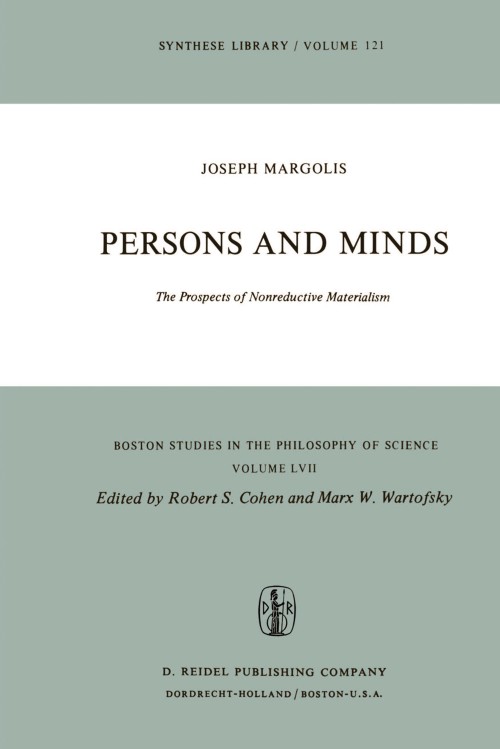
Persons and Minds [electronic resource] : The Prospects of Nonreductive Materialism / by Joseph Margolis.
Erişim Adresi
ISBN
9789400998018
Dil Kodu
İngilizce
Yer Numarası
DK/15056
Yazar
Basım Bildirimi
1st ed. 1978.
Yayın Bilgisi
Dordrecht : Springer Netherlands : Imprint: Springer, 1978.
Fiziksel Niteleme
XIV, 310 p. online resource.
Dizi
Boston Studies in the Philosophy and History of Science, 2214-7942 ; 57
İçindekiler Notu
General Introduction -- 1. The Theory of Persons Sketched -- One. Mind/Body Identity -- 2. The Relation of Mind and Body -- 3. The Identity Theory -- 4. Radical Materialism -- 5. Materialism without Identity -- Two. Toward a Theory of Persons -- 6. Problems Regarding Persons -- 7. Language Acquisition I: Rationalists vs. Empiricists -- 8. Language Acquisition II: First and Second Languages and the Theory of Thought and Perception -- 9. Propositional Content and the Beliefs of Animals -- 10. Mental States and Sentience -- Three. Sentience and Culture Psychophysical Interaction -- 11. Psychophysical Interaction -- 12. The Nature and Identity of Cultural Entities -- 13. Action and Ideology -- References -- General Index -- Index of References.
Özet, vb.
Persons and Minds is an inquiry into the possibilities of materialism. Professor Margolis starts his investigation, however, with a critique of the range of contemporary materialist theories, and does not find them viable. None of them, he argues, "can accommodate in a convincing way the most distinctive features of the mental life of men and oflower creatures and the imaginative possibilities of discovery and technology" (p. 8). In an extraordinarily rich analysis, Margolis carefully considers and criticizes mind-body identity theories, physicalism, eliminative materialism, behaviorism, as inadequate precisely in that they are reductive. He argues, then, for ramified concepts of emergence, and embodiment which will sustain a philosophically coherent account both of the distinctive non-natural character of persons and of their being naturally embodied. But Margolis provokes us to ask, what is an em bodied mind? The crucial context for him is not the plain physical body as such, but culture. "Persons", he writes, "are in a sense not natural entities: they exist only in cultural contexts and are identifiable as such only by refer ence to their mastery of language and of whatever further abilities presuppose such mastery" (p. 245). The hallmark of persons, in Margolis's account, is their capacity for freedom, as well as their physical endowment. Thus he writes, " . . . their characteristic powers - in effect, their freedom - must inform the order of purely physical causes in a distinctive way" (p. 246).
Konu
Philosophy of mind.
Philosophy of Mind.
Philosophy of Mind.
Kurum Adı
Eseri Alıntıla
Referansları kullanmadan önce gözden geçirmeniz ve varsa gerekli düzeltmeleri yapmanız önerilir.
Dijital Kaynak
MARC Görünümü
LEADER 04792nam a22005295i 4500
001 813816
003 TR_AnAIT
005 20260130223127
007 cr nn 008mamaa
008 121227s1978 ne | s |||| 0|eng d
020 |a9789400998018|9978-94-009-9801-8
024 7 |a10.1007/978-94-009-9801-8|2doi
041 |aeng
049 |aTürk Tarih Kurumu Kütüphanesi
050 4|aBD418-418.84
072 7|aHPM|2bicssc
072 7|aPHI015000|2bisacsh
072 7|aQDTM|2thema
082 04|a128.2|223
090 |aDK/15056
100 1 |aMargolis, Joseph.|eauthor.|4aut|4http://id.loc.gov/vocabulary/relators/aut
245 10|aPersons and Minds|h[electronic resource] :|bThe Prospects of Nonreductive Materialism /|cby Joseph Margolis.
250 |a1st ed. 1978.
264 1|aDordrecht :|bSpringer Netherlands :|bImprint: Springer,|c1978.
300 |aXIV, 310 p.|bonline resource.
336 |atext|btxt|2rdacontent
337 |acomputer|bc|2rdamedia
338 |aonline resource|bcr|2rdacarrier
347 |atext file|bPDF|2rda
490 1 |aBoston Studies in the Philosophy and History of Science,|x2214-7942 ;|v57
505 0 |aGeneral Introduction -- 1. The Theory of Persons Sketched -- One. Mind/Body Identity -- 2. The Relation of Mind and Body -- 3. The Identity Theory -- 4. Radical Materialism -- 5. Materialism without Identity -- Two. Toward a Theory of Persons -- 6. Problems Regarding Persons -- 7. Language Acquisition I: Rationalists vs. Empiricists -- 8. Language Acquisition II: First and Second Languages and the Theory of Thought and Perception -- 9. Propositional Content and the Beliefs of Animals -- 10. Mental States and Sentience -- Three. Sentience and Culture Psychophysical Interaction -- 11. Psychophysical Interaction -- 12. The Nature and Identity of Cultural Entities -- 13. Action and Ideology -- References -- General Index -- Index of References.
520 |aPersons and Minds is an inquiry into the possibilities of materialism. Professor Margolis starts his investigation, however, with a critique of the range of contemporary materialist theories, and does not find them viable. None of them, he argues, "can accommodate in a convincing way the most distinctive features of the mental life of men and oflower creatures and the imaginative possibilities of discovery and technology" (p. 8). In an extraordinarily rich analysis, Margolis carefully considers and criticizes mind-body identity theories, physicalism, eliminative materialism, behaviorism, as inadequate precisely in that they are reductive. He argues, then, for ramified concepts of emergence, and embodiment which will sustain a philosophically coherent account both of the distinctive non-natural character of persons and of their being naturally embodied. But Margolis provokes us to ask, what is an em bodied mind? The crucial context for him is not the plain physical body as such, but culture. "Persons", he writes, "are in a sense not natural entities: they exist only in cultural contexts and are identifiable as such only by refer ence to their mastery of language and of whatever further abilities presuppose such mastery" (p. 245). The hallmark of persons, in Margolis's account, is their capacity for freedom, as well as their physical endowment. Thus he writes, " . . . their characteristic powers - in effect, their freedom - must inform the order of purely physical causes in a distinctive way" (p. 246).
532 8 |aAccessibility summary: This PDF is not accessible. It is based on scanned pages and does not support features such as screen reader compatibility or described non-text content (images, graphs etc). However, it likely supports searchable and selectable text based on OCR (Optical Character Recognition). Users with accessibility needs may not be able to use this content effectively. Please contact us at accessibilitysupport@springernature.com if you require assistance or an alternative format.
532 8 |aInaccessible, or known limited accessibility
532 8 |aNo reading system accessibility options actively disabled
532 8 |aPublisher contact for further accessibility information: accessibilitysupport@springernature.com
650 0|aPhilosophy of mind.
650 14|aPhilosophy of Mind.
710 2 |aSpringerLink (Online service)
773 0 |tSpringer Nature eBook
776 08|iPrinted edition:|z9789027708540
776 08|iPrinted edition:|z9789027708632
776 08|iPrinted edition:|z9789400998025
830 0|aBoston Studies in the Philosophy and History of Science,|x2214-7942 ;|v57
856 40|uhttps://doi.org/10.1007/978-94-009-9801-8
912 |aZDB-2-SHU
912 |aZDB-2-SXPR
912 |aZDB-2-BAE
950 |aHumanities, Social Sciences and Law (SpringerNature-11648)
950 |aPhilosophy and Religion (R0) (SpringerNature-43725)
001 813816
003 TR_AnAIT
005 20260130223127
007 cr nn 008mamaa
008 121227s1978 ne | s |||| 0|eng d
020 |a9789400998018|9978-94-009-9801-8
024 7 |a10.1007/978-94-009-9801-8|2doi
041 |aeng
049 |aTürk Tarih Kurumu Kütüphanesi
050 4|aBD418-418.84
072 7|aHPM|2bicssc
072 7|aPHI015000|2bisacsh
072 7|aQDTM|2thema
082 04|a128.2|223
090 |aDK/15056
100 1 |aMargolis, Joseph.|eauthor.|4aut|4http://id.loc.gov/vocabulary/relators/aut
245 10|aPersons and Minds|h[electronic resource] :|bThe Prospects of Nonreductive Materialism /|cby Joseph Margolis.
250 |a1st ed. 1978.
264 1|aDordrecht :|bSpringer Netherlands :|bImprint: Springer,|c1978.
300 |aXIV, 310 p.|bonline resource.
336 |atext|btxt|2rdacontent
337 |acomputer|bc|2rdamedia
338 |aonline resource|bcr|2rdacarrier
347 |atext file|bPDF|2rda
490 1 |aBoston Studies in the Philosophy and History of Science,|x2214-7942 ;|v57
505 0 |aGeneral Introduction -- 1. The Theory of Persons Sketched -- One. Mind/Body Identity -- 2. The Relation of Mind and Body -- 3. The Identity Theory -- 4. Radical Materialism -- 5. Materialism without Identity -- Two. Toward a Theory of Persons -- 6. Problems Regarding Persons -- 7. Language Acquisition I: Rationalists vs. Empiricists -- 8. Language Acquisition II: First and Second Languages and the Theory of Thought and Perception -- 9. Propositional Content and the Beliefs of Animals -- 10. Mental States and Sentience -- Three. Sentience and Culture Psychophysical Interaction -- 11. Psychophysical Interaction -- 12. The Nature and Identity of Cultural Entities -- 13. Action and Ideology -- References -- General Index -- Index of References.
520 |aPersons and Minds is an inquiry into the possibilities of materialism. Professor Margolis starts his investigation, however, with a critique of the range of contemporary materialist theories, and does not find them viable. None of them, he argues, "can accommodate in a convincing way the most distinctive features of the mental life of men and oflower creatures and the imaginative possibilities of discovery and technology" (p. 8). In an extraordinarily rich analysis, Margolis carefully considers and criticizes mind-body identity theories, physicalism, eliminative materialism, behaviorism, as inadequate precisely in that they are reductive. He argues, then, for ramified concepts of emergence, and embodiment which will sustain a philosophically coherent account both of the distinctive non-natural character of persons and of their being naturally embodied. But Margolis provokes us to ask, what is an em bodied mind? The crucial context for him is not the plain physical body as such, but culture. "Persons", he writes, "are in a sense not natural entities: they exist only in cultural contexts and are identifiable as such only by refer ence to their mastery of language and of whatever further abilities presuppose such mastery" (p. 245). The hallmark of persons, in Margolis's account, is their capacity for freedom, as well as their physical endowment. Thus he writes, " . . . their characteristic powers - in effect, their freedom - must inform the order of purely physical causes in a distinctive way" (p. 246).
532 8 |aAccessibility summary: This PDF is not accessible. It is based on scanned pages and does not support features such as screen reader compatibility or described non-text content (images, graphs etc). However, it likely supports searchable and selectable text based on OCR (Optical Character Recognition). Users with accessibility needs may not be able to use this content effectively. Please contact us at accessibilitysupport@springernature.com if you require assistance or an alternative format.
532 8 |aInaccessible, or known limited accessibility
532 8 |aNo reading system accessibility options actively disabled
532 8 |aPublisher contact for further accessibility information: accessibilitysupport@springernature.com
650 0|aPhilosophy of mind.
650 14|aPhilosophy of Mind.
710 2 |aSpringerLink (Online service)
773 0 |tSpringer Nature eBook
776 08|iPrinted edition:|z9789027708540
776 08|iPrinted edition:|z9789027708632
776 08|iPrinted edition:|z9789400998025
830 0|aBoston Studies in the Philosophy and History of Science,|x2214-7942 ;|v57
856 40|uhttps://doi.org/10.1007/978-94-009-9801-8
912 |aZDB-2-SHU
912 |aZDB-2-SXPR
912 |aZDB-2-BAE
950 |aHumanities, Social Sciences and Law (SpringerNature-11648)
950 |aPhilosophy and Religion (R0) (SpringerNature-43725)
Materyaller
Depodan talep edilen materyal sadece kütüphane içerisinde kullanılmaktadır.
Materyal dışarıya ödünç verilmemektedir.
Materyal dışarıya ödünç verilmemektedir.
