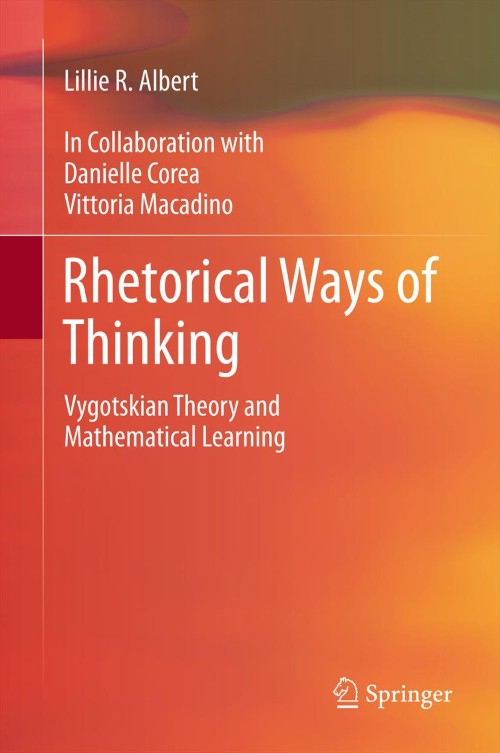
Rhetorical Ways of Thinking [electronic resource] : Vygotskian Theory and Mathematical Learning / by Lillie R. Albert.
Erişim Adresi
ISBN
9789400740655
Dil Kodu
İngilizce
Yer Numarası
DK/15061
Yazar
Basım Bildirimi
1st ed. 2012.
Yayın Bilgisi
Dordrecht : Springer Netherlands : Imprint: Springer, 2012.
Fiziksel Niteleme
XII, 100 p. online resource.
İçindekiler Notu
Preface -- Chapter 1 Introduction -- Why Rhetorical Thinking -- Overview of Chapters -- Chapter 2 Vygotsky’s Sociocultural Historic Theory, A Primer -- INTRODUCTION -- TOOLS OF HUMAN INTENSIFICATION -- Mediation through Signs -- THE DEVELOPMENT OF HIGHER PSYCHOLOGICAL FUNCTIONS -- Distinguishing Between Lower and Higher Functioning -- THE ROLE OF THE ZONE OF PROXIMAL DEVELOPMENT -- The Complex Nature of the Zone of Proximal Development -- Learning Potential, Performance, and Context -- Intersubjective Learning -- CONCEPT DEVELOPMENT IN THINKING -- Spontaneous and Scientific Concepts -- THE RELATIONSHIP BETWEEN THINKING AND LANGUAGE -- CONCLUSION. Chapter 3 Images and Drawings: A Study of Prospective Teachers' Perceptions of Teaching and Learning Mathematics -- INTRODUCTION -- AN EMERGING FRAMEWORK METHODOLOGY -- Coding Drawings -- Analysis of Focus Group Transcripts -- RESULTS -- The Changing Roles of Teachers -- Student Affect and Pedagogy -- Trends in Mathematical Representations and Content -- Changes in Room Structure -- DISCUSSION OF RESULTS -- CONCLUSION -- Chapter 4 Improving Teachers’ Mathematical Content Knowledge through Scaffolded Instruction -- INTRODUCTION -- THEORETICAL FRAMEWORK AND RELEVANT RESEARCH -- Explanation of the Framework -- METHODOLOGY -- Context and Participants -- Data Sources and Procedures -- Data Analysis -- FINDINGS -- Content Knowledge: Pretest and Posttest -- Presurvey and Postsurvey Results -- Talk and Scaffolded-Interactions -- Teacher-learner Talk and the More Knowledgeable Other -- DISCUSSION OF FINDINGS -- Connecting Learning to the Field of Social Interaction -- The Importance of Language and Action -- CONCLUDING COMMENTS -- Chapter 5 Closing Thoughts and Implications -- Teacher-generated Drawings as Tools of Human Development -- Achieving Intersubjectivity through Collaborative Learning -- Index. .
Özet, vb.
Rhetorical Ways of Thinking focuses on how the co-construction of learning models the interpretation of a mathematical situation. It is a comprehensive examination of the role of sociocultural-historical theory developed by Vygotsky. This book puts forward the supposition that the major assumptions of sociocultural-historic theory are essential to understanding the theory’s application to mathematical pedagogy, which explores issues relevant to learning and teaching mathematics-in-context, thus providing a valuable practical tool for general mathematics education research. The most important goal, then, is to exemplify the merging of the theory with practice and the subsequent applications to mathematics teaching and learning. This monograph contains five chapters, including a primer to Vygotsky’s sociocultural historic theory, two comprehensive empirical studies examining: prospective teachers’ perception of mathematics teaching and learning and the practice of scaffolded instruction to assist practicing teachers in developing their understanding of pedagogical content knowledge. Finally, the book concludes with a contextualization of the theory, linking it to best practices in the classroom.
Konu
Mathematics __ Study and teaching .
Education __ Philosophy.
Educational psychology.
Learning, Psychology of.
Mathematics Education.
Educational Philosophy.
Educational Psychology.
Instructional Psychology.
Education __ Philosophy.
Educational psychology.
Learning, Psychology of.
Mathematics Education.
Educational Philosophy.
Educational Psychology.
Instructional Psychology.
Kurum Adı

Eseri Alıntıla
Referansları kullanmadan önce gözden geçirmeniz ve varsa gerekli düzeltmeleri yapmanız önerilir.
Dijital Kaynak
MARC Görünümü
LEADER 04973nam a22005415i 4500
001 813821
003 TR_AnAIT
005 20260130223120
007 cr nn 008mamaa
008 120529s2012 ne | s |||| 0|eng d
020 |a9789400740655|9978-94-007-4065-5
024 7 |a10.1007/978-94-007-4065-5|2doi
041 |aeng
049 |aTürk Tarih Kurumu Kütüphanesi
050 4|aQA10.92-20
072 7|aJNU|2bicssc
072 7|aPB|2bicssc
072 7|aEDU029010|2bisacsh
072 7|aJNU|2thema
072 7|aPB|2thema
082 04|a510.71|223
090 |aDK/15061
100 1 |aAlbert, Lillie R.|eauthor.|4aut|4http://id.loc.gov/vocabulary/relators/aut
245 10|aRhetorical Ways of Thinking|h[electronic resource] :|bVygotskian Theory and Mathematical Learning /|cby Lillie R. Albert.
250 |a1st ed. 2012.
264 1|aDordrecht :|bSpringer Netherlands :|bImprint: Springer,|c2012.
300 |aXII, 100 p.|bonline resource.
336 |atext|btxt|2rdacontent
337 |acomputer|bc|2rdamedia
338 |aonline resource|bcr|2rdacarrier
347 |atext file|bPDF|2rda
505 0 |aPreface -- Chapter 1 Introduction -- Why Rhetorical Thinking -- Overview of Chapters -- Chapter 2 Vygotsky’s Sociocultural Historic Theory, A Primer -- INTRODUCTION -- TOOLS OF HUMAN INTENSIFICATION -- Mediation through Signs -- THE DEVELOPMENT OF HIGHER PSYCHOLOGICAL FUNCTIONS -- Distinguishing Between Lower and Higher Functioning -- THE ROLE OF THE ZONE OF PROXIMAL DEVELOPMENT -- The Complex Nature of the Zone of Proximal Development -- Learning Potential, Performance, and Context -- Intersubjective Learning -- CONCEPT DEVELOPMENT IN THINKING -- Spontaneous and Scientific Concepts -- THE RELATIONSHIP BETWEEN THINKING AND LANGUAGE -- CONCLUSION. Chapter 3 Images and Drawings: A Study of Prospective Teachers' Perceptions of Teaching and Learning Mathematics -- INTRODUCTION -- AN EMERGING FRAMEWORK METHODOLOGY -- Coding Drawings -- Analysis of Focus Group Transcripts -- RESULTS -- The Changing Roles of Teachers -- Student Affect and Pedagogy -- Trends in Mathematical Representations and Content -- Changes in Room Structure -- DISCUSSION OF RESULTS -- CONCLUSION -- Chapter 4 Improving Teachers’ Mathematical Content Knowledge through Scaffolded Instruction -- INTRODUCTION -- THEORETICAL FRAMEWORK AND RELEVANT RESEARCH -- Explanation of the Framework -- METHODOLOGY -- Context and Participants -- Data Sources and Procedures -- Data Analysis -- FINDINGS -- Content Knowledge: Pretest and Posttest -- Presurvey and Postsurvey Results -- Talk and Scaffolded-Interactions -- Teacher-learner Talk and the More Knowledgeable Other -- DISCUSSION OF FINDINGS -- Connecting Learning to the Field of Social Interaction -- The Importance of Language and Action -- CONCLUDING COMMENTS -- Chapter 5 Closing Thoughts and Implications -- Teacher-generated Drawings as Tools of Human Development -- Achieving Intersubjectivity through Collaborative Learning -- Index. .
520 |aRhetorical Ways of Thinking focuses on how the co-construction of learning models the interpretation of a mathematical situation. It is a comprehensive examination of the role of sociocultural-historical theory developed by Vygotsky. This book puts forward the supposition that the major assumptions of sociocultural-historic theory are essential to understanding the theory’s application to mathematical pedagogy, which explores issues relevant to learning and teaching mathematics-in-context, thus providing a valuable practical tool for general mathematics education research. The most important goal, then, is to exemplify the merging of the theory with practice and the subsequent applications to mathematics teaching and learning. This monograph contains five chapters, including a primer to Vygotsky’s sociocultural historic theory, two comprehensive empirical studies examining: prospective teachers’ perception of mathematics teaching and learning and the practice of scaffolded instruction to assist practicing teachers in developing their understanding of pedagogical content knowledge. Finally, the book concludes with a contextualization of the theory, linking it to best practices in the classroom.
650 0|aMathematics|xStudy and teaching .
650 0|aEducation|xPhilosophy.
650 0|aEducational psychology.
650 0|aLearning, Psychology of.
650 14|aMathematics Education.
650 24|aEducational Philosophy.
650 24|aEducational Psychology.
650 24|aInstructional Psychology.
710 2 |aSpringerLink (Online service)
773 0 |tSpringer Nature eBook
776 08|iPrinted edition:|z9789400740648
776 08|iPrinted edition:|z9789400740662
776 08|iPrinted edition:|z9789400796508
856 40|uhttps://doi.org/10.1007/978-94-007-4065-5
912 |aZDB-2-SHU
912 |aZDB-2-SXED
950 |aHumanities, Social Sciences and Law (SpringerNature-11648)
950 |aEducation (R0) (SpringerNature-43721)
001 813821
003 TR_AnAIT
005 20260130223120
007 cr nn 008mamaa
008 120529s2012 ne | s |||| 0|eng d
020 |a9789400740655|9978-94-007-4065-5
024 7 |a10.1007/978-94-007-4065-5|2doi
041 |aeng
049 |aTürk Tarih Kurumu Kütüphanesi
050 4|aQA10.92-20
072 7|aJNU|2bicssc
072 7|aPB|2bicssc
072 7|aEDU029010|2bisacsh
072 7|aJNU|2thema
072 7|aPB|2thema
082 04|a510.71|223
090 |aDK/15061
100 1 |aAlbert, Lillie R.|eauthor.|4aut|4http://id.loc.gov/vocabulary/relators/aut
245 10|aRhetorical Ways of Thinking|h[electronic resource] :|bVygotskian Theory and Mathematical Learning /|cby Lillie R. Albert.
250 |a1st ed. 2012.
264 1|aDordrecht :|bSpringer Netherlands :|bImprint: Springer,|c2012.
300 |aXII, 100 p.|bonline resource.
336 |atext|btxt|2rdacontent
337 |acomputer|bc|2rdamedia
338 |aonline resource|bcr|2rdacarrier
347 |atext file|bPDF|2rda
505 0 |aPreface -- Chapter 1 Introduction -- Why Rhetorical Thinking -- Overview of Chapters -- Chapter 2 Vygotsky’s Sociocultural Historic Theory, A Primer -- INTRODUCTION -- TOOLS OF HUMAN INTENSIFICATION -- Mediation through Signs -- THE DEVELOPMENT OF HIGHER PSYCHOLOGICAL FUNCTIONS -- Distinguishing Between Lower and Higher Functioning -- THE ROLE OF THE ZONE OF PROXIMAL DEVELOPMENT -- The Complex Nature of the Zone of Proximal Development -- Learning Potential, Performance, and Context -- Intersubjective Learning -- CONCEPT DEVELOPMENT IN THINKING -- Spontaneous and Scientific Concepts -- THE RELATIONSHIP BETWEEN THINKING AND LANGUAGE -- CONCLUSION. Chapter 3 Images and Drawings: A Study of Prospective Teachers' Perceptions of Teaching and Learning Mathematics -- INTRODUCTION -- AN EMERGING FRAMEWORK METHODOLOGY -- Coding Drawings -- Analysis of Focus Group Transcripts -- RESULTS -- The Changing Roles of Teachers -- Student Affect and Pedagogy -- Trends in Mathematical Representations and Content -- Changes in Room Structure -- DISCUSSION OF RESULTS -- CONCLUSION -- Chapter 4 Improving Teachers’ Mathematical Content Knowledge through Scaffolded Instruction -- INTRODUCTION -- THEORETICAL FRAMEWORK AND RELEVANT RESEARCH -- Explanation of the Framework -- METHODOLOGY -- Context and Participants -- Data Sources and Procedures -- Data Analysis -- FINDINGS -- Content Knowledge: Pretest and Posttest -- Presurvey and Postsurvey Results -- Talk and Scaffolded-Interactions -- Teacher-learner Talk and the More Knowledgeable Other -- DISCUSSION OF FINDINGS -- Connecting Learning to the Field of Social Interaction -- The Importance of Language and Action -- CONCLUDING COMMENTS -- Chapter 5 Closing Thoughts and Implications -- Teacher-generated Drawings as Tools of Human Development -- Achieving Intersubjectivity through Collaborative Learning -- Index. .
520 |aRhetorical Ways of Thinking focuses on how the co-construction of learning models the interpretation of a mathematical situation. It is a comprehensive examination of the role of sociocultural-historical theory developed by Vygotsky. This book puts forward the supposition that the major assumptions of sociocultural-historic theory are essential to understanding the theory’s application to mathematical pedagogy, which explores issues relevant to learning and teaching mathematics-in-context, thus providing a valuable practical tool for general mathematics education research. The most important goal, then, is to exemplify the merging of the theory with practice and the subsequent applications to mathematics teaching and learning. This monograph contains five chapters, including a primer to Vygotsky’s sociocultural historic theory, two comprehensive empirical studies examining: prospective teachers’ perception of mathematics teaching and learning and the practice of scaffolded instruction to assist practicing teachers in developing their understanding of pedagogical content knowledge. Finally, the book concludes with a contextualization of the theory, linking it to best practices in the classroom.
650 0|aMathematics|xStudy and teaching .
650 0|aEducation|xPhilosophy.
650 0|aEducational psychology.
650 0|aLearning, Psychology of.
650 14|aMathematics Education.
650 24|aEducational Philosophy.
650 24|aEducational Psychology.
650 24|aInstructional Psychology.
710 2 |aSpringerLink (Online service)
773 0 |tSpringer Nature eBook
776 08|iPrinted edition:|z9789400740648
776 08|iPrinted edition:|z9789400740662
776 08|iPrinted edition:|z9789400796508
856 40|uhttps://doi.org/10.1007/978-94-007-4065-5
912 |aZDB-2-SHU
912 |aZDB-2-SXED
950 |aHumanities, Social Sciences and Law (SpringerNature-11648)
950 |aEducation (R0) (SpringerNature-43721)
Materyaller
Depodan talep edilen materyal sadece kütüphane içerisinde kullanılmaktadır.
Materyal dışarıya ödünç verilmemektedir.
