

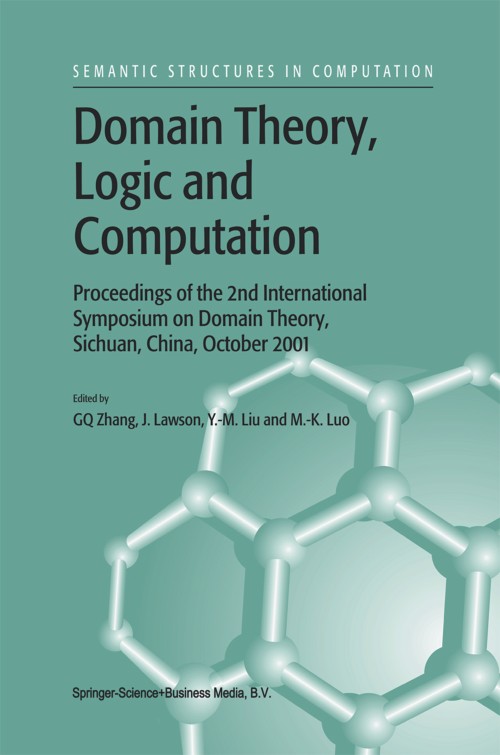
Domain Theory, Logic and Computation [electronic resource] : Proceedings of the 2nd International Symposium on Domain Theory, Sichuan, China, October 2001 / edited by Guo-Qiang Zhang, J. Lawson, Ying Ming Liu, M.K. Luo.
Erişim Adresi
ISBN
9789401712910
Dil Kodu
İngilizce
Yer Numarası
DK/15116
Basım Bildirimi
1st ed. 2003.
Yayın Bilgisi
Dordrecht : Springer Netherlands : Imprint: Springer, 2003.
Fiziksel Niteleme
XII, 197 p. online resource.
Dizi
Semantics Structures in Computation ; 3
İçindekiler Notu
1 Playful, streamlike computation -- 2 Universal types and what they are good for -- 3 Relational representations of hyper-continuous lattices -- 4 Convergence classes and spaces of partial functions -- 5 On meet-continuous dcpos -- 6 External characterizations of continuous sL-domains -- 7 Projectives and injectives in the category of quantales -- 8 On minimal event and concrete data structures -- 9 A note on strongly finite sequent structures.
Özet, vb.
Domains are mathematical structures for information and approximation; they combine order-theoretic, logical, and topological ideas and provide a natural framework for modelling and reasoning about computation. The theory of domains has proved to be a useful tool for programming languages and other areas of computer science, and for applications in mathematics. Included in this proceedings volume are selected papers of original research presented at the 2nd International Symposium on Domain Theory in Chengdu, China. With authors from France, Germany, Great Britain, Ireland, Mexico, and China, the papers cover the latest research in these sub-areas: domains and computation, topology and convergence, domains, lattices, and continuity, and representations of domains as event and logical structures. Researchers and students in theoretical computer science should find this a valuable source of reference. The survey papers at the beginning should be of particular interest to those who wish to gain an understanding of some general ideas and techniques in this area.
Konu
Logic.
Algebra.
Geometry.
Mathematical logic.
Compilers (Computer programs).
Logic.
Order, Lattices, Ordered Algebraic Structures.
Geometry.
Mathematical Logic and Foundations.
Compilers and Interpreters.
Algebra.
Geometry.
Mathematical logic.
Compilers (Computer programs).
Logic.
Order, Lattices, Ordered Algebraic Structures.
Geometry.
Mathematical Logic and Foundations.
Compilers and Interpreters.
Diğer Yazarlar
Kurum Adı
