

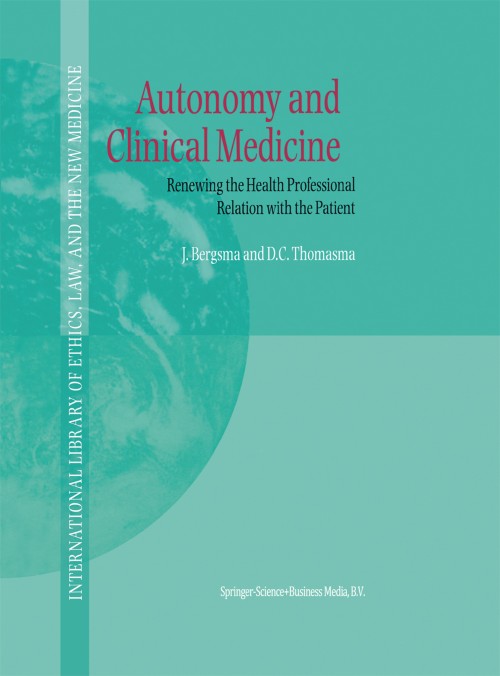
Autonomy and Clinical Medicine [electronic resource] : Renewing the Health Professional Relation with the Patient / by J. Bergsma, David C. Thomasma.
Erişim Adresi
ISBN
9789401708210
Dil Kodu
İngilizce
Yer Numarası
DK/15119
Yazar
Basım Bildirimi
1st ed. 2000.
Yayın Bilgisi
Dordrecht : Springer Netherlands : Imprint: Springer, 2000.
Fiziksel Niteleme
XVIII, 202 p. online resource.
Dizi
International Library of Ethics, Law, and the New Medicine, 2351-955X ; 2
İçindekiler Notu
One: The Dynamics of Autonomy -- 1: Autonomy as a Behavioral Concept -- 2: Autonomy, Identity, and Physical Disruption -- 3: Autonomy in the Doctor-Patient Encounter -- Two: Reflections on Autonomy -- 4: Modes of Autonomy: Psychology Meets Philosophy -- 5: Freedom and the Social Aspect of Medicine -- 6: Moving Beyond Autonomy to the Person with Illness -- 7: Autonomy and Ethical Models of the Doctor-Patient Relationship -- Three: Conclusion -- 8: Reconstituting the Doctor-Patient Encounter.
Özet, vb.
This book arises from a two-fold conviction. The first is that autonomy, despite recent critiques about its importance in bioethics and philosophy of medicine, and the traditional resistance of medicine to its "intrusion" into the doctor-patient relation, is a fundamental building block of an individual's identity and mechanisms for dealing with illness, disease, and incapacity. As such it is an essential component in the health care professional's armamentarium employed to bring about healing. Furthennore, it functions in a similar way to assist the health professional in his or her relations to the sick and injured. The second conviction follows from the fITst. Autonomy is far more complex than appears from the philosophical use of the concept. In this conviction we join those who have criticized the over-reliance on autonomy in modem, secular bioethics originating in the United States, but gaining ascendancy in other cultures. This critique relies on appeals to the richer contexts of persons' lives. Elsewhere the contemporary critique of autonomy appears in a variety of alternative ethical models like narrative ethics, casuist ethics, and contextualism. Indeed, postmodern criticism of all bioethics argues that there is no defensible foundation for claims that one ought to respect autonomy or any other principle as a way of ensuring that one is ethical.
Konu
Medicine __ Philosophy.
Ethics.
Bioethics.
Medicine __ History.
Philosophy.
Philosophy of Medicine.
Moral Philosophy and Applied Ethics.
Bioethics.
History of Medicine.
Philosophy.
Ethics.
Bioethics.
Medicine __ History.
Philosophy.
Philosophy of Medicine.
Moral Philosophy and Applied Ethics.
Bioethics.
History of Medicine.
Philosophy.
Diğer Yazarlar
Kurum Adı
Eseri Alıntıla
Referansları kullanmadan önce gözden geçirmeniz ve varsa gerekli düzeltmeleri yapmanız önerilir.
Dijital Kaynak
MARC Görünümü
LEADER 04838nam a22006615i 4500
001 813879
003 TR_AnAIT
005 20260130222844
007 cr nn 008mamaa
008 130107s2000 ne | s |||| 0|eng d
020 |a9789401708210|9978-94-017-0821-0
024 7 |a10.1007/978-94-017-0821-0|2doi
041 |aeng
049 |aTürk Tarih Kurumu Kütüphanesi
050 4|aR723-723.7
072 7|aHP|2bicssc
072 7|aMBDC|2bicssc
072 7|aMED050000|2bisacsh
072 7|aQD|2thema
072 7|aMBDC|2thema
082 04|a610.1|223
090 |aDK/15119
100 1 |aBergsma, J.|eauthor.|4aut|4http://id.loc.gov/vocabulary/relators/aut
245 10|aAutonomy and Clinical Medicine|h[electronic resource] :|bRenewing the Health Professional Relation with the Patient /|cby J. Bergsma, David C. Thomasma.
250 |a1st ed. 2000.
264 1|aDordrecht :|bSpringer Netherlands :|bImprint: Springer,|c2000.
300 |aXVIII, 202 p.|bonline resource.
336 |atext|btxt|2rdacontent
337 |acomputer|bc|2rdamedia
338 |aonline resource|bcr|2rdacarrier
347 |atext file|bPDF|2rda
490 1 |aInternational Library of Ethics, Law, and the New Medicine,|x2351-955X ;|v2
505 0 |aOne: The Dynamics of Autonomy -- 1: Autonomy as a Behavioral Concept -- 2: Autonomy, Identity, and Physical Disruption -- 3: Autonomy in the Doctor-Patient Encounter -- Two: Reflections on Autonomy -- 4: Modes of Autonomy: Psychology Meets Philosophy -- 5: Freedom and the Social Aspect of Medicine -- 6: Moving Beyond Autonomy to the Person with Illness -- 7: Autonomy and Ethical Models of the Doctor-Patient Relationship -- Three: Conclusion -- 8: Reconstituting the Doctor-Patient Encounter.
520 |aThis book arises from a two-fold conviction. The first is that autonomy, despite recent critiques about its importance in bioethics and philosophy of medicine, and the traditional resistance of medicine to its "intrusion" into the doctor-patient relation, is a fundamental building block of an individual's identity and mechanisms for dealing with illness, disease, and incapacity. As such it is an essential component in the health care professional's armamentarium employed to bring about healing. Furthennore, it functions in a similar way to assist the health professional in his or her relations to the sick and injured. The second conviction follows from the fITst. Autonomy is far more complex than appears from the philosophical use of the concept. In this conviction we join those who have criticized the over-reliance on autonomy in modem, secular bioethics originating in the United States, but gaining ascendancy in other cultures. This critique relies on appeals to the richer contexts of persons' lives. Elsewhere the contemporary critique of autonomy appears in a variety of alternative ethical models like narrative ethics, casuist ethics, and contextualism. Indeed, postmodern criticism of all bioethics argues that there is no defensible foundation for claims that one ought to respect autonomy or any other principle as a way of ensuring that one is ethical.
532 8 |aAccessibility summary: This PDF is not accessible. It is based on scanned pages and does not support features such as screen reader compatibility or described non-text content (images, graphs etc). However, it likely supports searchable and selectable text based on OCR (Optical Character Recognition). Users with accessibility needs may not be able to use this content effectively. Please contact us at accessibilitysupport@springernature.com if you require assistance or an alternative format.
532 8 |aInaccessible, or known limited accessibility
532 8 |aNo reading system accessibility options actively disabled
532 8 |aPublisher contact for further accessibility information: accessibilitysupport@springernature.com
650 0|aMedicine|xPhilosophy.
650 0|aEthics.
650 0|aBioethics.
650 0|aMedicine|xHistory.
650 0|aPhilosophy.
650 14|aPhilosophy of Medicine.
650 24|aMoral Philosophy and Applied Ethics.
650 24|aBioethics.
650 24|aHistory of Medicine.
650 24|aPhilosophy.
700 1 |aThomasma, David C.|eauthor.|4aut|4http://id.loc.gov/vocabulary/relators/aut
710 2 |aSpringerLink (Online service)
773 0 |tSpringer Nature eBook
776 08|iPrinted edition:|z9780792362074
776 08|iPrinted edition:|z9789048154135
776 08|iPrinted edition:|z9789401708227
830 0|aInternational Library of Ethics, Law, and the New Medicine,|x2351-955X ;|v2
856 40|uhttps://doi.org/10.1007/978-94-017-0821-0
912 |aZDB-2-SHU
912 |aZDB-2-SXPR
912 |aZDB-2-BAE
950 |aHumanities, Social Sciences and Law (SpringerNature-11648)
950 |aPhilosophy and Religion (R0) (SpringerNature-43725)
001 813879
003 TR_AnAIT
005 20260130222844
007 cr nn 008mamaa
008 130107s2000 ne | s |||| 0|eng d
020 |a9789401708210|9978-94-017-0821-0
024 7 |a10.1007/978-94-017-0821-0|2doi
041 |aeng
049 |aTürk Tarih Kurumu Kütüphanesi
050 4|aR723-723.7
072 7|aHP|2bicssc
072 7|aMBDC|2bicssc
072 7|aMED050000|2bisacsh
072 7|aQD|2thema
072 7|aMBDC|2thema
082 04|a610.1|223
090 |aDK/15119
100 1 |aBergsma, J.|eauthor.|4aut|4http://id.loc.gov/vocabulary/relators/aut
245 10|aAutonomy and Clinical Medicine|h[electronic resource] :|bRenewing the Health Professional Relation with the Patient /|cby J. Bergsma, David C. Thomasma.
250 |a1st ed. 2000.
264 1|aDordrecht :|bSpringer Netherlands :|bImprint: Springer,|c2000.
300 |aXVIII, 202 p.|bonline resource.
336 |atext|btxt|2rdacontent
337 |acomputer|bc|2rdamedia
338 |aonline resource|bcr|2rdacarrier
347 |atext file|bPDF|2rda
490 1 |aInternational Library of Ethics, Law, and the New Medicine,|x2351-955X ;|v2
505 0 |aOne: The Dynamics of Autonomy -- 1: Autonomy as a Behavioral Concept -- 2: Autonomy, Identity, and Physical Disruption -- 3: Autonomy in the Doctor-Patient Encounter -- Two: Reflections on Autonomy -- 4: Modes of Autonomy: Psychology Meets Philosophy -- 5: Freedom and the Social Aspect of Medicine -- 6: Moving Beyond Autonomy to the Person with Illness -- 7: Autonomy and Ethical Models of the Doctor-Patient Relationship -- Three: Conclusion -- 8: Reconstituting the Doctor-Patient Encounter.
520 |aThis book arises from a two-fold conviction. The first is that autonomy, despite recent critiques about its importance in bioethics and philosophy of medicine, and the traditional resistance of medicine to its "intrusion" into the doctor-patient relation, is a fundamental building block of an individual's identity and mechanisms for dealing with illness, disease, and incapacity. As such it is an essential component in the health care professional's armamentarium employed to bring about healing. Furthennore, it functions in a similar way to assist the health professional in his or her relations to the sick and injured. The second conviction follows from the fITst. Autonomy is far more complex than appears from the philosophical use of the concept. In this conviction we join those who have criticized the over-reliance on autonomy in modem, secular bioethics originating in the United States, but gaining ascendancy in other cultures. This critique relies on appeals to the richer contexts of persons' lives. Elsewhere the contemporary critique of autonomy appears in a variety of alternative ethical models like narrative ethics, casuist ethics, and contextualism. Indeed, postmodern criticism of all bioethics argues that there is no defensible foundation for claims that one ought to respect autonomy or any other principle as a way of ensuring that one is ethical.
532 8 |aAccessibility summary: This PDF is not accessible. It is based on scanned pages and does not support features such as screen reader compatibility or described non-text content (images, graphs etc). However, it likely supports searchable and selectable text based on OCR (Optical Character Recognition). Users with accessibility needs may not be able to use this content effectively. Please contact us at accessibilitysupport@springernature.com if you require assistance or an alternative format.
532 8 |aInaccessible, or known limited accessibility
532 8 |aNo reading system accessibility options actively disabled
532 8 |aPublisher contact for further accessibility information: accessibilitysupport@springernature.com
650 0|aMedicine|xPhilosophy.
650 0|aEthics.
650 0|aBioethics.
650 0|aMedicine|xHistory.
650 0|aPhilosophy.
650 14|aPhilosophy of Medicine.
650 24|aMoral Philosophy and Applied Ethics.
650 24|aBioethics.
650 24|aHistory of Medicine.
650 24|aPhilosophy.
700 1 |aThomasma, David C.|eauthor.|4aut|4http://id.loc.gov/vocabulary/relators/aut
710 2 |aSpringerLink (Online service)
773 0 |tSpringer Nature eBook
776 08|iPrinted edition:|z9780792362074
776 08|iPrinted edition:|z9789048154135
776 08|iPrinted edition:|z9789401708227
830 0|aInternational Library of Ethics, Law, and the New Medicine,|x2351-955X ;|v2
856 40|uhttps://doi.org/10.1007/978-94-017-0821-0
912 |aZDB-2-SHU
912 |aZDB-2-SXPR
912 |aZDB-2-BAE
950 |aHumanities, Social Sciences and Law (SpringerNature-11648)
950 |aPhilosophy and Religion (R0) (SpringerNature-43725)
Materyaller
Depodan talep edilen materyal sadece kütüphane içerisinde kullanılmaktadır.
Materyal dışarıya ödünç verilmemektedir.
Materyal dışarıya ödünç verilmemektedir.
