

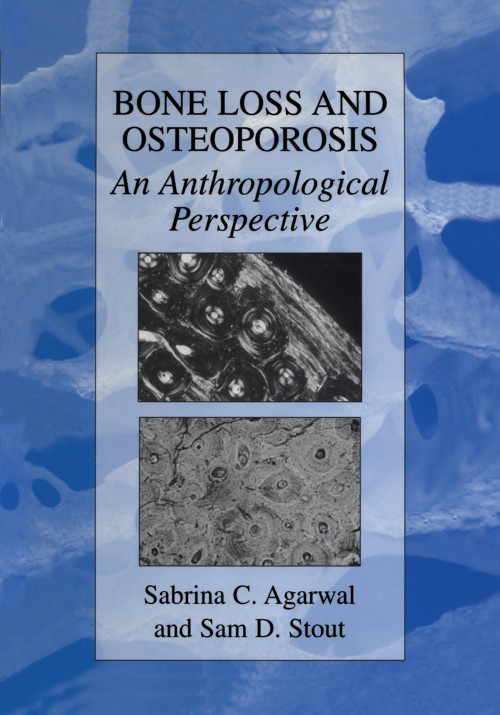
Bone Loss and Osteoporosis [electronic resource] : An Anthropological Perspective / edited by Sabrina C. Agarwal, Samuel D. Stout.
Erişim Adresi
ISBN
9781441988911
Dil Kodu
İngilizce
Yer Numarası
DK/15133
Basım Bildirimi
1st ed. 2003.
Yayın Bilgisi
New York, NY : Springer US : Imprint: Springer, 2003.
Fiziksel Niteleme
XXIV, 240 p. online resource.
İçindekiler Notu
I. Current Concepts of Bone Loss and Osteoporosis -- Concepts of Bone Remodeling: A Unified Spatial and Temporal Model with Physiologic and Pathophysiologic Implications -- 2. On Changing Views about Age-Related Bone Loss -- 3. The Role of Bone Quality on Bone Loss and Fragility -- II. Population Approaches -- 4. Ethnic Differences in Bone Mass and Architecture -- 5. Bone Loss, Fracture Histories, and Body Composition Characteristics of Older Males -- 6. The Histomorphometry of the Subadult Rib: Age-Associated Changes in Bone Mass and the Creation of Peak Bone Mass -- III. Evolutionary Perspectives -- 7. An Evolutionary and Biocultural Approach to Understanding the Effects of Reproductive Factors on the Female Skeleton -- 8. Functional Adaptation and Fragility of the Skeleton -- 9. Effects of Vitamin D on Bone and Natural Selection of Skin Color: How Much Vitamin D Nutrition are We Talking About? -- IV. Bone Loss and Osteoporosis in Past Populations -- 10. Techniques for the Investigation of Age-Related Bone Loss and Osteoporosis in Archaeological Bone -- 11. Differentail Diagnoses of Intravitam and Postmortem Bone Loss at the Micro-Level -- 12. Histomorphology, Geometry, and Mechanical Loading in Past Populations -- 13. Bone Remodeling and Age-Associated Bone Loss in the Past: A Histomorphometric Analysis of the Imperial Roman Skeletal Population of Isola Sacra.
Özet, vb.
With the growing incidence of fragility fractures in Europe and North America over the last three decades, bone loss and osteoporosis have become active areas of research in skeletal biology. Bone loss is associated with aging in both sexes and is accelerated in women with the onset of menopause. However, bone loss is related to a suite of complex and often synergistically related factors including genetics, pathology, nutrition, mechani cal usage, and lifestyle. It is not surprising that its incidence and severity vary among populations. There has been increasing interest to investigate bone loss and osteoporosis from an anthropological perspective that utilizes a biocultural approach. Biocultural approaches recognize the inter-relationship between biological, cultural, and environmental variables. Anthropological studies also highlight the value of evolutionary and population approaches to the study of bone loss. These approaches are particularly suited to elucidate the multifactorial etiology of bone loss. The idea for this volume came out of a symposium organized by the editors at the 70th annual meeting of The American Association of Physical Anthropologists in Kansas City, Missouri. Many of the symposium participants, along with several additional leading scientists involved in bone and osteoporosis research, are brought together in this volume. Each chapter focuses on a different aspect of bone loss and fragility with a fresh and stimulating perspective.
Konu
Anthropology.
Veterinary medicine.
Anthropology.
Veterinary Science.
Veterinary medicine.
Anthropology.
Veterinary Science.
Diğer Yazarlar
Kurum Adı
Eseri Alıntıla
Referansları kullanmadan önce gözden geçirmeniz ve varsa gerekli düzeltmeleri yapmanız önerilir.
Dijital Kaynak
MARC Görünümü
LEADER 05356nam a22005415i 4500
001 813893
003 TR_AnAIT
005 20260130222740
007 cr nn 008mamaa
008 121227s2003 xxu| s |||| 0|eng d
020 |a9781441988911|9978-1-4419-8891-1
024 7 |a10.1007/978-1-4419-8891-1|2doi
041 |aeng
049 |aTürk Tarih Kurumu Kütüphanesi
050 4|aGN
072 7|aJHM|2bicssc
072 7|aSOC002000|2bisacsh
072 7|aJHM|2thema
082 04|a301|223
090 |aDK/15133
245 10|aBone Loss and Osteoporosis|h[electronic resource] :|bAn Anthropological Perspective /|cedited by Sabrina C. Agarwal, Samuel D. Stout.
250 |a1st ed. 2003.
264 1|aNew York, NY :|bSpringer US :|bImprint: Springer,|c2003.
300 |aXXIV, 240 p.|bonline resource.
336 |atext|btxt|2rdacontent
337 |acomputer|bc|2rdamedia
338 |aonline resource|bcr|2rdacarrier
347 |atext file|bPDF|2rda
505 0 |aI. Current Concepts of Bone Loss and Osteoporosis -- Concepts of Bone Remodeling: A Unified Spatial and Temporal Model with Physiologic and Pathophysiologic Implications -- 2. On Changing Views about Age-Related Bone Loss -- 3. The Role of Bone Quality on Bone Loss and Fragility -- II. Population Approaches -- 4. Ethnic Differences in Bone Mass and Architecture -- 5. Bone Loss, Fracture Histories, and Body Composition Characteristics of Older Males -- 6. The Histomorphometry of the Subadult Rib: Age-Associated Changes in Bone Mass and the Creation of Peak Bone Mass -- III. Evolutionary Perspectives -- 7. An Evolutionary and Biocultural Approach to Understanding the Effects of Reproductive Factors on the Female Skeleton -- 8. Functional Adaptation and Fragility of the Skeleton -- 9. Effects of Vitamin D on Bone and Natural Selection of Skin Color: How Much Vitamin D Nutrition are We Talking About? -- IV. Bone Loss and Osteoporosis in Past Populations -- 10. Techniques for the Investigation of Age-Related Bone Loss and Osteoporosis in Archaeological Bone -- 11. Differentail Diagnoses of Intravitam and Postmortem Bone Loss at the Micro-Level -- 12. Histomorphology, Geometry, and Mechanical Loading in Past Populations -- 13. Bone Remodeling and Age-Associated Bone Loss in the Past: A Histomorphometric Analysis of the Imperial Roman Skeletal Population of Isola Sacra.
520 |aWith the growing incidence of fragility fractures in Europe and North America over the last three decades, bone loss and osteoporosis have become active areas of research in skeletal biology. Bone loss is associated with aging in both sexes and is accelerated in women with the onset of menopause. However, bone loss is related to a suite of complex and often synergistically related factors including genetics, pathology, nutrition, mechani cal usage, and lifestyle. It is not surprising that its incidence and severity vary among populations. There has been increasing interest to investigate bone loss and osteoporosis from an anthropological perspective that utilizes a biocultural approach. Biocultural approaches recognize the inter-relationship between biological, cultural, and environmental variables. Anthropological studies also highlight the value of evolutionary and population approaches to the study of bone loss. These approaches are particularly suited to elucidate the multifactorial etiology of bone loss. The idea for this volume came out of a symposium organized by the editors at the 70th annual meeting of The American Association of Physical Anthropologists in Kansas City, Missouri. Many of the symposium participants, along with several additional leading scientists involved in bone and osteoporosis research, are brought together in this volume. Each chapter focuses on a different aspect of bone loss and fragility with a fresh and stimulating perspective.
532 8 |aAccessibility summary: This PDF is not accessible. It is based on scanned pages and does not support features such as screen reader compatibility or described non-text content (images, graphs etc). However, it likely supports searchable and selectable text based on OCR (Optical Character Recognition). Users with accessibility needs may not be able to use this content effectively. Please contact us at accessibilitysupport@springernature.com if you require assistance or an alternative format.
532 8 |aInaccessible, or known limited accessibility
532 8 |aNo reading system accessibility options actively disabled
532 8 |aPublisher contact for further accessibility information: accessibilitysupport@springernature.com
650 0|aAnthropology.
650 0|aVeterinary medicine.
650 14|aAnthropology.
650 24|aVeterinary Science.
700 1 |aAgarwal, Sabrina C.|eeditor.|4edt|4http://id.loc.gov/vocabulary/relators/edt
700 1 |aStout, Samuel D.|eeditor.|4edt|4http://id.loc.gov/vocabulary/relators/edt
710 2 |aSpringerLink (Online service)
773 0 |tSpringer Nature eBook
776 08|iPrinted edition:|z9780306477676
776 08|iPrinted edition:|z9781441988928
776 08|iPrinted edition:|z9781461347088
856 40|uhttps://doi.org/10.1007/978-1-4419-8891-1
912 |aZDB-2-SHU
912 |aZDB-2-SXS
912 |aZDB-2-BAE
950 |aHumanities, Social Sciences and Law (SpringerNature-11648)
950 |aSocial Sciences (R0) (SpringerNature-43726)
001 813893
003 TR_AnAIT
005 20260130222740
007 cr nn 008mamaa
008 121227s2003 xxu| s |||| 0|eng d
020 |a9781441988911|9978-1-4419-8891-1
024 7 |a10.1007/978-1-4419-8891-1|2doi
041 |aeng
049 |aTürk Tarih Kurumu Kütüphanesi
050 4|aGN
072 7|aJHM|2bicssc
072 7|aSOC002000|2bisacsh
072 7|aJHM|2thema
082 04|a301|223
090 |aDK/15133
245 10|aBone Loss and Osteoporosis|h[electronic resource] :|bAn Anthropological Perspective /|cedited by Sabrina C. Agarwal, Samuel D. Stout.
250 |a1st ed. 2003.
264 1|aNew York, NY :|bSpringer US :|bImprint: Springer,|c2003.
300 |aXXIV, 240 p.|bonline resource.
336 |atext|btxt|2rdacontent
337 |acomputer|bc|2rdamedia
338 |aonline resource|bcr|2rdacarrier
347 |atext file|bPDF|2rda
505 0 |aI. Current Concepts of Bone Loss and Osteoporosis -- Concepts of Bone Remodeling: A Unified Spatial and Temporal Model with Physiologic and Pathophysiologic Implications -- 2. On Changing Views about Age-Related Bone Loss -- 3. The Role of Bone Quality on Bone Loss and Fragility -- II. Population Approaches -- 4. Ethnic Differences in Bone Mass and Architecture -- 5. Bone Loss, Fracture Histories, and Body Composition Characteristics of Older Males -- 6. The Histomorphometry of the Subadult Rib: Age-Associated Changes in Bone Mass and the Creation of Peak Bone Mass -- III. Evolutionary Perspectives -- 7. An Evolutionary and Biocultural Approach to Understanding the Effects of Reproductive Factors on the Female Skeleton -- 8. Functional Adaptation and Fragility of the Skeleton -- 9. Effects of Vitamin D on Bone and Natural Selection of Skin Color: How Much Vitamin D Nutrition are We Talking About? -- IV. Bone Loss and Osteoporosis in Past Populations -- 10. Techniques for the Investigation of Age-Related Bone Loss and Osteoporosis in Archaeological Bone -- 11. Differentail Diagnoses of Intravitam and Postmortem Bone Loss at the Micro-Level -- 12. Histomorphology, Geometry, and Mechanical Loading in Past Populations -- 13. Bone Remodeling and Age-Associated Bone Loss in the Past: A Histomorphometric Analysis of the Imperial Roman Skeletal Population of Isola Sacra.
520 |aWith the growing incidence of fragility fractures in Europe and North America over the last three decades, bone loss and osteoporosis have become active areas of research in skeletal biology. Bone loss is associated with aging in both sexes and is accelerated in women with the onset of menopause. However, bone loss is related to a suite of complex and often synergistically related factors including genetics, pathology, nutrition, mechani cal usage, and lifestyle. It is not surprising that its incidence and severity vary among populations. There has been increasing interest to investigate bone loss and osteoporosis from an anthropological perspective that utilizes a biocultural approach. Biocultural approaches recognize the inter-relationship between biological, cultural, and environmental variables. Anthropological studies also highlight the value of evolutionary and population approaches to the study of bone loss. These approaches are particularly suited to elucidate the multifactorial etiology of bone loss. The idea for this volume came out of a symposium organized by the editors at the 70th annual meeting of The American Association of Physical Anthropologists in Kansas City, Missouri. Many of the symposium participants, along with several additional leading scientists involved in bone and osteoporosis research, are brought together in this volume. Each chapter focuses on a different aspect of bone loss and fragility with a fresh and stimulating perspective.
532 8 |aAccessibility summary: This PDF is not accessible. It is based on scanned pages and does not support features such as screen reader compatibility or described non-text content (images, graphs etc). However, it likely supports searchable and selectable text based on OCR (Optical Character Recognition). Users with accessibility needs may not be able to use this content effectively. Please contact us at accessibilitysupport@springernature.com if you require assistance or an alternative format.
532 8 |aInaccessible, or known limited accessibility
532 8 |aNo reading system accessibility options actively disabled
532 8 |aPublisher contact for further accessibility information: accessibilitysupport@springernature.com
650 0|aAnthropology.
650 0|aVeterinary medicine.
650 14|aAnthropology.
650 24|aVeterinary Science.
700 1 |aAgarwal, Sabrina C.|eeditor.|4edt|4http://id.loc.gov/vocabulary/relators/edt
700 1 |aStout, Samuel D.|eeditor.|4edt|4http://id.loc.gov/vocabulary/relators/edt
710 2 |aSpringerLink (Online service)
773 0 |tSpringer Nature eBook
776 08|iPrinted edition:|z9780306477676
776 08|iPrinted edition:|z9781441988928
776 08|iPrinted edition:|z9781461347088
856 40|uhttps://doi.org/10.1007/978-1-4419-8891-1
912 |aZDB-2-SHU
912 |aZDB-2-SXS
912 |aZDB-2-BAE
950 |aHumanities, Social Sciences and Law (SpringerNature-11648)
950 |aSocial Sciences (R0) (SpringerNature-43726)
Materyaller
Depodan talep edilen materyal sadece kütüphane içerisinde kullanılmaktadır.
Materyal dışarıya ödünç verilmemektedir.
Materyal dışarıya ödünç verilmemektedir.
