

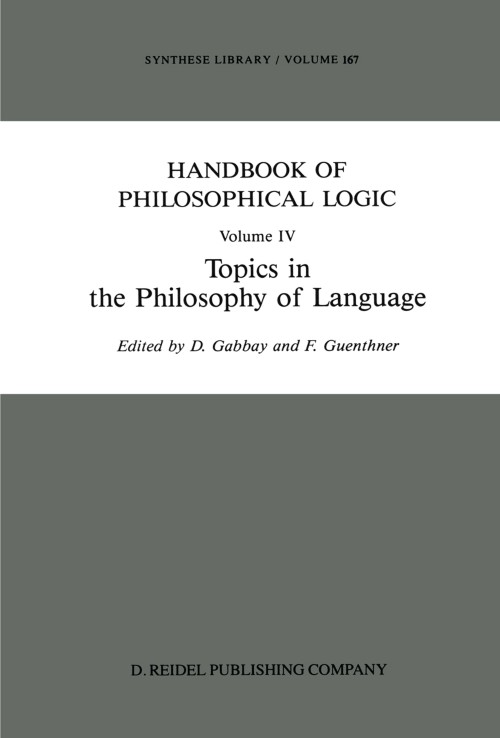
Handbook of Philosophical Logic [electronic resource] : Volume IV: Topics in the Philosophy of Language / edited by Dov M. Gabbay, Franz Guenthner.
Erişim Adresi
ISBN
9789400911710
Dil Kodu
İngilizce
Yer Numarası
DK/15134
Basım Bildirimi
1st ed. 1989.
Yayın Bilgisi
Dordrecht : Springer Netherlands : Imprint: Springer, 1989.
Fiziksel Niteleme
733 p. online resource.
Dizi
Synthese Library, Studies in Epistemology, Logic, Methodology, and Philosophy of Science, 2542-8292 ; 167
İçindekiler Notu
to Volume IV -- IV.I Quantifiers in Formal and Natural Languages -- IV.2 Property Theories -- IV.3 Philosophical Perspectives on Formal Theories of Predication -- IV.4 Mass Expressions -- IV.5 Reference and Information Content: Names and Descriptions -- IV.6 Indexicals -- IV.7 Propositional Attitudes -- IV.8 Tense and Time -- IV.9 Presupposition -- IV.10 Semantics and the Liar Paradox -- Name Index -- Table of Contents to Volume I, II, and III.
Özet, vb.
conceptual, realist) theories of predication. Chapter IV.4 centers on an important class of expressions used for predication in connection with quantities: mass expressions. This chapter reviews the most well-known approaches to mass terms and the ontological proposals related to them. In addition to quantification and predication, matters of reference have constituted the other overriding theme for semantic theories in both philosophical logic and the semantics of natural languages. Chapter IV.5 of how the semantics of proper names and descrip presents an overview tions have been dealt with in recent theories of reference. Chapter IV.6 is concerned with the context-dependence of reference, in particular, with the semantics of indexical expressions. The topic of Chapter IV.7 is related to predication as it surveys some of the central problems of ascribing propositional attitudes to agents. Chap ter IV.8 deals with the analysis of the main temporal aspects of natural language utterances. Together these two chapters give a good indication of the intricate complexities that arise once modalities of one or the other sort enter on the semantic stage. in philosophical Chapter IV.9 deals with another well-known topic logic: presupposition, an issue on the borderline of semantics and prag matics. The volume closes with an extensive study of the Liar paradox and its many implications for the study of language (as for example, self reference, truth concepts and truth definitions).
Konu
Logic.
Computational linguistics.
Mathematical logic.
Logic.
Computational Linguistics.
Mathematical Logic and Foundations.
Computational linguistics.
Mathematical logic.
Logic.
Computational Linguistics.
Mathematical Logic and Foundations.
Diğer Yazarlar
Kurum Adı
Eseri Alıntıla
Referansları kullanmadan önce gözden geçirmeniz ve varsa gerekli düzeltmeleri yapmanız önerilir.
Dijital Kaynak
MARC Görünümü
LEADER 04798nam a22005895i 4500
001 813894
003 TR_AnAIT
005 20260130222739
007 cr nn 008mamaa
008 121227s1989 ne | s |||| 0|eng d
020 |a9789400911710|9978-94-009-1171-0
024 7 |a10.1007/978-94-009-1171-0|2doi
041 |aeng
049 |aTürk Tarih Kurumu Kütüphanesi
050 4|aBC1-199
072 7|aHPL|2bicssc
072 7|aPHI011000|2bisacsh
072 7|aQDTL|2thema
082 04|a160|223
090 |aDK/15134
245 10|aHandbook of Philosophical Logic|h[electronic resource] :|bVolume IV: Topics in the Philosophy of Language /|cedited by Dov M. Gabbay, Franz Guenthner.
250 |a1st ed. 1989.
264 1|aDordrecht :|bSpringer Netherlands :|bImprint: Springer,|c1989.
300 |a733 p.|bonline resource.
336 |atext|btxt|2rdacontent
337 |acomputer|bc|2rdamedia
338 |aonline resource|bcr|2rdacarrier
347 |atext file|bPDF|2rda
490 1 |aSynthese Library, Studies in Epistemology, Logic, Methodology, and Philosophy of Science,|x2542-8292 ;|v167
505 0 |ato Volume IV -- IV.I Quantifiers in Formal and Natural Languages -- IV.2 Property Theories -- IV.3 Philosophical Perspectives on Formal Theories of Predication -- IV.4 Mass Expressions -- IV.5 Reference and Information Content: Names and Descriptions -- IV.6 Indexicals -- IV.7 Propositional Attitudes -- IV.8 Tense and Time -- IV.9 Presupposition -- IV.10 Semantics and the Liar Paradox -- Name Index -- Table of Contents to Volume I, II, and III.
520 |aconceptual, realist) theories of predication. Chapter IV.4 centers on an important class of expressions used for predication in connection with quantities: mass expressions. This chapter reviews the most well-known approaches to mass terms and the ontological proposals related to them. In addition to quantification and predication, matters of reference have constituted the other overriding theme for semantic theories in both philosophical logic and the semantics of natural languages. Chapter IV.5 of how the semantics of proper names and descrip presents an overview tions have been dealt with in recent theories of reference. Chapter IV.6 is concerned with the context-dependence of reference, in particular, with the semantics of indexical expressions. The topic of Chapter IV.7 is related to predication as it surveys some of the central problems of ascribing propositional attitudes to agents. Chap ter IV.8 deals with the analysis of the main temporal aspects of natural language utterances. Together these two chapters give a good indication of the intricate complexities that arise once modalities of one or the other sort enter on the semantic stage. in philosophical Chapter IV.9 deals with another well-known topic logic: presupposition, an issue on the borderline of semantics and prag matics. The volume closes with an extensive study of the Liar paradox and its many implications for the study of language (as for example, self reference, truth concepts and truth definitions).
532 8 |aAccessibility summary: This PDF is not accessible. It is based on scanned pages and does not support features such as screen reader compatibility or described non-text content (images, graphs etc). However, it likely supports searchable and selectable text based on OCR (Optical Character Recognition). Users with accessibility needs may not be able to use this content effectively. Please contact us at accessibilitysupport@springernature.com if you require assistance or an alternative format.
532 8 |aInaccessible, or known limited accessibility
532 8 |aNo reading system accessibility options actively disabled
532 8 |aPublisher contact for further accessibility information: accessibilitysupport@springernature.com
650 0|aLogic.
650 0|aComputational linguistics.
650 0|aMathematical logic.
650 14|aLogic.
650 24|aComputational Linguistics.
650 24|aMathematical Logic and Foundations.
700 1 |aGabbay, Dov M.|eeditor.|4edt|4http://id.loc.gov/vocabulary/relators/edt
700 1 |aGuenthner, Franz.|eeditor.|4edt|4http://id.loc.gov/vocabulary/relators/edt
710 2 |aSpringerLink (Online service)
773 0 |tSpringer Nature eBook
776 08|iPrinted edition:|z9789027716064
776 08|iPrinted edition:|z9789400911727
776 08|iPrinted edition:|z9789401070218
830 0|aSynthese Library, Studies in Epistemology, Logic, Methodology, and Philosophy of Science,|x2542-8292 ;|v167
856 40|uhttps://doi.org/10.1007/978-94-009-1171-0
912 |aZDB-2-SHU
912 |aZDB-2-SXPR
912 |aZDB-2-BAE
950 |aHumanities, Social Sciences and Law (SpringerNature-11648)
950 |aPhilosophy and Religion (R0) (SpringerNature-43725)
001 813894
003 TR_AnAIT
005 20260130222739
007 cr nn 008mamaa
008 121227s1989 ne | s |||| 0|eng d
020 |a9789400911710|9978-94-009-1171-0
024 7 |a10.1007/978-94-009-1171-0|2doi
041 |aeng
049 |aTürk Tarih Kurumu Kütüphanesi
050 4|aBC1-199
072 7|aHPL|2bicssc
072 7|aPHI011000|2bisacsh
072 7|aQDTL|2thema
082 04|a160|223
090 |aDK/15134
245 10|aHandbook of Philosophical Logic|h[electronic resource] :|bVolume IV: Topics in the Philosophy of Language /|cedited by Dov M. Gabbay, Franz Guenthner.
250 |a1st ed. 1989.
264 1|aDordrecht :|bSpringer Netherlands :|bImprint: Springer,|c1989.
300 |a733 p.|bonline resource.
336 |atext|btxt|2rdacontent
337 |acomputer|bc|2rdamedia
338 |aonline resource|bcr|2rdacarrier
347 |atext file|bPDF|2rda
490 1 |aSynthese Library, Studies in Epistemology, Logic, Methodology, and Philosophy of Science,|x2542-8292 ;|v167
505 0 |ato Volume IV -- IV.I Quantifiers in Formal and Natural Languages -- IV.2 Property Theories -- IV.3 Philosophical Perspectives on Formal Theories of Predication -- IV.4 Mass Expressions -- IV.5 Reference and Information Content: Names and Descriptions -- IV.6 Indexicals -- IV.7 Propositional Attitudes -- IV.8 Tense and Time -- IV.9 Presupposition -- IV.10 Semantics and the Liar Paradox -- Name Index -- Table of Contents to Volume I, II, and III.
520 |aconceptual, realist) theories of predication. Chapter IV.4 centers on an important class of expressions used for predication in connection with quantities: mass expressions. This chapter reviews the most well-known approaches to mass terms and the ontological proposals related to them. In addition to quantification and predication, matters of reference have constituted the other overriding theme for semantic theories in both philosophical logic and the semantics of natural languages. Chapter IV.5 of how the semantics of proper names and descrip presents an overview tions have been dealt with in recent theories of reference. Chapter IV.6 is concerned with the context-dependence of reference, in particular, with the semantics of indexical expressions. The topic of Chapter IV.7 is related to predication as it surveys some of the central problems of ascribing propositional attitudes to agents. Chap ter IV.8 deals with the analysis of the main temporal aspects of natural language utterances. Together these two chapters give a good indication of the intricate complexities that arise once modalities of one or the other sort enter on the semantic stage. in philosophical Chapter IV.9 deals with another well-known topic logic: presupposition, an issue on the borderline of semantics and prag matics. The volume closes with an extensive study of the Liar paradox and its many implications for the study of language (as for example, self reference, truth concepts and truth definitions).
532 8 |aAccessibility summary: This PDF is not accessible. It is based on scanned pages and does not support features such as screen reader compatibility or described non-text content (images, graphs etc). However, it likely supports searchable and selectable text based on OCR (Optical Character Recognition). Users with accessibility needs may not be able to use this content effectively. Please contact us at accessibilitysupport@springernature.com if you require assistance or an alternative format.
532 8 |aInaccessible, or known limited accessibility
532 8 |aNo reading system accessibility options actively disabled
532 8 |aPublisher contact for further accessibility information: accessibilitysupport@springernature.com
650 0|aLogic.
650 0|aComputational linguistics.
650 0|aMathematical logic.
650 14|aLogic.
650 24|aComputational Linguistics.
650 24|aMathematical Logic and Foundations.
700 1 |aGabbay, Dov M.|eeditor.|4edt|4http://id.loc.gov/vocabulary/relators/edt
700 1 |aGuenthner, Franz.|eeditor.|4edt|4http://id.loc.gov/vocabulary/relators/edt
710 2 |aSpringerLink (Online service)
773 0 |tSpringer Nature eBook
776 08|iPrinted edition:|z9789027716064
776 08|iPrinted edition:|z9789400911727
776 08|iPrinted edition:|z9789401070218
830 0|aSynthese Library, Studies in Epistemology, Logic, Methodology, and Philosophy of Science,|x2542-8292 ;|v167
856 40|uhttps://doi.org/10.1007/978-94-009-1171-0
912 |aZDB-2-SHU
912 |aZDB-2-SXPR
912 |aZDB-2-BAE
950 |aHumanities, Social Sciences and Law (SpringerNature-11648)
950 |aPhilosophy and Religion (R0) (SpringerNature-43725)
Materyaller
Depodan talep edilen materyal sadece kütüphane içerisinde kullanılmaktadır.
Materyal dışarıya ödünç verilmemektedir.
Materyal dışarıya ödünç verilmemektedir.
