

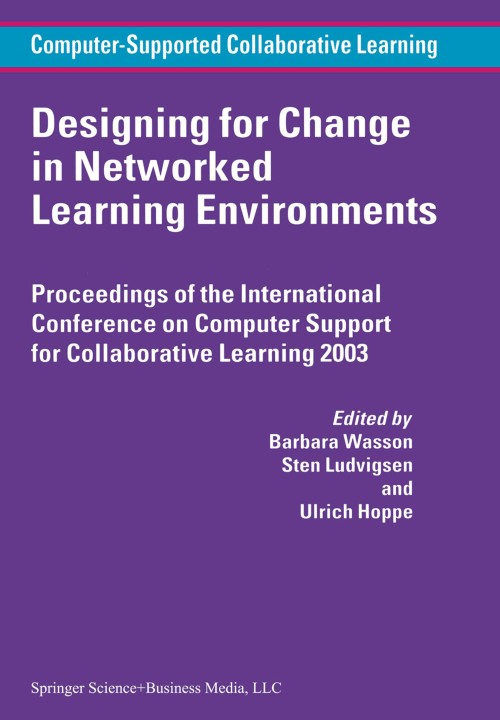
Designing for Change in Networked Learning Environments [electronic resource] / edited by B. Wasson, Sten Ludvigsen, Ulrich Hoppe.
Erişim Adresi
ISBN
9789401701952
Dil Kodu
İngilizce
Yer Numarası
DK/15144
Basım Bildirimi
1st ed. 2003.
Yayın Bilgisi
Dordrecht : Springer Netherlands : Imprint: Springer, 2003.
Fiziksel Niteleme
XX, 536 p. online resource.
Dizi
Computer-Supported Collaborative Learning Series, 2543-0157 ; 2
İçindekiler Notu
1.1 Representational tools and the transformation of learning -- 1.2 How sensing and mobile technologies can enhance collaborative learning in classrooms and museums -- 2.1 Comparing graphical and textual preparation tools for collaborative argumentation-based learning -- 2.2 Computer-supported collaborative learning in the space of debate -- 2.3 Assessing and scaffolding knowledge building: Pedagogical knowledge building principles and electronic portfolios -- 2.4 Primeclimb: Designing to facilitate mediated collaborative inquiry -- 2.5 Problematizing the problem: A single case analysis in a dPBL meeting -- 2.6 A quartet in E: Investigating collaborative learning and tutoring as knowledge creation processes -- 2.7 Developmental trajectory in knowledge building: An investigation -- 2.8 Categorisation in knowledge building: Task specific argumentation in a co-located CSCL environment -- 2.9 Grounding in electronic discussion: Standard (threaded) versus anchored discussion -- 2.10 Supporting emergence of threaded learning conversations through augmenting interactional and sequential coherence -- 3.1 Supporting historical reasoning in CSCL -- 3.2 Collaborative modelling of rational numbers -- 3.3 Students’ collaborative use of computer-based programming tools in science: A descriptive study -- 4.1 Promoting interaction in large classes with computer-mediated feedback -- 4.2 Some experiences with collaborative exercises -- 4.3 New breed of computer supported student contests: Learning by and for tele-collaboration -- 5.1 Towards lifelong learning environments: Agents supporting the collaborative construction of knowledge in virtual communities -- 5.2 Designing pedagogical agents for Cscl -- 5.3 Integrating software agents with -- 6.1 Validating a representational notation for collaborativeproblem solving -- 6.2 Deictic roles of external representation in face-to-face and online collaboration -- 7.1 Supporting awareness to facilitate collaborative learning in an online learning environment -- 7.2 Framework for scaffolding the development of problem representations by collaborative design -- 7.3 Instructional support for computer-mediated collaboration: Results from process analyses -- 7.4 Group skill usage: the accuracy and impact of self-assessment and feedback -- 7.5 Influence of feedback on distributed problem based learning -- 8.1 From face-to-face to virtual space -- 8.2 Practices of collaborative authoring with video episodes -- 8.3 CoVase: Collaborative visualization for constructivist learning -- 8.4 Sdr: networking -- 8.5 Digital-EE II: RV-augmented interface design for networked collaborative environmental learning -- 8.6 Role of icons and chat boxes in computer supported collaborative learning -- 9.1 Full-contact poetry: Creating space for poetic collaboration -- 9.2 Solving Meno’s paradox: Task sematics and narratives in multimediated educational environments -- 9.3 Situating historical events through mixed reality -- 9.4 Epro2: Design of a system and a curriculum to support group learning for school children -- 10.1 Individual behaviors and social structure in the development of communication networks of self-organizing online discussion groups -- 10.2 Measuring the perceived quality of social space in distributed learning groups -- 10.3 Developing tools for analyzing Cscl process -- 10.4 How social network analysis can help to measure cohesion in collaborative distance learning -- 11.1 Extending the scope of the current discussion on metadata towards situated models -- 11.2 A critical analysis of Ims learning design -- 11.3 Analysis methods for collaborativemodels and activities -- 11.4 Towards an Xml-based representation of collaborative action -- 12.1 The organisation of interaction in ditributed collaborative learning -- 12.2 Sharing perspectives in virtual interaction: Review of methods of analysis -- 12.3 Designing networked environments to support dialogical learning -- 12.4 A study on heterogeneity during real-time collaborative problem solving -- 12.5 Stimulating questioning behaviour: a study on learning and understanding in video-based design teams -- 12.6 Nonverbal signs in virtual environments -- 12.7 Is synchronous computer mediated collaborative problem-solving ‘justified’ only when by distance? ‘Teacher’s points of view and interventions with co-located groups, during everyday class activities -- 12.8 A participant experience method for illustrating individuals’ experiences in the course of an evolving virtual learning community -- 12.9 Designing for divergence -- 13.1 From lecture recording towards personalized collaborative learning -- 13.2 The activeclass project: Experiments in encouraging classroom participation -- 13.3 Supporting face-to-face learning with handheld devices -- 14.1 Scientific principles in Pasteur’s quadrant: Integrating goals of understanding and use in learning environments research -- 14.2 Moving toward a theory of CSCL -- 14.3 A new conceptual framework for CSCL -- 14.4 Meaning and interpretation in collaboration.
Özet, vb.
Designing for Learning in Networked Learning Environments is of interest to researchers and students, designers, educators, and industrial trainers across various disciplines including education, cognitive, social and educational psychology, didactics, computer science, linguistics and semiotics, speech communication, anthropology, sociology and design. Computer Support for Collaborative Learning (CSCL) is a genuinely interdisciplinary field that strives to create a better understanding of collaborative learning that is mediated by a diverse set of computational technologies. The theme of CSCL 2003 "Designing for Change in Networked Learning Environments" reflects a commitment to influence educational practice in times of the Internet. The contributions in this volume include discussions on knowledge building, designing and analysing group interaction, design of collaborative multimedia and 3D environments, computational modelling and analysis, software agents, and much more.
Konu
Educational technology.
Education.
Artificial intelligence.
Learning, Psychology of.
Digital Education and Educational Technology.
Education.
Artificial Intelligence.
Instructional Psychology.
Education.
Artificial intelligence.
Learning, Psychology of.
Digital Education and Educational Technology.
Education.
Artificial Intelligence.
Instructional Psychology.
Diğer Yazarlar
Kurum Adı
Eseri Alıntıla
Referansları kullanmadan önce gözden geçirmeniz ve varsa gerekli düzeltmeleri yapmanız önerilir.
Dijital Kaynak
MARC Görünümü
LEADER 08985nam a22006255i 4500
001 813904
003 TR_AnAIT
005 20260130222708
007 cr nn 008mamaa
008 130612s2003 ne | s |||| 0|eng d
020 |a9789401701952|9978-94-017-0195-2
024 7 |a10.1007/978-94-017-0195-2|2doi
041 |aeng
049 |aTürk Tarih Kurumu Kütüphanesi
050 4|aLB1028.3
072 7|aJNV|2bicssc
072 7|aEDU000000|2bisacsh
072 7|aJNV|2thema
082 04|a371.33|223
090 |aDK/15144
245 10|aDesigning for Change in Networked Learning Environments|h[electronic resource] /|cedited by B. Wasson, Sten Ludvigsen, Ulrich Hoppe.
250 |a1st ed. 2003.
264 1|aDordrecht :|bSpringer Netherlands :|bImprint: Springer,|c2003.
300 |aXX, 536 p.|bonline resource.
336 |atext|btxt|2rdacontent
337 |acomputer|bc|2rdamedia
338 |aonline resource|bcr|2rdacarrier
347 |atext file|bPDF|2rda
490 1 |aComputer-Supported Collaborative Learning Series,|x2543-0157 ;|v2
505 0 |a1.1 Representational tools and the transformation of learning -- 1.2 How sensing and mobile technologies can enhance collaborative learning in classrooms and museums -- 2.1 Comparing graphical and textual preparation tools for collaborative argumentation-based learning -- 2.2 Computer-supported collaborative learning in the space of debate -- 2.3 Assessing and scaffolding knowledge building: Pedagogical knowledge building principles and electronic portfolios -- 2.4 Primeclimb: Designing to facilitate mediated collaborative inquiry -- 2.5 Problematizing the problem: A single case analysis in a dPBL meeting -- 2.6 A quartet in E: Investigating collaborative learning and tutoring as knowledge creation processes -- 2.7 Developmental trajectory in knowledge building: An investigation -- 2.8 Categorisation in knowledge building: Task specific argumentation in a co-located CSCL environment -- 2.9 Grounding in electronic discussion: Standard (threaded) versus anchored discussion -- 2.10 Supporting emergence of threaded learning conversations through augmenting interactional and sequential coherence -- 3.1 Supporting historical reasoning in CSCL -- 3.2 Collaborative modelling of rational numbers -- 3.3 Students’ collaborative use of computer-based programming tools in science: A descriptive study -- 4.1 Promoting interaction in large classes with computer-mediated feedback -- 4.2 Some experiences with collaborative exercises -- 4.3 New breed of computer supported student contests: Learning by and for tele-collaboration -- 5.1 Towards lifelong learning environments: Agents supporting the collaborative construction of knowledge in virtual communities -- 5.2 Designing pedagogical agents for Cscl -- 5.3 Integrating software agents with -- 6.1 Validating a representational notation for collaborativeproblem solving -- 6.2 Deictic roles of external representation in face-to-face and online collaboration -- 7.1 Supporting awareness to facilitate collaborative learning in an online learning environment -- 7.2 Framework for scaffolding the development of problem representations by collaborative design -- 7.3 Instructional support for computer-mediated collaboration: Results from process analyses -- 7.4 Group skill usage: the accuracy and impact of self-assessment and feedback -- 7.5 Influence of feedback on distributed problem based learning -- 8.1 From face-to-face to virtual space -- 8.2 Practices of collaborative authoring with video episodes -- 8.3 CoVase: Collaborative visualization for constructivist learning -- 8.4 Sdr: networking -- 8.5 Digital-EE II: RV-augmented interface design for networked collaborative environmental learning -- 8.6 Role of icons and chat boxes in computer supported collaborative learning -- 9.1 Full-contact poetry: Creating space for poetic collaboration -- 9.2 Solving Meno’s paradox: Task sematics and narratives in multimediated educational environments -- 9.3 Situating historical events through mixed reality -- 9.4 Epro2: Design of a system and a curriculum to support group learning for school children -- 10.1 Individual behaviors and social structure in the development of communication networks of self-organizing online discussion groups -- 10.2 Measuring the perceived quality of social space in distributed learning groups -- 10.3 Developing tools for analyzing Cscl process -- 10.4 How social network analysis can help to measure cohesion in collaborative distance learning -- 11.1 Extending the scope of the current discussion on metadata towards situated models -- 11.2 A critical analysis of Ims learning design -- 11.3 Analysis methods for collaborativemodels and activities -- 11.4 Towards an Xml-based representation of collaborative action -- 12.1 The organisation of interaction in ditributed collaborative learning -- 12.2 Sharing perspectives in virtual interaction: Review of methods of analysis -- 12.3 Designing networked environments to support dialogical learning -- 12.4 A study on heterogeneity during real-time collaborative problem solving -- 12.5 Stimulating questioning behaviour: a study on learning and understanding in video-based design teams -- 12.6 Nonverbal signs in virtual environments -- 12.7 Is synchronous computer mediated collaborative problem-solving ‘justified’ only when by distance? ‘Teacher’s points of view and interventions with co-located groups, during everyday class activities -- 12.8 A participant experience method for illustrating individuals’ experiences in the course of an evolving virtual learning community -- 12.9 Designing for divergence -- 13.1 From lecture recording towards personalized collaborative learning -- 13.2 The activeclass project: Experiments in encouraging classroom participation -- 13.3 Supporting face-to-face learning with handheld devices -- 14.1 Scientific principles in Pasteur’s quadrant: Integrating goals of understanding and use in learning environments research -- 14.2 Moving toward a theory of CSCL -- 14.3 A new conceptual framework for CSCL -- 14.4 Meaning and interpretation in collaboration.
520 |aDesigning for Learning in Networked Learning Environments is of interest to researchers and students, designers, educators, and industrial trainers across various disciplines including education, cognitive, social and educational psychology, didactics, computer science, linguistics and semiotics, speech communication, anthropology, sociology and design. Computer Support for Collaborative Learning (CSCL) is a genuinely interdisciplinary field that strives to create a better understanding of collaborative learning that is mediated by a diverse set of computational technologies. The theme of CSCL 2003 "Designing for Change in Networked Learning Environments" reflects a commitment to influence educational practice in times of the Internet. The contributions in this volume include discussions on knowledge building, designing and analysing group interaction, design of collaborative multimedia and 3D environments, computational modelling and analysis, software agents, and much more.
532 8 |aAccessibility summary: This PDF is not accessible. It is based on scanned pages and does not support features such as screen reader compatibility or described non-text content (images, graphs etc). However, it likely supports searchable and selectable text based on OCR (Optical Character Recognition). Users with accessibility needs may not be able to use this content effectively. Please contact us at accessibilitysupport@springernature.com if you require assistance or an alternative format.
532 8 |aInaccessible, or known limited accessibility
532 8 |aNo reading system accessibility options actively disabled
532 8 |aPublisher contact for further accessibility information: accessibilitysupport@springernature.com
650 0|aEducational technology.
650 0|aEducation.
650 0|aArtificial intelligence.
650 0|aLearning, Psychology of.
650 14|aDigital Education and Educational Technology.
650 24|aEducation.
650 24|aArtificial Intelligence.
650 24|aInstructional Psychology.
700 1 |aWasson, B.|eeditor.|4edt|4http://id.loc.gov/vocabulary/relators/edt
700 1 |aLudvigsen, Sten.|eeditor.|4edt|4http://id.loc.gov/vocabulary/relators/edt
700 1 |aHoppe, Ulrich.|eeditor.|4edt|4http://id.loc.gov/vocabulary/relators/edt
710 2 |aSpringerLink (Online service)
773 0 |tSpringer Nature eBook
776 08|iPrinted edition:|z9781402013836
776 08|iPrinted edition:|z9789048163212
776 08|iPrinted edition:|z9789401701969
830 0|aComputer-Supported Collaborative Learning Series,|x2543-0157 ;|v2
856 40|uhttps://doi.org/10.1007/978-94-017-0195-2
912 |aZDB-2-SHU
912 |aZDB-2-SXED
912 |aZDB-2-BAE
950 |aHumanities, Social Sciences and Law (SpringerNature-11648)
950 |aEducation (R0) (SpringerNature-43721)
001 813904
003 TR_AnAIT
005 20260130222708
007 cr nn 008mamaa
008 130612s2003 ne | s |||| 0|eng d
020 |a9789401701952|9978-94-017-0195-2
024 7 |a10.1007/978-94-017-0195-2|2doi
041 |aeng
049 |aTürk Tarih Kurumu Kütüphanesi
050 4|aLB1028.3
072 7|aJNV|2bicssc
072 7|aEDU000000|2bisacsh
072 7|aJNV|2thema
082 04|a371.33|223
090 |aDK/15144
245 10|aDesigning for Change in Networked Learning Environments|h[electronic resource] /|cedited by B. Wasson, Sten Ludvigsen, Ulrich Hoppe.
250 |a1st ed. 2003.
264 1|aDordrecht :|bSpringer Netherlands :|bImprint: Springer,|c2003.
300 |aXX, 536 p.|bonline resource.
336 |atext|btxt|2rdacontent
337 |acomputer|bc|2rdamedia
338 |aonline resource|bcr|2rdacarrier
347 |atext file|bPDF|2rda
490 1 |aComputer-Supported Collaborative Learning Series,|x2543-0157 ;|v2
505 0 |a1.1 Representational tools and the transformation of learning -- 1.2 How sensing and mobile technologies can enhance collaborative learning in classrooms and museums -- 2.1 Comparing graphical and textual preparation tools for collaborative argumentation-based learning -- 2.2 Computer-supported collaborative learning in the space of debate -- 2.3 Assessing and scaffolding knowledge building: Pedagogical knowledge building principles and electronic portfolios -- 2.4 Primeclimb: Designing to facilitate mediated collaborative inquiry -- 2.5 Problematizing the problem: A single case analysis in a dPBL meeting -- 2.6 A quartet in E: Investigating collaborative learning and tutoring as knowledge creation processes -- 2.7 Developmental trajectory in knowledge building: An investigation -- 2.8 Categorisation in knowledge building: Task specific argumentation in a co-located CSCL environment -- 2.9 Grounding in electronic discussion: Standard (threaded) versus anchored discussion -- 2.10 Supporting emergence of threaded learning conversations through augmenting interactional and sequential coherence -- 3.1 Supporting historical reasoning in CSCL -- 3.2 Collaborative modelling of rational numbers -- 3.3 Students’ collaborative use of computer-based programming tools in science: A descriptive study -- 4.1 Promoting interaction in large classes with computer-mediated feedback -- 4.2 Some experiences with collaborative exercises -- 4.3 New breed of computer supported student contests: Learning by and for tele-collaboration -- 5.1 Towards lifelong learning environments: Agents supporting the collaborative construction of knowledge in virtual communities -- 5.2 Designing pedagogical agents for Cscl -- 5.3 Integrating software agents with -- 6.1 Validating a representational notation for collaborativeproblem solving -- 6.2 Deictic roles of external representation in face-to-face and online collaboration -- 7.1 Supporting awareness to facilitate collaborative learning in an online learning environment -- 7.2 Framework for scaffolding the development of problem representations by collaborative design -- 7.3 Instructional support for computer-mediated collaboration: Results from process analyses -- 7.4 Group skill usage: the accuracy and impact of self-assessment and feedback -- 7.5 Influence of feedback on distributed problem based learning -- 8.1 From face-to-face to virtual space -- 8.2 Practices of collaborative authoring with video episodes -- 8.3 CoVase: Collaborative visualization for constructivist learning -- 8.4 Sdr: networking -- 8.5 Digital-EE II: RV-augmented interface design for networked collaborative environmental learning -- 8.6 Role of icons and chat boxes in computer supported collaborative learning -- 9.1 Full-contact poetry: Creating space for poetic collaboration -- 9.2 Solving Meno’s paradox: Task sematics and narratives in multimediated educational environments -- 9.3 Situating historical events through mixed reality -- 9.4 Epro2: Design of a system and a curriculum to support group learning for school children -- 10.1 Individual behaviors and social structure in the development of communication networks of self-organizing online discussion groups -- 10.2 Measuring the perceived quality of social space in distributed learning groups -- 10.3 Developing tools for analyzing Cscl process -- 10.4 How social network analysis can help to measure cohesion in collaborative distance learning -- 11.1 Extending the scope of the current discussion on metadata towards situated models -- 11.2 A critical analysis of Ims learning design -- 11.3 Analysis methods for collaborativemodels and activities -- 11.4 Towards an Xml-based representation of collaborative action -- 12.1 The organisation of interaction in ditributed collaborative learning -- 12.2 Sharing perspectives in virtual interaction: Review of methods of analysis -- 12.3 Designing networked environments to support dialogical learning -- 12.4 A study on heterogeneity during real-time collaborative problem solving -- 12.5 Stimulating questioning behaviour: a study on learning and understanding in video-based design teams -- 12.6 Nonverbal signs in virtual environments -- 12.7 Is synchronous computer mediated collaborative problem-solving ‘justified’ only when by distance? ‘Teacher’s points of view and interventions with co-located groups, during everyday class activities -- 12.8 A participant experience method for illustrating individuals’ experiences in the course of an evolving virtual learning community -- 12.9 Designing for divergence -- 13.1 From lecture recording towards personalized collaborative learning -- 13.2 The activeclass project: Experiments in encouraging classroom participation -- 13.3 Supporting face-to-face learning with handheld devices -- 14.1 Scientific principles in Pasteur’s quadrant: Integrating goals of understanding and use in learning environments research -- 14.2 Moving toward a theory of CSCL -- 14.3 A new conceptual framework for CSCL -- 14.4 Meaning and interpretation in collaboration.
520 |aDesigning for Learning in Networked Learning Environments is of interest to researchers and students, designers, educators, and industrial trainers across various disciplines including education, cognitive, social and educational psychology, didactics, computer science, linguistics and semiotics, speech communication, anthropology, sociology and design. Computer Support for Collaborative Learning (CSCL) is a genuinely interdisciplinary field that strives to create a better understanding of collaborative learning that is mediated by a diverse set of computational technologies. The theme of CSCL 2003 "Designing for Change in Networked Learning Environments" reflects a commitment to influence educational practice in times of the Internet. The contributions in this volume include discussions on knowledge building, designing and analysing group interaction, design of collaborative multimedia and 3D environments, computational modelling and analysis, software agents, and much more.
532 8 |aAccessibility summary: This PDF is not accessible. It is based on scanned pages and does not support features such as screen reader compatibility or described non-text content (images, graphs etc). However, it likely supports searchable and selectable text based on OCR (Optical Character Recognition). Users with accessibility needs may not be able to use this content effectively. Please contact us at accessibilitysupport@springernature.com if you require assistance or an alternative format.
532 8 |aInaccessible, or known limited accessibility
532 8 |aNo reading system accessibility options actively disabled
532 8 |aPublisher contact for further accessibility information: accessibilitysupport@springernature.com
650 0|aEducational technology.
650 0|aEducation.
650 0|aArtificial intelligence.
650 0|aLearning, Psychology of.
650 14|aDigital Education and Educational Technology.
650 24|aEducation.
650 24|aArtificial Intelligence.
650 24|aInstructional Psychology.
700 1 |aWasson, B.|eeditor.|4edt|4http://id.loc.gov/vocabulary/relators/edt
700 1 |aLudvigsen, Sten.|eeditor.|4edt|4http://id.loc.gov/vocabulary/relators/edt
700 1 |aHoppe, Ulrich.|eeditor.|4edt|4http://id.loc.gov/vocabulary/relators/edt
710 2 |aSpringerLink (Online service)
773 0 |tSpringer Nature eBook
776 08|iPrinted edition:|z9781402013836
776 08|iPrinted edition:|z9789048163212
776 08|iPrinted edition:|z9789401701969
830 0|aComputer-Supported Collaborative Learning Series,|x2543-0157 ;|v2
856 40|uhttps://doi.org/10.1007/978-94-017-0195-2
912 |aZDB-2-SHU
912 |aZDB-2-SXED
912 |aZDB-2-BAE
950 |aHumanities, Social Sciences and Law (SpringerNature-11648)
950 |aEducation (R0) (SpringerNature-43721)
Materyaller
Depodan talep edilen materyal sadece kütüphane içerisinde kullanılmaktadır.
Materyal dışarıya ödünç verilmemektedir.
Materyal dışarıya ödünç verilmemektedir.
