

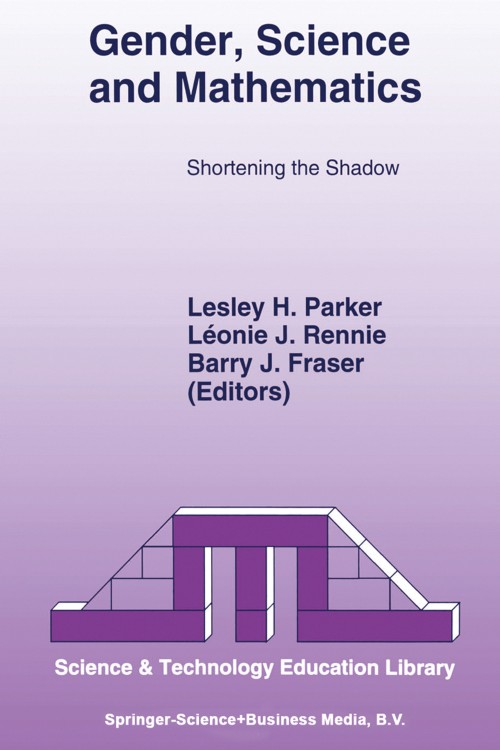
Gender, Science and Mathematics [electronic resource] : Shortening the Shadow / edited by L. H. Parker, L. Rennie, B. Fraser.
Erişim Adresi
ISBN
9789401101431
Dil Kodu
İngilizce
Yer Numarası
DK/15147
Basım Bildirimi
1st ed. 1996.
Yayın Bilgisi
Dordrecht : Springer Netherlands : Imprint: Springer, 1996.
Fiziksel Niteleme
XV, 230 p. online resource.
Dizi
Science & technology education library ; 2
İçindekiler Notu
Section I: Confronting Perceptions and Attitudes -- 1. Science in a Masculine Strait-Jacket -- 2. Towards a Gender-Inclusive Science in Schools: Confronting Student Teachers’ Perceptions and Attitudes -- 3. Examining and Extending Young Children’s Views of Science and Scientists -- 4. Gender Justice and the Mathematics Curriculum: Four Perspectives -- 5. Revealing Assumptions: Problematising Research on Gender and Mathematics and Science Education -- Section II: The Reality of Schools, Classrooms, Curriculum and Assessment -- 6. Under Cover of Night: (Re)Gendering Mathematics and Science Education -- 7. Patterns of Science Achievement: International Comparisons -- 8. Equity in the Mathematics Classroom: Beyond the Rhetoric -- 9. Assessment Practices and Gender in Science -- 10. Gender Equity and the Enacted Science Curriculum -- 11. Equitable Science Education: A Discrepancy Model -- Section III: From Policy to Practice — Building on Experience -- 12. The Role of Persuasive Communicators in Implementing Gender — Equity Initiatives -- 13. Sharing Science: Primary Science for Both Teachers and Pupils -- 14. ‘Do You Know Anyone Who Builds Skyscrapers?’ SOS — Skills and Opportunities in Science for Girls -- 15. The Politics and Practice of Equity: Experiences from Both Sides of the Pacific -- 16. Informing Teaching and Research in Science Education through Gender Equity Initiatives -- Notes on Contributors 223.
Özet, vb.
Throughout the Western world, the relationship between gender, science and math ematics has emerged as critical in a variety of contexts. In tertiary institutions, the study of "gender issues", frequently with reference to science and mathematics, is of central significance to many disciplines. Gender studies are being offered as sepa rate courses or parts of existing courses in preservice and postgraduate teacher edu cation, women's studies, technology studies and policy studies. In addition, in the broader context of education at all levels from primary/elementary through to higher, concerned policy-makers and practitioners frequently focus on the interaction of gender, science and mathematics in their attempts to reform and improve education for all students. In all of these contexts, there is an urgent need for suitable texts, both to provide resources for teachers and students and to inform policy-makers and practitioners. This book has been developed specifically to meet this need. It is designed to be used throughout the world in a variety of tertiary courses and by policy-makers concerned with activities which interface with the gender/science/mathematics rela tionship. It provides examples which illustrate vividly the rich field from which practitioners and policy-makers in this area now can draw. Its particular appeal will stem from its practical approach and creative future perspective, the international renown of the authors and the generalisability of the recent research and thinking presented in each of the chapters.
Konu
Education.
Science __ Study and teaching.
Education.
Science Education.
Science __ Study and teaching.
Education.
Science Education.
Diğer Yazarlar
Kurum Adı
Eseri Alıntıla
Referansları kullanmadan önce gözden geçirmeniz ve varsa gerekli düzeltmeleri yapmanız önerilir.
Dijital Kaynak
MARC Görünümü
LEADER 05681nam a22005775i 4500
001 813907
003 TR_AnAIT
005 20260130222705
007 cr nn 008mamaa
008 121227s1996 ne | s |||| 0|eng d
020 |a9789401101431|9978-94-011-0143-1
024 7 |a10.1007/978-94-011-0143-1|2doi
041 |aeng
049 |aTürk Tarih Kurumu Kütüphanesi
050 4|aL1-991
072 7|aJN|2bicssc
072 7|aEDU000000|2bisacsh
072 7|aJN|2thema
082 04|a370|223
090 |aDK/15147
245 10|aGender, Science and Mathematics|h[electronic resource] :|bShortening the Shadow /|cedited by L. H. Parker, L. Rennie, B. Fraser.
250 |a1st ed. 1996.
264 1|aDordrecht :|bSpringer Netherlands :|bImprint: Springer,|c1996.
300 |aXV, 230 p.|bonline resource.
336 |atext|btxt|2rdacontent
337 |acomputer|bc|2rdamedia
338 |aonline resource|bcr|2rdacarrier
347 |atext file|bPDF|2rda
490 1 |aScience & technology education library ;|v2
505 0 |aSection I: Confronting Perceptions and Attitudes -- 1. Science in a Masculine Strait-Jacket -- 2. Towards a Gender-Inclusive Science in Schools: Confronting Student Teachers’ Perceptions and Attitudes -- 3. Examining and Extending Young Children’s Views of Science and Scientists -- 4. Gender Justice and the Mathematics Curriculum: Four Perspectives -- 5. Revealing Assumptions: Problematising Research on Gender and Mathematics and Science Education -- Section II: The Reality of Schools, Classrooms, Curriculum and Assessment -- 6. Under Cover of Night: (Re)Gendering Mathematics and Science Education -- 7. Patterns of Science Achievement: International Comparisons -- 8. Equity in the Mathematics Classroom: Beyond the Rhetoric -- 9. Assessment Practices and Gender in Science -- 10. Gender Equity and the Enacted Science Curriculum -- 11. Equitable Science Education: A Discrepancy Model -- Section III: From Policy to Practice — Building on Experience -- 12. The Role of Persuasive Communicators in Implementing Gender — Equity Initiatives -- 13. Sharing Science: Primary Science for Both Teachers and Pupils -- 14. ‘Do You Know Anyone Who Builds Skyscrapers?’ SOS — Skills and Opportunities in Science for Girls -- 15. The Politics and Practice of Equity: Experiences from Both Sides of the Pacific -- 16. Informing Teaching and Research in Science Education through Gender Equity Initiatives -- Notes on Contributors 223.
520 |aThroughout the Western world, the relationship between gender, science and math ematics has emerged as critical in a variety of contexts. In tertiary institutions, the study of "gender issues", frequently with reference to science and mathematics, is of central significance to many disciplines. Gender studies are being offered as sepa rate courses or parts of existing courses in preservice and postgraduate teacher edu cation, women's studies, technology studies and policy studies. In addition, in the broader context of education at all levels from primary/elementary through to higher, concerned policy-makers and practitioners frequently focus on the interaction of gender, science and mathematics in their attempts to reform and improve education for all students. In all of these contexts, there is an urgent need for suitable texts, both to provide resources for teachers and students and to inform policy-makers and practitioners. This book has been developed specifically to meet this need. It is designed to be used throughout the world in a variety of tertiary courses and by policy-makers concerned with activities which interface with the gender/science/mathematics rela tionship. It provides examples which illustrate vividly the rich field from which practitioners and policy-makers in this area now can draw. Its particular appeal will stem from its practical approach and creative future perspective, the international renown of the authors and the generalisability of the recent research and thinking presented in each of the chapters.
532 8 |aAccessibility summary: This PDF is not accessible. It is based on scanned pages and does not support features such as screen reader compatibility or described non-text content (images, graphs etc). However, it likely supports searchable and selectable text based on OCR (Optical Character Recognition). Users with accessibility needs may not be able to use this content effectively. Please contact us at accessibilitysupport@springernature.com if you require assistance or an alternative format.
532 8 |aInaccessible, or known limited accessibility
532 8 |aNo reading system accessibility options actively disabled
532 8 |aPublisher contact for further accessibility information: accessibilitysupport@springernature.com
650 0|aEducation.
650 0|aScience|xStudy and teaching.
650 14|aEducation.
650 24|aScience Education.
700 1 |aParker, L. H.|eeditor.|4edt|4http://id.loc.gov/vocabulary/relators/edt
700 1 |aRennie, L.|eeditor.|4edt|4http://id.loc.gov/vocabulary/relators/edt
700 1 |aFraser, B.|eeditor.|4edt|4http://id.loc.gov/vocabulary/relators/edt
710 2 |aSpringerLink (Online service)
773 0 |tSpringer Nature eBook
776 08|iPrinted edition:|z9780792335351
776 08|iPrinted edition:|z9780792335825
776 08|iPrinted edition:|z9789401101448
830 0|aScience & technology education library ;|v2
856 40|uhttps://doi.org/10.1007/978-94-011-0143-1
912 |aZDB-2-SHU
912 |aZDB-2-SXED
912 |aZDB-2-BAE
950 |aHumanities, Social Sciences and Law (SpringerNature-11648)
950 |aEducation (R0) (SpringerNature-43721)
001 813907
003 TR_AnAIT
005 20260130222705
007 cr nn 008mamaa
008 121227s1996 ne | s |||| 0|eng d
020 |a9789401101431|9978-94-011-0143-1
024 7 |a10.1007/978-94-011-0143-1|2doi
041 |aeng
049 |aTürk Tarih Kurumu Kütüphanesi
050 4|aL1-991
072 7|aJN|2bicssc
072 7|aEDU000000|2bisacsh
072 7|aJN|2thema
082 04|a370|223
090 |aDK/15147
245 10|aGender, Science and Mathematics|h[electronic resource] :|bShortening the Shadow /|cedited by L. H. Parker, L. Rennie, B. Fraser.
250 |a1st ed. 1996.
264 1|aDordrecht :|bSpringer Netherlands :|bImprint: Springer,|c1996.
300 |aXV, 230 p.|bonline resource.
336 |atext|btxt|2rdacontent
337 |acomputer|bc|2rdamedia
338 |aonline resource|bcr|2rdacarrier
347 |atext file|bPDF|2rda
490 1 |aScience & technology education library ;|v2
505 0 |aSection I: Confronting Perceptions and Attitudes -- 1. Science in a Masculine Strait-Jacket -- 2. Towards a Gender-Inclusive Science in Schools: Confronting Student Teachers’ Perceptions and Attitudes -- 3. Examining and Extending Young Children’s Views of Science and Scientists -- 4. Gender Justice and the Mathematics Curriculum: Four Perspectives -- 5. Revealing Assumptions: Problematising Research on Gender and Mathematics and Science Education -- Section II: The Reality of Schools, Classrooms, Curriculum and Assessment -- 6. Under Cover of Night: (Re)Gendering Mathematics and Science Education -- 7. Patterns of Science Achievement: International Comparisons -- 8. Equity in the Mathematics Classroom: Beyond the Rhetoric -- 9. Assessment Practices and Gender in Science -- 10. Gender Equity and the Enacted Science Curriculum -- 11. Equitable Science Education: A Discrepancy Model -- Section III: From Policy to Practice — Building on Experience -- 12. The Role of Persuasive Communicators in Implementing Gender — Equity Initiatives -- 13. Sharing Science: Primary Science for Both Teachers and Pupils -- 14. ‘Do You Know Anyone Who Builds Skyscrapers?’ SOS — Skills and Opportunities in Science for Girls -- 15. The Politics and Practice of Equity: Experiences from Both Sides of the Pacific -- 16. Informing Teaching and Research in Science Education through Gender Equity Initiatives -- Notes on Contributors 223.
520 |aThroughout the Western world, the relationship between gender, science and math ematics has emerged as critical in a variety of contexts. In tertiary institutions, the study of "gender issues", frequently with reference to science and mathematics, is of central significance to many disciplines. Gender studies are being offered as sepa rate courses or parts of existing courses in preservice and postgraduate teacher edu cation, women's studies, technology studies and policy studies. In addition, in the broader context of education at all levels from primary/elementary through to higher, concerned policy-makers and practitioners frequently focus on the interaction of gender, science and mathematics in their attempts to reform and improve education for all students. In all of these contexts, there is an urgent need for suitable texts, both to provide resources for teachers and students and to inform policy-makers and practitioners. This book has been developed specifically to meet this need. It is designed to be used throughout the world in a variety of tertiary courses and by policy-makers concerned with activities which interface with the gender/science/mathematics rela tionship. It provides examples which illustrate vividly the rich field from which practitioners and policy-makers in this area now can draw. Its particular appeal will stem from its practical approach and creative future perspective, the international renown of the authors and the generalisability of the recent research and thinking presented in each of the chapters.
532 8 |aAccessibility summary: This PDF is not accessible. It is based on scanned pages and does not support features such as screen reader compatibility or described non-text content (images, graphs etc). However, it likely supports searchable and selectable text based on OCR (Optical Character Recognition). Users with accessibility needs may not be able to use this content effectively. Please contact us at accessibilitysupport@springernature.com if you require assistance or an alternative format.
532 8 |aInaccessible, or known limited accessibility
532 8 |aNo reading system accessibility options actively disabled
532 8 |aPublisher contact for further accessibility information: accessibilitysupport@springernature.com
650 0|aEducation.
650 0|aScience|xStudy and teaching.
650 14|aEducation.
650 24|aScience Education.
700 1 |aParker, L. H.|eeditor.|4edt|4http://id.loc.gov/vocabulary/relators/edt
700 1 |aRennie, L.|eeditor.|4edt|4http://id.loc.gov/vocabulary/relators/edt
700 1 |aFraser, B.|eeditor.|4edt|4http://id.loc.gov/vocabulary/relators/edt
710 2 |aSpringerLink (Online service)
773 0 |tSpringer Nature eBook
776 08|iPrinted edition:|z9780792335351
776 08|iPrinted edition:|z9780792335825
776 08|iPrinted edition:|z9789401101448
830 0|aScience & technology education library ;|v2
856 40|uhttps://doi.org/10.1007/978-94-011-0143-1
912 |aZDB-2-SHU
912 |aZDB-2-SXED
912 |aZDB-2-BAE
950 |aHumanities, Social Sciences and Law (SpringerNature-11648)
950 |aEducation (R0) (SpringerNature-43721)
Materyaller
Depodan talep edilen materyal sadece kütüphane içerisinde kullanılmaktadır.
Materyal dışarıya ödünç verilmemektedir.
Materyal dışarıya ödünç verilmemektedir.
