

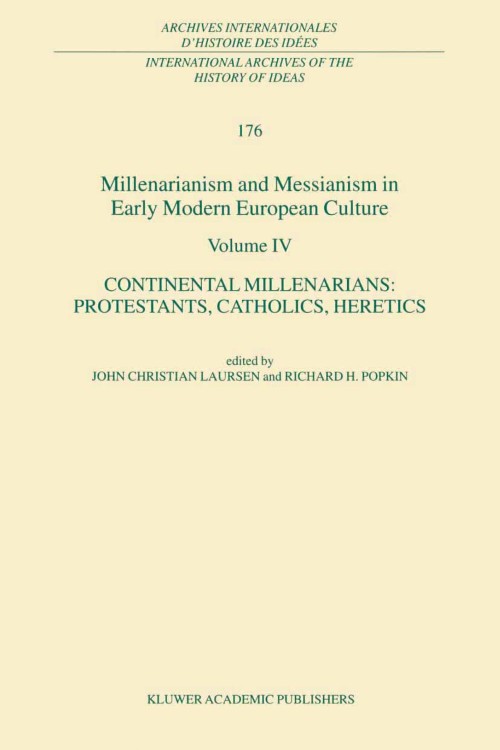
Millenarianism and Messianism in Early Modern European Culture Volume IV [electronic resource] : Continental Millenarians: Protestants, Catholics, Heretics / edited by John Christian Laursen, R.H. Popkin.
Erişim Adresi
ISBN
9789401007443
Dil Kodu
İngilizce
Yer Numarası
DK/15149
Basım Bildirimi
1st ed. 2001.
Yayın Bilgisi
Dordrecht : Springer Netherlands : Imprint: Springer, 2001.
Fiziksel Niteleme
XX, 126 p. online resource.
Dizi
International Archives of the History of Ideas Archives internationales d'histoire des idées, 2215-0307 ; 176
İçindekiler Notu
1. The Rosicrucians and the Great Conjunctions -- 2. Arianism and Millenarianism: The Link Between Two Heresies from Servetus to Socinus -- 3. Mystical Millenarianism in the Early Modern Dutch Republic -- 4. Dutch Millenarianism and the Role of Reason: Daniel de Breen and Joachim Oudaan -- 5. Who was the Author of the Clavis apocalyptica of 1651? Millenarianism and Prophecy between Silesian Mysticism and the Hartlib Circle -- 6. Millenarianism and Nationalism — A Case Study: Isaac La Peyrère -- 7. Pierre Jurieu: The Politics of Prophecy -- 8. Bayle’s Anti-Millenarianism: The Dangers of Those who Claim to Know the Future -- 9. Pietism, Millenarianism, and the Family Future: The Journal of Beate Hahn-Paulus (1778-1842).
Özet, vb.
Any number of misconceptions about millenarians and messianism in the early modern period will be laid to rest by a reading of this volume. It is too often thought that millenarianism was largely an English phenomenon. One of the reasons for bringing these studies together is to show, as Martin Mulsow puts it, that we can understand this European-wide movement as a "millenarian international" in analogy with the later "socialist international". Another misconception is that millenarianism and messianism were a world apart from mainstream developments in intellectual history; but, as Mulsow also insists, a proper understanding of millenarianism places it in the context of the growth and stabilization of science, material progress, and political reform. A third mistake is to conclude too quickly that millenarianism and messianism have formed a single, monolithic bloc in history; but we learn in this volume that there were all sorts of millenarians. Readers of this volume will be struck by at least two things. One is the sheer numbers of millenarian thinkers to be found throughout Europe in the early modern period, especially north of the Mediterranean. We will not list them all 1 here, but the index to this book contains dozens and dozens of them. The second striking point is the amount of work that remains to be done. For every millenarian that we explore and explain here, several are mentioned about which little is known.
Konu
Religion.
History.
Religion __ Philosophy.
Philosophy __ History.
Political science __ Philosophy.
Religion.
History.
Philosophy of Religion.
History of Philosophy.
Political Philosophy.
History.
Religion __ Philosophy.
Philosophy __ History.
Political science __ Philosophy.
Religion.
History.
Philosophy of Religion.
History of Philosophy.
Political Philosophy.
Diğer Yazarlar
Kurum Adı
Eseri Alıntıla
Referansları kullanmadan önce gözden geçirmeniz ve varsa gerekli düzeltmeleri yapmanız önerilir.
Dijital Kaynak
MARC Görünümü
LEADER 05167nam a22006255i 4500
001 813909
003 TR_AnAIT
005 20260130222703
007 cr nn 008mamaa
008 110523s2001 ne | s |||| 0|eng d
020 |a9789401007443|9978-94-010-0744-3
024 7 |a10.1007/978-94-010-0744-3|2doi
041 |aeng
049 |aTürk Tarih Kurumu Kütüphanesi
050 4|aBL
072 7|aHRA|2bicssc
072 7|aREL000000|2bisacsh
072 7|aQRA|2thema
082 04|a200|223
090 |aDK/15149
245 10|aMillenarianism and Messianism in Early Modern European Culture Volume IV|h[electronic resource] :|bContinental Millenarians: Protestants, Catholics, Heretics /|cedited by John Christian Laursen, R.H. Popkin.
250 |a1st ed. 2001.
264 1|aDordrecht :|bSpringer Netherlands :|bImprint: Springer,|c2001.
300 |aXX, 126 p.|bonline resource.
336 |atext|btxt|2rdacontent
337 |acomputer|bc|2rdamedia
338 |aonline resource|bcr|2rdacarrier
347 |atext file|bPDF|2rda
490 1 |aInternational Archives of the History of Ideas Archives internationales d'histoire des idées,|x2215-0307 ;|v176
505 0 |a1. The Rosicrucians and the Great Conjunctions -- 2. Arianism and Millenarianism: The Link Between Two Heresies from Servetus to Socinus -- 3. Mystical Millenarianism in the Early Modern Dutch Republic -- 4. Dutch Millenarianism and the Role of Reason: Daniel de Breen and Joachim Oudaan -- 5. Who was the Author of the Clavis apocalyptica of 1651? Millenarianism and Prophecy between Silesian Mysticism and the Hartlib Circle -- 6. Millenarianism and Nationalism — A Case Study: Isaac La Peyrère -- 7. Pierre Jurieu: The Politics of Prophecy -- 8. Bayle’s Anti-Millenarianism: The Dangers of Those who Claim to Know the Future -- 9. Pietism, Millenarianism, and the Family Future: The Journal of Beate Hahn-Paulus (1778-1842).
520 |aAny number of misconceptions about millenarians and messianism in the early modern period will be laid to rest by a reading of this volume. It is too often thought that millenarianism was largely an English phenomenon. One of the reasons for bringing these studies together is to show, as Martin Mulsow puts it, that we can understand this European-wide movement as a "millenarian international" in analogy with the later "socialist international". Another misconception is that millenarianism and messianism were a world apart from mainstream developments in intellectual history; but, as Mulsow also insists, a proper understanding of millenarianism places it in the context of the growth and stabilization of science, material progress, and political reform. A third mistake is to conclude too quickly that millenarianism and messianism have formed a single, monolithic bloc in history; but we learn in this volume that there were all sorts of millenarians. Readers of this volume will be struck by at least two things. One is the sheer numbers of millenarian thinkers to be found throughout Europe in the early modern period, especially north of the Mediterranean. We will not list them all 1 here, but the index to this book contains dozens and dozens of them. The second striking point is the amount of work that remains to be done. For every millenarian that we explore and explain here, several are mentioned about which little is known.
532 8 |aAccessibility summary: This PDF is not accessible. It is based on scanned pages and does not support features such as screen reader compatibility or described non-text content (images, graphs etc). However, it likely supports searchable and selectable text based on OCR (Optical Character Recognition). Users with accessibility needs may not be able to use this content effectively. Please contact us at accessibilitysupport@springernature.com if you require assistance or an alternative format.
532 8 |aInaccessible, or known limited accessibility
532 8 |aNo reading system accessibility options actively disabled
532 8 |aPublisher contact for further accessibility information: accessibilitysupport@springernature.com
650 0|aReligion.
650 0|aHistory.
650 0|aReligion|xPhilosophy.
650 0|aPhilosophy|xHistory.
650 0|aPolitical science|xPhilosophy.
650 14|aReligion.
650 24|aHistory.
650 24|aPhilosophy of Religion.
650 24|aHistory of Philosophy.
650 24|aPolitical Philosophy.
700 1 |aLaursen, John Christian.|eeditor.|4edt|4http://id.loc.gov/vocabulary/relators/edt
700 1 |aPopkin, R.H.|eeditor.|4edt|4http://id.loc.gov/vocabulary/relators/edt
710 2 |aSpringerLink (Online service)
773 0 |tSpringer Nature eBook
776 08|iPrinted edition:|z9780792368472
776 08|iPrinted edition:|z9789401007450
830 0|aInternational Archives of the History of Ideas Archives internationales d'histoire des idées,|x2215-0307 ;|v176
856 40|uhttps://doi.org/10.1007/978-94-010-0744-3
912 |aZDB-2-SHU
912 |aZDB-2-SXPR
912 |aZDB-2-BAE
950 |aHumanities, Social Sciences and Law (SpringerNature-11648)
950 |aPhilosophy and Religion (R0) (SpringerNature-43725)
001 813909
003 TR_AnAIT
005 20260130222703
007 cr nn 008mamaa
008 110523s2001 ne | s |||| 0|eng d
020 |a9789401007443|9978-94-010-0744-3
024 7 |a10.1007/978-94-010-0744-3|2doi
041 |aeng
049 |aTürk Tarih Kurumu Kütüphanesi
050 4|aBL
072 7|aHRA|2bicssc
072 7|aREL000000|2bisacsh
072 7|aQRA|2thema
082 04|a200|223
090 |aDK/15149
245 10|aMillenarianism and Messianism in Early Modern European Culture Volume IV|h[electronic resource] :|bContinental Millenarians: Protestants, Catholics, Heretics /|cedited by John Christian Laursen, R.H. Popkin.
250 |a1st ed. 2001.
264 1|aDordrecht :|bSpringer Netherlands :|bImprint: Springer,|c2001.
300 |aXX, 126 p.|bonline resource.
336 |atext|btxt|2rdacontent
337 |acomputer|bc|2rdamedia
338 |aonline resource|bcr|2rdacarrier
347 |atext file|bPDF|2rda
490 1 |aInternational Archives of the History of Ideas Archives internationales d'histoire des idées,|x2215-0307 ;|v176
505 0 |a1. The Rosicrucians and the Great Conjunctions -- 2. Arianism and Millenarianism: The Link Between Two Heresies from Servetus to Socinus -- 3. Mystical Millenarianism in the Early Modern Dutch Republic -- 4. Dutch Millenarianism and the Role of Reason: Daniel de Breen and Joachim Oudaan -- 5. Who was the Author of the Clavis apocalyptica of 1651? Millenarianism and Prophecy between Silesian Mysticism and the Hartlib Circle -- 6. Millenarianism and Nationalism — A Case Study: Isaac La Peyrère -- 7. Pierre Jurieu: The Politics of Prophecy -- 8. Bayle’s Anti-Millenarianism: The Dangers of Those who Claim to Know the Future -- 9. Pietism, Millenarianism, and the Family Future: The Journal of Beate Hahn-Paulus (1778-1842).
520 |aAny number of misconceptions about millenarians and messianism in the early modern period will be laid to rest by a reading of this volume. It is too often thought that millenarianism was largely an English phenomenon. One of the reasons for bringing these studies together is to show, as Martin Mulsow puts it, that we can understand this European-wide movement as a "millenarian international" in analogy with the later "socialist international". Another misconception is that millenarianism and messianism were a world apart from mainstream developments in intellectual history; but, as Mulsow also insists, a proper understanding of millenarianism places it in the context of the growth and stabilization of science, material progress, and political reform. A third mistake is to conclude too quickly that millenarianism and messianism have formed a single, monolithic bloc in history; but we learn in this volume that there were all sorts of millenarians. Readers of this volume will be struck by at least two things. One is the sheer numbers of millenarian thinkers to be found throughout Europe in the early modern period, especially north of the Mediterranean. We will not list them all 1 here, but the index to this book contains dozens and dozens of them. The second striking point is the amount of work that remains to be done. For every millenarian that we explore and explain here, several are mentioned about which little is known.
532 8 |aAccessibility summary: This PDF is not accessible. It is based on scanned pages and does not support features such as screen reader compatibility or described non-text content (images, graphs etc). However, it likely supports searchable and selectable text based on OCR (Optical Character Recognition). Users with accessibility needs may not be able to use this content effectively. Please contact us at accessibilitysupport@springernature.com if you require assistance or an alternative format.
532 8 |aInaccessible, or known limited accessibility
532 8 |aNo reading system accessibility options actively disabled
532 8 |aPublisher contact for further accessibility information: accessibilitysupport@springernature.com
650 0|aReligion.
650 0|aHistory.
650 0|aReligion|xPhilosophy.
650 0|aPhilosophy|xHistory.
650 0|aPolitical science|xPhilosophy.
650 14|aReligion.
650 24|aHistory.
650 24|aPhilosophy of Religion.
650 24|aHistory of Philosophy.
650 24|aPolitical Philosophy.
700 1 |aLaursen, John Christian.|eeditor.|4edt|4http://id.loc.gov/vocabulary/relators/edt
700 1 |aPopkin, R.H.|eeditor.|4edt|4http://id.loc.gov/vocabulary/relators/edt
710 2 |aSpringerLink (Online service)
773 0 |tSpringer Nature eBook
776 08|iPrinted edition:|z9780792368472
776 08|iPrinted edition:|z9789401007450
830 0|aInternational Archives of the History of Ideas Archives internationales d'histoire des idées,|x2215-0307 ;|v176
856 40|uhttps://doi.org/10.1007/978-94-010-0744-3
912 |aZDB-2-SHU
912 |aZDB-2-SXPR
912 |aZDB-2-BAE
950 |aHumanities, Social Sciences and Law (SpringerNature-11648)
950 |aPhilosophy and Religion (R0) (SpringerNature-43725)
Materyaller
Depodan talep edilen materyal sadece kütüphane içerisinde kullanılmaktadır.
Materyal dışarıya ödünç verilmemektedir.
Materyal dışarıya ödünç verilmemektedir.
