

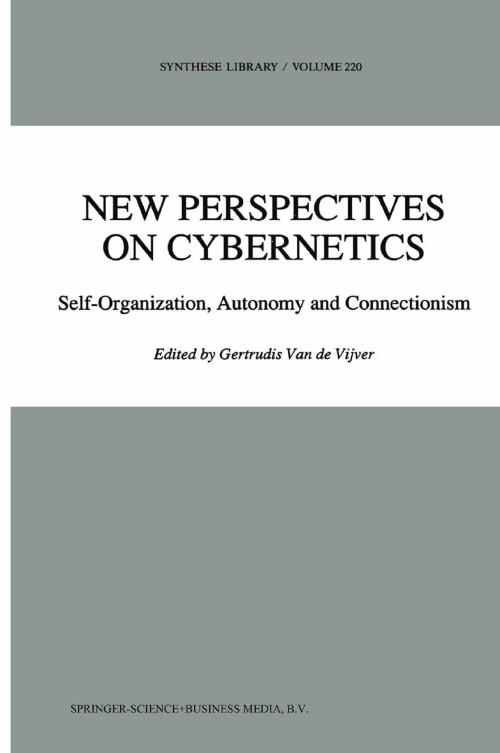
New Perspectives on Cybernetics [electronic resource] : Self-Organization, Autonomy and Connectionism / edited by G. Vijver.
Erişim Adresi
ISBN
9789401580625
Dil Kodu
İngilizce
Yer Numarası
DK/15193
Basım Bildirimi
1st ed. 1992.
Yayın Bilgisi
Dordrecht : Springer Netherlands : Imprint: Springer, 1992.
Fiziksel Niteleme
VI, 262 p. online resource.
Dizi
Synthese Library, Studies in Epistemology, Logic, Methodology, and Philosophy of Science, 2542-8292 ; 220
İçindekiler Notu
Introduction: Different kinds of cybernetics -- Self-organization and complexity -- Ends and meaning in machine-like systems -- Hierarchical non-equilibrium self-organization as the new post-cybernetic perspective -- A priori and a posteriori in cognitive praxis: the model for the regulation of agonistic antagonistic couples -- Non-rational cognitive processes as changes of distinctions -- Epistemological issues -- Self-organization and autonomy in a post-cybernetic perspective. Epistemological issues -- The experimental epistemology of W.S. McCulloch. A minimalistic interpretation -- From paleo- to neo-connectionism -- Second cybernetics: a double strategy for representing cognition -- The bringing forth of dialogue: Latour versus Maturana -- A one-sided boundary: on the limits of knowing organizational closure -- Mechanistic explanations and structure-determined systems. Maturana and the human sciences -- Sociological issues -- Correspondence, consensus, coherence and the rape of democracy -- Writers of the lost I: second-order self-observation and absolute writership.
Özet, vb.
Gertrudis Van de Vijver· Seminar of Logic and Epistemology University of Ghent Before being classified under the fashionable denominators of complexity and chaos, self-organization and autonomy were intensely inquired into in the cybernetic tradition. Despite all rejections that cybernetics has gone through in the second half of this century, today its importance is more and more recognized. Its decisive influence for connectionist theories, autopoietic and constructivist theories, for different forms of applied or experimental epistemology, is being more and more understood and generally accepted. It is mainly due to the success of connectionist models that we observe today a revival of interest for cybernetics. The 1943 article by McCulloch and Pitts is evidently a founding article. Cybernetics has however a much broader interest than the one linked to technical-mathematical details relevant to the construction of networks. For instance, the evolution from first to second order cybernetics, the ways of approaching biological and cognitive phenomena in the latter and the limits that were formulated there, are particularly meaningful to understand current developments and divergences in connectionism. A nuanced picture of cybernetic's history and its present state is therefore clearly epistemologically essential.
Konu
Science __ Philosophy.
System theory.
Control theory.
Knowledge, Theory of.
Philosophy of Science.
Systems Theory, Control.
Epistemology.
System theory.
Control theory.
Knowledge, Theory of.
Philosophy of Science.
Systems Theory, Control.
Epistemology.
Diğer Yazarlar
Kurum Adı
Eseri Alıntıla
Referansları kullanmadan önce gözden geçirmeniz ve varsa gerekli düzeltmeleri yapmanız önerilir.
Dijital Kaynak
MARC Görünümü
LEADER 05205nam a22006015i 4500
001 813954
003 TR_AnAIT
005 20260130222418
007 cr nn 008mamaa
008 130509s1992 ne | s |||| 0|eng d
020 |a9789401580625|9978-94-015-8062-5
024 7 |a10.1007/978-94-015-8062-5|2doi
041 |aeng
049 |aTürk Tarih Kurumu Kütüphanesi
050 4|aQ174-175.3
050 4|aB67
072 7|aPDA|2bicssc
072 7|aSCI075000|2bisacsh
072 7|aPDA|2thema
082 04|a501|223
090 |aDK/15193
245 10|aNew Perspectives on Cybernetics|h[electronic resource] :|bSelf-Organization, Autonomy and Connectionism /|cedited by G. Vijver.
250 |a1st ed. 1992.
264 1|aDordrecht :|bSpringer Netherlands :|bImprint: Springer,|c1992.
300 |aVI, 262 p.|bonline resource.
336 |atext|btxt|2rdacontent
337 |acomputer|bc|2rdamedia
338 |aonline resource|bcr|2rdacarrier
347 |atext file|bPDF|2rda
490 1 |aSynthese Library, Studies in Epistemology, Logic, Methodology, and Philosophy of Science,|x2542-8292 ;|v220
505 0 |aIntroduction: Different kinds of cybernetics -- Self-organization and complexity -- Ends and meaning in machine-like systems -- Hierarchical non-equilibrium self-organization as the new post-cybernetic perspective -- A priori and a posteriori in cognitive praxis: the model for the regulation of agonistic antagonistic couples -- Non-rational cognitive processes as changes of distinctions -- Epistemological issues -- Self-organization and autonomy in a post-cybernetic perspective. Epistemological issues -- The experimental epistemology of W.S. McCulloch. A minimalistic interpretation -- From paleo- to neo-connectionism -- Second cybernetics: a double strategy for representing cognition -- The bringing forth of dialogue: Latour versus Maturana -- A one-sided boundary: on the limits of knowing organizational closure -- Mechanistic explanations and structure-determined systems. Maturana and the human sciences -- Sociological issues -- Correspondence, consensus, coherence and the rape of democracy -- Writers of the lost I: second-order self-observation and absolute writership.
520 |aGertrudis Van de Vijver· Seminar of Logic and Epistemology University of Ghent Before being classified under the fashionable denominators of complexity and chaos, self-organization and autonomy were intensely inquired into in the cybernetic tradition. Despite all rejections that cybernetics has gone through in the second half of this century, today its importance is more and more recognized. Its decisive influence for connectionist theories, autopoietic and constructivist theories, for different forms of applied or experimental epistemology, is being more and more understood and generally accepted. It is mainly due to the success of connectionist models that we observe today a revival of interest for cybernetics. The 1943 article by McCulloch and Pitts is evidently a founding article. Cybernetics has however a much broader interest than the one linked to technical-mathematical details relevant to the construction of networks. For instance, the evolution from first to second order cybernetics, the ways of approaching biological and cognitive phenomena in the latter and the limits that were formulated there, are particularly meaningful to understand current developments and divergences in connectionism. A nuanced picture of cybernetic's history and its present state is therefore clearly epistemologically essential.
532 8 |aAccessibility summary: This PDF is not accessible. It is based on scanned pages and does not support features such as screen reader compatibility or described non-text content (images, graphs etc). However, it likely supports searchable and selectable text based on OCR (Optical Character Recognition). Users with accessibility needs may not be able to use this content effectively. Please contact us at accessibilitysupport@springernature.com if you require assistance or an alternative format.
532 8 |aInaccessible, or known limited accessibility
532 8 |aNo reading system accessibility options actively disabled
532 8 |aPublisher contact for further accessibility information: accessibilitysupport@springernature.com
650 0|aScience|xPhilosophy.
650 0|aSystem theory.
650 0|aControl theory.
650 0|aKnowledge, Theory of.
650 14|aPhilosophy of Science.
650 24|aSystems Theory, Control.
650 24|aEpistemology.
700 1 |aVijver, G.|eeditor.|4edt|4http://id.loc.gov/vocabulary/relators/edt
710 2 |aSpringerLink (Online service)
773 0 |tSpringer Nature eBook
776 08|iPrinted edition:|z9780792315193
776 08|iPrinted edition:|z9789048141074
776 08|iPrinted edition:|z9789401580632
830 0|aSynthese Library, Studies in Epistemology, Logic, Methodology, and Philosophy of Science,|x2542-8292 ;|v220
856 40|uhttps://doi.org/10.1007/978-94-015-8062-5
912 |aZDB-2-SHU
912 |aZDB-2-SXPR
912 |aZDB-2-BAE
950 |aHumanities, Social Sciences and Law (SpringerNature-11648)
950 |aPhilosophy and Religion (R0) (SpringerNature-43725)
001 813954
003 TR_AnAIT
005 20260130222418
007 cr nn 008mamaa
008 130509s1992 ne | s |||| 0|eng d
020 |a9789401580625|9978-94-015-8062-5
024 7 |a10.1007/978-94-015-8062-5|2doi
041 |aeng
049 |aTürk Tarih Kurumu Kütüphanesi
050 4|aQ174-175.3
050 4|aB67
072 7|aPDA|2bicssc
072 7|aSCI075000|2bisacsh
072 7|aPDA|2thema
082 04|a501|223
090 |aDK/15193
245 10|aNew Perspectives on Cybernetics|h[electronic resource] :|bSelf-Organization, Autonomy and Connectionism /|cedited by G. Vijver.
250 |a1st ed. 1992.
264 1|aDordrecht :|bSpringer Netherlands :|bImprint: Springer,|c1992.
300 |aVI, 262 p.|bonline resource.
336 |atext|btxt|2rdacontent
337 |acomputer|bc|2rdamedia
338 |aonline resource|bcr|2rdacarrier
347 |atext file|bPDF|2rda
490 1 |aSynthese Library, Studies in Epistemology, Logic, Methodology, and Philosophy of Science,|x2542-8292 ;|v220
505 0 |aIntroduction: Different kinds of cybernetics -- Self-organization and complexity -- Ends and meaning in machine-like systems -- Hierarchical non-equilibrium self-organization as the new post-cybernetic perspective -- A priori and a posteriori in cognitive praxis: the model for the regulation of agonistic antagonistic couples -- Non-rational cognitive processes as changes of distinctions -- Epistemological issues -- Self-organization and autonomy in a post-cybernetic perspective. Epistemological issues -- The experimental epistemology of W.S. McCulloch. A minimalistic interpretation -- From paleo- to neo-connectionism -- Second cybernetics: a double strategy for representing cognition -- The bringing forth of dialogue: Latour versus Maturana -- A one-sided boundary: on the limits of knowing organizational closure -- Mechanistic explanations and structure-determined systems. Maturana and the human sciences -- Sociological issues -- Correspondence, consensus, coherence and the rape of democracy -- Writers of the lost I: second-order self-observation and absolute writership.
520 |aGertrudis Van de Vijver· Seminar of Logic and Epistemology University of Ghent Before being classified under the fashionable denominators of complexity and chaos, self-organization and autonomy were intensely inquired into in the cybernetic tradition. Despite all rejections that cybernetics has gone through in the second half of this century, today its importance is more and more recognized. Its decisive influence for connectionist theories, autopoietic and constructivist theories, for different forms of applied or experimental epistemology, is being more and more understood and generally accepted. It is mainly due to the success of connectionist models that we observe today a revival of interest for cybernetics. The 1943 article by McCulloch and Pitts is evidently a founding article. Cybernetics has however a much broader interest than the one linked to technical-mathematical details relevant to the construction of networks. For instance, the evolution from first to second order cybernetics, the ways of approaching biological and cognitive phenomena in the latter and the limits that were formulated there, are particularly meaningful to understand current developments and divergences in connectionism. A nuanced picture of cybernetic's history and its present state is therefore clearly epistemologically essential.
532 8 |aAccessibility summary: This PDF is not accessible. It is based on scanned pages and does not support features such as screen reader compatibility or described non-text content (images, graphs etc). However, it likely supports searchable and selectable text based on OCR (Optical Character Recognition). Users with accessibility needs may not be able to use this content effectively. Please contact us at accessibilitysupport@springernature.com if you require assistance or an alternative format.
532 8 |aInaccessible, or known limited accessibility
532 8 |aNo reading system accessibility options actively disabled
532 8 |aPublisher contact for further accessibility information: accessibilitysupport@springernature.com
650 0|aScience|xPhilosophy.
650 0|aSystem theory.
650 0|aControl theory.
650 0|aKnowledge, Theory of.
650 14|aPhilosophy of Science.
650 24|aSystems Theory, Control.
650 24|aEpistemology.
700 1 |aVijver, G.|eeditor.|4edt|4http://id.loc.gov/vocabulary/relators/edt
710 2 |aSpringerLink (Online service)
773 0 |tSpringer Nature eBook
776 08|iPrinted edition:|z9780792315193
776 08|iPrinted edition:|z9789048141074
776 08|iPrinted edition:|z9789401580632
830 0|aSynthese Library, Studies in Epistemology, Logic, Methodology, and Philosophy of Science,|x2542-8292 ;|v220
856 40|uhttps://doi.org/10.1007/978-94-015-8062-5
912 |aZDB-2-SHU
912 |aZDB-2-SXPR
912 |aZDB-2-BAE
950 |aHumanities, Social Sciences and Law (SpringerNature-11648)
950 |aPhilosophy and Religion (R0) (SpringerNature-43725)
Materyaller
Depodan talep edilen materyal sadece kütüphane içerisinde kullanılmaktadır.
Materyal dışarıya ödünç verilmemektedir.
Materyal dışarıya ödünç verilmemektedir.
