

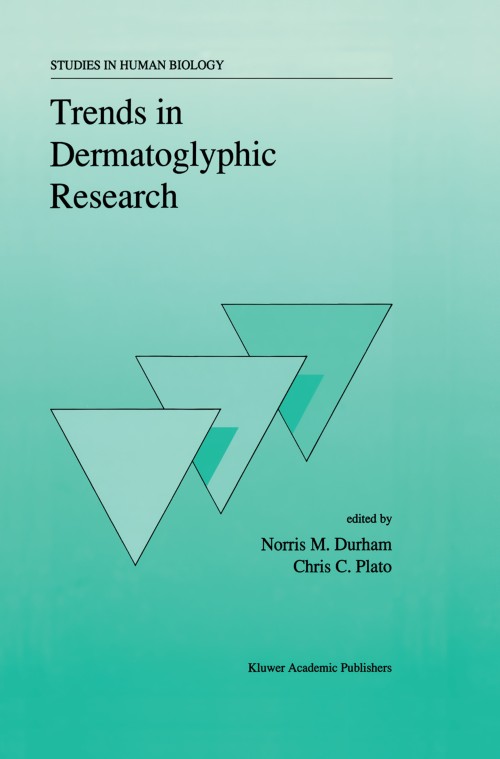
Trends in Dermatoglyphic Research [electronic resource] / edited by N.M. Durham, C.C. Plato.
Erişim Adresi
ISBN
9789400921375
Dil Kodu
İngilizce
Yer Numarası
DK/15198
Basım Bildirimi
1st ed. 1990.
Yayın Bilgisi
Dordrecht : Springer Netherlands : Imprint: Springer, 1990.
Fiziksel Niteleme
XX, 308 p. online resource.
Dizi
Studies in Human Biology ; 1
İçindekiler Notu
Historical Notes on Dermatoglyphics: From Purkinje to Cummins -- Dermatoglyphics as Genetic Markers -- Dermatoglyphic Recording and Scoring Techniques -- Genetic and Developmental Dermatoglyphics -- Prenatal Communalities in Epidermal Ridge Development -- Variability and Asymmetry in Main Line Index among 20 Dhangar Castes of Maharashtra, India -- Developmental Aspects of Human Palmar, Plantar, and Digital Flexion Creases -- Dermatoglyphics and the Geschwind Hypothesis. I. Theoretical Background and Palmar Results of Dyslexia -- Dermatoglyphics and the Geschwind Hypothesis. II. Digital Results of Dyslexia and Developmental Implications -- Effect of Environmental Pollutants on Dermatoglyphics Patterns -- Clinical Dermatoglyphics -- Dermatoglyphics of Three Alzheimer Families -- Dermatoglyphics in Hungarian Schizophrenic Patients -- Dermatoglyphic Variations in Achondroplasia -- Dermatoglyphics in Syndromes with Hand Malformations -- Dermatoglyphics in the Pathology of Breast Cancer and Cervix Carcinoma -- Dermatoglyphics in Marfan Syndrome -- Anthropological Dermatoglyphics -- Dermatoglyphics and Population Distance -- Dermatoglyphics in the Eastern Adriatic — Possibilities and Dilemmas in the Study of Population Structure -- Dermatoglyphics of Eastern Slavs -- Dermatoglyphics of the Finno-Ugrians of Eurasia -- The Dermatoglyphics of Egyptian Nubians -- Dermatoglyphics of Turkic Peoples of the U.S.S.R. -- Dermatoglyphics of Native Polynesians in the Cook Islands, and Their Biological Positioning Among South Pacific Populations -- Dermatoglyphics of the Isolated Kapingamarangese of Micronesia -- Pattern Intensities and Pattern Sizes on Palm and Sole of Chimpanzee: Description and Comparison with Humans.
Özet, vb.
The preparation of a volume of worldwide research contributions can be a time consuming task which is frequently more difficult than many other types of book. This particular venture was made easier by the assistance of many people. Therefore, we wish to acknowledge: the suggestions, academic support and direction of Dr. Kenneth M. Weiss, our American editor; the assistance of the staff of the Department of Sociology and Anthropology at the University of Northern Iowa, particularly the generous and congenial efforts of Ms. Rosemarie Skaine and Mrs. Heidi Anderegg whose computer and deciphering skills may be legendary; the kind responses to our long-distance questions from Mr. Martin Scrivener of Kluwer Publications are much appreciated; finally, the efforts of Dr. Paul T. Baker and Dr. Ralph M. Garruto for their help in rounding out the final contents. NMD CCP FOREWORD Among the many techniques developed by nineteenth century anatomists for the study of human morphological structures the analysis of dermatoglyphics has proven to be one of the most useful and durable. The series of reports presented herein reflect the dynamism of the topic. Such analyses provide a valuable tool for measuring the genetic relatedness of human populations and an inexpensive technique for alerting us to the degree of genetic involvement in the causes of many diseases.
Konu
Anthropology.
Evolution (Biology).
Anthropology.
Evolutionary Biology.
Evolution (Biology).
Anthropology.
Evolutionary Biology.
Diğer Yazarlar
Kurum Adı
Eseri Alıntıla
Referansları kullanmadan önce gözden geçirmeniz ve varsa gerekli düzeltmeleri yapmanız önerilir.
Dijital Kaynak
MARC Görünümü
LEADER 05633nam a22005655i 4500
001 813959
003 TR_AnAIT
005 20260130222408
007 cr nn 008mamaa
008 121227s1990 ne | s |||| 0|eng d
020 |a9789400921375|9978-94-009-2137-5
024 7 |a10.1007/978-94-009-2137-5|2doi
041 |aeng
049 |aTürk Tarih Kurumu Kütüphanesi
050 4|aGN
072 7|aJHM|2bicssc
072 7|aSOC002000|2bisacsh
072 7|aJHM|2thema
082 04|a301|223
090 |aDK/15198
245 10|aTrends in Dermatoglyphic Research|h[electronic resource] /|cedited by N.M. Durham, C.C. Plato.
250 |a1st ed. 1990.
264 1|aDordrecht :|bSpringer Netherlands :|bImprint: Springer,|c1990.
300 |aXX, 308 p.|bonline resource.
336 |atext|btxt|2rdacontent
337 |acomputer|bc|2rdamedia
338 |aonline resource|bcr|2rdacarrier
347 |atext file|bPDF|2rda
490 1 |aStudies in Human Biology ;|v1
505 0 |aHistorical Notes on Dermatoglyphics: From Purkinje to Cummins -- Dermatoglyphics as Genetic Markers -- Dermatoglyphic Recording and Scoring Techniques -- Genetic and Developmental Dermatoglyphics -- Prenatal Communalities in Epidermal Ridge Development -- Variability and Asymmetry in Main Line Index among 20 Dhangar Castes of Maharashtra, India -- Developmental Aspects of Human Palmar, Plantar, and Digital Flexion Creases -- Dermatoglyphics and the Geschwind Hypothesis. I. Theoretical Background and Palmar Results of Dyslexia -- Dermatoglyphics and the Geschwind Hypothesis. II. Digital Results of Dyslexia and Developmental Implications -- Effect of Environmental Pollutants on Dermatoglyphics Patterns -- Clinical Dermatoglyphics -- Dermatoglyphics of Three Alzheimer Families -- Dermatoglyphics in Hungarian Schizophrenic Patients -- Dermatoglyphic Variations in Achondroplasia -- Dermatoglyphics in Syndromes with Hand Malformations -- Dermatoglyphics in the Pathology of Breast Cancer and Cervix Carcinoma -- Dermatoglyphics in Marfan Syndrome -- Anthropological Dermatoglyphics -- Dermatoglyphics and Population Distance -- Dermatoglyphics in the Eastern Adriatic — Possibilities and Dilemmas in the Study of Population Structure -- Dermatoglyphics of Eastern Slavs -- Dermatoglyphics of the Finno-Ugrians of Eurasia -- The Dermatoglyphics of Egyptian Nubians -- Dermatoglyphics of Turkic Peoples of the U.S.S.R. -- Dermatoglyphics of Native Polynesians in the Cook Islands, and Their Biological Positioning Among South Pacific Populations -- Dermatoglyphics of the Isolated Kapingamarangese of Micronesia -- Pattern Intensities and Pattern Sizes on Palm and Sole of Chimpanzee: Description and Comparison with Humans.
520 |aThe preparation of a volume of worldwide research contributions can be a time consuming task which is frequently more difficult than many other types of book. This particular venture was made easier by the assistance of many people. Therefore, we wish to acknowledge: the suggestions, academic support and direction of Dr. Kenneth M. Weiss, our American editor; the assistance of the staff of the Department of Sociology and Anthropology at the University of Northern Iowa, particularly the generous and congenial efforts of Ms. Rosemarie Skaine and Mrs. Heidi Anderegg whose computer and deciphering skills may be legendary; the kind responses to our long-distance questions from Mr. Martin Scrivener of Kluwer Publications are much appreciated; finally, the efforts of Dr. Paul T. Baker and Dr. Ralph M. Garruto for their help in rounding out the final contents. NMD CCP FOREWORD Among the many techniques developed by nineteenth century anatomists for the study of human morphological structures the analysis of dermatoglyphics has proven to be one of the most useful and durable. The series of reports presented herein reflect the dynamism of the topic. Such analyses provide a valuable tool for measuring the genetic relatedness of human populations and an inexpensive technique for alerting us to the degree of genetic involvement in the causes of many diseases.
532 8 |aAccessibility summary: This PDF is not accessible. It is based on scanned pages and does not support features such as screen reader compatibility or described non-text content (images, graphs etc). However, it likely supports searchable and selectable text based on OCR (Optical Character Recognition). Users with accessibility needs may not be able to use this content effectively. Please contact us at accessibilitysupport@springernature.com if you require assistance or an alternative format.
532 8 |aInaccessible, or known limited accessibility
532 8 |aNo reading system accessibility options actively disabled
532 8 |aPublisher contact for further accessibility information: accessibilitysupport@springernature.com
650 0|aAnthropology.
650 0|aEvolution (Biology).
650 14|aAnthropology.
650 24|aEvolutionary Biology.
700 1 |aDurham, N.M.|eeditor.|4edt|4http://id.loc.gov/vocabulary/relators/edt
700 1 |aPlato, C.C.|eeditor.|4edt|4http://id.loc.gov/vocabulary/relators/edt
710 2 |aSpringerLink (Online service)
773 0 |tSpringer Nature eBook
776 08|iPrinted edition:|z9780792309635
776 08|iPrinted edition:|z9789400921382
776 08|iPrinted edition:|z9789401074629
830 0|aStudies in Human Biology ;|v1
856 40|uhttps://doi.org/10.1007/978-94-009-2137-5
912 |aZDB-2-SHU
912 |aZDB-2-SXS
912 |aZDB-2-BAE
950 |aHumanities, Social Sciences and Law (SpringerNature-11648)
950 |aSocial Sciences (R0) (SpringerNature-43726)
001 813959
003 TR_AnAIT
005 20260130222408
007 cr nn 008mamaa
008 121227s1990 ne | s |||| 0|eng d
020 |a9789400921375|9978-94-009-2137-5
024 7 |a10.1007/978-94-009-2137-5|2doi
041 |aeng
049 |aTürk Tarih Kurumu Kütüphanesi
050 4|aGN
072 7|aJHM|2bicssc
072 7|aSOC002000|2bisacsh
072 7|aJHM|2thema
082 04|a301|223
090 |aDK/15198
245 10|aTrends in Dermatoglyphic Research|h[electronic resource] /|cedited by N.M. Durham, C.C. Plato.
250 |a1st ed. 1990.
264 1|aDordrecht :|bSpringer Netherlands :|bImprint: Springer,|c1990.
300 |aXX, 308 p.|bonline resource.
336 |atext|btxt|2rdacontent
337 |acomputer|bc|2rdamedia
338 |aonline resource|bcr|2rdacarrier
347 |atext file|bPDF|2rda
490 1 |aStudies in Human Biology ;|v1
505 0 |aHistorical Notes on Dermatoglyphics: From Purkinje to Cummins -- Dermatoglyphics as Genetic Markers -- Dermatoglyphic Recording and Scoring Techniques -- Genetic and Developmental Dermatoglyphics -- Prenatal Communalities in Epidermal Ridge Development -- Variability and Asymmetry in Main Line Index among 20 Dhangar Castes of Maharashtra, India -- Developmental Aspects of Human Palmar, Plantar, and Digital Flexion Creases -- Dermatoglyphics and the Geschwind Hypothesis. I. Theoretical Background and Palmar Results of Dyslexia -- Dermatoglyphics and the Geschwind Hypothesis. II. Digital Results of Dyslexia and Developmental Implications -- Effect of Environmental Pollutants on Dermatoglyphics Patterns -- Clinical Dermatoglyphics -- Dermatoglyphics of Three Alzheimer Families -- Dermatoglyphics in Hungarian Schizophrenic Patients -- Dermatoglyphic Variations in Achondroplasia -- Dermatoglyphics in Syndromes with Hand Malformations -- Dermatoglyphics in the Pathology of Breast Cancer and Cervix Carcinoma -- Dermatoglyphics in Marfan Syndrome -- Anthropological Dermatoglyphics -- Dermatoglyphics and Population Distance -- Dermatoglyphics in the Eastern Adriatic — Possibilities and Dilemmas in the Study of Population Structure -- Dermatoglyphics of Eastern Slavs -- Dermatoglyphics of the Finno-Ugrians of Eurasia -- The Dermatoglyphics of Egyptian Nubians -- Dermatoglyphics of Turkic Peoples of the U.S.S.R. -- Dermatoglyphics of Native Polynesians in the Cook Islands, and Their Biological Positioning Among South Pacific Populations -- Dermatoglyphics of the Isolated Kapingamarangese of Micronesia -- Pattern Intensities and Pattern Sizes on Palm and Sole of Chimpanzee: Description and Comparison with Humans.
520 |aThe preparation of a volume of worldwide research contributions can be a time consuming task which is frequently more difficult than many other types of book. This particular venture was made easier by the assistance of many people. Therefore, we wish to acknowledge: the suggestions, academic support and direction of Dr. Kenneth M. Weiss, our American editor; the assistance of the staff of the Department of Sociology and Anthropology at the University of Northern Iowa, particularly the generous and congenial efforts of Ms. Rosemarie Skaine and Mrs. Heidi Anderegg whose computer and deciphering skills may be legendary; the kind responses to our long-distance questions from Mr. Martin Scrivener of Kluwer Publications are much appreciated; finally, the efforts of Dr. Paul T. Baker and Dr. Ralph M. Garruto for their help in rounding out the final contents. NMD CCP FOREWORD Among the many techniques developed by nineteenth century anatomists for the study of human morphological structures the analysis of dermatoglyphics has proven to be one of the most useful and durable. The series of reports presented herein reflect the dynamism of the topic. Such analyses provide a valuable tool for measuring the genetic relatedness of human populations and an inexpensive technique for alerting us to the degree of genetic involvement in the causes of many diseases.
532 8 |aAccessibility summary: This PDF is not accessible. It is based on scanned pages and does not support features such as screen reader compatibility or described non-text content (images, graphs etc). However, it likely supports searchable and selectable text based on OCR (Optical Character Recognition). Users with accessibility needs may not be able to use this content effectively. Please contact us at accessibilitysupport@springernature.com if you require assistance or an alternative format.
532 8 |aInaccessible, or known limited accessibility
532 8 |aNo reading system accessibility options actively disabled
532 8 |aPublisher contact for further accessibility information: accessibilitysupport@springernature.com
650 0|aAnthropology.
650 0|aEvolution (Biology).
650 14|aAnthropology.
650 24|aEvolutionary Biology.
700 1 |aDurham, N.M.|eeditor.|4edt|4http://id.loc.gov/vocabulary/relators/edt
700 1 |aPlato, C.C.|eeditor.|4edt|4http://id.loc.gov/vocabulary/relators/edt
710 2 |aSpringerLink (Online service)
773 0 |tSpringer Nature eBook
776 08|iPrinted edition:|z9780792309635
776 08|iPrinted edition:|z9789400921382
776 08|iPrinted edition:|z9789401074629
830 0|aStudies in Human Biology ;|v1
856 40|uhttps://doi.org/10.1007/978-94-009-2137-5
912 |aZDB-2-SHU
912 |aZDB-2-SXS
912 |aZDB-2-BAE
950 |aHumanities, Social Sciences and Law (SpringerNature-11648)
950 |aSocial Sciences (R0) (SpringerNature-43726)
Materyaller
Depodan talep edilen materyal sadece kütüphane içerisinde kullanılmaktadır.
Materyal dışarıya ödünç verilmemektedir.
Materyal dışarıya ödünç verilmemektedir.
