LEADER 04389nam a22005295i 4500
001 814048
003 TR_AnAIT
005 20260130221915
007 cr nn 008mamaa
008 130107s1981 ne | s |||| 0|eng d
020 |a9789401576628|9978-94-015-7662-8
024 7 |a10.1007/978-94-015-7662-8|2doi
041 |aeng
049 |aTürk Tarih Kurumu Kütüphanesi
050 4|aBD300-450
072 7|aHPJ|2bicssc
072 7|aPHI013000|2bisacsh
072 7|aQDTJ|2thema
082 04|a111|223
090 |aDK/15287
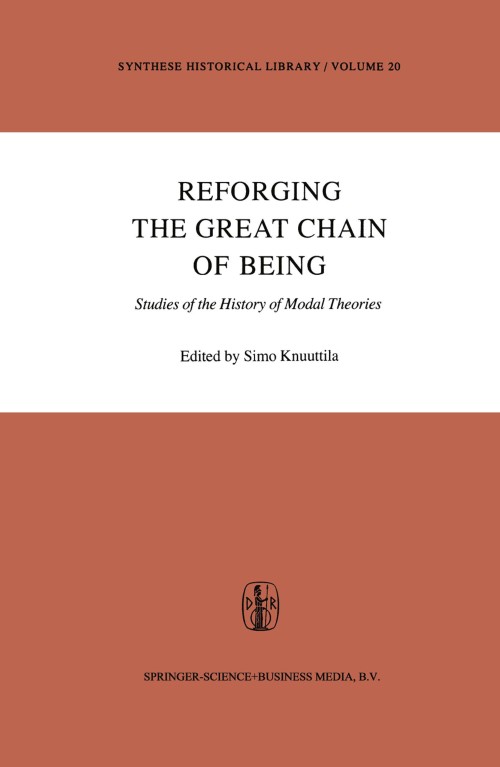
245 10|aReforging the Great Chain of Being|h[electronic resource] :|bStudies of the History of Modal Theories /|cedited by Simo Knuuttila.
250 |a1st ed. 1981.
264 1|aDordrecht :|bSpringer Netherlands :|bImprint: Springer,|c1981.
300 |aXIV, 320 p.|bonline resource.
336 |atext|btxt|2rdacontent
337 |acomputer|bc|2rdamedia
338 |aonline resource|bcr|2rdacarrier
347 |atext file|bPDF|2rda
490 1 |aSynthese Historical Library ;|v20
505 0 |aGaps in the Great Chain. of Being: An Exercise in the Methodology of the History of Ideas -- Empty Forms in Plato -- Aristotle on the Realization of Possibilities in Time -- Aristotle and the Priority of Actuality -- Anselm’s Modal Conceptions -- Time and Modality in Scholasticism -- Leibniz on Plenitude, Relations, and the ‘Reign of Law’ -- Kant on ‘The Great Chain of Being’ or the Eventual Realization of All Possibilities: A Comparative Study -- Index of Names -- Index of Subjects.
520 |aA sports reporter might say that in a competition all the participants realize their potentialities or possibilities. When an athlete performs far below his usual standard, it can be said that it was possible for him to do better. But the idea of fair play requires that this use of 'possible' refers to another com petition. It is presumed that the best athlete wins and that no real possibility of doing better is left unrealized in a competition. Here we have a use of language, a language game, in which modal notions are used so as to imply that if something is possible, it is realized. This idea does not belong to the general presuppositions of current ordinary usage. It is, nevertheless, not difficult to fmd other similar examples outside of the language of sports. It may be that such a use of modal notions is sometimes calculated to express that in the context in question there are no real alternative courses of events in contradistinction to other cases in which some possible alternatives remain unrealized. Even though modal notions are currently interpreted without the presup position that each genuine possibility should be realized at some moment of the actual history, there are contemporary philosophical models of modalities which incorporate this presupposition. In his book Untersuchungen tiber den Modalkalkiil (Anton Hain, Meisenheim am Glan 1952, pp. 16-36), Oscar Becker presents a statistical interpretation of modal calculi.
532 8 |aAccessibility summary: This PDF is not accessible. It is based on scanned pages and does not support features such as screen reader compatibility or described non-text content (images, graphs etc). However, it likely supports searchable and selectable text based on OCR (Optical Character Recognition). Users with accessibility needs may not be able to use this content effectively. Please contact us at accessibilitysupport@springernature.com if you require assistance or an alternative format.
532 8 |aInaccessible, or known limited accessibility
532 8 |aNo reading system accessibility options actively disabled
532 8 |aPublisher contact for further accessibility information: accessibilitysupport@springernature.com
650 0|aOntology.
650 14|aOntology.
700 1 |aKnuuttila, Simo.|eeditor.|4edt|4http://id.loc.gov/vocabulary/relators/edt
710 2 |aSpringerLink (Online service)
773 0 |tSpringer Nature eBook
776 08|iPrinted edition:|z9789027711250
776 08|iPrinted edition:|z9789048183609
776 08|iPrinted edition:|z9789401576635
830 0|aSynthese Historical Library ;|v20
856 40|uhttps://doi.org/10.1007/978-94-015-7662-8
912 |aZDB-2-SHU
912 |aZDB-2-SXPR
912 |aZDB-2-BAE
950 |aHumanities, Social Sciences and Law (SpringerNature-11648)
950 |aPhilosophy and Religion (R0) (SpringerNature-43725)