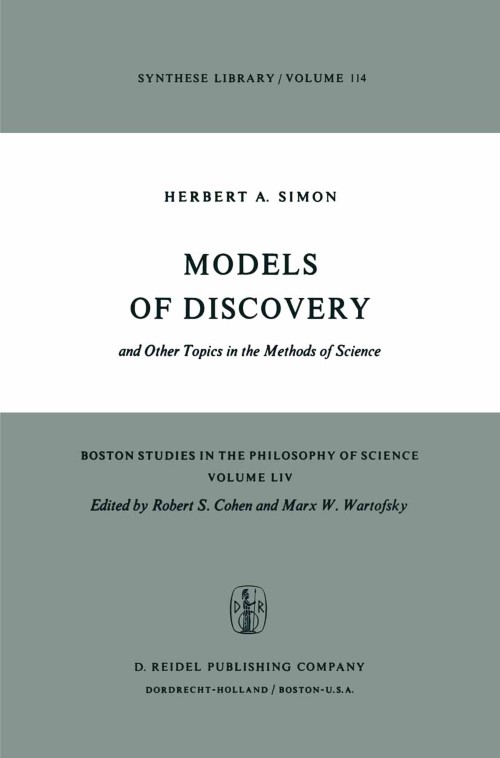
Models of Discovery [electronic resource] : and Other Topics in the Methods of Science / by Herbert A. Simon.
Erişim Adresi
ISBN
9789401095211
Dil Kodu
İngilizce
Yer Numarası
DK/15295
Yazar
Basım Bildirimi
1st ed. 1977.
Yayın Bilgisi
Dordrecht : Springer Netherlands : Imprint: Springer, 1977.
Fiziksel Niteleme
475 p. online resource.
Dizi
Boston Studies in the Philosophy and History of Science, 2214-7942 ; 54
İçindekiler Notu
Section 1 — Testing Theories of Empirical Phenomena -- to Section 1 -- 1.1. Symmetric Tests of the Hypothesis That the Mean of One Normal Population Exceeds That of Another -- 1.2. Statistical Tests as a Basis for ‘Yes—No’ Choices -- 1.3. Prediction and Hindsight as Confirmatory Evidence -- 1.4. On Judging the Plausibility of Theories -- Section 2 — Causes and Possible Worlds -- to Section 2 -- 2.1. Causal Ordering and Identifiability -- 2.2. On the Definition of the Causal Relation -- 2.3. Spurious Correlation: A Causal Interpretation -- 2.4. Cause and Counterfactual (with Nicholas Rescher) -- Section 3 — The Logic of Imperatives -- to Section 3 -- 3.1. The Logic of Rational Decision -- 3.2. The Logic of Heuristic Decision Making -- Section 4 — Complexity -- to Section 4 -- 4.1. Theory of Automata: Discussion -- 4.2. Aggregation of Variables in Dynamic Systems (with Albert Ando) -- 4.3. The Theory of Problem Solving -- 4.4. The Organization of Complex Systems -- Section 5 — Theory of Scientific Discovery -- to Section 5 -- 5.1. Thinking by Computers -- 5.2. Scientific Discovery and the Psychology of Problem Solving -- 5.3. The Structure of Ill-Structured Problems -- 5.4. Does Scientific Discovery Have a Logic? -- 5.5. Discussion: The Meno Paradox -- Section 6 — Formalizing Scientific Theories -- to Section 6 -- 6.1. The Axioms of Newtonian Mechanics -- 6.2. Discussion: The Axiomatization of Classical Mechanics -- 6.3. Definable Terms and Primitives in Axiom Systems -- 6.4. A Note on Almost-Everywhere Definability -- 6.5. The Axiomatization of Physical Theories -- 6.6. Ramsey Eliminability and the Testability of Scientific Theories (with Guy J. Groen) -- 6.7. Identifiability and the Status of Theoretical Terms -- Name Index.
Özet, vb.
We respect Herbert A. Simon as an established leader of empirical and logical analysis in the human sciences while we happily think of him as also the loner; of course he works with many colleagues but none can match him. He has been writing fruitfully and steadily for four decades in many fields, among them psychology, logic, decision theory, economics, computer science, management, production engineering, information and control theory, operations research, confirmation theory, and we must have omitted several. With all of them, he is at once the technical scientist and the philosophical critic and analyst. When writing of decisions and actions, he is at the interface of philosophy of science, decision theory, philosophy of the specific social sciences, and inventory theory (itself, for him, at the interface of economic theory, production engineering and information theory). When writing on causality, he is at the interface of methodology, metaphysics, logic and philosophy of physics, systems theory, and so on. Not that the interdisciplinary is his orthodoxy; we are delighted that he has chosen to include in this book both his early and little-appreciated treatment of straightforward philosophy of physics - the axioms of Newtonian mechanics, and also his fine papers on pure confirmation theory.
Konu
Science __ Philosophy.
Philosophy and social sciences.
Logic.
Philosophy of Science.
Philosophy of the Social Sciences.
Logic.
Philosophy and social sciences.
Logic.
Philosophy of Science.
Philosophy of the Social Sciences.
Logic.
Kurum Adı

Eseri Alıntıla
Referansları kullanmadan önce gözden geçirmeniz ve varsa gerekli düzeltmeleri yapmanız önerilir.
Dijital Kaynak
MARC Görünümü
LEADER 05765nam a22005895i 4500
001 814056
003 TR_AnAIT
005 20260130221838
007 cr nn 008mamaa
008 121227s1977 ne | s |||| 0|eng d
020 |a9789401095211|9978-94-010-9521-1
024 7 |a10.1007/978-94-010-9521-1|2doi
041 |aeng
049 |aTürk Tarih Kurumu Kütüphanesi
050 4|aQ174-175.3
050 4|aB67
072 7|aPDA|2bicssc
072 7|aSCI075000|2bisacsh
072 7|aPDA|2thema
082 04|a501|223
090 |aDK/15295
100 1 |aSimon, Herbert A.|eauthor.|4aut|4http://id.loc.gov/vocabulary/relators/aut
245 10|aModels of Discovery|h[electronic resource] :|band Other Topics in the Methods of Science /|cby Herbert A. Simon.
250 |a1st ed. 1977.
264 1|aDordrecht :|bSpringer Netherlands :|bImprint: Springer,|c1977.
300 |a475 p.|bonline resource.
336 |atext|btxt|2rdacontent
337 |acomputer|bc|2rdamedia
338 |aonline resource|bcr|2rdacarrier
347 |atext file|bPDF|2rda
490 1 |aBoston Studies in the Philosophy and History of Science,|x2214-7942 ;|v54
505 0 |aSection 1 — Testing Theories of Empirical Phenomena -- to Section 1 -- 1.1. Symmetric Tests of the Hypothesis That the Mean of One Normal Population Exceeds That of Another -- 1.2. Statistical Tests as a Basis for ‘Yes—No’ Choices -- 1.3. Prediction and Hindsight as Confirmatory Evidence -- 1.4. On Judging the Plausibility of Theories -- Section 2 — Causes and Possible Worlds -- to Section 2 -- 2.1. Causal Ordering and Identifiability -- 2.2. On the Definition of the Causal Relation -- 2.3. Spurious Correlation: A Causal Interpretation -- 2.4. Cause and Counterfactual (with Nicholas Rescher) -- Section 3 — The Logic of Imperatives -- to Section 3 -- 3.1. The Logic of Rational Decision -- 3.2. The Logic of Heuristic Decision Making -- Section 4 — Complexity -- to Section 4 -- 4.1. Theory of Automata: Discussion -- 4.2. Aggregation of Variables in Dynamic Systems (with Albert Ando) -- 4.3. The Theory of Problem Solving -- 4.4. The Organization of Complex Systems -- Section 5 — Theory of Scientific Discovery -- to Section 5 -- 5.1. Thinking by Computers -- 5.2. Scientific Discovery and the Psychology of Problem Solving -- 5.3. The Structure of Ill-Structured Problems -- 5.4. Does Scientific Discovery Have a Logic? -- 5.5. Discussion: The Meno Paradox -- Section 6 — Formalizing Scientific Theories -- to Section 6 -- 6.1. The Axioms of Newtonian Mechanics -- 6.2. Discussion: The Axiomatization of Classical Mechanics -- 6.3. Definable Terms and Primitives in Axiom Systems -- 6.4. A Note on Almost-Everywhere Definability -- 6.5. The Axiomatization of Physical Theories -- 6.6. Ramsey Eliminability and the Testability of Scientific Theories (with Guy J. Groen) -- 6.7. Identifiability and the Status of Theoretical Terms -- Name Index.
520 |aWe respect Herbert A. Simon as an established leader of empirical and logical analysis in the human sciences while we happily think of him as also the loner; of course he works with many colleagues but none can match him. He has been writing fruitfully and steadily for four decades in many fields, among them psychology, logic, decision theory, economics, computer science, management, production engineering, information and control theory, operations research, confirmation theory, and we must have omitted several. With all of them, he is at once the technical scientist and the philosophical critic and analyst. When writing of decisions and actions, he is at the interface of philosophy of science, decision theory, philosophy of the specific social sciences, and inventory theory (itself, for him, at the interface of economic theory, production engineering and information theory). When writing on causality, he is at the interface of methodology, metaphysics, logic and philosophy of physics, systems theory, and so on. Not that the interdisciplinary is his orthodoxy; we are delighted that he has chosen to include in this book both his early and little-appreciated treatment of straightforward philosophy of physics - the axioms of Newtonian mechanics, and also his fine papers on pure confirmation theory.
532 8 |aAccessibility summary: This PDF is not accessible. It is based on scanned pages and does not support features such as screen reader compatibility or described non-text content (images, graphs etc). However, it likely supports searchable and selectable text based on OCR (Optical Character Recognition). Users with accessibility needs may not be able to use this content effectively. Please contact us at accessibilitysupport@springernature.com if you require assistance or an alternative format.
532 8 |aInaccessible, or known limited accessibility
532 8 |aNo reading system accessibility options actively disabled
532 8 |aPublisher contact for further accessibility information: accessibilitysupport@springernature.com
650 0|aScience|xPhilosophy.
650 0|aPhilosophy and social sciences.
650 0|aLogic.
650 14|aPhilosophy of Science.
650 24|aPhilosophy of the Social Sciences.
650 24|aLogic.
710 2 |aSpringerLink (Online service)
773 0 |tSpringer Nature eBook
776 08|iPrinted edition:|z9789027708120
776 08|iPrinted edition:|z9789027709707
776 08|iPrinted edition:|z9789401095228
830 0|aBoston Studies in the Philosophy and History of Science,|x2214-7942 ;|v54
856 40|uhttps://doi.org/10.1007/978-94-010-9521-1
912 |aZDB-2-SHU
912 |aZDB-2-SXPR
912 |aZDB-2-BAE
950 |aHumanities, Social Sciences and Law (SpringerNature-11648)
950 |aPhilosophy and Religion (R0) (SpringerNature-43725)
001 814056
003 TR_AnAIT
005 20260130221838
007 cr nn 008mamaa
008 121227s1977 ne | s |||| 0|eng d
020 |a9789401095211|9978-94-010-9521-1
024 7 |a10.1007/978-94-010-9521-1|2doi
041 |aeng
049 |aTürk Tarih Kurumu Kütüphanesi
050 4|aQ174-175.3
050 4|aB67
072 7|aPDA|2bicssc
072 7|aSCI075000|2bisacsh
072 7|aPDA|2thema
082 04|a501|223
090 |aDK/15295
100 1 |aSimon, Herbert A.|eauthor.|4aut|4http://id.loc.gov/vocabulary/relators/aut
245 10|aModels of Discovery|h[electronic resource] :|band Other Topics in the Methods of Science /|cby Herbert A. Simon.
250 |a1st ed. 1977.
264 1|aDordrecht :|bSpringer Netherlands :|bImprint: Springer,|c1977.
300 |a475 p.|bonline resource.
336 |atext|btxt|2rdacontent
337 |acomputer|bc|2rdamedia
338 |aonline resource|bcr|2rdacarrier
347 |atext file|bPDF|2rda
490 1 |aBoston Studies in the Philosophy and History of Science,|x2214-7942 ;|v54
505 0 |aSection 1 — Testing Theories of Empirical Phenomena -- to Section 1 -- 1.1. Symmetric Tests of the Hypothesis That the Mean of One Normal Population Exceeds That of Another -- 1.2. Statistical Tests as a Basis for ‘Yes—No’ Choices -- 1.3. Prediction and Hindsight as Confirmatory Evidence -- 1.4. On Judging the Plausibility of Theories -- Section 2 — Causes and Possible Worlds -- to Section 2 -- 2.1. Causal Ordering and Identifiability -- 2.2. On the Definition of the Causal Relation -- 2.3. Spurious Correlation: A Causal Interpretation -- 2.4. Cause and Counterfactual (with Nicholas Rescher) -- Section 3 — The Logic of Imperatives -- to Section 3 -- 3.1. The Logic of Rational Decision -- 3.2. The Logic of Heuristic Decision Making -- Section 4 — Complexity -- to Section 4 -- 4.1. Theory of Automata: Discussion -- 4.2. Aggregation of Variables in Dynamic Systems (with Albert Ando) -- 4.3. The Theory of Problem Solving -- 4.4. The Organization of Complex Systems -- Section 5 — Theory of Scientific Discovery -- to Section 5 -- 5.1. Thinking by Computers -- 5.2. Scientific Discovery and the Psychology of Problem Solving -- 5.3. The Structure of Ill-Structured Problems -- 5.4. Does Scientific Discovery Have a Logic? -- 5.5. Discussion: The Meno Paradox -- Section 6 — Formalizing Scientific Theories -- to Section 6 -- 6.1. The Axioms of Newtonian Mechanics -- 6.2. Discussion: The Axiomatization of Classical Mechanics -- 6.3. Definable Terms and Primitives in Axiom Systems -- 6.4. A Note on Almost-Everywhere Definability -- 6.5. The Axiomatization of Physical Theories -- 6.6. Ramsey Eliminability and the Testability of Scientific Theories (with Guy J. Groen) -- 6.7. Identifiability and the Status of Theoretical Terms -- Name Index.
520 |aWe respect Herbert A. Simon as an established leader of empirical and logical analysis in the human sciences while we happily think of him as also the loner; of course he works with many colleagues but none can match him. He has been writing fruitfully and steadily for four decades in many fields, among them psychology, logic, decision theory, economics, computer science, management, production engineering, information and control theory, operations research, confirmation theory, and we must have omitted several. With all of them, he is at once the technical scientist and the philosophical critic and analyst. When writing of decisions and actions, he is at the interface of philosophy of science, decision theory, philosophy of the specific social sciences, and inventory theory (itself, for him, at the interface of economic theory, production engineering and information theory). When writing on causality, he is at the interface of methodology, metaphysics, logic and philosophy of physics, systems theory, and so on. Not that the interdisciplinary is his orthodoxy; we are delighted that he has chosen to include in this book both his early and little-appreciated treatment of straightforward philosophy of physics - the axioms of Newtonian mechanics, and also his fine papers on pure confirmation theory.
532 8 |aAccessibility summary: This PDF is not accessible. It is based on scanned pages and does not support features such as screen reader compatibility or described non-text content (images, graphs etc). However, it likely supports searchable and selectable text based on OCR (Optical Character Recognition). Users with accessibility needs may not be able to use this content effectively. Please contact us at accessibilitysupport@springernature.com if you require assistance or an alternative format.
532 8 |aInaccessible, or known limited accessibility
532 8 |aNo reading system accessibility options actively disabled
532 8 |aPublisher contact for further accessibility information: accessibilitysupport@springernature.com
650 0|aScience|xPhilosophy.
650 0|aPhilosophy and social sciences.
650 0|aLogic.
650 14|aPhilosophy of Science.
650 24|aPhilosophy of the Social Sciences.
650 24|aLogic.
710 2 |aSpringerLink (Online service)
773 0 |tSpringer Nature eBook
776 08|iPrinted edition:|z9789027708120
776 08|iPrinted edition:|z9789027709707
776 08|iPrinted edition:|z9789401095228
830 0|aBoston Studies in the Philosophy and History of Science,|x2214-7942 ;|v54
856 40|uhttps://doi.org/10.1007/978-94-010-9521-1
912 |aZDB-2-SHU
912 |aZDB-2-SXPR
912 |aZDB-2-BAE
950 |aHumanities, Social Sciences and Law (SpringerNature-11648)
950 |aPhilosophy and Religion (R0) (SpringerNature-43725)
Materyaller
Depodan talep edilen materyal sadece kütüphane içerisinde kullanılmaktadır.
Materyal dışarıya ödünç verilmemektedir.
