

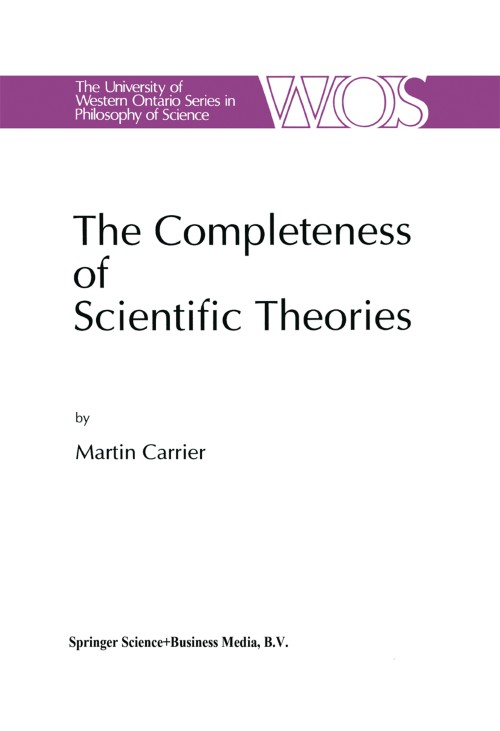
The Completeness of Scientific Theories [electronic resource] : On the Derivation of Empirical Indicators within a Theoretical Framework: The Case of Physical Geometry / by Martin Carrier.
Erişim Adresi
ISBN
9789401109109
Dil Kodu
İngilizce
Yer Numarası
DK/15311
Yazar
Basım Bildirimi
1st ed. 1994.
Yayın Bilgisi
Dordrecht : Springer Netherlands : Imprint: Springer, 1994.
Fiziksel Niteleme
XVIII, 278 p. online resource.
Dizi
The Western Ontario Series in Philosophy of Science, A Series of Books in Philosophy of Science, Methodology, Epistemology, Logic, History of Science, and Related Fields, 2215-1974 ; 53
İçindekiler Notu
A. Theory and Evidence in Scientific Theories -- I / The Theory-Ladenness of Observation and Measurement -- II / The Completeness of Theories -- III / Completeness in Natural Science and Psychology -- B. Theory and Evidence in Physical Geometry -- IV / Reichenbach Loops in Operation: The Conventionality of Physical Geometry -- V / The Completeness of General Relativity Theory -- VI / The Conventionality of Physical Geometry: A Reconsideration -- Notes -- Index of Names -- Index of Subjects.
Özet, vb.
Earlier in this century, many philosophers of science (for example, Rudolf Carnap) drew a fairly sharp distinction between theory and observation, between theoretical terms like 'mass' and 'electron', and observation terms like 'measures three meters in length' and 'is _2° Celsius'. By simply looking at our instruments we can ascertain what numbers our measurements yield. Creatures like mass are different: we determine mass by calculation; we never directly observe a mass. Nor an electron: this term is introduced in order to explain what we observe. This (once standard) distinction between theory and observation was eventually found to be wanting. First, if the distinction holds, it is difficult to see what can characterize the relationship between theory :md observation. How can theoretical terms explain that which is itself in no way theorized? The second point leads out of the first: are not the instruments that provide us with observational material themselves creatures of theory? Is it really possible to have an observation language that is entirely barren of theory? The theory-Iadenness of observation languages is now an accept ed feature of the logic of science. Many regard such dependence of observation on theory as a virtue. If our instruments of observation do not derive their meaning from theories, whence comes that meaning? Surely - in science - we have nothing else but theories to tell us what to try to observe.
Konu
Science __ Philosophy.
Mathematical physics.
Knowledge, Theory of.
Philosophy of Science.
Theoretical, Mathematical and Computational Physics.
Epistemology.
Mathematical physics.
Knowledge, Theory of.
Philosophy of Science.
Theoretical, Mathematical and Computational Physics.
Epistemology.
Kurum Adı
Eseri Alıntıla
Referansları kullanmadan önce gözden geçirmeniz ve varsa gerekli düzeltmeleri yapmanız önerilir.
Dijital Kaynak
MARC Görünümü
LEADER 04965nam a22005895i 4500
001 814072
003 TR_AnAIT
005 20260130221733
007 cr nn 008mamaa
008 121227s1994 ne | s |||| 0|eng d
020 |a9789401109109|9978-94-011-0910-9
024 7 |a10.1007/978-94-011-0910-9|2doi
041 |aeng
049 |aTürk Tarih Kurumu Kütüphanesi
050 4|aQ174-175.3
050 4|aB67
072 7|aPDA|2bicssc
072 7|aSCI075000|2bisacsh
072 7|aPDA|2thema
082 04|a501|223
090 |aDK/15311
100 1 |aCarrier, Martin.|eauthor.|4aut|4http://id.loc.gov/vocabulary/relators/aut
245 14|aThe Completeness of Scientific Theories|h[electronic resource] :|bOn the Derivation of Empirical Indicators within a Theoretical Framework: The Case of Physical Geometry /|cby Martin Carrier.
250 |a1st ed. 1994.
264 1|aDordrecht :|bSpringer Netherlands :|bImprint: Springer,|c1994.
300 |aXVIII, 278 p.|bonline resource.
336 |atext|btxt|2rdacontent
337 |acomputer|bc|2rdamedia
338 |aonline resource|bcr|2rdacarrier
347 |atext file|bPDF|2rda
490 1 |aThe Western Ontario Series in Philosophy of Science, A Series of Books in Philosophy of Science, Methodology, Epistemology, Logic, History of Science, and Related Fields,|x2215-1974 ;|v53
505 0 |aA. Theory and Evidence in Scientific Theories -- I / The Theory-Ladenness of Observation and Measurement -- II / The Completeness of Theories -- III / Completeness in Natural Science and Psychology -- B. Theory and Evidence in Physical Geometry -- IV / Reichenbach Loops in Operation: The Conventionality of Physical Geometry -- V / The Completeness of General Relativity Theory -- VI / The Conventionality of Physical Geometry: A Reconsideration -- Notes -- Index of Names -- Index of Subjects.
520 |aEarlier in this century, many philosophers of science (for example, Rudolf Carnap) drew a fairly sharp distinction between theory and observation, between theoretical terms like 'mass' and 'electron', and observation terms like 'measures three meters in length' and 'is _2° Celsius'. By simply looking at our instruments we can ascertain what numbers our measurements yield. Creatures like mass are different: we determine mass by calculation; we never directly observe a mass. Nor an electron: this term is introduced in order to explain what we observe. This (once standard) distinction between theory and observation was eventually found to be wanting. First, if the distinction holds, it is difficult to see what can characterize the relationship between theory :md observation. How can theoretical terms explain that which is itself in no way theorized? The second point leads out of the first: are not the instruments that provide us with observational material themselves creatures of theory? Is it really possible to have an observation language that is entirely barren of theory? The theory-Iadenness of observation languages is now an accept ed feature of the logic of science. Many regard such dependence of observation on theory as a virtue. If our instruments of observation do not derive their meaning from theories, whence comes that meaning? Surely - in science - we have nothing else but theories to tell us what to try to observe.
532 8 |aAccessibility summary: This PDF is not accessible. It is based on scanned pages and does not support features such as screen reader compatibility or described non-text content (images, graphs etc). However, it likely supports searchable and selectable text based on OCR (Optical Character Recognition). Users with accessibility needs may not be able to use this content effectively. Please contact us at accessibilitysupport@springernature.com if you require assistance or an alternative format.
532 8 |aInaccessible, or known limited accessibility
532 8 |aNo reading system accessibility options actively disabled
532 8 |aPublisher contact for further accessibility information: accessibilitysupport@springernature.com
650 0|aScience|xPhilosophy.
650 0|aMathematical physics.
650 0|aKnowledge, Theory of.
650 14|aPhilosophy of Science.
650 24|aTheoretical, Mathematical and Computational Physics.
650 24|aEpistemology.
710 2 |aSpringerLink (Online service)
773 0 |tSpringer Nature eBook
776 08|iPrinted edition:|z9780792324751
776 08|iPrinted edition:|z9789401109116
776 08|iPrinted edition:|z9789401043939
830 0|aThe Western Ontario Series in Philosophy of Science, A Series of Books in Philosophy of Science, Methodology, Epistemology, Logic, History of Science, and Related Fields,|x2215-1974 ;|v53
856 40|uhttps://doi.org/10.1007/978-94-011-0910-9
912 |aZDB-2-SHU
912 |aZDB-2-SXPR
912 |aZDB-2-BAE
950 |aHumanities, Social Sciences and Law (SpringerNature-11648)
950 |aPhilosophy and Religion (R0) (SpringerNature-43725)
001 814072
003 TR_AnAIT
005 20260130221733
007 cr nn 008mamaa
008 121227s1994 ne | s |||| 0|eng d
020 |a9789401109109|9978-94-011-0910-9
024 7 |a10.1007/978-94-011-0910-9|2doi
041 |aeng
049 |aTürk Tarih Kurumu Kütüphanesi
050 4|aQ174-175.3
050 4|aB67
072 7|aPDA|2bicssc
072 7|aSCI075000|2bisacsh
072 7|aPDA|2thema
082 04|a501|223
090 |aDK/15311
100 1 |aCarrier, Martin.|eauthor.|4aut|4http://id.loc.gov/vocabulary/relators/aut
245 14|aThe Completeness of Scientific Theories|h[electronic resource] :|bOn the Derivation of Empirical Indicators within a Theoretical Framework: The Case of Physical Geometry /|cby Martin Carrier.
250 |a1st ed. 1994.
264 1|aDordrecht :|bSpringer Netherlands :|bImprint: Springer,|c1994.
300 |aXVIII, 278 p.|bonline resource.
336 |atext|btxt|2rdacontent
337 |acomputer|bc|2rdamedia
338 |aonline resource|bcr|2rdacarrier
347 |atext file|bPDF|2rda
490 1 |aThe Western Ontario Series in Philosophy of Science, A Series of Books in Philosophy of Science, Methodology, Epistemology, Logic, History of Science, and Related Fields,|x2215-1974 ;|v53
505 0 |aA. Theory and Evidence in Scientific Theories -- I / The Theory-Ladenness of Observation and Measurement -- II / The Completeness of Theories -- III / Completeness in Natural Science and Psychology -- B. Theory and Evidence in Physical Geometry -- IV / Reichenbach Loops in Operation: The Conventionality of Physical Geometry -- V / The Completeness of General Relativity Theory -- VI / The Conventionality of Physical Geometry: A Reconsideration -- Notes -- Index of Names -- Index of Subjects.
520 |aEarlier in this century, many philosophers of science (for example, Rudolf Carnap) drew a fairly sharp distinction between theory and observation, between theoretical terms like 'mass' and 'electron', and observation terms like 'measures three meters in length' and 'is _2° Celsius'. By simply looking at our instruments we can ascertain what numbers our measurements yield. Creatures like mass are different: we determine mass by calculation; we never directly observe a mass. Nor an electron: this term is introduced in order to explain what we observe. This (once standard) distinction between theory and observation was eventually found to be wanting. First, if the distinction holds, it is difficult to see what can characterize the relationship between theory :md observation. How can theoretical terms explain that which is itself in no way theorized? The second point leads out of the first: are not the instruments that provide us with observational material themselves creatures of theory? Is it really possible to have an observation language that is entirely barren of theory? The theory-Iadenness of observation languages is now an accept ed feature of the logic of science. Many regard such dependence of observation on theory as a virtue. If our instruments of observation do not derive their meaning from theories, whence comes that meaning? Surely - in science - we have nothing else but theories to tell us what to try to observe.
532 8 |aAccessibility summary: This PDF is not accessible. It is based on scanned pages and does not support features such as screen reader compatibility or described non-text content (images, graphs etc). However, it likely supports searchable and selectable text based on OCR (Optical Character Recognition). Users with accessibility needs may not be able to use this content effectively. Please contact us at accessibilitysupport@springernature.com if you require assistance or an alternative format.
532 8 |aInaccessible, or known limited accessibility
532 8 |aNo reading system accessibility options actively disabled
532 8 |aPublisher contact for further accessibility information: accessibilitysupport@springernature.com
650 0|aScience|xPhilosophy.
650 0|aMathematical physics.
650 0|aKnowledge, Theory of.
650 14|aPhilosophy of Science.
650 24|aTheoretical, Mathematical and Computational Physics.
650 24|aEpistemology.
710 2 |aSpringerLink (Online service)
773 0 |tSpringer Nature eBook
776 08|iPrinted edition:|z9780792324751
776 08|iPrinted edition:|z9789401109116
776 08|iPrinted edition:|z9789401043939
830 0|aThe Western Ontario Series in Philosophy of Science, A Series of Books in Philosophy of Science, Methodology, Epistemology, Logic, History of Science, and Related Fields,|x2215-1974 ;|v53
856 40|uhttps://doi.org/10.1007/978-94-011-0910-9
912 |aZDB-2-SHU
912 |aZDB-2-SXPR
912 |aZDB-2-BAE
950 |aHumanities, Social Sciences and Law (SpringerNature-11648)
950 |aPhilosophy and Religion (R0) (SpringerNature-43725)
Materyaller
Depodan talep edilen materyal sadece kütüphane içerisinde kullanılmaktadır.
Materyal dışarıya ödünç verilmemektedir.
Materyal dışarıya ödünç verilmemektedir.
