

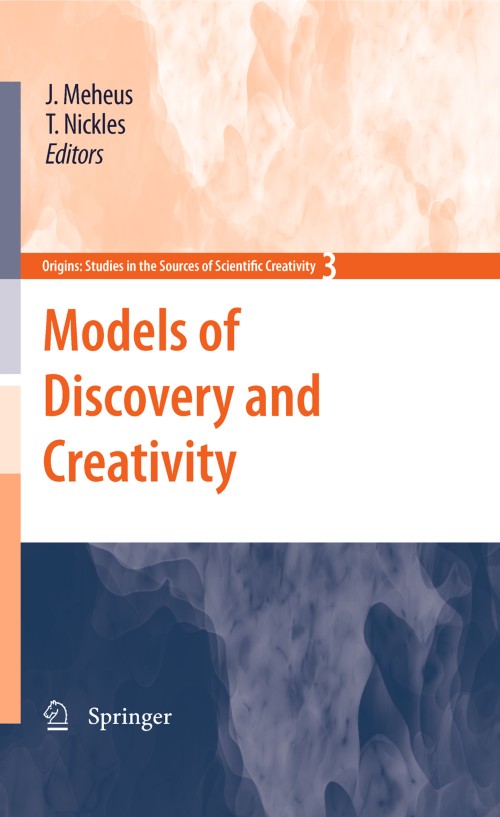
Models of Discovery and Creativity [electronic resource] / edited by Joke Meheus, Thomas Nickles.
Erişim Adresi
ISBN
9789048134212
Dil Kodu
İngilizce
Yer Numarası
DK/15318
Basım Bildirimi
1st ed. 2009.
Yayın Bilgisi
Dordrecht : Springer Netherlands : Imprint: Springer, 2009.
Fiziksel Niteleme
X, 249 p. online resource.
Dizi
Origins: Studies in the Sources of Scientific Creativity ; 3
İçindekiler Notu
Unexpected Discoveries, Graded Structures, and the Difference Between Acceptance and Neglect -- Conceptual Comparison and Conceptual Innovation -- Discovering Mechanisms in Molecular Biology -- On the Role of Thought-Experiments in Mathematical Discovery -- Experimental Systems, Investigative Pathways, and the Nature of Discovery -- Abduction as a Heuristic Constraint -- Creative Abduction and Hypothesis Withdrawal -- Conceptual Change: Creativity, Cognition, and Culture -- The Strange Story of Scientific Method -- Tradition and Innovation: Exploring and Transforming Conceptual Structures -- A Purposeful Alliance in the Service of Creative Research.
Özet, vb.
Since the origin of the modern sciences, our views on discovery and creativity had a remarkable history. Originally, discovery was seen as an integral part of methodology and the logic of discovery as algorithmic or nearly algorithmic. During the nineteenth century, conceptions in line with romanticism led to the famous opposition between the context of discovery and the context of justification, culminating in a view that banned discovery from methodology. The revival of the methodological investigation of discovery, which started some thirty years ago, derived its major impetus from historical and sociological studies of the sciences and from developments within cognitive psychology and artificial intelligence. Today, a large majority of philosophers of science agrees that the classical conception as well as the romantic conception are mistaken. Against the classical conception, it is generally accepted that truly novel discoveries are not the result of simply applying some standardized procedure. Against the romantic conception, it is rejected that discoveries are produced by unstructured flashes of insight. An especially important result of the contemporary study concerns the availability of (descriptive and normative) models for explaining discoveries and creative processes. Descriptive models mainly aim at explaining the origin of novel products; normative models moreover address the question how rational researchers should proceed when confronted with problems for which a standard procedure is missing. The present book provides an overview of these models and of the important changes they induced within methodology. As appears from several papers, the methodological study of discovery and creativity led to profound changes in our conceptions of justification and acceptance, of rationality, of scientific change, and of conceptual change. The book contains contributions from both historians and philosophers of science. All of them, however, are methodological in the contemporary sense of the term. The central values of this methodology are empirical accurateness, clarity and precision, and rationality. The different contributions realize these values by their interdisciplinary nature. Some philosophically oriented papers rely on historical case studies and results from the cognitive sciences, others on recent results from the computer sciences and/or non-standard logics. The historically oriented papers address central philosophical questions and hypotheses.
Konu
Science __ Philosophy.
Science __ History.
Philosophy of Science.
History of Science.
Science __ History.
Philosophy of Science.
History of Science.
Diğer Yazarlar
Kurum Adı
Eseri Alıntıla
Referansları kullanmadan önce gözden geçirmeniz ve varsa gerekli düzeltmeleri yapmanız önerilir.
Dijital Kaynak
MARC Görünümü
LEADER 05031nam a22005175i 4500
001 814079
003 TR_AnAIT
005 20260130221657
007 cr nn 008mamaa
008 100301s2009 ne | s |||| 0|eng d
020 |a9789048134212|9978-90-481-3421-2
024 7 |a10.1007/978-90-481-3421-2|2doi
041 |aeng
049 |aTürk Tarih Kurumu Kütüphanesi
050 4|aQ174-175.3
050 4|aB67
072 7|aPDA|2bicssc
072 7|aSCI075000|2bisacsh
072 7|aPDA|2thema
082 04|a501|223
090 |aDK/15318
245 10|aModels of Discovery and Creativity|h[electronic resource] /|cedited by Joke Meheus, Thomas Nickles.
250 |a1st ed. 2009.
264 1|aDordrecht :|bSpringer Netherlands :|bImprint: Springer,|c2009.
300 |aX, 249 p.|bonline resource.
336 |atext|btxt|2rdacontent
337 |acomputer|bc|2rdamedia
338 |aonline resource|bcr|2rdacarrier
347 |atext file|bPDF|2rda
490 1 |aOrigins: Studies in the Sources of Scientific Creativity ;|v3
505 0 |aUnexpected Discoveries, Graded Structures, and the Difference Between Acceptance and Neglect -- Conceptual Comparison and Conceptual Innovation -- Discovering Mechanisms in Molecular Biology -- On the Role of Thought-Experiments in Mathematical Discovery -- Experimental Systems, Investigative Pathways, and the Nature of Discovery -- Abduction as a Heuristic Constraint -- Creative Abduction and Hypothesis Withdrawal -- Conceptual Change: Creativity, Cognition, and Culture -- The Strange Story of Scientific Method -- Tradition and Innovation: Exploring and Transforming Conceptual Structures -- A Purposeful Alliance in the Service of Creative Research.
520 |aSince the origin of the modern sciences, our views on discovery and creativity had a remarkable history. Originally, discovery was seen as an integral part of methodology and the logic of discovery as algorithmic or nearly algorithmic. During the nineteenth century, conceptions in line with romanticism led to the famous opposition between the context of discovery and the context of justification, culminating in a view that banned discovery from methodology. The revival of the methodological investigation of discovery, which started some thirty years ago, derived its major impetus from historical and sociological studies of the sciences and from developments within cognitive psychology and artificial intelligence. Today, a large majority of philosophers of science agrees that the classical conception as well as the romantic conception are mistaken. Against the classical conception, it is generally accepted that truly novel discoveries are not the result of simply applying some standardized procedure. Against the romantic conception, it is rejected that discoveries are produced by unstructured flashes of insight. An especially important result of the contemporary study concerns the availability of (descriptive and normative) models for explaining discoveries and creative processes. Descriptive models mainly aim at explaining the origin of novel products; normative models moreover address the question how rational researchers should proceed when confronted with problems for which a standard procedure is missing. The present book provides an overview of these models and of the important changes they induced within methodology. As appears from several papers, the methodological study of discovery and creativity led to profound changes in our conceptions of justification and acceptance, of rationality, of scientific change, and of conceptual change. The book contains contributions from both historians and philosophers of science. All of them, however, are methodological in the contemporary sense of the term. The central values of this methodology are empirical accurateness, clarity and precision, and rationality. The different contributions realize these values by their interdisciplinary nature. Some philosophically oriented papers rely on historical case studies and results from the cognitive sciences, others on recent results from the computer sciences and/or non-standard logics. The historically oriented papers address central philosophical questions and hypotheses.
650 0|aScience|xPhilosophy.
650 0|aScience|xHistory.
650 14|aPhilosophy of Science.
650 24|aHistory of Science.
700 1 |aMeheus, Joke.|eeditor.|4edt|4http://id.loc.gov/vocabulary/relators/edt
700 1 |aNickles, Thomas.|eeditor.|4edt|4http://id.loc.gov/vocabulary/relators/edt
710 2 |aSpringerLink (Online service)
773 0 |tSpringer Nature eBook
776 08|iPrinted edition:|z9789048134205
776 08|iPrinted edition:|z9789048134601
776 08|iPrinted edition:|z9789400731523
830 0|aOrigins: Studies in the Sources of Scientific Creativity ;|v3
856 40|uhttps://doi.org/10.1007/978-90-481-3421-2
912 |aZDB-2-SHU
912 |aZDB-2-SXPR
950 |aHumanities, Social Sciences and Law (SpringerNature-11648)
950 |aPhilosophy and Religion (R0) (SpringerNature-43725)
001 814079
003 TR_AnAIT
005 20260130221657
007 cr nn 008mamaa
008 100301s2009 ne | s |||| 0|eng d
020 |a9789048134212|9978-90-481-3421-2
024 7 |a10.1007/978-90-481-3421-2|2doi
041 |aeng
049 |aTürk Tarih Kurumu Kütüphanesi
050 4|aQ174-175.3
050 4|aB67
072 7|aPDA|2bicssc
072 7|aSCI075000|2bisacsh
072 7|aPDA|2thema
082 04|a501|223
090 |aDK/15318
245 10|aModels of Discovery and Creativity|h[electronic resource] /|cedited by Joke Meheus, Thomas Nickles.
250 |a1st ed. 2009.
264 1|aDordrecht :|bSpringer Netherlands :|bImprint: Springer,|c2009.
300 |aX, 249 p.|bonline resource.
336 |atext|btxt|2rdacontent
337 |acomputer|bc|2rdamedia
338 |aonline resource|bcr|2rdacarrier
347 |atext file|bPDF|2rda
490 1 |aOrigins: Studies in the Sources of Scientific Creativity ;|v3
505 0 |aUnexpected Discoveries, Graded Structures, and the Difference Between Acceptance and Neglect -- Conceptual Comparison and Conceptual Innovation -- Discovering Mechanisms in Molecular Biology -- On the Role of Thought-Experiments in Mathematical Discovery -- Experimental Systems, Investigative Pathways, and the Nature of Discovery -- Abduction as a Heuristic Constraint -- Creative Abduction and Hypothesis Withdrawal -- Conceptual Change: Creativity, Cognition, and Culture -- The Strange Story of Scientific Method -- Tradition and Innovation: Exploring and Transforming Conceptual Structures -- A Purposeful Alliance in the Service of Creative Research.
520 |aSince the origin of the modern sciences, our views on discovery and creativity had a remarkable history. Originally, discovery was seen as an integral part of methodology and the logic of discovery as algorithmic or nearly algorithmic. During the nineteenth century, conceptions in line with romanticism led to the famous opposition between the context of discovery and the context of justification, culminating in a view that banned discovery from methodology. The revival of the methodological investigation of discovery, which started some thirty years ago, derived its major impetus from historical and sociological studies of the sciences and from developments within cognitive psychology and artificial intelligence. Today, a large majority of philosophers of science agrees that the classical conception as well as the romantic conception are mistaken. Against the classical conception, it is generally accepted that truly novel discoveries are not the result of simply applying some standardized procedure. Against the romantic conception, it is rejected that discoveries are produced by unstructured flashes of insight. An especially important result of the contemporary study concerns the availability of (descriptive and normative) models for explaining discoveries and creative processes. Descriptive models mainly aim at explaining the origin of novel products; normative models moreover address the question how rational researchers should proceed when confronted with problems for which a standard procedure is missing. The present book provides an overview of these models and of the important changes they induced within methodology. As appears from several papers, the methodological study of discovery and creativity led to profound changes in our conceptions of justification and acceptance, of rationality, of scientific change, and of conceptual change. The book contains contributions from both historians and philosophers of science. All of them, however, are methodological in the contemporary sense of the term. The central values of this methodology are empirical accurateness, clarity and precision, and rationality. The different contributions realize these values by their interdisciplinary nature. Some philosophically oriented papers rely on historical case studies and results from the cognitive sciences, others on recent results from the computer sciences and/or non-standard logics. The historically oriented papers address central philosophical questions and hypotheses.
650 0|aScience|xPhilosophy.
650 0|aScience|xHistory.
650 14|aPhilosophy of Science.
650 24|aHistory of Science.
700 1 |aMeheus, Joke.|eeditor.|4edt|4http://id.loc.gov/vocabulary/relators/edt
700 1 |aNickles, Thomas.|eeditor.|4edt|4http://id.loc.gov/vocabulary/relators/edt
710 2 |aSpringerLink (Online service)
773 0 |tSpringer Nature eBook
776 08|iPrinted edition:|z9789048134205
776 08|iPrinted edition:|z9789048134601
776 08|iPrinted edition:|z9789400731523
830 0|aOrigins: Studies in the Sources of Scientific Creativity ;|v3
856 40|uhttps://doi.org/10.1007/978-90-481-3421-2
912 |aZDB-2-SHU
912 |aZDB-2-SXPR
950 |aHumanities, Social Sciences and Law (SpringerNature-11648)
950 |aPhilosophy and Religion (R0) (SpringerNature-43725)
Materyaller
Depodan talep edilen materyal sadece kütüphane içerisinde kullanılmaktadır.
Materyal dışarıya ödünç verilmemektedir.
Materyal dışarıya ödünç verilmemektedir.
