

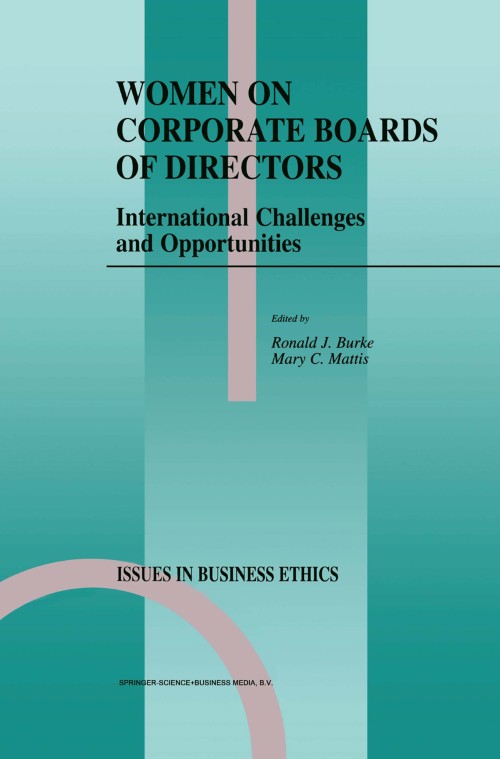
Women on Corporate Boards of Directors [electronic resource] : International Challenges and Opportunities / edited by Ronald J. Burke, M.C. Mattis.
Erişim Adresi
ISBN
9789048134014
Dil Kodu
İngilizce
Yer Numarası
DK/15333
Basım Bildirimi
1st ed. 2000.
Yayın Bilgisi
Dordrecht : Springer Netherlands : Imprint: Springer, 2000.
Fiziksel Niteleme
X, 273 p. online resource.
Dizi
Issues in Business Ethics, 2215-1680 ; 14
İçindekiler Notu
One: Women Corporate Directors: A Research Appraisal -- Women Corporate Boards of Directors: Where Do We Go From Here? -- The Future of Corporate Women: Progress Toward the Executive Suite and the Boardroom? -- Building the business case for women corporate directors -- Two: International Research Findings -- Women Corporate Directors in the United States -- Making it to the Top in Britain -- The Paradox of Affirmative Action for Women Directors in Israel -- Women on Canadian Corporate Boards of Directors: Still a Long Way to Go -- What Distinguishes Women Non-executive Directors From Executive Directors? Individual, Interpersonal and Organizational Factors Related to Women’s Appointments to Boards -- The New Zealand Experiment — Training to be on Board as a Director -- Taking a Seat on the Board: Women Directors in Britain -- Company Size, Board Size and Numbers of Women Corporate Directors -- Three: Women Directors and Board Dynamics -- Women on Boards of Directors: Gender Bias or Power Threat? -- Women on Corporate Boards of Directors: Understanding the Context -- The Experiences of White Women on Corporate Boards in Canada: Compliance and Non-compliance to Hegemonic Masculinity -- Public Sector Board Composition in Australia: Leading the Way? -- Four: Views of Corporate Directors -- From Male Locker Room to Co-ed Board Room: A Twenty-five Year Perspective -- Making Boards Work: Recruiting for Balance, Competence and Results -- Catalyst Corporate Board Placement: New Seats at the Table.
Özet, vb.
Both the practitioner and academic communities have voiced strong opinions regarding the progress of women in reaching the executive suite and the corporate boardroom. Proponents on each side of the current debate offer evidence suggesting the accuracy of their respective positions. One view holds: "The fight is over. The battle is won. Women are now accepted as outside directors in the preponderance of corporate boardrooms" (Lear, 1994: 10). An alternative perspective, however, suggests there is much progress left. An illustration of the type of remaining barriers is provided by T. J. Rodgers, chief executive officer (CEO) of Cypress Semiconductor Corp. , who has commented that "a 'woman's view' on how to run our semiconductor company does not help us" (Rodgers, 1996: 14). Regardless of where one falls along the spectrum anchored at one end by the view that women have made substantial progress in reaching the upper echelons of corporations and anchored at the other end by the view that women have barely begun to penetrate the "inner sanctum" of corporations, the central issue is the extent to which women have succeeded in cracking the proverbial "glass ceiling. " The glass ceiling is a metaphorical barrier which prevents women from attaining the upper-most organizational positions (e. g. , Karr, 1991; Morrison, White, Van Velsor, and the Center for Creative Leadership, 1992; Powell & Butterfield, 1994; U. S. Department of Labor, 1991).
Konu
Ethics.
Management.
Sociology.
Personnel management.
Moral Philosophy and Applied Ethics.
Management.
Sociology.
Human Resource Management.
Management.
Sociology.
Personnel management.
Moral Philosophy and Applied Ethics.
Management.
Sociology.
Human Resource Management.
Diğer Yazarlar
Kurum Adı
Eseri Alıntıla
Referansları kullanmadan önce gözden geçirmeniz ve varsa gerekli düzeltmeleri yapmanız önerilir.
Dijital Kaynak
MARC Görünümü
LEADER 05746nam a22006135i 4500
001 814094
003 TR_AnAIT
005 20260130221558
007 cr nn 008mamaa
008 130130s2000 ne | s |||| 0|eng d
020 |a9789048134014|9978-90-481-3401-4
024 7 |a10.1007/978-90-481-3401-4|2doi
041 |aeng
049 |aTürk Tarih Kurumu Kütüphanesi
050 4|aBJ1-1725
072 7|aHPQ|2bicssc
072 7|aPHI005000|2bisacsh
072 7|aQDTQ|2thema
082 04|a170|223
090 |aDK/15333
245 10|aWomen on Corporate Boards of Directors|h[electronic resource] :|bInternational Challenges and Opportunities /|cedited by Ronald J. Burke, M.C. Mattis.
250 |a1st ed. 2000.
264 1|aDordrecht :|bSpringer Netherlands :|bImprint: Springer,|c2000.
300 |aX, 273 p.|bonline resource.
336 |atext|btxt|2rdacontent
337 |acomputer|bc|2rdamedia
338 |aonline resource|bcr|2rdacarrier
347 |atext file|bPDF|2rda
490 1 |aIssues in Business Ethics,|x2215-1680 ;|v14
505 0 |aOne: Women Corporate Directors: A Research Appraisal -- Women Corporate Boards of Directors: Where Do We Go From Here? -- The Future of Corporate Women: Progress Toward the Executive Suite and the Boardroom? -- Building the business case for women corporate directors -- Two: International Research Findings -- Women Corporate Directors in the United States -- Making it to the Top in Britain -- The Paradox of Affirmative Action for Women Directors in Israel -- Women on Canadian Corporate Boards of Directors: Still a Long Way to Go -- What Distinguishes Women Non-executive Directors From Executive Directors? Individual, Interpersonal and Organizational Factors Related to Women’s Appointments to Boards -- The New Zealand Experiment — Training to be on Board as a Director -- Taking a Seat on the Board: Women Directors in Britain -- Company Size, Board Size and Numbers of Women Corporate Directors -- Three: Women Directors and Board Dynamics -- Women on Boards of Directors: Gender Bias or Power Threat? -- Women on Corporate Boards of Directors: Understanding the Context -- The Experiences of White Women on Corporate Boards in Canada: Compliance and Non-compliance to Hegemonic Masculinity -- Public Sector Board Composition in Australia: Leading the Way? -- Four: Views of Corporate Directors -- From Male Locker Room to Co-ed Board Room: A Twenty-five Year Perspective -- Making Boards Work: Recruiting for Balance, Competence and Results -- Catalyst Corporate Board Placement: New Seats at the Table.
520 |aBoth the practitioner and academic communities have voiced strong opinions regarding the progress of women in reaching the executive suite and the corporate boardroom. Proponents on each side of the current debate offer evidence suggesting the accuracy of their respective positions. One view holds: "The fight is over. The battle is won. Women are now accepted as outside directors in the preponderance of corporate boardrooms" (Lear, 1994: 10). An alternative perspective, however, suggests there is much progress left. An illustration of the type of remaining barriers is provided by T. J. Rodgers, chief executive officer (CEO) of Cypress Semiconductor Corp. , who has commented that "a 'woman's view' on how to run our semiconductor company does not help us" (Rodgers, 1996: 14). Regardless of where one falls along the spectrum anchored at one end by the view that women have made substantial progress in reaching the upper echelons of corporations and anchored at the other end by the view that women have barely begun to penetrate the "inner sanctum" of corporations, the central issue is the extent to which women have succeeded in cracking the proverbial "glass ceiling. " The glass ceiling is a metaphorical barrier which prevents women from attaining the upper-most organizational positions (e. g. , Karr, 1991; Morrison, White, Van Velsor, and the Center for Creative Leadership, 1992; Powell & Butterfield, 1994; U. S. Department of Labor, 1991).
532 8 |aAccessibility summary: This PDF is not accessible. It is based on scanned pages and does not support features such as screen reader compatibility or described non-text content (images, graphs etc). However, it likely supports searchable and selectable text based on OCR (Optical Character Recognition). Users with accessibility needs may not be able to use this content effectively. Please contact us at accessibilitysupport@springernature.com if you require assistance or an alternative format.
532 8 |aInaccessible, or known limited accessibility
532 8 |aNo reading system accessibility options actively disabled
532 8 |aPublisher contact for further accessibility information: accessibilitysupport@springernature.com
650 0|aEthics.
650 0|aManagement.
650 0|aSociology.
650 0|aPersonnel management.
650 14|aMoral Philosophy and Applied Ethics.
650 24|aManagement.
650 24|aSociology.
650 24|aHuman Resource Management.
700 1 |aBurke, Ronald J.|eeditor.|4edt|4http://id.loc.gov/vocabulary/relators/edt
700 1 |aMattis, M.C.|eeditor.|4edt|4http://id.loc.gov/vocabulary/relators/edt
710 2 |aSpringerLink (Online service)
773 0 |tSpringer Nature eBook
776 08|iPrinted edition:|z9780792361626
776 08|iPrinted edition:|z9789048153954
776 08|iPrinted edition:|z9789401736930
830 0|aIssues in Business Ethics,|x2215-1680 ;|v14
856 40|uhttps://doi.org/10.1007/978-90-481-3401-4
912 |aZDB-2-SHU
912 |aZDB-2-SXPR
912 |aZDB-2-BAE
950 |aHumanities, Social Sciences and Law (SpringerNature-11648)
950 |aPhilosophy and Religion (R0) (SpringerNature-43725)
001 814094
003 TR_AnAIT
005 20260130221558
007 cr nn 008mamaa
008 130130s2000 ne | s |||| 0|eng d
020 |a9789048134014|9978-90-481-3401-4
024 7 |a10.1007/978-90-481-3401-4|2doi
041 |aeng
049 |aTürk Tarih Kurumu Kütüphanesi
050 4|aBJ1-1725
072 7|aHPQ|2bicssc
072 7|aPHI005000|2bisacsh
072 7|aQDTQ|2thema
082 04|a170|223
090 |aDK/15333
245 10|aWomen on Corporate Boards of Directors|h[electronic resource] :|bInternational Challenges and Opportunities /|cedited by Ronald J. Burke, M.C. Mattis.
250 |a1st ed. 2000.
264 1|aDordrecht :|bSpringer Netherlands :|bImprint: Springer,|c2000.
300 |aX, 273 p.|bonline resource.
336 |atext|btxt|2rdacontent
337 |acomputer|bc|2rdamedia
338 |aonline resource|bcr|2rdacarrier
347 |atext file|bPDF|2rda
490 1 |aIssues in Business Ethics,|x2215-1680 ;|v14
505 0 |aOne: Women Corporate Directors: A Research Appraisal -- Women Corporate Boards of Directors: Where Do We Go From Here? -- The Future of Corporate Women: Progress Toward the Executive Suite and the Boardroom? -- Building the business case for women corporate directors -- Two: International Research Findings -- Women Corporate Directors in the United States -- Making it to the Top in Britain -- The Paradox of Affirmative Action for Women Directors in Israel -- Women on Canadian Corporate Boards of Directors: Still a Long Way to Go -- What Distinguishes Women Non-executive Directors From Executive Directors? Individual, Interpersonal and Organizational Factors Related to Women’s Appointments to Boards -- The New Zealand Experiment — Training to be on Board as a Director -- Taking a Seat on the Board: Women Directors in Britain -- Company Size, Board Size and Numbers of Women Corporate Directors -- Three: Women Directors and Board Dynamics -- Women on Boards of Directors: Gender Bias or Power Threat? -- Women on Corporate Boards of Directors: Understanding the Context -- The Experiences of White Women on Corporate Boards in Canada: Compliance and Non-compliance to Hegemonic Masculinity -- Public Sector Board Composition in Australia: Leading the Way? -- Four: Views of Corporate Directors -- From Male Locker Room to Co-ed Board Room: A Twenty-five Year Perspective -- Making Boards Work: Recruiting for Balance, Competence and Results -- Catalyst Corporate Board Placement: New Seats at the Table.
520 |aBoth the practitioner and academic communities have voiced strong opinions regarding the progress of women in reaching the executive suite and the corporate boardroom. Proponents on each side of the current debate offer evidence suggesting the accuracy of their respective positions. One view holds: "The fight is over. The battle is won. Women are now accepted as outside directors in the preponderance of corporate boardrooms" (Lear, 1994: 10). An alternative perspective, however, suggests there is much progress left. An illustration of the type of remaining barriers is provided by T. J. Rodgers, chief executive officer (CEO) of Cypress Semiconductor Corp. , who has commented that "a 'woman's view' on how to run our semiconductor company does not help us" (Rodgers, 1996: 14). Regardless of where one falls along the spectrum anchored at one end by the view that women have made substantial progress in reaching the upper echelons of corporations and anchored at the other end by the view that women have barely begun to penetrate the "inner sanctum" of corporations, the central issue is the extent to which women have succeeded in cracking the proverbial "glass ceiling. " The glass ceiling is a metaphorical barrier which prevents women from attaining the upper-most organizational positions (e. g. , Karr, 1991; Morrison, White, Van Velsor, and the Center for Creative Leadership, 1992; Powell & Butterfield, 1994; U. S. Department of Labor, 1991).
532 8 |aAccessibility summary: This PDF is not accessible. It is based on scanned pages and does not support features such as screen reader compatibility or described non-text content (images, graphs etc). However, it likely supports searchable and selectable text based on OCR (Optical Character Recognition). Users with accessibility needs may not be able to use this content effectively. Please contact us at accessibilitysupport@springernature.com if you require assistance or an alternative format.
532 8 |aInaccessible, or known limited accessibility
532 8 |aNo reading system accessibility options actively disabled
532 8 |aPublisher contact for further accessibility information: accessibilitysupport@springernature.com
650 0|aEthics.
650 0|aManagement.
650 0|aSociology.
650 0|aPersonnel management.
650 14|aMoral Philosophy and Applied Ethics.
650 24|aManagement.
650 24|aSociology.
650 24|aHuman Resource Management.
700 1 |aBurke, Ronald J.|eeditor.|4edt|4http://id.loc.gov/vocabulary/relators/edt
700 1 |aMattis, M.C.|eeditor.|4edt|4http://id.loc.gov/vocabulary/relators/edt
710 2 |aSpringerLink (Online service)
773 0 |tSpringer Nature eBook
776 08|iPrinted edition:|z9780792361626
776 08|iPrinted edition:|z9789048153954
776 08|iPrinted edition:|z9789401736930
830 0|aIssues in Business Ethics,|x2215-1680 ;|v14
856 40|uhttps://doi.org/10.1007/978-90-481-3401-4
912 |aZDB-2-SHU
912 |aZDB-2-SXPR
912 |aZDB-2-BAE
950 |aHumanities, Social Sciences and Law (SpringerNature-11648)
950 |aPhilosophy and Religion (R0) (SpringerNature-43725)
Materyaller
Depodan talep edilen materyal sadece kütüphane içerisinde kullanılmaktadır.
Materyal dışarıya ödünç verilmemektedir.
Materyal dışarıya ödünç verilmemektedir.
