

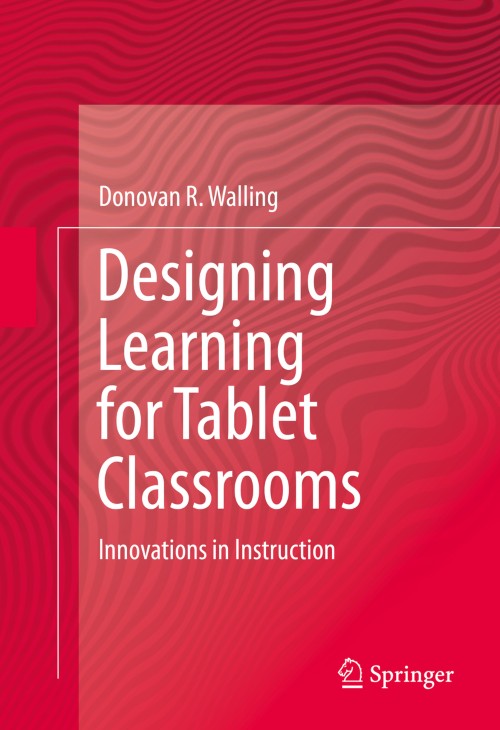
Designing Learning for Tablet Classrooms [electronic resource] : Innovations in Instruction / by Donovan R. Walling.
Erişim Adresi
ISBN
9783319024202
Dil Kodu
İngilizce
Yer Numarası
DK/15361
Yazar
Basım Bildirimi
1st ed. 2014.
Yayın Bilgisi
Cham : Springer International Publishing : Imprint: Springer, 2014.
Fiziksel Niteleme
XV, 137 p. 6 illus., 1 illus. in color. online resource.
İçindekiler Notu
Introduction -- Chapter 1: “i” Is for Innovation -- Chapter 2: Tablet Technology as a Moving Target -- Chapter 3: Who’s the Learning Designer Here? -- Chapter 4: Framing the Learning Design Approach -- Chapter 5: Analyzing the Learning Environment -- Chapter 6: Designing Learning that Capitalizes on Tablet Technology -- Chapter 7: Developing Activities that Match Learning Needs -- Chapter 8: Implementing the Learning Design -- Chapter 9: Evaluation—Before, During and After -- Chapter 10: Are eTextbooks More than Books? -- Chapter 11: Tablet Computer Reading—the How’s -- Chapter 12: Tablet Computer Reading—the What’s -- Chapter 13: Are Apps a Good Fit for Learning Goals? -- Chapter 14: The Immediacy of Connectivity—Pluses and Pitfalls -- Chapter 15: Using Tablet Technology for Multisensory Learning -- Chapter 16: Can Virtual Be as Effective as Real? -- Chapter 17: From the Tablet to the Big Picture -- Chapter 18: Tablet Take-Home Strategies -- Chapter 19: Do You Moodle? -- Chapter 20: Tackling Trouble in the Tablet Classroom.
Özet, vb.
The versatile, cost-effective technology of the tablet computer has proved to be a good fit with the learning capabilities of today's students. Not surprisingly, in more and more classrooms, the tablet has replaced not only traditional print materials but the desktop computer and the laptop as well. Designing Instruction for Tablet Classrooms makes sense of this transition, clearly showing not just how and why tablet-based learning works, but how it is likely to evolve. Written for the non-technical reader, it balances elegant theoretical background with practical applications suitable to learning environments from kindergarten through college. A wealth of specialized topics ranges from course management and troubleshooting to creating and customizing etextbooks, from tablet use in early and remedial reading to the pros and cons of virtual field trips. And for maximum usefulness, early chapters are organized to spotlight core skills needed to negotiate the new design frontier, including: Framing the learning design approach. Analyzing the learning environment. Designing learning that capitalizes on tablet technology. Developing activities that match learning needs. Implementing the learning design. Conducting evaluations before, during, and after. This is proactive reading befitting a future of exciting developments in educational technology. For researchers and practitioners in this and allied fields, Designing Instruction for Tablet Classrooms offers limitless opportunities to think outside the box.
Konu
Educational technology.
Learning, Psychology of.
Digital Education and Educational Technology.
Instructional Psychology.
Learning, Psychology of.
Digital Education and Educational Technology.
Instructional Psychology.
Kurum Adı
Eseri Alıntıla
Referansları kullanmadan önce gözden geçirmeniz ve varsa gerekli düzeltmeleri yapmanız önerilir.
Dijital Kaynak
MARC Görünümü
LEADER 04275nam a22004695i 4500
001 814122
003 TR_AnAIT
005 20260130221418
007 cr nn 008mamaa
008 140204s2014 sz | s |||| 0|eng d
020 |a9783319024202|9978-3-319-02420-2
024 7 |a10.1007/978-3-319-02420-2|2doi
041 |aeng
049 |aTürk Tarih Kurumu Kütüphanesi
050 4|aLB1028.3
072 7|aJNV|2bicssc
072 7|aEDU000000|2bisacsh
072 7|aJNV|2thema
082 04|a371.33|223
090 |aDK/15361
100 1 |aWalling, Donovan R.|eauthor.|4aut|4http://id.loc.gov/vocabulary/relators/aut
245 10|aDesigning Learning for Tablet Classrooms|h[electronic resource] :|bInnovations in Instruction /|cby Donovan R. Walling.
250 |a1st ed. 2014.
264 1|aCham :|bSpringer International Publishing :|bImprint: Springer,|c2014.
300 |aXV, 137 p. 6 illus., 1 illus. in color.|bonline resource.
336 |atext|btxt|2rdacontent
337 |acomputer|bc|2rdamedia
338 |aonline resource|bcr|2rdacarrier
347 |atext file|bPDF|2rda
505 0 |aIntroduction -- Chapter 1: “i” Is for Innovation -- Chapter 2: Tablet Technology as a Moving Target -- Chapter 3: Who’s the Learning Designer Here? -- Chapter 4: Framing the Learning Design Approach -- Chapter 5: Analyzing the Learning Environment -- Chapter 6: Designing Learning that Capitalizes on Tablet Technology -- Chapter 7: Developing Activities that Match Learning Needs -- Chapter 8: Implementing the Learning Design -- Chapter 9: Evaluation—Before, During and After -- Chapter 10: Are eTextbooks More than Books? -- Chapter 11: Tablet Computer Reading—the How’s -- Chapter 12: Tablet Computer Reading—the What’s -- Chapter 13: Are Apps a Good Fit for Learning Goals? -- Chapter 14: The Immediacy of Connectivity—Pluses and Pitfalls -- Chapter 15: Using Tablet Technology for Multisensory Learning -- Chapter 16: Can Virtual Be as Effective as Real? -- Chapter 17: From the Tablet to the Big Picture -- Chapter 18: Tablet Take-Home Strategies -- Chapter 19: Do You Moodle? -- Chapter 20: Tackling Trouble in the Tablet Classroom.
520 |aThe versatile, cost-effective technology of the tablet computer has proved to be a good fit with the learning capabilities of today's students. Not surprisingly, in more and more classrooms, the tablet has replaced not only traditional print materials but the desktop computer and the laptop as well. Designing Instruction for Tablet Classrooms makes sense of this transition, clearly showing not just how and why tablet-based learning works, but how it is likely to evolve. Written for the non-technical reader, it balances elegant theoretical background with practical applications suitable to learning environments from kindergarten through college. A wealth of specialized topics ranges from course management and troubleshooting to creating and customizing etextbooks, from tablet use in early and remedial reading to the pros and cons of virtual field trips. And for maximum usefulness, early chapters are organized to spotlight core skills needed to negotiate the new design frontier, including: Framing the learning design approach. Analyzing the learning environment. Designing learning that capitalizes on tablet technology. Developing activities that match learning needs. Implementing the learning design. Conducting evaluations before, during, and after. This is proactive reading befitting a future of exciting developments in educational technology. For researchers and practitioners in this and allied fields, Designing Instruction for Tablet Classrooms offers limitless opportunities to think outside the box.
650 0|aEducational technology.
650 0|aLearning, Psychology of.
650 14|aDigital Education and Educational Technology.
650 24|aInstructional Psychology.
710 2 |aSpringerLink (Online service)
773 0 |tSpringer Nature eBook
776 08|iPrinted edition:|z9783319024196
776 08|iPrinted edition:|z9783319024219
776 08|iPrinted edition:|z9783319344706
856 40|uhttps://doi.org/10.1007/978-3-319-02420-2
912 |aZDB-2-SHU
912 |aZDB-2-SXED
950 |aHumanities, Social Sciences and Law (SpringerNature-11648)
950 |aEducation (R0) (SpringerNature-43721)
001 814122
003 TR_AnAIT
005 20260130221418
007 cr nn 008mamaa
008 140204s2014 sz | s |||| 0|eng d
020 |a9783319024202|9978-3-319-02420-2
024 7 |a10.1007/978-3-319-02420-2|2doi
041 |aeng
049 |aTürk Tarih Kurumu Kütüphanesi
050 4|aLB1028.3
072 7|aJNV|2bicssc
072 7|aEDU000000|2bisacsh
072 7|aJNV|2thema
082 04|a371.33|223
090 |aDK/15361
100 1 |aWalling, Donovan R.|eauthor.|4aut|4http://id.loc.gov/vocabulary/relators/aut
245 10|aDesigning Learning for Tablet Classrooms|h[electronic resource] :|bInnovations in Instruction /|cby Donovan R. Walling.
250 |a1st ed. 2014.
264 1|aCham :|bSpringer International Publishing :|bImprint: Springer,|c2014.
300 |aXV, 137 p. 6 illus., 1 illus. in color.|bonline resource.
336 |atext|btxt|2rdacontent
337 |acomputer|bc|2rdamedia
338 |aonline resource|bcr|2rdacarrier
347 |atext file|bPDF|2rda
505 0 |aIntroduction -- Chapter 1: “i” Is for Innovation -- Chapter 2: Tablet Technology as a Moving Target -- Chapter 3: Who’s the Learning Designer Here? -- Chapter 4: Framing the Learning Design Approach -- Chapter 5: Analyzing the Learning Environment -- Chapter 6: Designing Learning that Capitalizes on Tablet Technology -- Chapter 7: Developing Activities that Match Learning Needs -- Chapter 8: Implementing the Learning Design -- Chapter 9: Evaluation—Before, During and After -- Chapter 10: Are eTextbooks More than Books? -- Chapter 11: Tablet Computer Reading—the How’s -- Chapter 12: Tablet Computer Reading—the What’s -- Chapter 13: Are Apps a Good Fit for Learning Goals? -- Chapter 14: The Immediacy of Connectivity—Pluses and Pitfalls -- Chapter 15: Using Tablet Technology for Multisensory Learning -- Chapter 16: Can Virtual Be as Effective as Real? -- Chapter 17: From the Tablet to the Big Picture -- Chapter 18: Tablet Take-Home Strategies -- Chapter 19: Do You Moodle? -- Chapter 20: Tackling Trouble in the Tablet Classroom.
520 |aThe versatile, cost-effective technology of the tablet computer has proved to be a good fit with the learning capabilities of today's students. Not surprisingly, in more and more classrooms, the tablet has replaced not only traditional print materials but the desktop computer and the laptop as well. Designing Instruction for Tablet Classrooms makes sense of this transition, clearly showing not just how and why tablet-based learning works, but how it is likely to evolve. Written for the non-technical reader, it balances elegant theoretical background with practical applications suitable to learning environments from kindergarten through college. A wealth of specialized topics ranges from course management and troubleshooting to creating and customizing etextbooks, from tablet use in early and remedial reading to the pros and cons of virtual field trips. And for maximum usefulness, early chapters are organized to spotlight core skills needed to negotiate the new design frontier, including: Framing the learning design approach. Analyzing the learning environment. Designing learning that capitalizes on tablet technology. Developing activities that match learning needs. Implementing the learning design. Conducting evaluations before, during, and after. This is proactive reading befitting a future of exciting developments in educational technology. For researchers and practitioners in this and allied fields, Designing Instruction for Tablet Classrooms offers limitless opportunities to think outside the box.
650 0|aEducational technology.
650 0|aLearning, Psychology of.
650 14|aDigital Education and Educational Technology.
650 24|aInstructional Psychology.
710 2 |aSpringerLink (Online service)
773 0 |tSpringer Nature eBook
776 08|iPrinted edition:|z9783319024196
776 08|iPrinted edition:|z9783319024219
776 08|iPrinted edition:|z9783319344706
856 40|uhttps://doi.org/10.1007/978-3-319-02420-2
912 |aZDB-2-SHU
912 |aZDB-2-SXED
950 |aHumanities, Social Sciences and Law (SpringerNature-11648)
950 |aEducation (R0) (SpringerNature-43721)
Materyaller
Depodan talep edilen materyal sadece kütüphane içerisinde kullanılmaktadır.
Materyal dışarıya ödünç verilmemektedir.
Materyal dışarıya ödünç verilmemektedir.
