

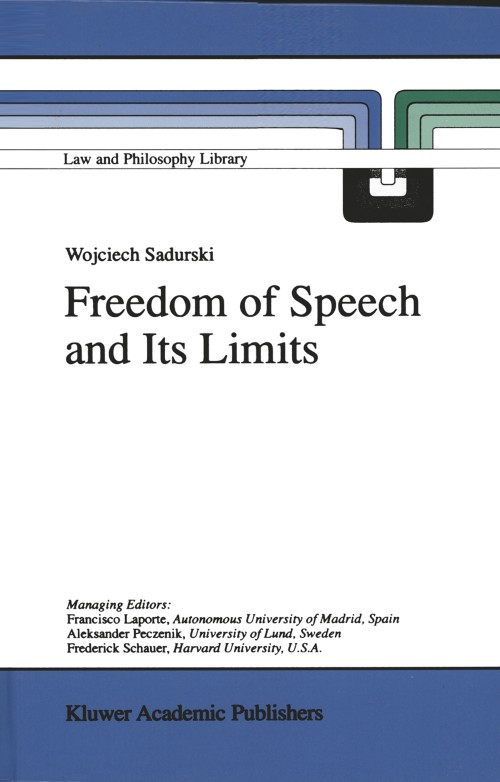
Freedom of Speech and Its Limits [electronic resource] / by Wojciech Sadurski.
Erişim Adresi
ISBN
9789401093422
Dil Kodu
İngilizce
Yer Numarası
DK/15369
Yazar
Basım Bildirimi
1st ed. 1999.
Yayın Bilgisi
Dordrecht : Springer Netherlands : Imprint: Springer, 1999.
Fiziksel Niteleme
240 p. online resource.
Dizi
Law and Philosophy Library, 2215-0315 ; 38
İçindekiler Notu
Preface -- 1: Justifications of Freedom of Speech -- 1 Search for Truth -- 2 Individual Autonomy -- 3 Democracy and Self-Government -- 4 Tolerance -- 2: Speech and Harm -- 1 Levels of Scrutiny -- 2 Low and High Value Speech -- 3 Speech-Plus and Symbolic Action -- 4 Speech and Harm: A Case Study of R.A.V. -- 3: Speech and Equality -- 1 Equal Opportunity and Public Speech -- 2 Silencing -- 3 Asymmetry of Fighting Words -- 4: Discrimination and Illocutionary Acts -- 1 Illocutions and Perlocutions -- 2 Authority in Discriminatory Illocutions -- 5: Viewpoint Neutrality and Its Rationales -- 1 Two Types of Neutrality -- 2 What is “A Viewpoint”? A Case Study of Rosenberger -- 3 Reasonableness and Viewpoint Regulations: A Case Study of Lamb’s Chapel -- 4 Rationales for Viewpoint Neutrality and Subject-Matter Neutrality -- 5 The Content/Viewpoint Distinction and the Level of Generality -- 6 Indirect Viewpoint Discrimination -- 7 Paternalism and Intolerance -- 6: Racial Vilification and Freedom of Speech -- 1 The Context of the Hate-Speech Controversy -- 2 The Contours of “Racial Vilification” -- 3 The Harms of Hate Speech -- 4 Liberalism and Prohibitions of Hate Speech.
Özet, vb.
In authoritarian states, the discourse on freedom of speech, conducted by those opposed to non-democratic governments, focuses on the core aspects of this freedom: on a right to criticize the government, a right to advocate theories arid ideologies contrary to government-imposed orthodoxy, a right to demand institutional reforms, changes in politics, resignation of the incompetent and the corrupt from positions of authority. The claims for freedom of speech focus on those exercises of freedom that are most fundamental and most beneficial to citizens - and which are denied to them by the government. But in a by-and large democratic polity, where these fundamental benefits of freedom of speech are generally enjoyed by the citizens, the public and scholarly discourse on freedom of speech hovers about the peripheries of that freedom; the focus is on its outer boundaries rather than at the central territory of freedom of speech. Those borderline cases, in which people who are otherwise genuinely committed to the core aspects of freedom of speech may sincerely disagree, include pornography, racist hate speech and religious bigoted expressions, defamation of politicians and of private persons, contempt of court, incitement to violence, disclosure of military or commercial secrets, advertising of merchandise such as alcohol or cigarettes or of services and entertainment such as gambling and prostitution.
Konu
Law __ Philosophy.
Political science __ Philosophy.
Law __ History.
Constitutional law.
International law.
Philosophy of Law.
Political Philosophy.
Theories of Law, Philosophy of Law, Legal History.
Constitutional Law.
Public International Law.
Political science __ Philosophy.
Law __ History.
Constitutional law.
International law.
Philosophy of Law.
Political Philosophy.
Theories of Law, Philosophy of Law, Legal History.
Constitutional Law.
Public International Law.
Kurum Adı
Eseri Alıntıla
Referansları kullanmadan önce gözden geçirmeniz ve varsa gerekli düzeltmeleri yapmanız önerilir.
Dijital Kaynak
MARC Görünümü
LEADER 05356nam a22006255i 4500
001 814130
003 TR_AnAIT
005 20260130221352
007 cr nn 008mamaa
008 120217s1999 ne | s |||| 0|eng d
020 |a9789401093422|9978-94-010-9342-2
024 7 |a10.1007/978-94-010-9342-2|2doi
041 |aeng
049 |aTürk Tarih Kurumu Kütüphanesi
050 4|aK201-487
072 7|aLAB|2bicssc
072 7|aPHI000000|2bisacsh
072 7|aLAB|2thema
082 04|a340.1|223
090 |aDK/15369
100 1 |aSadurski, Wojciech.|eauthor.|4aut|4http://id.loc.gov/vocabulary/relators/aut
245 10|aFreedom of Speech and Its Limits|h[electronic resource] /|cby Wojciech Sadurski.
250 |a1st ed. 1999.
264 1|aDordrecht :|bSpringer Netherlands :|bImprint: Springer,|c1999.
300 |a240 p.|bonline resource.
336 |atext|btxt|2rdacontent
337 |acomputer|bc|2rdamedia
338 |aonline resource|bcr|2rdacarrier
347 |atext file|bPDF|2rda
490 1 |aLaw and Philosophy Library,|x2215-0315 ;|v38
505 0 |aPreface -- 1: Justifications of Freedom of Speech -- 1 Search for Truth -- 2 Individual Autonomy -- 3 Democracy and Self-Government -- 4 Tolerance -- 2: Speech and Harm -- 1 Levels of Scrutiny -- 2 Low and High Value Speech -- 3 Speech-Plus and Symbolic Action -- 4 Speech and Harm: A Case Study of R.A.V. -- 3: Speech and Equality -- 1 Equal Opportunity and Public Speech -- 2 Silencing -- 3 Asymmetry of Fighting Words -- 4: Discrimination and Illocutionary Acts -- 1 Illocutions and Perlocutions -- 2 Authority in Discriminatory Illocutions -- 5: Viewpoint Neutrality and Its Rationales -- 1 Two Types of Neutrality -- 2 What is “A Viewpoint”? A Case Study of Rosenberger -- 3 Reasonableness and Viewpoint Regulations: A Case Study of Lamb’s Chapel -- 4 Rationales for Viewpoint Neutrality and Subject-Matter Neutrality -- 5 The Content/Viewpoint Distinction and the Level of Generality -- 6 Indirect Viewpoint Discrimination -- 7 Paternalism and Intolerance -- 6: Racial Vilification and Freedom of Speech -- 1 The Context of the Hate-Speech Controversy -- 2 The Contours of “Racial Vilification” -- 3 The Harms of Hate Speech -- 4 Liberalism and Prohibitions of Hate Speech.
520 |aIn authoritarian states, the discourse on freedom of speech, conducted by those opposed to non-democratic governments, focuses on the core aspects of this freedom: on a right to criticize the government, a right to advocate theories arid ideologies contrary to government-imposed orthodoxy, a right to demand institutional reforms, changes in politics, resignation of the incompetent and the corrupt from positions of authority. The claims for freedom of speech focus on those exercises of freedom that are most fundamental and most beneficial to citizens - and which are denied to them by the government. But in a by-and large democratic polity, where these fundamental benefits of freedom of speech are generally enjoyed by the citizens, the public and scholarly discourse on freedom of speech hovers about the peripheries of that freedom; the focus is on its outer boundaries rather than at the central territory of freedom of speech. Those borderline cases, in which people who are otherwise genuinely committed to the core aspects of freedom of speech may sincerely disagree, include pornography, racist hate speech and religious bigoted expressions, defamation of politicians and of private persons, contempt of court, incitement to violence, disclosure of military or commercial secrets, advertising of merchandise such as alcohol or cigarettes or of services and entertainment such as gambling and prostitution.
532 8 |aAccessibility summary: This PDF is not accessible. It is based on scanned pages and does not support features such as screen reader compatibility or described non-text content (images, graphs etc). However, it likely supports searchable and selectable text based on OCR (Optical Character Recognition). Users with accessibility needs may not be able to use this content effectively. Please contact us at accessibilitysupport@springernature.com if you require assistance or an alternative format.
532 8 |aInaccessible, or known limited accessibility
532 8 |aNo reading system accessibility options actively disabled
532 8 |aPublisher contact for further accessibility information: accessibilitysupport@springernature.com
650 0|aLaw|xPhilosophy.
650 0|aPolitical science|xPhilosophy.
650 0|aLaw|xHistory.
650 0|aConstitutional law.
650 0|aInternational law.
650 14|aPhilosophy of Law.
650 24|aPolitical Philosophy.
650 24|aTheories of Law, Philosophy of Law, Legal History.
650 24|aConstitutional Law.
650 24|aPublic International Law.
710 2 |aSpringerLink (Online service)
773 0 |tSpringer Nature eBook
776 08|iPrinted edition:|z9780792355236
776 08|iPrinted edition:|z9781402002816
776 08|iPrinted edition:|z9789401093439
830 0|aLaw and Philosophy Library,|x2215-0315 ;|v38
856 40|uhttps://doi.org/10.1007/978-94-010-9342-2
912 |aZDB-2-SHU
912 |aZDB-2-SXPR
912 |aZDB-2-BAE
950 |aHumanities, Social Sciences and Law (SpringerNature-11648)
950 |aPhilosophy and Religion (R0) (SpringerNature-43725)
001 814130
003 TR_AnAIT
005 20260130221352
007 cr nn 008mamaa
008 120217s1999 ne | s |||| 0|eng d
020 |a9789401093422|9978-94-010-9342-2
024 7 |a10.1007/978-94-010-9342-2|2doi
041 |aeng
049 |aTürk Tarih Kurumu Kütüphanesi
050 4|aK201-487
072 7|aLAB|2bicssc
072 7|aPHI000000|2bisacsh
072 7|aLAB|2thema
082 04|a340.1|223
090 |aDK/15369
100 1 |aSadurski, Wojciech.|eauthor.|4aut|4http://id.loc.gov/vocabulary/relators/aut
245 10|aFreedom of Speech and Its Limits|h[electronic resource] /|cby Wojciech Sadurski.
250 |a1st ed. 1999.
264 1|aDordrecht :|bSpringer Netherlands :|bImprint: Springer,|c1999.
300 |a240 p.|bonline resource.
336 |atext|btxt|2rdacontent
337 |acomputer|bc|2rdamedia
338 |aonline resource|bcr|2rdacarrier
347 |atext file|bPDF|2rda
490 1 |aLaw and Philosophy Library,|x2215-0315 ;|v38
505 0 |aPreface -- 1: Justifications of Freedom of Speech -- 1 Search for Truth -- 2 Individual Autonomy -- 3 Democracy and Self-Government -- 4 Tolerance -- 2: Speech and Harm -- 1 Levels of Scrutiny -- 2 Low and High Value Speech -- 3 Speech-Plus and Symbolic Action -- 4 Speech and Harm: A Case Study of R.A.V. -- 3: Speech and Equality -- 1 Equal Opportunity and Public Speech -- 2 Silencing -- 3 Asymmetry of Fighting Words -- 4: Discrimination and Illocutionary Acts -- 1 Illocutions and Perlocutions -- 2 Authority in Discriminatory Illocutions -- 5: Viewpoint Neutrality and Its Rationales -- 1 Two Types of Neutrality -- 2 What is “A Viewpoint”? A Case Study of Rosenberger -- 3 Reasonableness and Viewpoint Regulations: A Case Study of Lamb’s Chapel -- 4 Rationales for Viewpoint Neutrality and Subject-Matter Neutrality -- 5 The Content/Viewpoint Distinction and the Level of Generality -- 6 Indirect Viewpoint Discrimination -- 7 Paternalism and Intolerance -- 6: Racial Vilification and Freedom of Speech -- 1 The Context of the Hate-Speech Controversy -- 2 The Contours of “Racial Vilification” -- 3 The Harms of Hate Speech -- 4 Liberalism and Prohibitions of Hate Speech.
520 |aIn authoritarian states, the discourse on freedom of speech, conducted by those opposed to non-democratic governments, focuses on the core aspects of this freedom: on a right to criticize the government, a right to advocate theories arid ideologies contrary to government-imposed orthodoxy, a right to demand institutional reforms, changes in politics, resignation of the incompetent and the corrupt from positions of authority. The claims for freedom of speech focus on those exercises of freedom that are most fundamental and most beneficial to citizens - and which are denied to them by the government. But in a by-and large democratic polity, where these fundamental benefits of freedom of speech are generally enjoyed by the citizens, the public and scholarly discourse on freedom of speech hovers about the peripheries of that freedom; the focus is on its outer boundaries rather than at the central territory of freedom of speech. Those borderline cases, in which people who are otherwise genuinely committed to the core aspects of freedom of speech may sincerely disagree, include pornography, racist hate speech and religious bigoted expressions, defamation of politicians and of private persons, contempt of court, incitement to violence, disclosure of military or commercial secrets, advertising of merchandise such as alcohol or cigarettes or of services and entertainment such as gambling and prostitution.
532 8 |aAccessibility summary: This PDF is not accessible. It is based on scanned pages and does not support features such as screen reader compatibility or described non-text content (images, graphs etc). However, it likely supports searchable and selectable text based on OCR (Optical Character Recognition). Users with accessibility needs may not be able to use this content effectively. Please contact us at accessibilitysupport@springernature.com if you require assistance or an alternative format.
532 8 |aInaccessible, or known limited accessibility
532 8 |aNo reading system accessibility options actively disabled
532 8 |aPublisher contact for further accessibility information: accessibilitysupport@springernature.com
650 0|aLaw|xPhilosophy.
650 0|aPolitical science|xPhilosophy.
650 0|aLaw|xHistory.
650 0|aConstitutional law.
650 0|aInternational law.
650 14|aPhilosophy of Law.
650 24|aPolitical Philosophy.
650 24|aTheories of Law, Philosophy of Law, Legal History.
650 24|aConstitutional Law.
650 24|aPublic International Law.
710 2 |aSpringerLink (Online service)
773 0 |tSpringer Nature eBook
776 08|iPrinted edition:|z9780792355236
776 08|iPrinted edition:|z9781402002816
776 08|iPrinted edition:|z9789401093439
830 0|aLaw and Philosophy Library,|x2215-0315 ;|v38
856 40|uhttps://doi.org/10.1007/978-94-010-9342-2
912 |aZDB-2-SHU
912 |aZDB-2-SXPR
912 |aZDB-2-BAE
950 |aHumanities, Social Sciences and Law (SpringerNature-11648)
950 |aPhilosophy and Religion (R0) (SpringerNature-43725)
Materyaller
Depodan talep edilen materyal sadece kütüphane içerisinde kullanılmaktadır.
Materyal dışarıya ödünç verilmemektedir.
Materyal dışarıya ödünç verilmemektedir.
