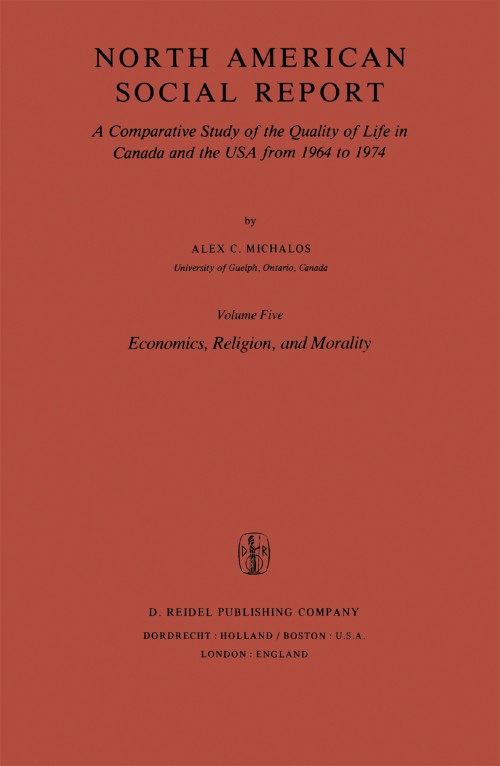
North American Social Report [electronic resource] : A Comparative Study of the Quality of Life in Canada and the USA from 1964 to 1974.Vol. 5: Economics, Religion and Morality / by Alex C. Michalos.
Erişim Adresi
ISBN
9789401095594
Dil Kodu
İngilizce
Yer Numarası
DK/15408
Yazar
Basım Bildirimi
1st ed. 1982.
Yayın Bilgisi
Dordrecht : Springer Netherlands : Imprint: Springer, 1982.
Fiziksel Niteleme
247 p. online resource.
Dizi
Social Indicators Research Programmes ; 5
İçindekiler Notu
12: Economics -- 1. Introduction -- 2. Goals -- 3. National accounts -- 4. Gross national product -- 5. Manufacturing productivity -- 6. Income and saving -- 7. Equity, equality, and efficiency -- 8. Male, female living standards -- 9. Earnings gaps -- 10. Gini coefficients and wealth -- 11. Corporate concentration -- 12. Inflation -- 13. Taxes -- 14. Work and unemployment -- 15. Poverty -- 16. Bankruptcy -- 17. Balance of payments -- 18. Net public debt -- 19. Foreign direct investment -- 20. Summary and results -- Notes -- Tables, Figures, and Charts -- 13: Religion -- 1. Introduction -- 2. Religion in life -- 3. Reason and compassion -- 4. Indicator limitations -- 5. Affiliation and attendance -- 6. Beliefs -- 7. Influence, confidence, and significance -- 8. Summary and results -- Notes -- Tables, Figures and Charts -- 14: Morality and Social Customs -- 1. Introduction -- 2. Marriage -- 3. Families -- 4. Divorce -- 5. Personal problems and future -- 6. National problems -- 7. Tastes -- 8. Prejudice -- 9. Happiness -- 10. Summary and results -- Notes -- Tables, Figures, and Charts -- 15: Conclusion -- Index of Names -- Index of Subjects.
Özet, vb.
For readers who intend to read this volume without reading the first, some in troductory remarks are in order about the scope of the work and the strategy used in all five volumes to measure the qUality of life. In the frrst chapter of Volume I, I reviewed the relevant recent literature on social indicators and so cial reporting, and explained all the general difficulties involved in such work. It would be redundant to repeat that discussion here, but there are some fundamental points that are worth mentioning. Readers who fmd this account too brief should consult the longer discussion. The basic question that will be answered in this work is this: Is there a difference in the quality of life in Canada and the United States of America, and if so, in which country is it better? Alternatively, one could put the question thus: If one individual were randomly selected out of Canada and another out of the United States, would there be important qualitative differences, and if so, which one would probably be better off? To simplify matters, I often use the terms 'Canadian' and 'American' as abbreviations for 'a randomly selected resident' of Canada or the United States, respec tively.
Konu
Sociology.
Sociology.
Sociology.
Kurum Adı

Eseri Alıntıla
Referansları kullanmadan önce gözden geçirmeniz ve varsa gerekli düzeltmeleri yapmanız önerilir.
Dijital Kaynak
MARC Görünümü
LEADER 04867nam a22005415i 4500
001 814169
003 TR_AnAIT
005 20260130221230
007 cr nn 008mamaa
008 121227s1982 ne | s |||| 0|eng d
020 |a9789401095594|9978-94-010-9559-4
024 7 |a10.1007/978-94-010-9559-4|2doi
041 |aeng
049 |aTürk Tarih Kurumu Kütüphanesi
050 4|aHM
072 7|aJHB|2bicssc
072 7|aJHB|2bicssc
072 7|aSOC026000|2bisacsh
072 7|aJHB|2thema
072 7|aJHB|2thema
082 04|a301|223
090 |aDK/15408
100 1 |aMichalos, Alex C.|eauthor.|4aut|4http://id.loc.gov/vocabulary/relators/aut
245 10|aNorth American Social Report|h[electronic resource] :|bA Comparative Study of the Quality of Life in Canada and the USA from 1964 to 1974.Vol. 5: Economics, Religion and Morality /|cby Alex C. Michalos.
250 |a1st ed. 1982.
264 1|aDordrecht :|bSpringer Netherlands :|bImprint: Springer,|c1982.
300 |a247 p.|bonline resource.
336 |atext|btxt|2rdacontent
337 |acomputer|bc|2rdamedia
338 |aonline resource|bcr|2rdacarrier
347 |atext file|bPDF|2rda
490 1 |aSocial Indicators Research Programmes ;|v5
505 0 |a12: Economics -- 1. Introduction -- 2. Goals -- 3. National accounts -- 4. Gross national product -- 5. Manufacturing productivity -- 6. Income and saving -- 7. Equity, equality, and efficiency -- 8. Male, female living standards -- 9. Earnings gaps -- 10. Gini coefficients and wealth -- 11. Corporate concentration -- 12. Inflation -- 13. Taxes -- 14. Work and unemployment -- 15. Poverty -- 16. Bankruptcy -- 17. Balance of payments -- 18. Net public debt -- 19. Foreign direct investment -- 20. Summary and results -- Notes -- Tables, Figures, and Charts -- 13: Religion -- 1. Introduction -- 2. Religion in life -- 3. Reason and compassion -- 4. Indicator limitations -- 5. Affiliation and attendance -- 6. Beliefs -- 7. Influence, confidence, and significance -- 8. Summary and results -- Notes -- Tables, Figures and Charts -- 14: Morality and Social Customs -- 1. Introduction -- 2. Marriage -- 3. Families -- 4. Divorce -- 5. Personal problems and future -- 6. National problems -- 7. Tastes -- 8. Prejudice -- 9. Happiness -- 10. Summary and results -- Notes -- Tables, Figures, and Charts -- 15: Conclusion -- Index of Names -- Index of Subjects.
520 |aFor readers who intend to read this volume without reading the first, some in troductory remarks are in order about the scope of the work and the strategy used in all five volumes to measure the qUality of life. In the frrst chapter of Volume I, I reviewed the relevant recent literature on social indicators and so cial reporting, and explained all the general difficulties involved in such work. It would be redundant to repeat that discussion here, but there are some fundamental points that are worth mentioning. Readers who fmd this account too brief should consult the longer discussion. The basic question that will be answered in this work is this: Is there a difference in the quality of life in Canada and the United States of America, and if so, in which country is it better? Alternatively, one could put the question thus: If one individual were randomly selected out of Canada and another out of the United States, would there be important qualitative differences, and if so, which one would probably be better off? To simplify matters, I often use the terms 'Canadian' and 'American' as abbreviations for 'a randomly selected resident' of Canada or the United States, respec tively.
532 8 |aAccessibility summary: This PDF is not accessible. It is based on scanned pages and does not support features such as screen reader compatibility or described non-text content (images, graphs etc). However, it likely supports searchable and selectable text based on OCR (Optical Character Recognition). Users with accessibility needs may not be able to use this content effectively. Please contact us at accessibilitysupport@springernature.com if you require assistance or an alternative format.
532 8 |aInaccessible, or known limited accessibility
532 8 |aNo reading system accessibility options actively disabled
532 8 |aPublisher contact for further accessibility information: accessibilitysupport@springernature.com
650 0|aSociology.
650 14|aSociology.
710 2 |aSpringerLink (Online service)
773 0 |tSpringer Nature eBook
776 08|iPrinted edition:|z9789027713582
776 08|iPrinted edition:|z9789401095600
830 0|aSocial Indicators Research Programmes ;|v5
856 40|uhttps://doi.org/10.1007/978-94-010-9559-4
912 |aZDB-2-SHU
912 |aZDB-2-SXS
912 |aZDB-2-BAE
950 |aHumanities, Social Sciences and Law (SpringerNature-11648)
950 |aSocial Sciences (R0) (SpringerNature-43726)
001 814169
003 TR_AnAIT
005 20260130221230
007 cr nn 008mamaa
008 121227s1982 ne | s |||| 0|eng d
020 |a9789401095594|9978-94-010-9559-4
024 7 |a10.1007/978-94-010-9559-4|2doi
041 |aeng
049 |aTürk Tarih Kurumu Kütüphanesi
050 4|aHM
072 7|aJHB|2bicssc
072 7|aJHB|2bicssc
072 7|aSOC026000|2bisacsh
072 7|aJHB|2thema
072 7|aJHB|2thema
082 04|a301|223
090 |aDK/15408
100 1 |aMichalos, Alex C.|eauthor.|4aut|4http://id.loc.gov/vocabulary/relators/aut
245 10|aNorth American Social Report|h[electronic resource] :|bA Comparative Study of the Quality of Life in Canada and the USA from 1964 to 1974.Vol. 5: Economics, Religion and Morality /|cby Alex C. Michalos.
250 |a1st ed. 1982.
264 1|aDordrecht :|bSpringer Netherlands :|bImprint: Springer,|c1982.
300 |a247 p.|bonline resource.
336 |atext|btxt|2rdacontent
337 |acomputer|bc|2rdamedia
338 |aonline resource|bcr|2rdacarrier
347 |atext file|bPDF|2rda
490 1 |aSocial Indicators Research Programmes ;|v5
505 0 |a12: Economics -- 1. Introduction -- 2. Goals -- 3. National accounts -- 4. Gross national product -- 5. Manufacturing productivity -- 6. Income and saving -- 7. Equity, equality, and efficiency -- 8. Male, female living standards -- 9. Earnings gaps -- 10. Gini coefficients and wealth -- 11. Corporate concentration -- 12. Inflation -- 13. Taxes -- 14. Work and unemployment -- 15. Poverty -- 16. Bankruptcy -- 17. Balance of payments -- 18. Net public debt -- 19. Foreign direct investment -- 20. Summary and results -- Notes -- Tables, Figures, and Charts -- 13: Religion -- 1. Introduction -- 2. Religion in life -- 3. Reason and compassion -- 4. Indicator limitations -- 5. Affiliation and attendance -- 6. Beliefs -- 7. Influence, confidence, and significance -- 8. Summary and results -- Notes -- Tables, Figures and Charts -- 14: Morality and Social Customs -- 1. Introduction -- 2. Marriage -- 3. Families -- 4. Divorce -- 5. Personal problems and future -- 6. National problems -- 7. Tastes -- 8. Prejudice -- 9. Happiness -- 10. Summary and results -- Notes -- Tables, Figures, and Charts -- 15: Conclusion -- Index of Names -- Index of Subjects.
520 |aFor readers who intend to read this volume without reading the first, some in troductory remarks are in order about the scope of the work and the strategy used in all five volumes to measure the qUality of life. In the frrst chapter of Volume I, I reviewed the relevant recent literature on social indicators and so cial reporting, and explained all the general difficulties involved in such work. It would be redundant to repeat that discussion here, but there are some fundamental points that are worth mentioning. Readers who fmd this account too brief should consult the longer discussion. The basic question that will be answered in this work is this: Is there a difference in the quality of life in Canada and the United States of America, and if so, in which country is it better? Alternatively, one could put the question thus: If one individual were randomly selected out of Canada and another out of the United States, would there be important qualitative differences, and if so, which one would probably be better off? To simplify matters, I often use the terms 'Canadian' and 'American' as abbreviations for 'a randomly selected resident' of Canada or the United States, respec tively.
532 8 |aAccessibility summary: This PDF is not accessible. It is based on scanned pages and does not support features such as screen reader compatibility or described non-text content (images, graphs etc). However, it likely supports searchable and selectable text based on OCR (Optical Character Recognition). Users with accessibility needs may not be able to use this content effectively. Please contact us at accessibilitysupport@springernature.com if you require assistance or an alternative format.
532 8 |aInaccessible, or known limited accessibility
532 8 |aNo reading system accessibility options actively disabled
532 8 |aPublisher contact for further accessibility information: accessibilitysupport@springernature.com
650 0|aSociology.
650 14|aSociology.
710 2 |aSpringerLink (Online service)
773 0 |tSpringer Nature eBook
776 08|iPrinted edition:|z9789027713582
776 08|iPrinted edition:|z9789401095600
830 0|aSocial Indicators Research Programmes ;|v5
856 40|uhttps://doi.org/10.1007/978-94-010-9559-4
912 |aZDB-2-SHU
912 |aZDB-2-SXS
912 |aZDB-2-BAE
950 |aHumanities, Social Sciences and Law (SpringerNature-11648)
950 |aSocial Sciences (R0) (SpringerNature-43726)
Materyaller
Depodan talep edilen materyal sadece kütüphane içerisinde kullanılmaktadır.
Materyal dışarıya ödünç verilmemektedir.
