

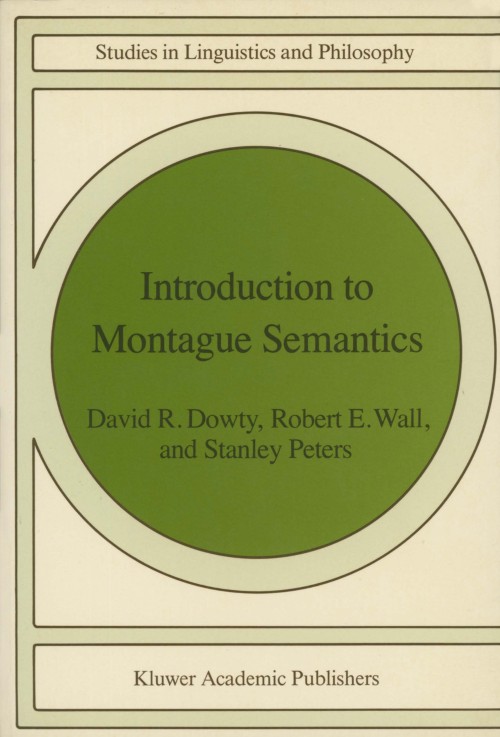
Introduction to Montague Semantics [electronic resource] / by D. R. Dowty, R. Wall, S. Peters.
Erişim Adresi
ISBN
9789400990654
Dil Kodu
İngilizce
Yer Numarası
DK/15456
Yazar
Basım Bildirimi
1st ed. 1981.
Yayın Bilgisi
Dordrecht : Springer Netherlands : Imprint: Springer, 1981.
Fiziksel Niteleme
XII, 316 p. online resource.
Dizi
Studies in Linguistics and Philosophy, 2215-034X ; 11
İçindekiler Notu
1. Introduction -- 2. The Syntax and Semantics of Two Simple Languages -- I. The Language L0 -- II. The Language L0E -- III. A Synopsis of Truth-Conditional Semantics -- IV. The Notion of Truth Relative to a Model -- V. Validity and Entailment Defined in Terms of Possible Models -- VI. Model Theory and Deductive Systems -- Exercises -- Note -- 3. First-Order Predicate Logic -- I. The Language L1 -- II. The Language L1E -- Exercises -- Notes -- 4. A Higher-Order Type-Theoretic Language -- I. A Notational Variant of L1 -- II. The Language Ltype -- III. Lambda Abstraction and the Language L? -- Exercises -- Notes -- 5. Tense and Modal Operators -- I. Tense Operators and Their Interpretation -- II. The Other Varieties of Modal Logic; the Operators ? and ? -- III. Languages Containing Both Tense and Modal Operators: Coordinate Semantics -- Exercises -- Notes -- 6. Montague’s Intensional Logic -- I. Compositionality and the Intension-Extension Distinction -- II. The Intensional Logic of PTQ -- III. Examples of ‘Oblique Contexts’ as Represented in IL -- IV. Some Unresolved Issues with Possible Worlds Semantics and Propositional Attitudes -- Notes -- 7. The Grammar of PTQ -- I. The Overall Organization of the PTQ Grammar -- II. Subject-Predicate and Determiner-Noun Rules -- III. Conjoined Sentences, Verb Phrases, and Term Phrases -- IV. Anaphoric Pronouns as Bound Variables; Scope Ambiguities and Relative Clauses -- V. Be, Transitive Verbs, Meaning Postulates, and Non-Specific Readings -- VI. Adverbs and Infinitive Complement Verbs -- VII. De dicto Pronouns and Some Pronoun Problems -- VIII. Prepositions, Tenses, and Negation -- Exercises -- Notes -- 8. Montague’s General Semiotic Program -- 9. An Annotated Bibliography of Further Work in Montague Semantics -- Appendix I: Index of Symbols -- Appendix II:Variable Type Conventions for Chapter 7 -- Notes -- References -- Answers to Selected Problems and Exercises.
Özet, vb.
In this book we hope to acquaint the reader with the fundamentals of truth conditional model-theoretic semantics, and in particular with a version of this developed by Richard Montague in a series of papers published during the 1960's and early 1970's. In many ways the paper 'The Proper Treatment of Quantification in Ordinary English' (commonly abbreviated PTQ) represents the culmination of Montague's efforts to apply the techniques developed within mathematical logic to the semantics of natural languages, and indeed it is the system outlined there that people generally have in mind when they refer to "Montague Grammar". (We prefer the term "Montague Semantics" inasmuch as a grammar, as conceived of in current linguistics, would contain at least a phonological component, a morphological component, and other subsystems which are either lacking entirely or present only in a very rudi mentary state in the PTQ system. ) Montague's work has attracted increasing attention in recent years among linguists and philosophers since it offers the hope that semantics can be characterized with the same formal rigor and explicitness that transformational approaches have brought to syntax. Whether this hope can be fully realized remains to be seen, but it is clear nonetheless that Montague semantics has already established itself as a productive para digm, leading to new areas of inquiry and suggesting new ways of conceiving of theories of natural language. Unfortunately, Montague's papers are tersely written and very difficult to follow unless one has a considerable background in logical semantics.
Konu
Grammar, Comparative and general __ Syntax.
Semiotics.
Language and languages __ Philosophy.
Syntax.
Semiotics.
Philosophy of Language.
Semiotics.
Language and languages __ Philosophy.
Syntax.
Semiotics.
Philosophy of Language.
Diğer Yazarlar
Kurum Adı
Eseri Alıntıla
Referansları kullanmadan önce gözden geçirmeniz ve varsa gerekli düzeltmeleri yapmanız önerilir.
Dijital Kaynak
MARC Görünümü
LEADER 06325nam a22006015i 4500
001 814217
003 TR_AnAIT
005 20260130220825
007 cr nn 008mamaa
008 121227s1981 ne | s |||| 0|eng d
020 |a9789400990654|9978-94-009-9065-4
024 7 |a10.1007/978-94-009-9065-4|2doi
041 |aeng
049 |aTürk Tarih Kurumu Kütüphanesi
050 4|aP291-298
072 7|aCFK|2bicssc
072 7|aLAN009060|2bisacsh
072 7|aCFK|2thema
082 04|a415|223
090 |aDK/15456
100 1 |aDowty, D. R.|eauthor.|4aut|4http://id.loc.gov/vocabulary/relators/aut
245 10|aIntroduction to Montague Semantics|h[electronic resource] /|cby D. R. Dowty, R. Wall, S. Peters.
250 |a1st ed. 1981.
264 1|aDordrecht :|bSpringer Netherlands :|bImprint: Springer,|c1981.
300 |aXII, 316 p.|bonline resource.
336 |atext|btxt|2rdacontent
337 |acomputer|bc|2rdamedia
338 |aonline resource|bcr|2rdacarrier
347 |atext file|bPDF|2rda
490 1 |aStudies in Linguistics and Philosophy,|x2215-034X ;|v11
505 0 |a1. Introduction -- 2. The Syntax and Semantics of Two Simple Languages -- I. The Language L0 -- II. The Language L0E -- III. A Synopsis of Truth-Conditional Semantics -- IV. The Notion of Truth Relative to a Model -- V. Validity and Entailment Defined in Terms of Possible Models -- VI. Model Theory and Deductive Systems -- Exercises -- Note -- 3. First-Order Predicate Logic -- I. The Language L1 -- II. The Language L1E -- Exercises -- Notes -- 4. A Higher-Order Type-Theoretic Language -- I. A Notational Variant of L1 -- II. The Language Ltype -- III. Lambda Abstraction and the Language L? -- Exercises -- Notes -- 5. Tense and Modal Operators -- I. Tense Operators and Their Interpretation -- II. The Other Varieties of Modal Logic; the Operators ? and ? -- III. Languages Containing Both Tense and Modal Operators: Coordinate Semantics -- Exercises -- Notes -- 6. Montague’s Intensional Logic -- I. Compositionality and the Intension-Extension Distinction -- II. The Intensional Logic of PTQ -- III. Examples of ‘Oblique Contexts’ as Represented in IL -- IV. Some Unresolved Issues with Possible Worlds Semantics and Propositional Attitudes -- Notes -- 7. The Grammar of PTQ -- I. The Overall Organization of the PTQ Grammar -- II. Subject-Predicate and Determiner-Noun Rules -- III. Conjoined Sentences, Verb Phrases, and Term Phrases -- IV. Anaphoric Pronouns as Bound Variables; Scope Ambiguities and Relative Clauses -- V. Be, Transitive Verbs, Meaning Postulates, and Non-Specific Readings -- VI. Adverbs and Infinitive Complement Verbs -- VII. De dicto Pronouns and Some Pronoun Problems -- VIII. Prepositions, Tenses, and Negation -- Exercises -- Notes -- 8. Montague’s General Semiotic Program -- 9. An Annotated Bibliography of Further Work in Montague Semantics -- Appendix I: Index of Symbols -- Appendix II:Variable Type Conventions for Chapter 7 -- Notes -- References -- Answers to Selected Problems and Exercises.
520 |aIn this book we hope to acquaint the reader with the fundamentals of truth conditional model-theoretic semantics, and in particular with a version of this developed by Richard Montague in a series of papers published during the 1960's and early 1970's. In many ways the paper 'The Proper Treatment of Quantification in Ordinary English' (commonly abbreviated PTQ) represents the culmination of Montague's efforts to apply the techniques developed within mathematical logic to the semantics of natural languages, and indeed it is the system outlined there that people generally have in mind when they refer to "Montague Grammar". (We prefer the term "Montague Semantics" inasmuch as a grammar, as conceived of in current linguistics, would contain at least a phonological component, a morphological component, and other subsystems which are either lacking entirely or present only in a very rudi mentary state in the PTQ system. ) Montague's work has attracted increasing attention in recent years among linguists and philosophers since it offers the hope that semantics can be characterized with the same formal rigor and explicitness that transformational approaches have brought to syntax. Whether this hope can be fully realized remains to be seen, but it is clear nonetheless that Montague semantics has already established itself as a productive para digm, leading to new areas of inquiry and suggesting new ways of conceiving of theories of natural language. Unfortunately, Montague's papers are tersely written and very difficult to follow unless one has a considerable background in logical semantics.
532 8 |aAccessibility summary: This PDF is not accessible. It is based on scanned pages and does not support features such as screen reader compatibility or described non-text content (images, graphs etc). However, it likely supports searchable and selectable text based on OCR (Optical Character Recognition). Users with accessibility needs may not be able to use this content effectively. Please contact us at accessibilitysupport@springernature.com if you require assistance or an alternative format.
532 8 |aInaccessible, or known limited accessibility
532 8 |aNo reading system accessibility options actively disabled
532 8 |aPublisher contact for further accessibility information: accessibilitysupport@springernature.com
650 0|aGrammar, Comparative and general|xSyntax.
650 0|aSemiotics.
650 0|aLanguage and languages|xPhilosophy.
650 14|aSyntax.
650 24|aSemiotics.
650 24|aPhilosophy of Language.
700 1 |aWall, R.|eauthor.|4aut|4http://id.loc.gov/vocabulary/relators/aut
700 1 |aPeters, S.|eauthor.|4aut|4http://id.loc.gov/vocabulary/relators/aut
710 2 |aSpringerLink (Online service)
773 0 |tSpringer Nature eBook
776 08|iPrinted edition:|z9789027711410
776 08|iPrinted edition:|z9789027711427
776 08|iPrinted edition:|z9789400990661
830 0|aStudies in Linguistics and Philosophy,|x2215-034X ;|v11
856 40|uhttps://doi.org/10.1007/978-94-009-9065-4
912 |aZDB-2-SHU
912 |aZDB-2-SXS
912 |aZDB-2-BAE
950 |aHumanities, Social Sciences and Law (SpringerNature-11648)
950 |aSocial Sciences (R0) (SpringerNature-43726)
001 814217
003 TR_AnAIT
005 20260130220825
007 cr nn 008mamaa
008 121227s1981 ne | s |||| 0|eng d
020 |a9789400990654|9978-94-009-9065-4
024 7 |a10.1007/978-94-009-9065-4|2doi
041 |aeng
049 |aTürk Tarih Kurumu Kütüphanesi
050 4|aP291-298
072 7|aCFK|2bicssc
072 7|aLAN009060|2bisacsh
072 7|aCFK|2thema
082 04|a415|223
090 |aDK/15456
100 1 |aDowty, D. R.|eauthor.|4aut|4http://id.loc.gov/vocabulary/relators/aut
245 10|aIntroduction to Montague Semantics|h[electronic resource] /|cby D. R. Dowty, R. Wall, S. Peters.
250 |a1st ed. 1981.
264 1|aDordrecht :|bSpringer Netherlands :|bImprint: Springer,|c1981.
300 |aXII, 316 p.|bonline resource.
336 |atext|btxt|2rdacontent
337 |acomputer|bc|2rdamedia
338 |aonline resource|bcr|2rdacarrier
347 |atext file|bPDF|2rda
490 1 |aStudies in Linguistics and Philosophy,|x2215-034X ;|v11
505 0 |a1. Introduction -- 2. The Syntax and Semantics of Two Simple Languages -- I. The Language L0 -- II. The Language L0E -- III. A Synopsis of Truth-Conditional Semantics -- IV. The Notion of Truth Relative to a Model -- V. Validity and Entailment Defined in Terms of Possible Models -- VI. Model Theory and Deductive Systems -- Exercises -- Note -- 3. First-Order Predicate Logic -- I. The Language L1 -- II. The Language L1E -- Exercises -- Notes -- 4. A Higher-Order Type-Theoretic Language -- I. A Notational Variant of L1 -- II. The Language Ltype -- III. Lambda Abstraction and the Language L? -- Exercises -- Notes -- 5. Tense and Modal Operators -- I. Tense Operators and Their Interpretation -- II. The Other Varieties of Modal Logic; the Operators ? and ? -- III. Languages Containing Both Tense and Modal Operators: Coordinate Semantics -- Exercises -- Notes -- 6. Montague’s Intensional Logic -- I. Compositionality and the Intension-Extension Distinction -- II. The Intensional Logic of PTQ -- III. Examples of ‘Oblique Contexts’ as Represented in IL -- IV. Some Unresolved Issues with Possible Worlds Semantics and Propositional Attitudes -- Notes -- 7. The Grammar of PTQ -- I. The Overall Organization of the PTQ Grammar -- II. Subject-Predicate and Determiner-Noun Rules -- III. Conjoined Sentences, Verb Phrases, and Term Phrases -- IV. Anaphoric Pronouns as Bound Variables; Scope Ambiguities and Relative Clauses -- V. Be, Transitive Verbs, Meaning Postulates, and Non-Specific Readings -- VI. Adverbs and Infinitive Complement Verbs -- VII. De dicto Pronouns and Some Pronoun Problems -- VIII. Prepositions, Tenses, and Negation -- Exercises -- Notes -- 8. Montague’s General Semiotic Program -- 9. An Annotated Bibliography of Further Work in Montague Semantics -- Appendix I: Index of Symbols -- Appendix II:Variable Type Conventions for Chapter 7 -- Notes -- References -- Answers to Selected Problems and Exercises.
520 |aIn this book we hope to acquaint the reader with the fundamentals of truth conditional model-theoretic semantics, and in particular with a version of this developed by Richard Montague in a series of papers published during the 1960's and early 1970's. In many ways the paper 'The Proper Treatment of Quantification in Ordinary English' (commonly abbreviated PTQ) represents the culmination of Montague's efforts to apply the techniques developed within mathematical logic to the semantics of natural languages, and indeed it is the system outlined there that people generally have in mind when they refer to "Montague Grammar". (We prefer the term "Montague Semantics" inasmuch as a grammar, as conceived of in current linguistics, would contain at least a phonological component, a morphological component, and other subsystems which are either lacking entirely or present only in a very rudi mentary state in the PTQ system. ) Montague's work has attracted increasing attention in recent years among linguists and philosophers since it offers the hope that semantics can be characterized with the same formal rigor and explicitness that transformational approaches have brought to syntax. Whether this hope can be fully realized remains to be seen, but it is clear nonetheless that Montague semantics has already established itself as a productive para digm, leading to new areas of inquiry and suggesting new ways of conceiving of theories of natural language. Unfortunately, Montague's papers are tersely written and very difficult to follow unless one has a considerable background in logical semantics.
532 8 |aAccessibility summary: This PDF is not accessible. It is based on scanned pages and does not support features such as screen reader compatibility or described non-text content (images, graphs etc). However, it likely supports searchable and selectable text based on OCR (Optical Character Recognition). Users with accessibility needs may not be able to use this content effectively. Please contact us at accessibilitysupport@springernature.com if you require assistance or an alternative format.
532 8 |aInaccessible, or known limited accessibility
532 8 |aNo reading system accessibility options actively disabled
532 8 |aPublisher contact for further accessibility information: accessibilitysupport@springernature.com
650 0|aGrammar, Comparative and general|xSyntax.
650 0|aSemiotics.
650 0|aLanguage and languages|xPhilosophy.
650 14|aSyntax.
650 24|aSemiotics.
650 24|aPhilosophy of Language.
700 1 |aWall, R.|eauthor.|4aut|4http://id.loc.gov/vocabulary/relators/aut
700 1 |aPeters, S.|eauthor.|4aut|4http://id.loc.gov/vocabulary/relators/aut
710 2 |aSpringerLink (Online service)
773 0 |tSpringer Nature eBook
776 08|iPrinted edition:|z9789027711410
776 08|iPrinted edition:|z9789027711427
776 08|iPrinted edition:|z9789400990661
830 0|aStudies in Linguistics and Philosophy,|x2215-034X ;|v11
856 40|uhttps://doi.org/10.1007/978-94-009-9065-4
912 |aZDB-2-SHU
912 |aZDB-2-SXS
912 |aZDB-2-BAE
950 |aHumanities, Social Sciences and Law (SpringerNature-11648)
950 |aSocial Sciences (R0) (SpringerNature-43726)
Materyaller
Depodan talep edilen materyal sadece kütüphane içerisinde kullanılmaktadır.
Materyal dışarıya ödünç verilmemektedir.
Materyal dışarıya ödünç verilmemektedir.
