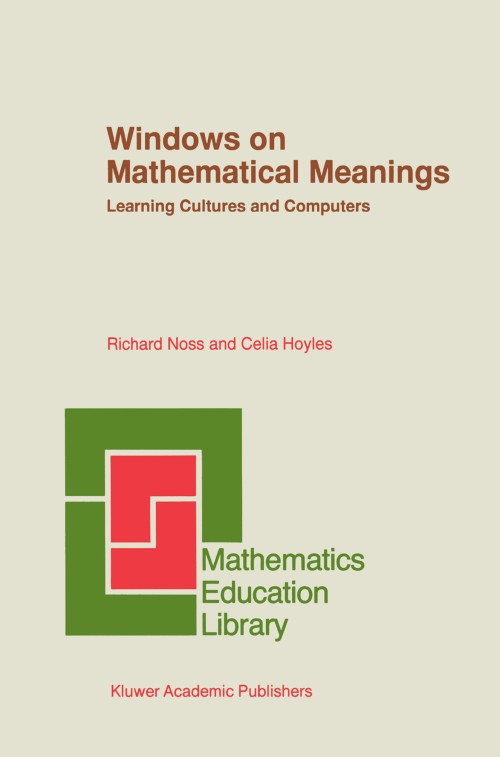
Windows on Mathematical Meanings [electronic resource] : Learning Cultures and Computers / by Richard Noss, Celia Hoyles.
Erişim Adresi
ISBN
9789400916968
Dil Kodu
İngilizce
Yer Numarası
DK/15467
Yazar
Basım Bildirimi
1st ed. 1996.
Yayın Bilgisi
Dordrecht : Springer Netherlands : Imprint: Springer, 1996.
Fiziksel Niteleme
XII, 278 p. online resource.
Dizi
Mathematics Education Library, 2214-983X ; 17
İçindekiler Notu
1. Visions of the mathematical -- 1. Reshaping mathematics, revisioning learning -- 2. Computers -- 3. …and cultures -- 4. Windows on methodologies -- 2. Laying the Foundations -- 1. Introduction -- 2. Meanings in mathematics education: a brief survey -- 3. Vignette: The N-task -- 4. The influence of setting on mathematical behaviour -- 5. Street mathematics -- 6. A way out of the cul-de-sac? -- 7. Rethinking abstraction -- 3. Tools and technologies -- 1. Computers and educational cultures -- 2. A preliminary case for programming -- 3. The development of a programming culture -- 4. Micro worlds: the genesis of the idea -- 5. Opening windows on microworlds -- 6. Objects and structures -- 4. RatioWorld -- 1. What do we — and learners — know? -- 2. Building an alternative methodology -- 3. The data set -- 4. The microworld activities and student responses -- 5. Quantitative windows on learning -- 6. Reflections -- 5. Webs and situated abstractions -- 1. Reviewing the foundations -- 2. Webs of meaning -- 3. Domains of situated abstraction -- 6. Beyond the individual learner -- 1. Extending the web -- 2. Collaborative activity in mathematics -- 3. A study of groupwork -- 4. Opening new windows -- 7. Cultures and change -- 1. Innovation and inertia -- 2. Visions of Logo -- 3. Myths and methodologies: a case study of Logo research -- 4. The struggle for meanings -- 8. A window on teachers -- 1. Investigating teachers’ attitudes and interactions -- 2. Teachers making meanings -- 3. Connections and cultures -- 9. A window on schools -- 1. The background to the case study -- 2. The teachers’ voices -- 3. The students’ voices -- 4. Meanings in conflict -- 10. Re-visioning mathematical meanings -- 1. Reviewing the scene -- 2. Epistemological revisions: six examples -- 3. Reconnecting mathematics and culture -- References.
Özet, vb.
This book is the culmination of some ten years' theoretical and empirical investigation. Throughout this period, we have come into contact with many who have stimulated our thinking, some of whom belong to the community of Mathematics Educators. Our membership of that community has challenged us to make sense of some deep issues related to mathematical learning, especially the cognitive and pedagogical faces of mathematical meaning making. Alongside this community, we are privileged to have been part of another, whose members are centrally concerned both with mathematics and educa tion. Yet many of them might reject the label of Mathematics Educators. This community has historically been clustered around what is now called the Epistemology and Learning Group at the Massachusetts Institute of Technol ogy. Their work has focused our attention on cognitive science, ethnography, sociology, artificial intelligence and other related disciplines. Crucially, it has forced our awareness of the construction of computational settings as a crucial component of the struggle to understand how mathematical learning happens. We have sometimes felt that few have tried to span both communities. Indeed, an analysis of the references in the literature would, we are sure, reveal that the two communities have often ignored each other's strengths. One reason for writing this book is born of our hope that we might draw together Mathematics Educators and mathematics educators, and assist both communities in recognising that there are insights that might be derived from each other.
Konu
Mathematics __ Study and teaching .
Mathematics.
Mathematics Education.
Mathematics.
Mathematics.
Mathematics Education.
Mathematics.
Diğer Yazarlar
Kurum Adı

Eseri Alıntıla
Referansları kullanmadan önce gözden geçirmeniz ve varsa gerekli düzeltmeleri yapmanız önerilir.
Dijital Kaynak
MARC Görünümü
LEADER 06116nam a22005895i 4500
001 814228
003 TR_AnAIT
005 20260130220804
007 cr nn 008mamaa
008 121227s1996 ne | s |||| 0|eng d
020 |a9789400916968|9978-94-009-1696-8
024 7 |a10.1007/978-94-009-1696-8|2doi
041 |aeng
049 |aTürk Tarih Kurumu Kütüphanesi
050 4|aQA10.92-20
072 7|aJNU|2bicssc
072 7|aPB|2bicssc
072 7|aEDU029010|2bisacsh
072 7|aJNU|2thema
072 7|aPB|2thema
082 04|a510.71|223
090 |aDK/15467
100 1 |aNoss, Richard.|eauthor.|4aut|4http://id.loc.gov/vocabulary/relators/aut
245 10|aWindows on Mathematical Meanings|h[electronic resource] :|bLearning Cultures and Computers /|cby Richard Noss, Celia Hoyles.
250 |a1st ed. 1996.
264 1|aDordrecht :|bSpringer Netherlands :|bImprint: Springer,|c1996.
300 |aXII, 278 p.|bonline resource.
336 |atext|btxt|2rdacontent
337 |acomputer|bc|2rdamedia
338 |aonline resource|bcr|2rdacarrier
347 |atext file|bPDF|2rda
490 1 |aMathematics Education Library,|x2214-983X ;|v17
505 0 |a1. Visions of the mathematical -- 1. Reshaping mathematics, revisioning learning -- 2. Computers -- 3. …and cultures -- 4. Windows on methodologies -- 2. Laying the Foundations -- 1. Introduction -- 2. Meanings in mathematics education: a brief survey -- 3. Vignette: The N-task -- 4. The influence of setting on mathematical behaviour -- 5. Street mathematics -- 6. A way out of the cul-de-sac? -- 7. Rethinking abstraction -- 3. Tools and technologies -- 1. Computers and educational cultures -- 2. A preliminary case for programming -- 3. The development of a programming culture -- 4. Micro worlds: the genesis of the idea -- 5. Opening windows on microworlds -- 6. Objects and structures -- 4. RatioWorld -- 1. What do we — and learners — know? -- 2. Building an alternative methodology -- 3. The data set -- 4. The microworld activities and student responses -- 5. Quantitative windows on learning -- 6. Reflections -- 5. Webs and situated abstractions -- 1. Reviewing the foundations -- 2. Webs of meaning -- 3. Domains of situated abstraction -- 6. Beyond the individual learner -- 1. Extending the web -- 2. Collaborative activity in mathematics -- 3. A study of groupwork -- 4. Opening new windows -- 7. Cultures and change -- 1. Innovation and inertia -- 2. Visions of Logo -- 3. Myths and methodologies: a case study of Logo research -- 4. The struggle for meanings -- 8. A window on teachers -- 1. Investigating teachers’ attitudes and interactions -- 2. Teachers making meanings -- 3. Connections and cultures -- 9. A window on schools -- 1. The background to the case study -- 2. The teachers’ voices -- 3. The students’ voices -- 4. Meanings in conflict -- 10. Re-visioning mathematical meanings -- 1. Reviewing the scene -- 2. Epistemological revisions: six examples -- 3. Reconnecting mathematics and culture -- References.
520 |aThis book is the culmination of some ten years' theoretical and empirical investigation. Throughout this period, we have come into contact with many who have stimulated our thinking, some of whom belong to the community of Mathematics Educators. Our membership of that community has challenged us to make sense of some deep issues related to mathematical learning, especially the cognitive and pedagogical faces of mathematical meaning making. Alongside this community, we are privileged to have been part of another, whose members are centrally concerned both with mathematics and educa tion. Yet many of them might reject the label of Mathematics Educators. This community has historically been clustered around what is now called the Epistemology and Learning Group at the Massachusetts Institute of Technol ogy. Their work has focused our attention on cognitive science, ethnography, sociology, artificial intelligence and other related disciplines. Crucially, it has forced our awareness of the construction of computational settings as a crucial component of the struggle to understand how mathematical learning happens. We have sometimes felt that few have tried to span both communities. Indeed, an analysis of the references in the literature would, we are sure, reveal that the two communities have often ignored each other's strengths. One reason for writing this book is born of our hope that we might draw together Mathematics Educators and mathematics educators, and assist both communities in recognising that there are insights that might be derived from each other.
532 8 |aAccessibility summary: This PDF is not accessible. It is based on scanned pages and does not support features such as screen reader compatibility or described non-text content (images, graphs etc). However, it likely supports searchable and selectable text based on OCR (Optical Character Recognition). Users with accessibility needs may not be able to use this content effectively. Please contact us at accessibilitysupport@springernature.com if you require assistance or an alternative format.
532 8 |aInaccessible, or known limited accessibility
532 8 |aNo reading system accessibility options actively disabled
532 8 |aPublisher contact for further accessibility information: accessibilitysupport@springernature.com
650 0|aMathematics|xStudy and teaching .
650 0|aMathematics.
650 14|aMathematics Education.
650 24|aMathematics.
700 1 |aHoyles, Celia.|eauthor.|4aut|4http://id.loc.gov/vocabulary/relators/aut
710 2 |aSpringerLink (Online service)
773 0 |tSpringer Nature eBook
776 08|iPrinted edition:|z9780792340737
776 08|iPrinted edition:|z9780792340744
776 08|iPrinted edition:|z9789400916975
830 0|aMathematics Education Library,|x2214-983X ;|v17
856 40|uhttps://doi.org/10.1007/978-94-009-1696-8
912 |aZDB-2-SHU
912 |aZDB-2-SXED
912 |aZDB-2-BAE
950 |aHumanities, Social Sciences and Law (SpringerNature-11648)
950 |aEducation (R0) (SpringerNature-43721)
001 814228
003 TR_AnAIT
005 20260130220804
007 cr nn 008mamaa
008 121227s1996 ne | s |||| 0|eng d
020 |a9789400916968|9978-94-009-1696-8
024 7 |a10.1007/978-94-009-1696-8|2doi
041 |aeng
049 |aTürk Tarih Kurumu Kütüphanesi
050 4|aQA10.92-20
072 7|aJNU|2bicssc
072 7|aPB|2bicssc
072 7|aEDU029010|2bisacsh
072 7|aJNU|2thema
072 7|aPB|2thema
082 04|a510.71|223
090 |aDK/15467
100 1 |aNoss, Richard.|eauthor.|4aut|4http://id.loc.gov/vocabulary/relators/aut
245 10|aWindows on Mathematical Meanings|h[electronic resource] :|bLearning Cultures and Computers /|cby Richard Noss, Celia Hoyles.
250 |a1st ed. 1996.
264 1|aDordrecht :|bSpringer Netherlands :|bImprint: Springer,|c1996.
300 |aXII, 278 p.|bonline resource.
336 |atext|btxt|2rdacontent
337 |acomputer|bc|2rdamedia
338 |aonline resource|bcr|2rdacarrier
347 |atext file|bPDF|2rda
490 1 |aMathematics Education Library,|x2214-983X ;|v17
505 0 |a1. Visions of the mathematical -- 1. Reshaping mathematics, revisioning learning -- 2. Computers -- 3. …and cultures -- 4. Windows on methodologies -- 2. Laying the Foundations -- 1. Introduction -- 2. Meanings in mathematics education: a brief survey -- 3. Vignette: The N-task -- 4. The influence of setting on mathematical behaviour -- 5. Street mathematics -- 6. A way out of the cul-de-sac? -- 7. Rethinking abstraction -- 3. Tools and technologies -- 1. Computers and educational cultures -- 2. A preliminary case for programming -- 3. The development of a programming culture -- 4. Micro worlds: the genesis of the idea -- 5. Opening windows on microworlds -- 6. Objects and structures -- 4. RatioWorld -- 1. What do we — and learners — know? -- 2. Building an alternative methodology -- 3. The data set -- 4. The microworld activities and student responses -- 5. Quantitative windows on learning -- 6. Reflections -- 5. Webs and situated abstractions -- 1. Reviewing the foundations -- 2. Webs of meaning -- 3. Domains of situated abstraction -- 6. Beyond the individual learner -- 1. Extending the web -- 2. Collaborative activity in mathematics -- 3. A study of groupwork -- 4. Opening new windows -- 7. Cultures and change -- 1. Innovation and inertia -- 2. Visions of Logo -- 3. Myths and methodologies: a case study of Logo research -- 4. The struggle for meanings -- 8. A window on teachers -- 1. Investigating teachers’ attitudes and interactions -- 2. Teachers making meanings -- 3. Connections and cultures -- 9. A window on schools -- 1. The background to the case study -- 2. The teachers’ voices -- 3. The students’ voices -- 4. Meanings in conflict -- 10. Re-visioning mathematical meanings -- 1. Reviewing the scene -- 2. Epistemological revisions: six examples -- 3. Reconnecting mathematics and culture -- References.
520 |aThis book is the culmination of some ten years' theoretical and empirical investigation. Throughout this period, we have come into contact with many who have stimulated our thinking, some of whom belong to the community of Mathematics Educators. Our membership of that community has challenged us to make sense of some deep issues related to mathematical learning, especially the cognitive and pedagogical faces of mathematical meaning making. Alongside this community, we are privileged to have been part of another, whose members are centrally concerned both with mathematics and educa tion. Yet many of them might reject the label of Mathematics Educators. This community has historically been clustered around what is now called the Epistemology and Learning Group at the Massachusetts Institute of Technol ogy. Their work has focused our attention on cognitive science, ethnography, sociology, artificial intelligence and other related disciplines. Crucially, it has forced our awareness of the construction of computational settings as a crucial component of the struggle to understand how mathematical learning happens. We have sometimes felt that few have tried to span both communities. Indeed, an analysis of the references in the literature would, we are sure, reveal that the two communities have often ignored each other's strengths. One reason for writing this book is born of our hope that we might draw together Mathematics Educators and mathematics educators, and assist both communities in recognising that there are insights that might be derived from each other.
532 8 |aAccessibility summary: This PDF is not accessible. It is based on scanned pages and does not support features such as screen reader compatibility or described non-text content (images, graphs etc). However, it likely supports searchable and selectable text based on OCR (Optical Character Recognition). Users with accessibility needs may not be able to use this content effectively. Please contact us at accessibilitysupport@springernature.com if you require assistance or an alternative format.
532 8 |aInaccessible, or known limited accessibility
532 8 |aNo reading system accessibility options actively disabled
532 8 |aPublisher contact for further accessibility information: accessibilitysupport@springernature.com
650 0|aMathematics|xStudy and teaching .
650 0|aMathematics.
650 14|aMathematics Education.
650 24|aMathematics.
700 1 |aHoyles, Celia.|eauthor.|4aut|4http://id.loc.gov/vocabulary/relators/aut
710 2 |aSpringerLink (Online service)
773 0 |tSpringer Nature eBook
776 08|iPrinted edition:|z9780792340737
776 08|iPrinted edition:|z9780792340744
776 08|iPrinted edition:|z9789400916975
830 0|aMathematics Education Library,|x2214-983X ;|v17
856 40|uhttps://doi.org/10.1007/978-94-009-1696-8
912 |aZDB-2-SHU
912 |aZDB-2-SXED
912 |aZDB-2-BAE
950 |aHumanities, Social Sciences and Law (SpringerNature-11648)
950 |aEducation (R0) (SpringerNature-43721)
Materyaller
Depodan talep edilen materyal sadece kütüphane içerisinde kullanılmaktadır.
Materyal dışarıya ödünç verilmemektedir.
