

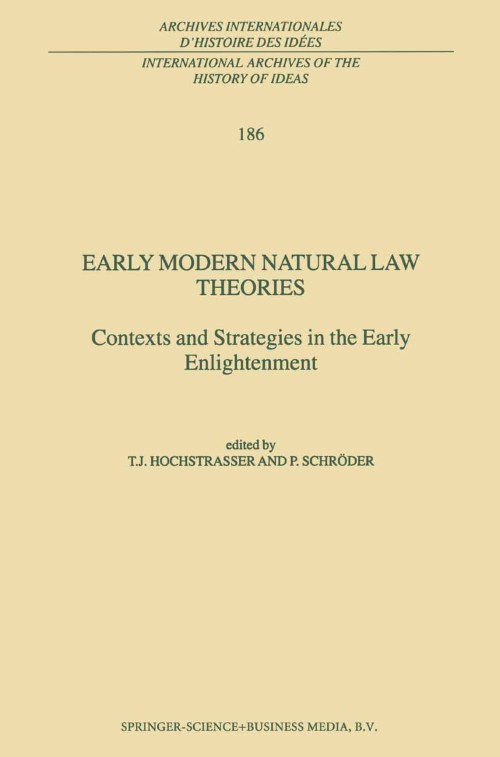
Early Modern Natural Law Theories [electronic resource] : Context and Strategies in the Early Enlightenment / edited by T. Hochstrasser, P. Schröder.
Erişim Adresi
ISBN
9789401703918
Dil Kodu
İngilizce
Yer Numarası
DK/15472
Basım Bildirimi
1st ed. 2003.
Yayın Bilgisi
Dordrecht : Springer Netherlands : Imprint: Springer, 2003.
Fiziksel Niteleme
XVIII, 342 p. online resource.
Dizi
International Archives of the History of Ideas Archives internationales d'histoire des idées, 2215-0307 ; 186
İçindekiler Notu
Before and after Natural Law: Models of Natural Law in Ancient and Modern Times -- Taming the Leviathan — Reading Hobbes in Seventeenth-Century Europe -- Malebranche and Natural Law -- The Reception of Hugo Grotius’s De Jure Belli AC Pacis in the Early German Enlightenment -- Revolution Principles, IUS Naturae, and IUS Gentium in Early-Enlightenment Scotland: The Contribution of Sir Francis Grant, Lord Cullen (C.1660–1726) -- Natural Jurisprudence, Argument from History and Constitutional Struggle in the Early Enlightenment: The Case of Gottlieb Samuel Treuer’s Polemic Against Absolutism in 1719 -- The Love of a Sage or the Command of a Superior: The Natural Law Doctrines of Leibniz and Pufendorf -- Voluntarism and Moral Obligation: Barbeyrac’s Defence of Pufendorf Revisited -- The Politics of Self-Preservation: Toleration and Identity in Pufendorf and Locke -- De Sympathia et Antipathia Rerum: Natural Law, Religion and the Rejection of Mechanistic Science in the Works of Christian Thomasius -- “Decorum” and “Politesse”: Thomasius’s Theory of Civilised Society in Comparative Perspective -- Natural Law and Enlightenment in France and Scotland — A Comparative Perspective -- Notes onContributors.
Özet, vb.
The study of natural law theories in the early Enlightenment continues to be one of the most fruitful areas of research in early modern intellectual history. In recent years there have been substantial reassessments of Grotius, Pufendorf, Thomasius 1 and the whole university-based tradition associated with the Frühaujklärung. The appeal of the discourse of natural jurisprudence to groups and individuals operating outside conventional educational and political structures - such as the Huguenot diaspora - has also been highlighted? Moreover the contextual understanding of the work of unambiguously major philosophers such as Hobbes and Kant - and its reception - has been greatly enhanced by studies that have sought to view them as 3 participants in rather than bystanders alongside the discourse of natural law. Thus thinkers previously not considered central to this discourse have been incorporated into it afresh. However, there is no danger of natural jurisprudence going unchallenged as the meta-discourse of political theory in this period, for recently new studies of the role of libertine and jansenist thought in shaping the priorities of the early Republic of Letters have challenged its position among the intellectual 4 achievements of the social and political theory of the early Enlightenment. This volume therefore offers a timely opportunity to reassess both the coherence of the concept of 'early Enlightenment' and the specific contribution of natural law theories to it.
Konu
History.
Philosophy __ History.
Ontology.
Political science.
History.
History of Philosophy.
Ontology.
Political Science.
Philosophy __ History.
Ontology.
Political science.
History.
History of Philosophy.
Ontology.
Political Science.
Diğer Yazarlar
Kurum Adı
Eseri Alıntıla
Referansları kullanmadan önce gözden geçirmeniz ve varsa gerekli düzeltmeleri yapmanız önerilir.
Dijital Kaynak
MARC Görünümü
LEADER 05662nam a22006375i 4500
001 814233
003 TR_AnAIT
005 20260130220758
007 cr nn 008mamaa
008 130428s2003 ne | s |||| 0|eng d
020 |a9789401703918|9978-94-017-0391-8
024 7 |a10.1007/978-94-017-0391-8|2doi
041 |aeng
049 |aTürk Tarih Kurumu Kütüphanesi
050 4|aD1-2027
072 7|aHB|2bicssc
072 7|aHBAH|2bicssc
072 7|aHIS000000|2bisacsh
072 7|aNH|2thema
072 7|aNHAH|2thema
082 04|a900|223
090 |aDK/15472
245 10|aEarly Modern Natural Law Theories|h[electronic resource] :|bContext and Strategies in the Early Enlightenment /|cedited by T. Hochstrasser, P. Schröder.
250 |a1st ed. 2003.
264 1|aDordrecht :|bSpringer Netherlands :|bImprint: Springer,|c2003.
300 |aXVIII, 342 p.|bonline resource.
336 |atext|btxt|2rdacontent
337 |acomputer|bc|2rdamedia
338 |aonline resource|bcr|2rdacarrier
347 |atext file|bPDF|2rda
490 1 |aInternational Archives of the History of Ideas Archives internationales d'histoire des idées,|x2215-0307 ;|v186
505 0 |aBefore and after Natural Law: Models of Natural Law in Ancient and Modern Times -- Taming the Leviathan — Reading Hobbes in Seventeenth-Century Europe -- Malebranche and Natural Law -- The Reception of Hugo Grotius’s De Jure Belli AC Pacis in the Early German Enlightenment -- Revolution Principles, IUS Naturae, and IUS Gentium in Early-Enlightenment Scotland: The Contribution of Sir Francis Grant, Lord Cullen (C.1660–1726) -- Natural Jurisprudence, Argument from History and Constitutional Struggle in the Early Enlightenment: The Case of Gottlieb Samuel Treuer’s Polemic Against Absolutism in 1719 -- The Love of a Sage or the Command of a Superior: The Natural Law Doctrines of Leibniz and Pufendorf -- Voluntarism and Moral Obligation: Barbeyrac’s Defence of Pufendorf Revisited -- The Politics of Self-Preservation: Toleration and Identity in Pufendorf and Locke -- De Sympathia et Antipathia Rerum: Natural Law, Religion and the Rejection of Mechanistic Science in the Works of Christian Thomasius -- “Decorum” and “Politesse”: Thomasius’s Theory of Civilised Society in Comparative Perspective -- Natural Law and Enlightenment in France and Scotland — A Comparative Perspective -- Notes onContributors.
520 |aThe study of natural law theories in the early Enlightenment continues to be one of the most fruitful areas of research in early modern intellectual history. In recent years there have been substantial reassessments of Grotius, Pufendorf, Thomasius 1 and the whole university-based tradition associated with the Frühaujklärung. The appeal of the discourse of natural jurisprudence to groups and individuals operating outside conventional educational and political structures - such as the Huguenot diaspora - has also been highlighted? Moreover the contextual understanding of the work of unambiguously major philosophers such as Hobbes and Kant - and its reception - has been greatly enhanced by studies that have sought to view them as 3 participants in rather than bystanders alongside the discourse of natural law. Thus thinkers previously not considered central to this discourse have been incorporated into it afresh. However, there is no danger of natural jurisprudence going unchallenged as the meta-discourse of political theory in this period, for recently new studies of the role of libertine and jansenist thought in shaping the priorities of the early Republic of Letters have challenged its position among the intellectual 4 achievements of the social and political theory of the early Enlightenment. This volume therefore offers a timely opportunity to reassess both the coherence of the concept of 'early Enlightenment' and the specific contribution of natural law theories to it.
532 8 |aAccessibility summary: This PDF is not accessible. It is based on scanned pages and does not support features such as screen reader compatibility or described non-text content (images, graphs etc). However, it likely supports searchable and selectable text based on OCR (Optical Character Recognition). Users with accessibility needs may not be able to use this content effectively. Please contact us at accessibilitysupport@springernature.com if you require assistance or an alternative format.
532 8 |aInaccessible, or known limited accessibility
532 8 |aNo reading system accessibility options actively disabled
532 8 |aPublisher contact for further accessibility information: accessibilitysupport@springernature.com
650 0|aHistory.
650 0|aPhilosophy|xHistory.
650 0|aOntology.
650 0|aPolitical science.
650 14|aHistory.
650 24|aHistory of Philosophy.
650 24|aOntology.
650 24|aPolitical Science.
700 1 |aHochstrasser, T.|eeditor.|4edt|4http://id.loc.gov/vocabulary/relators/edt
700 1 |aSchröder, P.|eeditor.|4edt|4http://id.loc.gov/vocabulary/relators/edt
710 2 |aSpringerLink (Online service)
773 0 |tSpringer Nature eBook
776 08|iPrinted edition:|z9781402015694
776 08|iPrinted edition:|z9789048164035
776 08|iPrinted edition:|z9789401703925
830 0|aInternational Archives of the History of Ideas Archives internationales d'histoire des idées,|x2215-0307 ;|v186
856 40|uhttps://doi.org/10.1007/978-94-017-0391-8
912 |aZDB-2-SHU
912 |aZDB-2-SXH
912 |aZDB-2-BAE
950 |aHumanities, Social Sciences and Law (SpringerNature-11648)
950 |aHistory (R0) (SpringerNature-43722)
001 814233
003 TR_AnAIT
005 20260130220758
007 cr nn 008mamaa
008 130428s2003 ne | s |||| 0|eng d
020 |a9789401703918|9978-94-017-0391-8
024 7 |a10.1007/978-94-017-0391-8|2doi
041 |aeng
049 |aTürk Tarih Kurumu Kütüphanesi
050 4|aD1-2027
072 7|aHB|2bicssc
072 7|aHBAH|2bicssc
072 7|aHIS000000|2bisacsh
072 7|aNH|2thema
072 7|aNHAH|2thema
082 04|a900|223
090 |aDK/15472
245 10|aEarly Modern Natural Law Theories|h[electronic resource] :|bContext and Strategies in the Early Enlightenment /|cedited by T. Hochstrasser, P. Schröder.
250 |a1st ed. 2003.
264 1|aDordrecht :|bSpringer Netherlands :|bImprint: Springer,|c2003.
300 |aXVIII, 342 p.|bonline resource.
336 |atext|btxt|2rdacontent
337 |acomputer|bc|2rdamedia
338 |aonline resource|bcr|2rdacarrier
347 |atext file|bPDF|2rda
490 1 |aInternational Archives of the History of Ideas Archives internationales d'histoire des idées,|x2215-0307 ;|v186
505 0 |aBefore and after Natural Law: Models of Natural Law in Ancient and Modern Times -- Taming the Leviathan — Reading Hobbes in Seventeenth-Century Europe -- Malebranche and Natural Law -- The Reception of Hugo Grotius’s De Jure Belli AC Pacis in the Early German Enlightenment -- Revolution Principles, IUS Naturae, and IUS Gentium in Early-Enlightenment Scotland: The Contribution of Sir Francis Grant, Lord Cullen (C.1660–1726) -- Natural Jurisprudence, Argument from History and Constitutional Struggle in the Early Enlightenment: The Case of Gottlieb Samuel Treuer’s Polemic Against Absolutism in 1719 -- The Love of a Sage or the Command of a Superior: The Natural Law Doctrines of Leibniz and Pufendorf -- Voluntarism and Moral Obligation: Barbeyrac’s Defence of Pufendorf Revisited -- The Politics of Self-Preservation: Toleration and Identity in Pufendorf and Locke -- De Sympathia et Antipathia Rerum: Natural Law, Religion and the Rejection of Mechanistic Science in the Works of Christian Thomasius -- “Decorum” and “Politesse”: Thomasius’s Theory of Civilised Society in Comparative Perspective -- Natural Law and Enlightenment in France and Scotland — A Comparative Perspective -- Notes onContributors.
520 |aThe study of natural law theories in the early Enlightenment continues to be one of the most fruitful areas of research in early modern intellectual history. In recent years there have been substantial reassessments of Grotius, Pufendorf, Thomasius 1 and the whole university-based tradition associated with the Frühaujklärung. The appeal of the discourse of natural jurisprudence to groups and individuals operating outside conventional educational and political structures - such as the Huguenot diaspora - has also been highlighted? Moreover the contextual understanding of the work of unambiguously major philosophers such as Hobbes and Kant - and its reception - has been greatly enhanced by studies that have sought to view them as 3 participants in rather than bystanders alongside the discourse of natural law. Thus thinkers previously not considered central to this discourse have been incorporated into it afresh. However, there is no danger of natural jurisprudence going unchallenged as the meta-discourse of political theory in this period, for recently new studies of the role of libertine and jansenist thought in shaping the priorities of the early Republic of Letters have challenged its position among the intellectual 4 achievements of the social and political theory of the early Enlightenment. This volume therefore offers a timely opportunity to reassess both the coherence of the concept of 'early Enlightenment' and the specific contribution of natural law theories to it.
532 8 |aAccessibility summary: This PDF is not accessible. It is based on scanned pages and does not support features such as screen reader compatibility or described non-text content (images, graphs etc). However, it likely supports searchable and selectable text based on OCR (Optical Character Recognition). Users with accessibility needs may not be able to use this content effectively. Please contact us at accessibilitysupport@springernature.com if you require assistance or an alternative format.
532 8 |aInaccessible, or known limited accessibility
532 8 |aNo reading system accessibility options actively disabled
532 8 |aPublisher contact for further accessibility information: accessibilitysupport@springernature.com
650 0|aHistory.
650 0|aPhilosophy|xHistory.
650 0|aOntology.
650 0|aPolitical science.
650 14|aHistory.
650 24|aHistory of Philosophy.
650 24|aOntology.
650 24|aPolitical Science.
700 1 |aHochstrasser, T.|eeditor.|4edt|4http://id.loc.gov/vocabulary/relators/edt
700 1 |aSchröder, P.|eeditor.|4edt|4http://id.loc.gov/vocabulary/relators/edt
710 2 |aSpringerLink (Online service)
773 0 |tSpringer Nature eBook
776 08|iPrinted edition:|z9781402015694
776 08|iPrinted edition:|z9789048164035
776 08|iPrinted edition:|z9789401703925
830 0|aInternational Archives of the History of Ideas Archives internationales d'histoire des idées,|x2215-0307 ;|v186
856 40|uhttps://doi.org/10.1007/978-94-017-0391-8
912 |aZDB-2-SHU
912 |aZDB-2-SXH
912 |aZDB-2-BAE
950 |aHumanities, Social Sciences and Law (SpringerNature-11648)
950 |aHistory (R0) (SpringerNature-43722)
Materyaller
Depodan talep edilen materyal sadece kütüphane içerisinde kullanılmaktadır.
Materyal dışarıya ödünç verilmemektedir.
Materyal dışarıya ödünç verilmemektedir.
