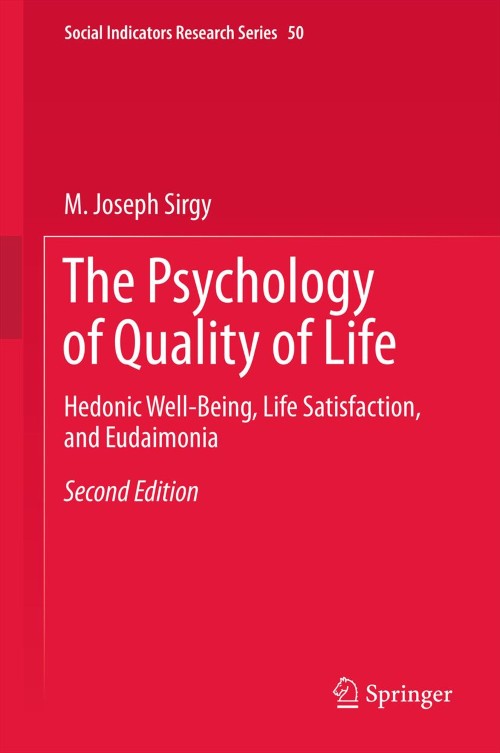
The Psychology of Quality of Life [electronic resource] : Hedonic Well-Being, Life Satisfaction, and Eudaimonia / by M. Joseph Sirgy.
Erişim Adresi
ISBN
9789400744059
Dil Kodu
İngilizce
Yer Numarası
DK/15500
Yazar
Basım Bildirimi
2nd ed. 2012.
Yayın Bilgisi
Dordrecht : Springer Netherlands : Imprint: Springer, 2012.
Fiziksel Niteleme
XXIII, 622 p. online resource.
Dizi
Social Indicators Research Series, 2215-0099 ; 50
İçindekiler Notu
Preface -- Part I: Introduction -- Chapter 1: Philosophical Foundations, Definitions, and Measure -- Chapter 2: Further Distinctions among Major Subjective QOL Concepts -- Chapter 3: Consequences of Hedonic Well-being, Life Satisfaction, and Eudaimonia -- Part II: Objective Reality and Its Effects on Subjective QOL -- Chapter 4: Effects of Socio-Economic, Political, Cultural, and Other Macro Factors on Subjective QOL -- Chapter 5: Effects of Income and Wealth on Subjective QOL -- Chapter 6: Effects of Other Demographic Factors on QOL -- Chapter 7: Effects of Personal Activities on Subjective QOL -- Chapter 8: Effects of Genetics, Health, Biology, the Environment, and Drugs on Subjective QOL -- Part III: Subjective Reality and Its Effects on Subjective QOL -- Chapter 9: Effects of Personality on Subjective QOL -- Chapter 10: Effects of Affect and Cognition on Subjective QOL -- Chapter 11: Effects of Values on Subjective QOL -- Chapter 12: Effects of Needs and Need Satisfaction on Subjective QOL -- Chapter 13: Effects of Goals on Subjective QOL -- Chapter 14: Effects of Self-Concept on Subjective QOL -- Chapter 15: Effects of Social Comparisons on Subjective QOL -- Part IV: Life Domains and Their Effects on Subjective QOL -- Chapter 16: Domain Dynamics -- Chapter 17: Work Well-Being -- Chapter 18: Residential Well-Being -- Chapter 19: Material Well-Being -- Chapter 20: Social, Family, and Marital Well-Being -- Chapter 21: Health Well-Being -- Chapter 22: Leisure Well-Being -- Chapter 23: Other Life Domains Varying in Salience -- Part V: Population Groups and QOL -- Chapter 24: Children, Youth, and College Students and Subjective QOL -- Chapter 25: The Elderly and Subjective QOL -- Chapter 26: Women and Subjective QOL -- Chapter 27: Countries and Subjective QOL -- Chapter 28: Other Population Segments and Subjective QOL -- Part VI: Epilogue -- Chapter 29: Integrative Theories of Subjective QOL -- Chapter 30: Final Thoughts about Subjective QOL -- Appendix: Measurement Issues -- References -- Index -- About the Author.
Özet, vb.
The updated edition of this popular book covers up-to-date research on hedonic well-being (emotional well-being, positive/negative affect, affective dimension of happiness, etc.), life satisfaction (subjective well-being, perceived quality of life, subjective well-being, and cognitive dimension of happiness), and eudaimonia (psychological well-being, self-actualization, self-realization, growth, mental health, character strengths, etc.). The book is divided in six major sections. Part 1 begins with a chapter that covers much of the history and philosophical foundations of the psychology of quality of life in terms of three major pillars: hedonic well-being, life satisfaction, and eudaimonia. This part also covers much of the research that has successfully made distinctions among these three major constructs and its varied dimensions. To establish to the importance of the topic (the psychology of quality of life), this part also covers much of the literature on the positive benefits of hedonic well-being, life satisfaction, and eudaimonia on the individual, the community, organizations, and society at large. Part 2 focuses on capturing much of research dealing with the effects of objective reality (objective factors grounded in real, environmental conditions) on hedonic well-being, life satisfaction, and eudaimonia. Specifically, this part captures the quality-of-life literature related to biological and health-related effects, income effects, other demographic effects, effects of personal activities, and socio-cultural effects. Part 3 shifts gears to focus on the effects of subjective reality on hedonic well-being, life satisfaction, and eudaimonia. In this context, the book reviews research on personality effects, effects of affect and cognition, effects of beliefs and values,effects of goals, self-concept effects, and social comparison effects. Part 4 focuses on quality-of-life research that is domain specific. That is, the book covers the research on the psychology of life domains in general and delves in some depth to describe research on work well-being, residential well-being, material well-being, social well-being, health well-being, leisure well-being, and the well-being of other life domains of lesser salience. Part 5 focuses on covering much of the psychology of quality-of-life literature dealing with specific populations such as the elderly, women, children and youth, and specific countries. Part 6 is essentially an epilogue. This part discusses a variety of theories proposed by quality-of-life scholars designed to integrate much of the literature on the psychology of quality of life. The last chapter covers the author’s own integrative theory. M. Joseph Sirgy is a social/consumer/organizational psychologist who has written extensively on quality-of-life research. He is the co-founder of the International Society for Quality-of-Life Studies (ISQOLS, www.isqols.org), has served as ISQOLS’ executive director for many years, and is currently ISQOLS development director. He also served as editor-in-chief of Applied Research in Quality of Life, ISQOLS’ flagship journal. ISQOLS has honored him as the Distinguished Quality-of-Life Research for research excellence and a record of lifetime achievement in quality-of-life research.
Konu
Quality of life.
Clinical health psychology.
Quality of Life Research.
Health Psychology.
Clinical health psychology.
Quality of Life Research.
Health Psychology.
Kurum Adı

Eseri Alıntıla
Referansları kullanmadan önce gözden geçirmeniz ve varsa gerekli düzeltmeleri yapmanız önerilir.
Dijital Kaynak
MARC Görünümü
LEADER 07212nam a22005175i 4500
001 814261
003 TR_AnAIT
005 20260130220607
007 cr nn 008mamaa
008 120619s2012 ne | s |||| 0|eng d
020 |a9789400744059|9978-94-007-4405-9
024 7 |a10.1007/978-94-007-4405-9|2doi
041 |aeng
049 |aTürk Tarih Kurumu Kütüphanesi
050 4|aRA407-409.5
050 4|aHN25
072 7|aMBNH|2bicssc
072 7|aMED003000|2bisacsh
072 7|aMBNH|2thema
082 04|a610|223
082 04|a306|223
090 |aDK/15500
100 1 |aSirgy, M. Joseph.|eauthor.|4aut|4http://id.loc.gov/vocabulary/relators/aut
245 14|aThe Psychology of Quality of Life|h[electronic resource] :|bHedonic Well-Being, Life Satisfaction, and Eudaimonia /|cby M. Joseph Sirgy.
250 |a2nd ed. 2012.
264 1|aDordrecht :|bSpringer Netherlands :|bImprint: Springer,|c2012.
300 |aXXIII, 622 p.|bonline resource.
336 |atext|btxt|2rdacontent
337 |acomputer|bc|2rdamedia
338 |aonline resource|bcr|2rdacarrier
347 |atext file|bPDF|2rda
490 1 |aSocial Indicators Research Series,|x2215-0099 ;|v50
505 0 |aPreface -- Part I: Introduction -- Chapter 1: Philosophical Foundations, Definitions, and Measure -- Chapter 2: Further Distinctions among Major Subjective QOL Concepts -- Chapter 3: Consequences of Hedonic Well-being, Life Satisfaction, and Eudaimonia -- Part II: Objective Reality and Its Effects on Subjective QOL -- Chapter 4: Effects of Socio-Economic, Political, Cultural, and Other Macro Factors on Subjective QOL -- Chapter 5: Effects of Income and Wealth on Subjective QOL -- Chapter 6: Effects of Other Demographic Factors on QOL -- Chapter 7: Effects of Personal Activities on Subjective QOL -- Chapter 8: Effects of Genetics, Health, Biology, the Environment, and Drugs on Subjective QOL -- Part III: Subjective Reality and Its Effects on Subjective QOL -- Chapter 9: Effects of Personality on Subjective QOL -- Chapter 10: Effects of Affect and Cognition on Subjective QOL -- Chapter 11: Effects of Values on Subjective QOL -- Chapter 12: Effects of Needs and Need Satisfaction on Subjective QOL -- Chapter 13: Effects of Goals on Subjective QOL -- Chapter 14: Effects of Self-Concept on Subjective QOL -- Chapter 15: Effects of Social Comparisons on Subjective QOL -- Part IV: Life Domains and Their Effects on Subjective QOL -- Chapter 16: Domain Dynamics -- Chapter 17: Work Well-Being -- Chapter 18: Residential Well-Being -- Chapter 19: Material Well-Being -- Chapter 20: Social, Family, and Marital Well-Being -- Chapter 21: Health Well-Being -- Chapter 22: Leisure Well-Being -- Chapter 23: Other Life Domains Varying in Salience -- Part V: Population Groups and QOL -- Chapter 24: Children, Youth, and College Students and Subjective QOL -- Chapter 25: The Elderly and Subjective QOL -- Chapter 26: Women and Subjective QOL -- Chapter 27: Countries and Subjective QOL -- Chapter 28: Other Population Segments and Subjective QOL -- Part VI: Epilogue -- Chapter 29: Integrative Theories of Subjective QOL -- Chapter 30: Final Thoughts about Subjective QOL -- Appendix: Measurement Issues -- References -- Index -- About the Author.
520 |aThe updated edition of this popular book covers up-to-date research on hedonic well-being (emotional well-being, positive/negative affect, affective dimension of happiness, etc.), life satisfaction (subjective well-being, perceived quality of life, subjective well-being, and cognitive dimension of happiness), and eudaimonia (psychological well-being, self-actualization, self-realization, growth, mental health, character strengths, etc.). The book is divided in six major sections. Part 1 begins with a chapter that covers much of the history and philosophical foundations of the psychology of quality of life in terms of three major pillars: hedonic well-being, life satisfaction, and eudaimonia. This part also covers much of the research that has successfully made distinctions among these three major constructs and its varied dimensions. To establish to the importance of the topic (the psychology of quality of life), this part also covers much of the literature on the positive benefits of hedonic well-being, life satisfaction, and eudaimonia on the individual, the community, organizations, and society at large. Part 2 focuses on capturing much of research dealing with the effects of objective reality (objective factors grounded in real, environmental conditions) on hedonic well-being, life satisfaction, and eudaimonia. Specifically, this part captures the quality-of-life literature related to biological and health-related effects, income effects, other demographic effects, effects of personal activities, and socio-cultural effects. Part 3 shifts gears to focus on the effects of subjective reality on hedonic well-being, life satisfaction, and eudaimonia. In this context, the book reviews research on personality effects, effects of affect and cognition, effects of beliefs and values,effects of goals, self-concept effects, and social comparison effects. Part 4 focuses on quality-of-life research that is domain specific. That is, the book covers the research on the psychology of life domains in general and delves in some depth to describe research on work well-being, residential well-being, material well-being, social well-being, health well-being, leisure well-being, and the well-being of other life domains of lesser salience. Part 5 focuses on covering much of the psychology of quality-of-life literature dealing with specific populations such as the elderly, women, children and youth, and specific countries. Part 6 is essentially an epilogue. This part discusses a variety of theories proposed by quality-of-life scholars designed to integrate much of the literature on the psychology of quality of life. The last chapter covers the author’s own integrative theory. M. Joseph Sirgy is a social/consumer/organizational psychologist who has written extensively on quality-of-life research. He is the co-founder of the International Society for Quality-of-Life Studies (ISQOLS, www.isqols.org), has served as ISQOLS’ executive director for many years, and is currently ISQOLS development director. He also served as editor-in-chief of Applied Research in Quality of Life, ISQOLS’ flagship journal. ISQOLS has honored him as the Distinguished Quality-of-Life Research for research excellence and a record of lifetime achievement in quality-of-life research.
650 0|aQuality of life.
650 0|aClinical health psychology.
650 14|aQuality of Life Research.
650 24|aHealth Psychology.
710 2 |aSpringerLink (Online service)
773 0 |tSpringer Nature eBook
776 08|iPrinted edition:|z9789400744042
776 08|iPrinted edition:|z9789400744066
776 08|iPrinted edition:|z9789400799301
830 0|aSocial Indicators Research Series,|x2215-0099 ;|v50
856 40|uhttps://doi.org/10.1007/978-94-007-4405-9
912 |aZDB-2-SHU
912 |aZDB-2-SXS
950 |aHumanities, Social Sciences and Law (SpringerNature-11648)
950 |aSocial Sciences (R0) (SpringerNature-43726)
001 814261
003 TR_AnAIT
005 20260130220607
007 cr nn 008mamaa
008 120619s2012 ne | s |||| 0|eng d
020 |a9789400744059|9978-94-007-4405-9
024 7 |a10.1007/978-94-007-4405-9|2doi
041 |aeng
049 |aTürk Tarih Kurumu Kütüphanesi
050 4|aRA407-409.5
050 4|aHN25
072 7|aMBNH|2bicssc
072 7|aMED003000|2bisacsh
072 7|aMBNH|2thema
082 04|a610|223
082 04|a306|223
090 |aDK/15500
100 1 |aSirgy, M. Joseph.|eauthor.|4aut|4http://id.loc.gov/vocabulary/relators/aut
245 14|aThe Psychology of Quality of Life|h[electronic resource] :|bHedonic Well-Being, Life Satisfaction, and Eudaimonia /|cby M. Joseph Sirgy.
250 |a2nd ed. 2012.
264 1|aDordrecht :|bSpringer Netherlands :|bImprint: Springer,|c2012.
300 |aXXIII, 622 p.|bonline resource.
336 |atext|btxt|2rdacontent
337 |acomputer|bc|2rdamedia
338 |aonline resource|bcr|2rdacarrier
347 |atext file|bPDF|2rda
490 1 |aSocial Indicators Research Series,|x2215-0099 ;|v50
505 0 |aPreface -- Part I: Introduction -- Chapter 1: Philosophical Foundations, Definitions, and Measure -- Chapter 2: Further Distinctions among Major Subjective QOL Concepts -- Chapter 3: Consequences of Hedonic Well-being, Life Satisfaction, and Eudaimonia -- Part II: Objective Reality and Its Effects on Subjective QOL -- Chapter 4: Effects of Socio-Economic, Political, Cultural, and Other Macro Factors on Subjective QOL -- Chapter 5: Effects of Income and Wealth on Subjective QOL -- Chapter 6: Effects of Other Demographic Factors on QOL -- Chapter 7: Effects of Personal Activities on Subjective QOL -- Chapter 8: Effects of Genetics, Health, Biology, the Environment, and Drugs on Subjective QOL -- Part III: Subjective Reality and Its Effects on Subjective QOL -- Chapter 9: Effects of Personality on Subjective QOL -- Chapter 10: Effects of Affect and Cognition on Subjective QOL -- Chapter 11: Effects of Values on Subjective QOL -- Chapter 12: Effects of Needs and Need Satisfaction on Subjective QOL -- Chapter 13: Effects of Goals on Subjective QOL -- Chapter 14: Effects of Self-Concept on Subjective QOL -- Chapter 15: Effects of Social Comparisons on Subjective QOL -- Part IV: Life Domains and Their Effects on Subjective QOL -- Chapter 16: Domain Dynamics -- Chapter 17: Work Well-Being -- Chapter 18: Residential Well-Being -- Chapter 19: Material Well-Being -- Chapter 20: Social, Family, and Marital Well-Being -- Chapter 21: Health Well-Being -- Chapter 22: Leisure Well-Being -- Chapter 23: Other Life Domains Varying in Salience -- Part V: Population Groups and QOL -- Chapter 24: Children, Youth, and College Students and Subjective QOL -- Chapter 25: The Elderly and Subjective QOL -- Chapter 26: Women and Subjective QOL -- Chapter 27: Countries and Subjective QOL -- Chapter 28: Other Population Segments and Subjective QOL -- Part VI: Epilogue -- Chapter 29: Integrative Theories of Subjective QOL -- Chapter 30: Final Thoughts about Subjective QOL -- Appendix: Measurement Issues -- References -- Index -- About the Author.
520 |aThe updated edition of this popular book covers up-to-date research on hedonic well-being (emotional well-being, positive/negative affect, affective dimension of happiness, etc.), life satisfaction (subjective well-being, perceived quality of life, subjective well-being, and cognitive dimension of happiness), and eudaimonia (psychological well-being, self-actualization, self-realization, growth, mental health, character strengths, etc.). The book is divided in six major sections. Part 1 begins with a chapter that covers much of the history and philosophical foundations of the psychology of quality of life in terms of three major pillars: hedonic well-being, life satisfaction, and eudaimonia. This part also covers much of the research that has successfully made distinctions among these three major constructs and its varied dimensions. To establish to the importance of the topic (the psychology of quality of life), this part also covers much of the literature on the positive benefits of hedonic well-being, life satisfaction, and eudaimonia on the individual, the community, organizations, and society at large. Part 2 focuses on capturing much of research dealing with the effects of objective reality (objective factors grounded in real, environmental conditions) on hedonic well-being, life satisfaction, and eudaimonia. Specifically, this part captures the quality-of-life literature related to biological and health-related effects, income effects, other demographic effects, effects of personal activities, and socio-cultural effects. Part 3 shifts gears to focus on the effects of subjective reality on hedonic well-being, life satisfaction, and eudaimonia. In this context, the book reviews research on personality effects, effects of affect and cognition, effects of beliefs and values,effects of goals, self-concept effects, and social comparison effects. Part 4 focuses on quality-of-life research that is domain specific. That is, the book covers the research on the psychology of life domains in general and delves in some depth to describe research on work well-being, residential well-being, material well-being, social well-being, health well-being, leisure well-being, and the well-being of other life domains of lesser salience. Part 5 focuses on covering much of the psychology of quality-of-life literature dealing with specific populations such as the elderly, women, children and youth, and specific countries. Part 6 is essentially an epilogue. This part discusses a variety of theories proposed by quality-of-life scholars designed to integrate much of the literature on the psychology of quality of life. The last chapter covers the author’s own integrative theory. M. Joseph Sirgy is a social/consumer/organizational psychologist who has written extensively on quality-of-life research. He is the co-founder of the International Society for Quality-of-Life Studies (ISQOLS, www.isqols.org), has served as ISQOLS’ executive director for many years, and is currently ISQOLS development director. He also served as editor-in-chief of Applied Research in Quality of Life, ISQOLS’ flagship journal. ISQOLS has honored him as the Distinguished Quality-of-Life Research for research excellence and a record of lifetime achievement in quality-of-life research.
650 0|aQuality of life.
650 0|aClinical health psychology.
650 14|aQuality of Life Research.
650 24|aHealth Psychology.
710 2 |aSpringerLink (Online service)
773 0 |tSpringer Nature eBook
776 08|iPrinted edition:|z9789400744042
776 08|iPrinted edition:|z9789400744066
776 08|iPrinted edition:|z9789400799301
830 0|aSocial Indicators Research Series,|x2215-0099 ;|v50
856 40|uhttps://doi.org/10.1007/978-94-007-4405-9
912 |aZDB-2-SHU
912 |aZDB-2-SXS
950 |aHumanities, Social Sciences and Law (SpringerNature-11648)
950 |aSocial Sciences (R0) (SpringerNature-43726)
Materyaller
Depodan talep edilen materyal sadece kütüphane içerisinde kullanılmaktadır.
Materyal dışarıya ödünç verilmemektedir.
