

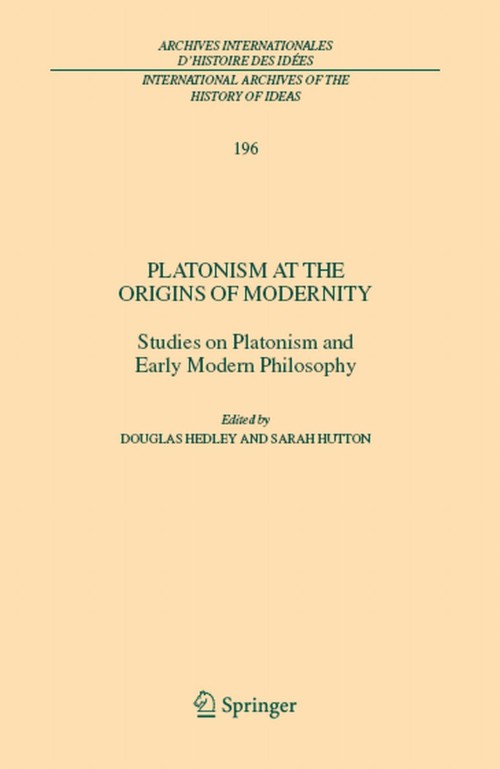
Platonism at the Origins of Modernity [electronic resource] : Studies on Platonism and Early Modern Philosophy / edited by Douglas Hedley, Sarah Hutton.
Erişim Adresi
ISBN
9781402064074
Dil Kodu
İngilizce
Yer Numarası
DK/15521
Basım Bildirimi
1st ed. 2008.
Yayın Bilgisi
Dordrecht : Springer Netherlands : Imprint: Springer, 2008.
Fiziksel Niteleme
X, 296 p. online resource.
Dizi
International Archives of the History of Ideas Archives internationales d'histoire des idées, 2215-0307 ; 196
İçindekiler Notu
Nicholas of Cusa (1401–1464): Platonism at the Dawn of Modernity -- At Variance: Marsilio Ficino, Platonism and Heresy -- Going Naked into the Shrine: Herbert, Plotinus and the Constructive Metaphor -- Comenius, Light Metaphysics and Educational Reform -- Robert Fludd’s Kabbalistic Cosmos -- Reconciling Theory and Fact: The Problem of ‘Other Faiths’ in Lord Herbert and the Cambridge Platonists -- Trinity, Community and Love: Cudworth’s Platonism and the Idea of God -- Chaos and Order in Cudworth’s Thought -- Cudworth, Prior and Passmore on the Autonomy of Ethics -- Substituting Aristotle: Platonic Themes in Dutch Cartesianism -- Soul, Body and World: Plato’s Timaeus and Descartes’ Meditations -- Locke, Plato and Platonism -- Reflections on Locke’s Platonism -- The Platonism at the Core of Leibniz’s Philosophy -- Leibniz and Berkeley: Platonic Metaphysics and ‘The Mechanical Philosophy’ -- Which Platonism for Which Modernity? A Note on Shaftesbury’s Socratic Sea-Cards -- Platonism, Aesthetics and the Sublime at the Origins of Modernity.
Özet, vb.
commentary, but by selection and accretion. Those inspired by Plato form as intrinsic a part of Platonism as Plato himself—these are the so-called Neo-P- tonists (a divisive latter-day term which implies discontinuity between Plato and 6 his later followers to the disadvantage of the latter). In the process of its long course of development, Platonism has gathered a long tradition of interpr- ers, whose contributions have been enriched by other philosophical strands—for example Stoicism, which is an important element in the philosophy of Plotinus. To this it must be added that so much of the impact of Platonism is indirect. The Platonism of many thinkers, especially in medieval times, was more often than not implicit, rather than conscious borrowing. It derived not from the Platonic corpus (most of which was unknown at that time), but indirectly through Philo, and theologians like Augustine and Origen. The combined effect of these factors is that the legacy of Platonism is rich, varied and extensive, but eludes the scope of focused enquiry. A further factor complicating assessments of Platonism in the modern era, is polarisation in the historiography itself. Historians of modern philosophy—at least in the anglophone world—readily adopt a model which counterposes ancient and modern. Drawing on a division, which the early modern philosophers themselves invoked, they employ an ‘ancient- 7 modern distinction’ as a principle for organising the history of philosophy.
Konu
Philosophy, Ancient.
Philosophy.
Ancient Philosophy / Classical Philosophy.
Philosophy.
Philosophy.
Ancient Philosophy / Classical Philosophy.
Philosophy.
Diğer Yazarlar
Kurum Adı
Eseri Alıntıla
Referansları kullanmadan önce gözden geçirmeniz ve varsa gerekli düzeltmeleri yapmanız önerilir.
Dijital Kaynak
MARC Görünümü
LEADER 04591nam a22005055i 4500
001 814282
003 TR_AnAIT
005 20260130220519
007 cr nn 008mamaa
008 100301s2008 ne | s |||| 0|eng d
020 |a9781402064074|9978-1-4020-6407-4
024 7 |a10.1007/978-1-4020-6407-4|2doi
041 |aeng
049 |aTürk Tarih Kurumu Kütüphanesi
050 4|aB108-708
072 7|aHPCA|2bicssc
072 7|aPHI002000|2bisacsh
072 7|aQDHA|2thema
082 04|a180.0901|223
090 |aDK/15521
245 10|aPlatonism at the Origins of Modernity|h[electronic resource] :|bStudies on Platonism and Early Modern Philosophy /|cedited by Douglas Hedley, Sarah Hutton.
250 |a1st ed. 2008.
264 1|aDordrecht :|bSpringer Netherlands :|bImprint: Springer,|c2008.
300 |aX, 296 p.|bonline resource.
336 |atext|btxt|2rdacontent
337 |acomputer|bc|2rdamedia
338 |aonline resource|bcr|2rdacarrier
347 |atext file|bPDF|2rda
490 1 |aInternational Archives of the History of Ideas Archives internationales d'histoire des idées,|x2215-0307 ;|v196
505 0 |aNicholas of Cusa (1401–1464): Platonism at the Dawn of Modernity -- At Variance: Marsilio Ficino, Platonism and Heresy -- Going Naked into the Shrine: Herbert, Plotinus and the Constructive Metaphor -- Comenius, Light Metaphysics and Educational Reform -- Robert Fludd’s Kabbalistic Cosmos -- Reconciling Theory and Fact: The Problem of ‘Other Faiths’ in Lord Herbert and the Cambridge Platonists -- Trinity, Community and Love: Cudworth’s Platonism and the Idea of God -- Chaos and Order in Cudworth’s Thought -- Cudworth, Prior and Passmore on the Autonomy of Ethics -- Substituting Aristotle: Platonic Themes in Dutch Cartesianism -- Soul, Body and World: Plato’s Timaeus and Descartes’ Meditations -- Locke, Plato and Platonism -- Reflections on Locke’s Platonism -- The Platonism at the Core of Leibniz’s Philosophy -- Leibniz and Berkeley: Platonic Metaphysics and ‘The Mechanical Philosophy’ -- Which Platonism for Which Modernity? A Note on Shaftesbury’s Socratic Sea-Cards -- Platonism, Aesthetics and the Sublime at the Origins of Modernity.
520 |acommentary, but by selection and accretion. Those inspired by Plato form as intrinsic a part of Platonism as Plato himself—these are the so-called Neo-P- tonists (a divisive latter-day term which implies discontinuity between Plato and 6 his later followers to the disadvantage of the latter). In the process of its long course of development, Platonism has gathered a long tradition of interpr- ers, whose contributions have been enriched by other philosophical strands—for example Stoicism, which is an important element in the philosophy of Plotinus. To this it must be added that so much of the impact of Platonism is indirect. The Platonism of many thinkers, especially in medieval times, was more often than not implicit, rather than conscious borrowing. It derived not from the Platonic corpus (most of which was unknown at that time), but indirectly through Philo, and theologians like Augustine and Origen. The combined effect of these factors is that the legacy of Platonism is rich, varied and extensive, but eludes the scope of focused enquiry. A further factor complicating assessments of Platonism in the modern era, is polarisation in the historiography itself. Historians of modern philosophy—at least in the anglophone world—readily adopt a model which counterposes ancient and modern. Drawing on a division, which the early modern philosophers themselves invoked, they employ an ‘ancient- 7 modern distinction’ as a principle for organising the history of philosophy.
650 0|aPhilosophy, Ancient.
650 0|aPhilosophy.
650 14|aAncient Philosophy / Classical Philosophy.
650 24|aPhilosophy.
700 1 |aHedley, Douglas.|eeditor.|4edt|4http://id.loc.gov/vocabulary/relators/edt
700 1 |aHutton, Sarah.|eeditor.|4edt|4http://id.loc.gov/vocabulary/relators/edt
710 2 |aSpringerLink (Online service)
773 0 |tSpringer Nature eBook
776 08|iPrinted edition:|z9781402064067
776 08|iPrinted edition:|z9789048114788
776 08|iPrinted edition:|z9789048176298
830 0|aInternational Archives of the History of Ideas Archives internationales d'histoire des idées,|x2215-0307 ;|v196
856 40|uhttps://doi.org/10.1007/978-1-4020-6407-4
912 |aZDB-2-SHU
912 |aZDB-2-SXPR
950 |aHumanities, Social Sciences and Law (SpringerNature-11648)
950 |aPhilosophy and Religion (R0) (SpringerNature-43725)
001 814282
003 TR_AnAIT
005 20260130220519
007 cr nn 008mamaa
008 100301s2008 ne | s |||| 0|eng d
020 |a9781402064074|9978-1-4020-6407-4
024 7 |a10.1007/978-1-4020-6407-4|2doi
041 |aeng
049 |aTürk Tarih Kurumu Kütüphanesi
050 4|aB108-708
072 7|aHPCA|2bicssc
072 7|aPHI002000|2bisacsh
072 7|aQDHA|2thema
082 04|a180.0901|223
090 |aDK/15521
245 10|aPlatonism at the Origins of Modernity|h[electronic resource] :|bStudies on Platonism and Early Modern Philosophy /|cedited by Douglas Hedley, Sarah Hutton.
250 |a1st ed. 2008.
264 1|aDordrecht :|bSpringer Netherlands :|bImprint: Springer,|c2008.
300 |aX, 296 p.|bonline resource.
336 |atext|btxt|2rdacontent
337 |acomputer|bc|2rdamedia
338 |aonline resource|bcr|2rdacarrier
347 |atext file|bPDF|2rda
490 1 |aInternational Archives of the History of Ideas Archives internationales d'histoire des idées,|x2215-0307 ;|v196
505 0 |aNicholas of Cusa (1401–1464): Platonism at the Dawn of Modernity -- At Variance: Marsilio Ficino, Platonism and Heresy -- Going Naked into the Shrine: Herbert, Plotinus and the Constructive Metaphor -- Comenius, Light Metaphysics and Educational Reform -- Robert Fludd’s Kabbalistic Cosmos -- Reconciling Theory and Fact: The Problem of ‘Other Faiths’ in Lord Herbert and the Cambridge Platonists -- Trinity, Community and Love: Cudworth’s Platonism and the Idea of God -- Chaos and Order in Cudworth’s Thought -- Cudworth, Prior and Passmore on the Autonomy of Ethics -- Substituting Aristotle: Platonic Themes in Dutch Cartesianism -- Soul, Body and World: Plato’s Timaeus and Descartes’ Meditations -- Locke, Plato and Platonism -- Reflections on Locke’s Platonism -- The Platonism at the Core of Leibniz’s Philosophy -- Leibniz and Berkeley: Platonic Metaphysics and ‘The Mechanical Philosophy’ -- Which Platonism for Which Modernity? A Note on Shaftesbury’s Socratic Sea-Cards -- Platonism, Aesthetics and the Sublime at the Origins of Modernity.
520 |acommentary, but by selection and accretion. Those inspired by Plato form as intrinsic a part of Platonism as Plato himself—these are the so-called Neo-P- tonists (a divisive latter-day term which implies discontinuity between Plato and 6 his later followers to the disadvantage of the latter). In the process of its long course of development, Platonism has gathered a long tradition of interpr- ers, whose contributions have been enriched by other philosophical strands—for example Stoicism, which is an important element in the philosophy of Plotinus. To this it must be added that so much of the impact of Platonism is indirect. The Platonism of many thinkers, especially in medieval times, was more often than not implicit, rather than conscious borrowing. It derived not from the Platonic corpus (most of which was unknown at that time), but indirectly through Philo, and theologians like Augustine and Origen. The combined effect of these factors is that the legacy of Platonism is rich, varied and extensive, but eludes the scope of focused enquiry. A further factor complicating assessments of Platonism in the modern era, is polarisation in the historiography itself. Historians of modern philosophy—at least in the anglophone world—readily adopt a model which counterposes ancient and modern. Drawing on a division, which the early modern philosophers themselves invoked, they employ an ‘ancient- 7 modern distinction’ as a principle for organising the history of philosophy.
650 0|aPhilosophy, Ancient.
650 0|aPhilosophy.
650 14|aAncient Philosophy / Classical Philosophy.
650 24|aPhilosophy.
700 1 |aHedley, Douglas.|eeditor.|4edt|4http://id.loc.gov/vocabulary/relators/edt
700 1 |aHutton, Sarah.|eeditor.|4edt|4http://id.loc.gov/vocabulary/relators/edt
710 2 |aSpringerLink (Online service)
773 0 |tSpringer Nature eBook
776 08|iPrinted edition:|z9781402064067
776 08|iPrinted edition:|z9789048114788
776 08|iPrinted edition:|z9789048176298
830 0|aInternational Archives of the History of Ideas Archives internationales d'histoire des idées,|x2215-0307 ;|v196
856 40|uhttps://doi.org/10.1007/978-1-4020-6407-4
912 |aZDB-2-SHU
912 |aZDB-2-SXPR
950 |aHumanities, Social Sciences and Law (SpringerNature-11648)
950 |aPhilosophy and Religion (R0) (SpringerNature-43725)
Materyaller
Depodan talep edilen materyal sadece kütüphane içerisinde kullanılmaktadır.
Materyal dışarıya ödünç verilmemektedir.
Materyal dışarıya ödünç verilmemektedir.
