

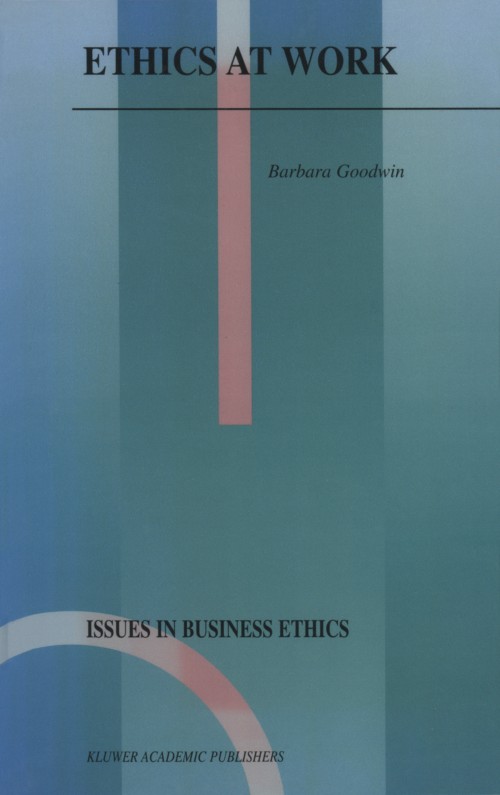
Ethics at Work [electronic resource] / by Barbara Goodwin.
Erişim Adresi
ISBN
9789401093316
Dil Kodu
İngilizce
Yer Numarası
DK/15526
Yazar
Basım Bildirimi
1st ed. 2000.
Yayın Bilgisi
Dordrecht : Springer Netherlands : Imprint: Springer, 2000.
Fiziksel Niteleme
264 p. online resource.
Dizi
Issues in Business Ethics, 2215-1680 ; 16
İçindekiler Notu
1. Moral Questions -- 2. Ethos or Code? -- The Participating Organisations -- The Public Service Ethos -- Codes of Conduct -- Conclusions -- 3. Personal Morality at Work -- Ethical Issues -- Moral Beliefs -- Dilemmas and Conflicts at Work -- Whistleblowing -- Conclusions -- 4. Topical Ethical Questions -- Ethics and Democracy -- Equal Opportunities and Discrimination -- The Ethical Role of Unions -- Privatisation and Ethics -- 5. Responsibility at Work -- Problems of Responsibility -- Perceptions of Responsibility -- Individual Responsibility and Organisational Structure -- 6. The Moral Organisation -- Perceptions of the Organisations -- Attitudes to Empowerment -- The Value of Procedures -- What Makes a Moral Organisation? -- References.
Özet, vb.
What would tempt you to whistleblow? Do Codes of Conduct make organisations ethical? How do people react to taking the blame for others? This book answers such questions, drawing on the views of employees in eight large organisations. One finding is the `whited sepulchre phenomenon': an organisation which presents a squeaky-clean image to the world but has intrinsic failings which cause moral dilemmas for staff. While treatment of customers is regulated by Codes and Charters, internal organisation is typically more anarchic. The study also exposes the moral conflicts generated by party-political machinations in organisations with democratic governance. The book offers a unique perspective on ethical attitudes at work and reactions to responsibility and accountability. It finds that, although religious belief is declining, strong moral beliefs still thrive and `ethical employees' abound. It highlights the importance of empowerment, procedures, and professionalism in creating the `moral organisation'. This original study will interest practitioners in business, the public sector and NGOs, especially human resources professionals, as well as philosophers and business ethicists.
Konu
Ethics.
Ontology.
Personnel management.
Management.
Moral Philosophy and Applied Ethics.
Ontology.
Human Resource Management.
Management.
Ontology.
Personnel management.
Management.
Moral Philosophy and Applied Ethics.
Ontology.
Human Resource Management.
Management.
Kurum Adı
Eseri Alıntıla
Referansları kullanmadan önce gözden geçirmeniz ve varsa gerekli düzeltmeleri yapmanız önerilir.
Dijital Kaynak
MARC Görünümü
LEADER 04529nam a22006015i 4500
001 814287
003 TR_AnAIT
005 20260130220513
007 cr nn 008mamaa
008 121227s2000 ne | s |||| 0|eng d
020 |a9789401093316|9978-94-010-9331-6
024 7 |a10.1007/978-94-010-9331-6|2doi
041 |aeng
049 |aTürk Tarih Kurumu Kütüphanesi
050 4|aBJ1-1725
072 7|aHPQ|2bicssc
072 7|aPHI005000|2bisacsh
072 7|aQDTQ|2thema
082 04|a170|223
090 |aDK/15526
100 1 |aGoodwin, Barbara.|eauthor.|4aut|4http://id.loc.gov/vocabulary/relators/aut
245 10|aEthics at Work|h[electronic resource] /|cby Barbara Goodwin.
250 |a1st ed. 2000.
264 1|aDordrecht :|bSpringer Netherlands :|bImprint: Springer,|c2000.
300 |a264 p.|bonline resource.
336 |atext|btxt|2rdacontent
337 |acomputer|bc|2rdamedia
338 |aonline resource|bcr|2rdacarrier
347 |atext file|bPDF|2rda
490 1 |aIssues in Business Ethics,|x2215-1680 ;|v16
505 0 |a1. Moral Questions -- 2. Ethos or Code? -- The Participating Organisations -- The Public Service Ethos -- Codes of Conduct -- Conclusions -- 3. Personal Morality at Work -- Ethical Issues -- Moral Beliefs -- Dilemmas and Conflicts at Work -- Whistleblowing -- Conclusions -- 4. Topical Ethical Questions -- Ethics and Democracy -- Equal Opportunities and Discrimination -- The Ethical Role of Unions -- Privatisation and Ethics -- 5. Responsibility at Work -- Problems of Responsibility -- Perceptions of Responsibility -- Individual Responsibility and Organisational Structure -- 6. The Moral Organisation -- Perceptions of the Organisations -- Attitudes to Empowerment -- The Value of Procedures -- What Makes a Moral Organisation? -- References.
520 |aWhat would tempt you to whistleblow? Do Codes of Conduct make organisations ethical? How do people react to taking the blame for others? This book answers such questions, drawing on the views of employees in eight large organisations. One finding is the `whited sepulchre phenomenon': an organisation which presents a squeaky-clean image to the world but has intrinsic failings which cause moral dilemmas for staff. While treatment of customers is regulated by Codes and Charters, internal organisation is typically more anarchic. The study also exposes the moral conflicts generated by party-political machinations in organisations with democratic governance. The book offers a unique perspective on ethical attitudes at work and reactions to responsibility and accountability. It finds that, although religious belief is declining, strong moral beliefs still thrive and `ethical employees' abound. It highlights the importance of empowerment, procedures, and professionalism in creating the `moral organisation'. This original study will interest practitioners in business, the public sector and NGOs, especially human resources professionals, as well as philosophers and business ethicists.
532 8 |aAccessibility summary: This PDF is not accessible. It is based on scanned pages and does not support features such as screen reader compatibility or described non-text content (images, graphs etc). However, it likely supports searchable and selectable text based on OCR (Optical Character Recognition). Users with accessibility needs may not be able to use this content effectively. Please contact us at accessibilitysupport@springernature.com if you require assistance or an alternative format.
532 8 |aInaccessible, or known limited accessibility
532 8 |aNo reading system accessibility options actively disabled
532 8 |aPublisher contact for further accessibility information: accessibilitysupport@springernature.com
650 0|aEthics.
650 0|aOntology.
650 0|aPersonnel management.
650 0|aManagement.
650 14|aMoral Philosophy and Applied Ethics.
650 24|aOntology.
650 24|aHuman Resource Management.
650 24|aManagement.
710 2 |aSpringerLink (Online service)
773 0 |tSpringer Nature eBook
776 08|iPrinted edition:|z9780792366492
776 08|iPrinted edition:|z9781402003639
776 08|iPrinted edition:|z9789401093323
830 0|aIssues in Business Ethics,|x2215-1680 ;|v16
856 40|uhttps://doi.org/10.1007/978-94-010-9331-6
912 |aZDB-2-SHU
912 |aZDB-2-SXPR
912 |aZDB-2-BAE
950 |aHumanities, Social Sciences and Law (SpringerNature-11648)
950 |aPhilosophy and Religion (R0) (SpringerNature-43725)
Materyaller
Depodan talep edilen materyal sadece kütüphane içerisinde kullanılmaktadır.
Materyal dışarıya ödünç verilmemektedir.
Materyal dışarıya ödünç verilmemektedir.
