

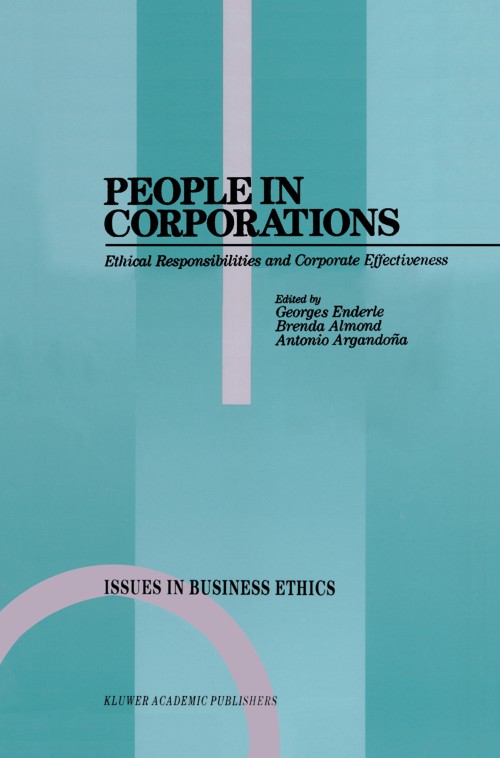
People in Corporations [electronic resource] : Ethical Responsibilities and Corporate Effectiveness / edited by Georges Enderle, Brenda Almond, Antonio Argandoña.
Erişim Adresi
ISBN
9789400920835
Dil Kodu
İngilizce
Yer Numarası
DK/15536
Basım Bildirimi
1st ed. 1990.
Yayın Bilgisi
Dordrecht : Springer Netherlands : Imprint: Springer, 1990.
Fiziksel Niteleme
VIII, 264 p. online resource.
Dizi
Issues in Business Ethics, 2215-1680 ; 1
İçindekiler Notu
1 Introduction -- I: Personal Convictions and Corporate Claims: Ethical Conflicts and Solutions -- 2 The Responsible Corporation and the Subversive Side of Ethics -- 3 Ethical Decision-making in a National Utility: The Electricity Industry in France -- 4 Using the Techniques of Ethical Analysis in Corporate Practice -- 5 Ethical Responsibilities Versus Corporate Effectiveness -- 6 The Corporation As an Open Organisation -- 7 The Function of Management Control Systems in Innovative Organisations -- 8 Ethics and Interpersonal Trust in Corporate Management -- 9 The Parameters of Ethical Decision-making in Organisations -- II: “Empowering” People: End or Means? -- 10 The Ethical Challenge to the Corporations: Meaningful Progress and Individual Development -- 11 The Individual Dimension in Corporations -- 12 Human Development and the Images of the Organisation -- 13 Empowering People as an End for Business -- 14 On the Demand for Meaningful Work -- 15 Ethics and Labour Contracts: an Economist’s Point of View -- 16 To Encourage or Repress? Corporate Policy and Whistle-blowing -- 17 The Responsibility of Individuals for a Company Disaster: The Example of the Zeebrugge Car Ferry -- III: Men and Women in Corporations: Repression, Competition or Co-operation? -- 18 Introductory Remarks -- 19 Male or Female Ethics for Corporations? -- 20 Demographic Pressure in Favour of the Promotion of Women -- 21 How to Include Women In Corporate Decision-Making -- IV: The Ethical Role of Top Managers -- 22 Who or What Is “the Boss”? Authority Without Authoritarianism -- 23 “I Am the Boss. Why Should I Be Ethical?” -- 24 Ethics and the Definition of Business Strategy -- 25 Management as the Symbolisation of Ethical Values -- 26 Values and Types of Entrepreneurs in Small Business -- 27 Executive Decisions andValues -- Outlook Some Perspectives -- 28 Spheres and Limits of Ethical Responsibilities in and of the Corporation -- 29 Philosophical Considerations of a Top Manager -- 30 The Importance of the Cultural Context for Business Ethics: The Italian Example -- Note on the Contributors.
Özet, vb.
Georges Enderle Before presenting some introductory remarks on the topic of this volume I should like to outline briefly the context from which this selection of articles originates. (It seems to me necessary to emphasise these circumstances in order to make clearer the contours of what is said and what is not said and to understand it better. ) This context involves, flrstly, a general evaluation of the state of the business ethics debate today and, secondly, considerations of the question of what attitude and strategy should be chosen in order to promote business ethics most effectively. On the present state of affairs of the business ethics debate Today, it is extremely difflcult, if not impossible, to gain even a rough overview of the business ethics debate in the different countries of Europe and North America. Many activities take place in informal circles and on a local and regional level; linguistic and other barriers impede the spread of information about them and, often, they are not even labelled "business ethics". At the same time, so many other things sail under the flag of "business ethics" that one sometimes wonders if it should not be replaced by another flag, for instance new methods of public-relations or better motivation of company's employees. Yet, in spite of these difflculties in deflning business ethics activities, one statement at least can be made with certainty. .
Konu
Ethics.
Management.
Econometrics.
Moral Philosophy and Applied Ethics.
Management.
Quantitative Economics.
Management.
Econometrics.
Moral Philosophy and Applied Ethics.
Management.
Quantitative Economics.
Diğer Yazarlar
Kurum Adı
Eseri Alıntıla
Referansları kullanmadan önce gözden geçirmeniz ve varsa gerekli düzeltmeleri yapmanız önerilir.
Dijital Kaynak
MARC Görünümü
LEADER 06341nam a22006015i 4500
001 814297
003 TR_AnAIT
005 20260130220421
007 cr nn 008mamaa
008 121227s1990 ne | s |||| 0|eng d
020 |a9789400920835|9978-94-009-2083-5
024 7 |a10.1007/978-94-009-2083-5|2doi
041 |aeng
049 |aTürk Tarih Kurumu Kütüphanesi
050 4|aBJ1-1725
072 7|aHPQ|2bicssc
072 7|aPHI005000|2bisacsh
072 7|aQDTQ|2thema
082 04|a170|223
090 |aDK/15536
245 10|aPeople in Corporations|h[electronic resource] :|bEthical Responsibilities and Corporate Effectiveness /|cedited by Georges Enderle, Brenda Almond, Antonio Argandoña.
250 |a1st ed. 1990.
264 1|aDordrecht :|bSpringer Netherlands :|bImprint: Springer,|c1990.
300 |aVIII, 264 p.|bonline resource.
336 |atext|btxt|2rdacontent
337 |acomputer|bc|2rdamedia
338 |aonline resource|bcr|2rdacarrier
347 |atext file|bPDF|2rda
490 1 |aIssues in Business Ethics,|x2215-1680 ;|v1
505 0 |a1 Introduction -- I: Personal Convictions and Corporate Claims: Ethical Conflicts and Solutions -- 2 The Responsible Corporation and the Subversive Side of Ethics -- 3 Ethical Decision-making in a National Utility: The Electricity Industry in France -- 4 Using the Techniques of Ethical Analysis in Corporate Practice -- 5 Ethical Responsibilities Versus Corporate Effectiveness -- 6 The Corporation As an Open Organisation -- 7 The Function of Management Control Systems in Innovative Organisations -- 8 Ethics and Interpersonal Trust in Corporate Management -- 9 The Parameters of Ethical Decision-making in Organisations -- II: “Empowering” People: End or Means? -- 10 The Ethical Challenge to the Corporations: Meaningful Progress and Individual Development -- 11 The Individual Dimension in Corporations -- 12 Human Development and the Images of the Organisation -- 13 Empowering People as an End for Business -- 14 On the Demand for Meaningful Work -- 15 Ethics and Labour Contracts: an Economist’s Point of View -- 16 To Encourage or Repress? Corporate Policy and Whistle-blowing -- 17 The Responsibility of Individuals for a Company Disaster: The Example of the Zeebrugge Car Ferry -- III: Men and Women in Corporations: Repression, Competition or Co-operation? -- 18 Introductory Remarks -- 19 Male or Female Ethics for Corporations? -- 20 Demographic Pressure in Favour of the Promotion of Women -- 21 How to Include Women In Corporate Decision-Making -- IV: The Ethical Role of Top Managers -- 22 Who or What Is “the Boss”? Authority Without Authoritarianism -- 23 “I Am the Boss. Why Should I Be Ethical?” -- 24 Ethics and the Definition of Business Strategy -- 25 Management as the Symbolisation of Ethical Values -- 26 Values and Types of Entrepreneurs in Small Business -- 27 Executive Decisions andValues -- Outlook Some Perspectives -- 28 Spheres and Limits of Ethical Responsibilities in and of the Corporation -- 29 Philosophical Considerations of a Top Manager -- 30 The Importance of the Cultural Context for Business Ethics: The Italian Example -- Note on the Contributors.
520 |aGeorges Enderle Before presenting some introductory remarks on the topic of this volume I should like to outline briefly the context from which this selection of articles originates. (It seems to me necessary to emphasise these circumstances in order to make clearer the contours of what is said and what is not said and to understand it better. ) This context involves, flrstly, a general evaluation of the state of the business ethics debate today and, secondly, considerations of the question of what attitude and strategy should be chosen in order to promote business ethics most effectively. On the present state of affairs of the business ethics debate Today, it is extremely difflcult, if not impossible, to gain even a rough overview of the business ethics debate in the different countries of Europe and North America. Many activities take place in informal circles and on a local and regional level; linguistic and other barriers impede the spread of information about them and, often, they are not even labelled "business ethics". At the same time, so many other things sail under the flag of "business ethics" that one sometimes wonders if it should not be replaced by another flag, for instance new methods of public-relations or better motivation of company's employees. Yet, in spite of these difflculties in deflning business ethics activities, one statement at least can be made with certainty. .
532 8 |aAccessibility summary: This PDF is not accessible. It is based on scanned pages and does not support features such as screen reader compatibility or described non-text content (images, graphs etc). However, it likely supports searchable and selectable text based on OCR (Optical Character Recognition). Users with accessibility needs may not be able to use this content effectively. Please contact us at accessibilitysupport@springernature.com if you require assistance or an alternative format.
532 8 |aInaccessible, or known limited accessibility
532 8 |aNo reading system accessibility options actively disabled
532 8 |aPublisher contact for further accessibility information: accessibilitysupport@springernature.com
650 0|aEthics.
650 0|aManagement.
650 0|aEconometrics.
650 14|aMoral Philosophy and Applied Ethics.
650 24|aManagement.
650 24|aQuantitative Economics.
700 1 |aEnderle, Georges.|eeditor.|4edt|4http://id.loc.gov/vocabulary/relators/edt
700 1 |aAlmond, Brenda.|eeditor.|4edt|4http://id.loc.gov/vocabulary/relators/edt
700 1 |aArgandoña, Antonio.|eeditor.|4edt|4http://id.loc.gov/vocabulary/relators/edt
710 2 |aSpringerLink (Online service)
773 0 |tSpringer Nature eBook
776 08|iPrinted edition:|z9780792308294
776 08|iPrinted edition:|z9789400920842
776 08|iPrinted edition:|z9789401074353
830 0|aIssues in Business Ethics,|x2215-1680 ;|v1
856 40|uhttps://doi.org/10.1007/978-94-009-2083-5
912 |aZDB-2-SHU
912 |aZDB-2-SXPR
912 |aZDB-2-BAE
950 |aHumanities, Social Sciences and Law (SpringerNature-11648)
950 |aPhilosophy and Religion (R0) (SpringerNature-43725)
001 814297
003 TR_AnAIT
005 20260130220421
007 cr nn 008mamaa
008 121227s1990 ne | s |||| 0|eng d
020 |a9789400920835|9978-94-009-2083-5
024 7 |a10.1007/978-94-009-2083-5|2doi
041 |aeng
049 |aTürk Tarih Kurumu Kütüphanesi
050 4|aBJ1-1725
072 7|aHPQ|2bicssc
072 7|aPHI005000|2bisacsh
072 7|aQDTQ|2thema
082 04|a170|223
090 |aDK/15536
245 10|aPeople in Corporations|h[electronic resource] :|bEthical Responsibilities and Corporate Effectiveness /|cedited by Georges Enderle, Brenda Almond, Antonio Argandoña.
250 |a1st ed. 1990.
264 1|aDordrecht :|bSpringer Netherlands :|bImprint: Springer,|c1990.
300 |aVIII, 264 p.|bonline resource.
336 |atext|btxt|2rdacontent
337 |acomputer|bc|2rdamedia
338 |aonline resource|bcr|2rdacarrier
347 |atext file|bPDF|2rda
490 1 |aIssues in Business Ethics,|x2215-1680 ;|v1
505 0 |a1 Introduction -- I: Personal Convictions and Corporate Claims: Ethical Conflicts and Solutions -- 2 The Responsible Corporation and the Subversive Side of Ethics -- 3 Ethical Decision-making in a National Utility: The Electricity Industry in France -- 4 Using the Techniques of Ethical Analysis in Corporate Practice -- 5 Ethical Responsibilities Versus Corporate Effectiveness -- 6 The Corporation As an Open Organisation -- 7 The Function of Management Control Systems in Innovative Organisations -- 8 Ethics and Interpersonal Trust in Corporate Management -- 9 The Parameters of Ethical Decision-making in Organisations -- II: “Empowering” People: End or Means? -- 10 The Ethical Challenge to the Corporations: Meaningful Progress and Individual Development -- 11 The Individual Dimension in Corporations -- 12 Human Development and the Images of the Organisation -- 13 Empowering People as an End for Business -- 14 On the Demand for Meaningful Work -- 15 Ethics and Labour Contracts: an Economist’s Point of View -- 16 To Encourage or Repress? Corporate Policy and Whistle-blowing -- 17 The Responsibility of Individuals for a Company Disaster: The Example of the Zeebrugge Car Ferry -- III: Men and Women in Corporations: Repression, Competition or Co-operation? -- 18 Introductory Remarks -- 19 Male or Female Ethics for Corporations? -- 20 Demographic Pressure in Favour of the Promotion of Women -- 21 How to Include Women In Corporate Decision-Making -- IV: The Ethical Role of Top Managers -- 22 Who or What Is “the Boss”? Authority Without Authoritarianism -- 23 “I Am the Boss. Why Should I Be Ethical?” -- 24 Ethics and the Definition of Business Strategy -- 25 Management as the Symbolisation of Ethical Values -- 26 Values and Types of Entrepreneurs in Small Business -- 27 Executive Decisions andValues -- Outlook Some Perspectives -- 28 Spheres and Limits of Ethical Responsibilities in and of the Corporation -- 29 Philosophical Considerations of a Top Manager -- 30 The Importance of the Cultural Context for Business Ethics: The Italian Example -- Note on the Contributors.
520 |aGeorges Enderle Before presenting some introductory remarks on the topic of this volume I should like to outline briefly the context from which this selection of articles originates. (It seems to me necessary to emphasise these circumstances in order to make clearer the contours of what is said and what is not said and to understand it better. ) This context involves, flrstly, a general evaluation of the state of the business ethics debate today and, secondly, considerations of the question of what attitude and strategy should be chosen in order to promote business ethics most effectively. On the present state of affairs of the business ethics debate Today, it is extremely difflcult, if not impossible, to gain even a rough overview of the business ethics debate in the different countries of Europe and North America. Many activities take place in informal circles and on a local and regional level; linguistic and other barriers impede the spread of information about them and, often, they are not even labelled "business ethics". At the same time, so many other things sail under the flag of "business ethics" that one sometimes wonders if it should not be replaced by another flag, for instance new methods of public-relations or better motivation of company's employees. Yet, in spite of these difflculties in deflning business ethics activities, one statement at least can be made with certainty. .
532 8 |aAccessibility summary: This PDF is not accessible. It is based on scanned pages and does not support features such as screen reader compatibility or described non-text content (images, graphs etc). However, it likely supports searchable and selectable text based on OCR (Optical Character Recognition). Users with accessibility needs may not be able to use this content effectively. Please contact us at accessibilitysupport@springernature.com if you require assistance or an alternative format.
532 8 |aInaccessible, or known limited accessibility
532 8 |aNo reading system accessibility options actively disabled
532 8 |aPublisher contact for further accessibility information: accessibilitysupport@springernature.com
650 0|aEthics.
650 0|aManagement.
650 0|aEconometrics.
650 14|aMoral Philosophy and Applied Ethics.
650 24|aManagement.
650 24|aQuantitative Economics.
700 1 |aEnderle, Georges.|eeditor.|4edt|4http://id.loc.gov/vocabulary/relators/edt
700 1 |aAlmond, Brenda.|eeditor.|4edt|4http://id.loc.gov/vocabulary/relators/edt
700 1 |aArgandoña, Antonio.|eeditor.|4edt|4http://id.loc.gov/vocabulary/relators/edt
710 2 |aSpringerLink (Online service)
773 0 |tSpringer Nature eBook
776 08|iPrinted edition:|z9780792308294
776 08|iPrinted edition:|z9789400920842
776 08|iPrinted edition:|z9789401074353
830 0|aIssues in Business Ethics,|x2215-1680 ;|v1
856 40|uhttps://doi.org/10.1007/978-94-009-2083-5
912 |aZDB-2-SHU
912 |aZDB-2-SXPR
912 |aZDB-2-BAE
950 |aHumanities, Social Sciences and Law (SpringerNature-11648)
950 |aPhilosophy and Religion (R0) (SpringerNature-43725)
Materyaller
Depodan talep edilen materyal sadece kütüphane içerisinde kullanılmaktadır.
Materyal dışarıya ödünç verilmemektedir.
Materyal dışarıya ödünç verilmemektedir.
