

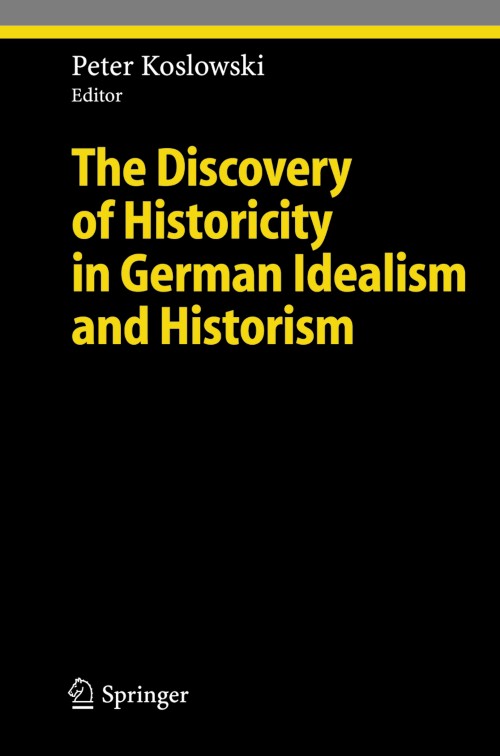
The Discovery of Historicity in German Idealism and Historism [electronic resource] / edited by Peter Koslowski.
Erişim Adresi
ISBN
9783540273523
Dil Kodu
İngilizce
Yer Numarası
DK/15567
Basım Bildirimi
1st ed. 2005.
Yayın Bilgisi
Berlin, Heidelberg : Springer Berlin Heidelberg : Imprint: Springer, 2005.
Fiziksel Niteleme
VIII, 292 p. online resource.
Dizi
Ethical Economy, Studies in Economic Ethics and Philosophy, 2211-2723
İçindekiler Notu
German Idealism's Philosophy of History and its Contemporary Critique -- Schlegel's Theory of History and his Critique of Idealistic Reason -- History as the Control of Speculation: Schelling's Discovery of History and Baader's Critique of Absolute Historicity -- Absolute Historicity, Theory of the Becoming Absolute, and the Affect for the Particular in German Idealism and Historism: Introduction -- The Theory of History in German Historism -- Leopold von Ranke -- Droysen and Nietzsche: Two Different Answers to the Discovery of Historicity -- Philosophy of History and Theory of Historiography in Jacob Burckhardt -- Historiography as Political Activity: Heinrich von Treitschke and the Historical Reconstruction of Politics -- Literary Criticism and Historical Science: The Textuality of History in the Age of Goethe — and Beyond -- Social and Philosophical Theory in the 19th Century German Thought -- German Theory and Philosophy of History Today -- Philosophy of History After the End of the Formative Substantial Philosophy of History: Remarks on the Present State of the Philosophy of History -- Why Kant's Reflections on History Still Have Relevance -- Rehabilitating the Philosophy of History -- History and Subjectivity — The Relevance of a Philosophical Concept of History in the Kantian Tradition -- Towards a New Theory-Based History of Historiography -- Philosophy of History After the Philosophy of History: Toward a Cultural History with Historical-Philosophical Background.
Özet, vb.
German Idealism develops its philosophy of history as the theory of becoming absolute and as absolute knowledge. Historism also originates from Hegel's and Schelling's discovery of absolute historicity as it turns against Idealism's philosophy of history by emphasizing the singular and unique in the process of history. German Idealism and Historism can be considered as the central German contribution to the history of ideas. Since Idealism became most influential for modern philosophy and Historism for modern historiography, they are analyzed in this volume in a collaboration of philosophers and historians. German Idealism is presented in Schelling and its critics Schlegel, Baader, and Nietzsche; Historism in Ranke, Droysen, Burckhardt, and Treitschke. The volume further presents the impact of Idealism and Historism on present German approaches to the philosophy of history and outlines the debates on the possibility of a philosophy of history and on the methodology of the historical sciences.
Konu
Philosophy __ History.
History.
Economics __ History.
History of Philosophy.
History.
History of Economic Thought and Methodology.
History.
Economics __ History.
History of Philosophy.
History.
History of Economic Thought and Methodology.
Diğer Yazarlar
Kurum Adı
Eseri Alıntıla
Referansları kullanmadan önce gözden geçirmeniz ve varsa gerekli düzeltmeleri yapmanız önerilir.
Dijital Kaynak
MARC Görünümü
LEADER 05132nam a22005655i 4500
001 814328
003 TR_AnAIT
005 20260130220254
007 cr nn 008mamaa
008 100301s2005 gw | s |||| 0|eng d
020 |a9783540273523|9978-3-540-27352-3
024 7 |a10.1007/b138947|2doi
041 |aeng
049 |aTürk Tarih Kurumu Kütüphanesi
050 4|aB1-5802
072 7|aHPC|2bicssc
072 7|aPHI009000|2bisacsh
072 7|aQDH|2thema
082 04|a109|223
090 |aDK/15567
245 14|aThe Discovery of Historicity in German Idealism and Historism|h[electronic resource] /|cedited by Peter Koslowski.
250 |a1st ed. 2005.
264 1|aBerlin, Heidelberg :|bSpringer Berlin Heidelberg :|bImprint: Springer,|c2005.
300 |aVIII, 292 p.|bonline resource.
336 |atext|btxt|2rdacontent
337 |acomputer|bc|2rdamedia
338 |aonline resource|bcr|2rdacarrier
347 |atext file|bPDF|2rda
490 1 |aEthical Economy, Studies in Economic Ethics and Philosophy,|x2211-2723
505 0 |aGerman Idealism's Philosophy of History and its Contemporary Critique -- Schlegel's Theory of History and his Critique of Idealistic Reason -- History as the Control of Speculation: Schelling's Discovery of History and Baader's Critique of Absolute Historicity -- Absolute Historicity, Theory of the Becoming Absolute, and the Affect for the Particular in German Idealism and Historism: Introduction -- The Theory of History in German Historism -- Leopold von Ranke -- Droysen and Nietzsche: Two Different Answers to the Discovery of Historicity -- Philosophy of History and Theory of Historiography in Jacob Burckhardt -- Historiography as Political Activity: Heinrich von Treitschke and the Historical Reconstruction of Politics -- Literary Criticism and Historical Science: The Textuality of History in the Age of Goethe — and Beyond -- Social and Philosophical Theory in the 19th Century German Thought -- German Theory and Philosophy of History Today -- Philosophy of History After the End of the Formative Substantial Philosophy of History: Remarks on the Present State of the Philosophy of History -- Why Kant's Reflections on History Still Have Relevance -- Rehabilitating the Philosophy of History -- History and Subjectivity — The Relevance of a Philosophical Concept of History in the Kantian Tradition -- Towards a New Theory-Based History of Historiography -- Philosophy of History After the Philosophy of History: Toward a Cultural History with Historical-Philosophical Background.
520 |aGerman Idealism develops its philosophy of history as the theory of becoming absolute and as absolute knowledge. Historism also originates from Hegel's and Schelling's discovery of absolute historicity as it turns against Idealism's philosophy of history by emphasizing the singular and unique in the process of history. German Idealism and Historism can be considered as the central German contribution to the history of ideas. Since Idealism became most influential for modern philosophy and Historism for modern historiography, they are analyzed in this volume in a collaboration of philosophers and historians. German Idealism is presented in Schelling and its critics Schlegel, Baader, and Nietzsche; Historism in Ranke, Droysen, Burckhardt, and Treitschke. The volume further presents the impact of Idealism and Historism on present German approaches to the philosophy of history and outlines the debates on the possibility of a philosophy of history and on the methodology of the historical sciences.
532 8 |aAccessibility summary: This PDF is not accessible. It is based on scanned pages and does not support features such as screen reader compatibility or described non-text content (images, graphs etc). However, it likely supports searchable and selectable text based on OCR (Optical Character Recognition). Users with accessibility needs may not be able to use this content effectively. Please contact us at accessibilitysupport@springernature.com if you require assistance or an alternative format.
532 8 |aInaccessible, or known limited accessibility
532 8 |aNo reading system accessibility options actively disabled
532 8 |aPublisher contact for further accessibility information: accessibilitysupport@springernature.com
650 0|aPhilosophy|xHistory.
650 0|aHistory.
650 0|aEconomics|xHistory.
650 14|aHistory of Philosophy.
650 24|aHistory.
650 24|aHistory of Economic Thought and Methodology.
700 1 |aKoslowski, Peter.|eeditor.|4edt|4http://id.loc.gov/vocabulary/relators/edt
710 2 |aSpringerLink (Online service)
773 0 |tSpringer Nature eBook
776 08|iPrinted edition:|z9783540243939
776 08|iPrinted edition:|z9783540807049
776 08|iPrinted edition:|z9783642063695
830 0|aEthical Economy, Studies in Economic Ethics and Philosophy,|x2211-2723
856 40|uhttps://doi.org/10.1007/b138947
912 |aZDB-2-SHU
912 |aZDB-2-SXPR
950 |aHumanities, Social Sciences and Law (SpringerNature-11648)
950 |aPhilosophy and Religion (R0) (SpringerNature-43725)
001 814328
003 TR_AnAIT
005 20260130220254
007 cr nn 008mamaa
008 100301s2005 gw | s |||| 0|eng d
020 |a9783540273523|9978-3-540-27352-3
024 7 |a10.1007/b138947|2doi
041 |aeng
049 |aTürk Tarih Kurumu Kütüphanesi
050 4|aB1-5802
072 7|aHPC|2bicssc
072 7|aPHI009000|2bisacsh
072 7|aQDH|2thema
082 04|a109|223
090 |aDK/15567
245 14|aThe Discovery of Historicity in German Idealism and Historism|h[electronic resource] /|cedited by Peter Koslowski.
250 |a1st ed. 2005.
264 1|aBerlin, Heidelberg :|bSpringer Berlin Heidelberg :|bImprint: Springer,|c2005.
300 |aVIII, 292 p.|bonline resource.
336 |atext|btxt|2rdacontent
337 |acomputer|bc|2rdamedia
338 |aonline resource|bcr|2rdacarrier
347 |atext file|bPDF|2rda
490 1 |aEthical Economy, Studies in Economic Ethics and Philosophy,|x2211-2723
505 0 |aGerman Idealism's Philosophy of History and its Contemporary Critique -- Schlegel's Theory of History and his Critique of Idealistic Reason -- History as the Control of Speculation: Schelling's Discovery of History and Baader's Critique of Absolute Historicity -- Absolute Historicity, Theory of the Becoming Absolute, and the Affect for the Particular in German Idealism and Historism: Introduction -- The Theory of History in German Historism -- Leopold von Ranke -- Droysen and Nietzsche: Two Different Answers to the Discovery of Historicity -- Philosophy of History and Theory of Historiography in Jacob Burckhardt -- Historiography as Political Activity: Heinrich von Treitschke and the Historical Reconstruction of Politics -- Literary Criticism and Historical Science: The Textuality of History in the Age of Goethe — and Beyond -- Social and Philosophical Theory in the 19th Century German Thought -- German Theory and Philosophy of History Today -- Philosophy of History After the End of the Formative Substantial Philosophy of History: Remarks on the Present State of the Philosophy of History -- Why Kant's Reflections on History Still Have Relevance -- Rehabilitating the Philosophy of History -- History and Subjectivity — The Relevance of a Philosophical Concept of History in the Kantian Tradition -- Towards a New Theory-Based History of Historiography -- Philosophy of History After the Philosophy of History: Toward a Cultural History with Historical-Philosophical Background.
520 |aGerman Idealism develops its philosophy of history as the theory of becoming absolute and as absolute knowledge. Historism also originates from Hegel's and Schelling's discovery of absolute historicity as it turns against Idealism's philosophy of history by emphasizing the singular and unique in the process of history. German Idealism and Historism can be considered as the central German contribution to the history of ideas. Since Idealism became most influential for modern philosophy and Historism for modern historiography, they are analyzed in this volume in a collaboration of philosophers and historians. German Idealism is presented in Schelling and its critics Schlegel, Baader, and Nietzsche; Historism in Ranke, Droysen, Burckhardt, and Treitschke. The volume further presents the impact of Idealism and Historism on present German approaches to the philosophy of history and outlines the debates on the possibility of a philosophy of history and on the methodology of the historical sciences.
532 8 |aAccessibility summary: This PDF is not accessible. It is based on scanned pages and does not support features such as screen reader compatibility or described non-text content (images, graphs etc). However, it likely supports searchable and selectable text based on OCR (Optical Character Recognition). Users with accessibility needs may not be able to use this content effectively. Please contact us at accessibilitysupport@springernature.com if you require assistance or an alternative format.
532 8 |aInaccessible, or known limited accessibility
532 8 |aNo reading system accessibility options actively disabled
532 8 |aPublisher contact for further accessibility information: accessibilitysupport@springernature.com
650 0|aPhilosophy|xHistory.
650 0|aHistory.
650 0|aEconomics|xHistory.
650 14|aHistory of Philosophy.
650 24|aHistory.
650 24|aHistory of Economic Thought and Methodology.
700 1 |aKoslowski, Peter.|eeditor.|4edt|4http://id.loc.gov/vocabulary/relators/edt
710 2 |aSpringerLink (Online service)
773 0 |tSpringer Nature eBook
776 08|iPrinted edition:|z9783540243939
776 08|iPrinted edition:|z9783540807049
776 08|iPrinted edition:|z9783642063695
830 0|aEthical Economy, Studies in Economic Ethics and Philosophy,|x2211-2723
856 40|uhttps://doi.org/10.1007/b138947
912 |aZDB-2-SHU
912 |aZDB-2-SXPR
950 |aHumanities, Social Sciences and Law (SpringerNature-11648)
950 |aPhilosophy and Religion (R0) (SpringerNature-43725)
Materyaller
Depodan talep edilen materyal sadece kütüphane içerisinde kullanılmaktadır.
Materyal dışarıya ödünç verilmemektedir.
Materyal dışarıya ödünç verilmemektedir.
