

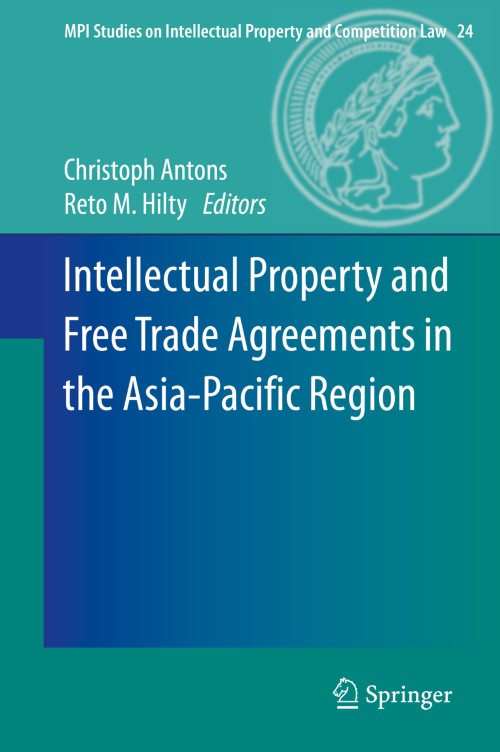
Intellectual Property and Free Trade Agreements in the Asia-Pacific Region [electronic resource] / edited by Christoph Antons, Reto M. Hilty.
Erişim Adresi
ISBN
9783642308888
Dil Kodu
İngilizce
Yer Numarası
DK/15579
Basım Bildirimi
1st ed. 2015.
Yayın Bilgisi
Berlin, Heidelberg : Springer Berlin Heidelberg : Imprint: Springer, 2015.
Fiziksel Niteleme
VIII, 438 p. online resource.
Dizi
MPI Studies on Intellectual Property and Competition Law, 2191-5830 ; 24
İçindekiler Notu
Part I: Free Trade Agreements in the Context of WTO and International Law -- Part II: The Political Economy of Free Trade Agreements in the Asia-Pacific Region -- Part III: US, EU and Japanese Strategies Regarding IP and Free Trade Agreements in the Asia-Pacific Region -- Part IV: IP and FTA Strategies of China -- Part V: The Australasian Perspective on FTAs: Australia and New Zealand -- Part VI: IP in the FTAs of Newly Industrialised Economies: Korea and Singapore -- Part VII: IP in the FTAs of “Second Tier NICs” in Southeast Asia.
Özet, vb.
This book is highly topical. The shift from the multilateral WTO negotiations to bilateral and regional Free Trade Agreements has been going on for some time, but it is bound to accelerate after the WTO Doha round of negotiations is now widely regarded as a failure. However, there is a particular regional angle to this topic as well. After concluding that further progress in the Doha round was unlikely, Pacific Rim nations recently have progressed with the negotiations of a greatly expanded Trans-Pacific Partnership Agreement that includes industrialised economies and developed countries such as the United States, Japan, Australia and New Zealand, recently emerged economies such as Singapore, but also several developing countries in Asia and Latin America such as Malaysia and Vietnam. US and EU led efforts to conclude FTAs with Asia-Pacific nations are also bound to accelerate again, after a temporary slowdown in the negotiations following the change of government in the United Statesand the expiry of the US President’s fast-track negotiation authority. The book will provide an assessment of these dynamics in the world’s fastest growing region. It will look at the IP chapters from a legal perspective, but also put the developments into a socio-economic and political context. Many agreements in fact are concluded because of this context rather than for purely economic reasons or to achieve progress in fields like IP law. The structure of the book follows an outline that groups countries into interest alliances according to their respective IP priorities. This ranges from the driving forces of the EU, US and Japan, via Asia-Pacific resource-rich but IP poor economies such as Australia and New Zealand, recently emerged economies with strong IP systems such as Singapore and Korea to leading developing countries such as China and India and ‘second tier industrializing economies’ such as Thailand, Malaysia and Indonesia.
Konu
Information technology __ Law and legislation.
Mass media __ Law and legislation.
International law.
Trade regulation.
Regional economics.
Spatial economics.
International economic relations.
IT Law, Media Law, Intellectual Property.
International Economic Law, Trade Law.
Regional and Spatial Economics.
International Economics.
Mass media __ Law and legislation.
International law.
Trade regulation.
Regional economics.
Spatial economics.
International economic relations.
IT Law, Media Law, Intellectual Property.
International Economic Law, Trade Law.
Regional and Spatial Economics.
International Economics.
Diğer Yazarlar
Kurum Adı
Eseri Alıntıla
Referansları kullanmadan önce gözden geçirmeniz ve varsa gerekli düzeltmeleri yapmanız önerilir.
Dijital Kaynak
MARC Görünümü
LEADER 04792nam a22005895i 4500
001 814340
003 TR_AnAIT
005 20260130220237
007 cr nn 008mamaa
008 141205s2015 gw | s |||| 0|eng d
020 |a9783642308888|9978-3-642-30888-8
024 7 |a10.1007/978-3-642-30888-8|2doi
041 |aeng
049 |aTürk Tarih Kurumu Kütüphanesi
050 4|aK4240-4343
072 7|aLNJ|2bicssc
072 7|aLAW000000|2bisacsh
072 7|aLNJ|2thema
082 04|a343.099|223
090 |aDK/15579
245 10|aIntellectual Property and Free Trade Agreements in the Asia-Pacific Region|h[electronic resource] /|cedited by Christoph Antons, Reto M. Hilty.
250 |a1st ed. 2015.
264 1|aBerlin, Heidelberg :|bSpringer Berlin Heidelberg :|bImprint: Springer,|c2015.
300 |aVIII, 438 p.|bonline resource.
336 |atext|btxt|2rdacontent
337 |acomputer|bc|2rdamedia
338 |aonline resource|bcr|2rdacarrier
347 |atext file|bPDF|2rda
490 1 |aMPI Studies on Intellectual Property and Competition Law,|x2191-5830 ;|v24
505 0 |aPart I: Free Trade Agreements in the Context of WTO and International Law -- Part II: The Political Economy of Free Trade Agreements in the Asia-Pacific Region -- Part III: US, EU and Japanese Strategies Regarding IP and Free Trade Agreements in the Asia-Pacific Region -- Part IV: IP and FTA Strategies of China -- Part V: The Australasian Perspective on FTAs: Australia and New Zealand -- Part VI: IP in the FTAs of Newly Industrialised Economies: Korea and Singapore -- Part VII: IP in the FTAs of “Second Tier NICs” in Southeast Asia.
520 |aThis book is highly topical. The shift from the multilateral WTO negotiations to bilateral and regional Free Trade Agreements has been going on for some time, but it is bound to accelerate after the WTO Doha round of negotiations is now widely regarded as a failure. However, there is a particular regional angle to this topic as well. After concluding that further progress in the Doha round was unlikely, Pacific Rim nations recently have progressed with the negotiations of a greatly expanded Trans-Pacific Partnership Agreement that includes industrialised economies and developed countries such as the United States, Japan, Australia and New Zealand, recently emerged economies such as Singapore, but also several developing countries in Asia and Latin America such as Malaysia and Vietnam. US and EU led efforts to conclude FTAs with Asia-Pacific nations are also bound to accelerate again, after a temporary slowdown in the negotiations following the change of government in the United Statesand the expiry of the US President’s fast-track negotiation authority. The book will provide an assessment of these dynamics in the world’s fastest growing region. It will look at the IP chapters from a legal perspective, but also put the developments into a socio-economic and political context. Many agreements in fact are concluded because of this context rather than for purely economic reasons or to achieve progress in fields like IP law. The structure of the book follows an outline that groups countries into interest alliances according to their respective IP priorities. This ranges from the driving forces of the EU, US and Japan, via Asia-Pacific resource-rich but IP poor economies such as Australia and New Zealand, recently emerged economies with strong IP systems such as Singapore and Korea to leading developing countries such as China and India and ‘second tier industrializing economies’ such as Thailand, Malaysia and Indonesia.
650 0|aInformation technology|xLaw and legislation.
650 0|aMass media|xLaw and legislation.
650 0|aInternational law.
650 0|aTrade regulation.
650 0|aRegional economics.
650 0|aSpatial economics.
650 0|aInternational economic relations.
650 14|aIT Law, Media Law, Intellectual Property.
650 24|aInternational Economic Law, Trade Law.
650 24|aRegional and Spatial Economics.
650 24|aInternational Economics.
700 1 |aAntons, Christoph.|eeditor.|4edt|4http://id.loc.gov/vocabulary/relators/edt
700 1 |aHilty, Reto M.|eeditor.|4edt|4http://id.loc.gov/vocabulary/relators/edt
710 2 |aSpringerLink (Online service)
773 0 |tSpringer Nature eBook
776 08|iPrinted edition:|z9783642308871
776 08|iPrinted edition:|z9783642308895
776 08|iPrinted edition:|z9783662510414
830 0|aMPI Studies on Intellectual Property and Competition Law,|x2191-5830 ;|v24
856 40|uhttps://doi.org/10.1007/978-3-642-30888-8
912 |aZDB-2-SHU
912 |aZDB-2-SXLC
950 |aHumanities, Social Sciences and Law (SpringerNature-11648)
950 |aLaw and Criminology (R0) (SpringerNature-43727)
001 814340
003 TR_AnAIT
005 20260130220237
007 cr nn 008mamaa
008 141205s2015 gw | s |||| 0|eng d
020 |a9783642308888|9978-3-642-30888-8
024 7 |a10.1007/978-3-642-30888-8|2doi
041 |aeng
049 |aTürk Tarih Kurumu Kütüphanesi
050 4|aK4240-4343
072 7|aLNJ|2bicssc
072 7|aLAW000000|2bisacsh
072 7|aLNJ|2thema
082 04|a343.099|223
090 |aDK/15579
245 10|aIntellectual Property and Free Trade Agreements in the Asia-Pacific Region|h[electronic resource] /|cedited by Christoph Antons, Reto M. Hilty.
250 |a1st ed. 2015.
264 1|aBerlin, Heidelberg :|bSpringer Berlin Heidelberg :|bImprint: Springer,|c2015.
300 |aVIII, 438 p.|bonline resource.
336 |atext|btxt|2rdacontent
337 |acomputer|bc|2rdamedia
338 |aonline resource|bcr|2rdacarrier
347 |atext file|bPDF|2rda
490 1 |aMPI Studies on Intellectual Property and Competition Law,|x2191-5830 ;|v24
505 0 |aPart I: Free Trade Agreements in the Context of WTO and International Law -- Part II: The Political Economy of Free Trade Agreements in the Asia-Pacific Region -- Part III: US, EU and Japanese Strategies Regarding IP and Free Trade Agreements in the Asia-Pacific Region -- Part IV: IP and FTA Strategies of China -- Part V: The Australasian Perspective on FTAs: Australia and New Zealand -- Part VI: IP in the FTAs of Newly Industrialised Economies: Korea and Singapore -- Part VII: IP in the FTAs of “Second Tier NICs” in Southeast Asia.
520 |aThis book is highly topical. The shift from the multilateral WTO negotiations to bilateral and regional Free Trade Agreements has been going on for some time, but it is bound to accelerate after the WTO Doha round of negotiations is now widely regarded as a failure. However, there is a particular regional angle to this topic as well. After concluding that further progress in the Doha round was unlikely, Pacific Rim nations recently have progressed with the negotiations of a greatly expanded Trans-Pacific Partnership Agreement that includes industrialised economies and developed countries such as the United States, Japan, Australia and New Zealand, recently emerged economies such as Singapore, but also several developing countries in Asia and Latin America such as Malaysia and Vietnam. US and EU led efforts to conclude FTAs with Asia-Pacific nations are also bound to accelerate again, after a temporary slowdown in the negotiations following the change of government in the United Statesand the expiry of the US President’s fast-track negotiation authority. The book will provide an assessment of these dynamics in the world’s fastest growing region. It will look at the IP chapters from a legal perspective, but also put the developments into a socio-economic and political context. Many agreements in fact are concluded because of this context rather than for purely economic reasons or to achieve progress in fields like IP law. The structure of the book follows an outline that groups countries into interest alliances according to their respective IP priorities. This ranges from the driving forces of the EU, US and Japan, via Asia-Pacific resource-rich but IP poor economies such as Australia and New Zealand, recently emerged economies with strong IP systems such as Singapore and Korea to leading developing countries such as China and India and ‘second tier industrializing economies’ such as Thailand, Malaysia and Indonesia.
650 0|aInformation technology|xLaw and legislation.
650 0|aMass media|xLaw and legislation.
650 0|aInternational law.
650 0|aTrade regulation.
650 0|aRegional economics.
650 0|aSpatial economics.
650 0|aInternational economic relations.
650 14|aIT Law, Media Law, Intellectual Property.
650 24|aInternational Economic Law, Trade Law.
650 24|aRegional and Spatial Economics.
650 24|aInternational Economics.
700 1 |aAntons, Christoph.|eeditor.|4edt|4http://id.loc.gov/vocabulary/relators/edt
700 1 |aHilty, Reto M.|eeditor.|4edt|4http://id.loc.gov/vocabulary/relators/edt
710 2 |aSpringerLink (Online service)
773 0 |tSpringer Nature eBook
776 08|iPrinted edition:|z9783642308871
776 08|iPrinted edition:|z9783642308895
776 08|iPrinted edition:|z9783662510414
830 0|aMPI Studies on Intellectual Property and Competition Law,|x2191-5830 ;|v24
856 40|uhttps://doi.org/10.1007/978-3-642-30888-8
912 |aZDB-2-SHU
912 |aZDB-2-SXLC
950 |aHumanities, Social Sciences and Law (SpringerNature-11648)
950 |aLaw and Criminology (R0) (SpringerNature-43727)
Materyaller
Depodan talep edilen materyal sadece kütüphane içerisinde kullanılmaktadır.
Materyal dışarıya ödünç verilmemektedir.
Materyal dışarıya ödünç verilmemektedir.
