LEADER 03781nam a22005415i 4500
001 814372
003 TR_AnAIT
005 20260130220028
007 cr nn 008mamaa
008 100301s2007 ne | s |||| 0|eng d
020 |a9781402060847|9978-1-4020-6084-7
024 7 |a10.1007/978-1-4020-6084-7|2doi
041 |aeng
049 |aTürk Tarih Kurumu Kütüphanesi
050 4|aB720-765
072 7|aHPCB|2bicssc
072 7|aPHI012000|2bisacsh
072 7|aQDHF|2thema
082 04|a189|223
090 |aDK/15611
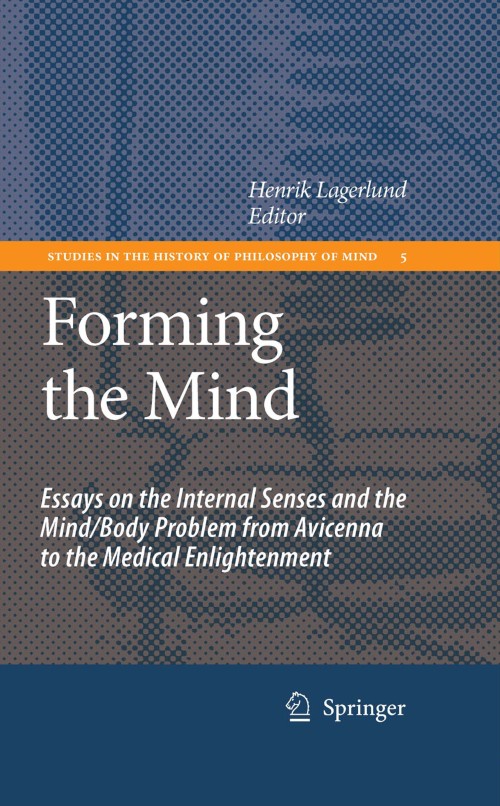
245 10|aForming the Mind|h[electronic resource] :|bEssays on the Internal Senses and the Mind/Body Problem from Avicenna to the Medical Enlightenment /|cedited by Henrik Lagerlund.
250 |a1st ed. 2007.
264 1|aDordrecht :|bSpringer Netherlands :|bImprint: Springer,|c2007.
300 |aX, 346 p.|bonline resource.
336 |atext|btxt|2rdacontent
337 |acomputer|bc|2rdamedia
338 |aonline resource|bcr|2rdacarrier
347 |atext file|bPDF|2rda
490 1 |aStudies in the History of Philosophy of Mind,|x2542-9922 ;|v5
505 0 |aIntroduction: The Mind/Body Problem and Late Medieval Conceptions of the Soul -- Memory and Recollection in IBN SÎNÂ’S and IBN Rushd’S Philosophical Texts Translated into Latin in the Twelfth and Thirteenth Centuries: A Perspective on the Doctrine of the Internal Senses in Arabic Psychological Science -- Imagination and Experience in the Sensory Soul and Beyond: Richard Rufus, Roger Bacon & Their Contemporaries -- The Soul as an Entity: Dante, Aquinas, and Olivi -- Self-Knowledge and Cognitive Ascent: Thomas Aquinas and Peter Olivi on the KK–THESIS -- The Invention of Singular Thought -- John Buridan on the Immateriality of the Intellect -- How Matter Becomes Mind: Late-Medieval Theories of Emergence -- Passions and Old Men in Renaissance Gerontology -- Why Isn’t the Mind-Body Problem Medieval? -- Matter, Mind, and Hylomorphism in IBN Gabirol and Spinoza -- Cajetan and Suarez on Agent Sense: Metaphysics and Epistemology in Late Aristotelian Thought -- Is Descartes’ Body A Mode of Mind? -- Mind andExtension (Descartes, Hobbes, More) -- Emotional Pathologies and Reason in French Medical Enlightenment.
520 |aForming the Mind deals with the internal senses, the mind/body problem and other problems associated with the concept of mind as it developed from Avicenna to the medical Enlightenment. The book collects essays from some of the foremost scholars in a relatively new and very promising field of research. It stresses how important and fruitful it is to see the time period between 1100 and 1700 as one continuous tradition, and brings together scholars working on the same issues in the Arabic, Jewish and Western philosophical traditions. In this respect, this collection opens up several new and interesting perspectives on the history of the philosophy of mind.
650 0|aPhilosophy, Medieval.
650 0|aPhilosophy of mind.
650 0|aPhilosophy, Modern.
650 0|aPhilosophy|xHistory.
650 14|aMedieval Philosophy.
650 24|aPhilosophy of Mind.
650 24|aPhilosophical Traditions.
650 24|aHistory of Philosophy.
700 1 |aLagerlund, Henrik.|eeditor.|4edt|4http://id.loc.gov/vocabulary/relators/edt
710 2 |aSpringerLink (Online service)
773 0 |tSpringer Nature eBook
776 08|iPrinted edition:|z9781402060830
776 08|iPrinted edition:|z9789048113514
776 08|iPrinted edition:|z9789048175307
830 0|aStudies in the History of Philosophy of Mind,|x2542-9922 ;|v5
856 40|uhttps://doi.org/10.1007/978-1-4020-6084-7
912 |aZDB-2-SHU
912 |aZDB-2-SXPR
950 |aHumanities, Social Sciences and Law (SpringerNature-11648)
950 |aPhilosophy and Religion (R0) (SpringerNature-43725)