

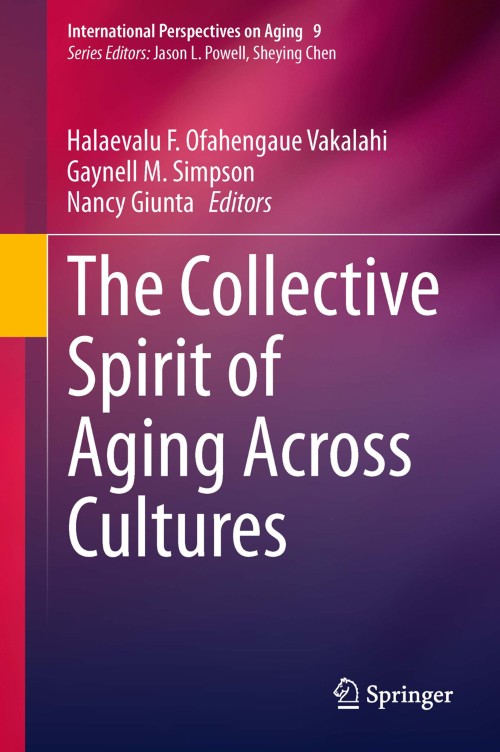
The Collective Spirit of Aging Across Cultures [electronic resource] / edited by Halaevalu F.Ofahengaue Vakalahi, Gaynell M. Simpson, Nancy Giunta.
Erişim Adresi
ISBN
9789401785945
Dil Kodu
İngilizce
Yer Numarası
DK/15635
Basım Bildirimi
1st ed. 2014.
Yayın Bilgisi
Dordrecht : Springer Netherlands : Imprint: Springer, 2014.
Fiziksel Niteleme
XII, 286 p. 8 illus. online resource.
Dizi
International Perspectives on Aging, 2197-585X ; 9
İçindekiler Notu
Foreword: Chandra Mehrotra -- Chapter 1: 4th Generational Theories of Intersection: Multicultural Aging:Gaynell M. Simpson, Nancy Giunta -- Chapter 2: A Historical Perspective in Aging and Gerontology: Patsy R. Smith -- Chapter 3: The Fourth Hill of Life: American Indian/Alaska Native Elders:Priscilla A Day -- Chapter 4: Aging and Mistreatment: Victimization of Older Adults in the United States: Pamela B. Teaster, Debra A. Harley, Amani Kettaneh -- Chapter 5: Latin@ Elders: Securing Healthy Aging Inspite of Health and Mental Health Disparities: Catherine K. Medina, Lirio K. Negroni -- Chapter 6: Aging, Intimacy, and Sex: Nancy Giunta, Stephanie A. Jacobson -- Chapter 7: The Effects of Minority and Immigration Status on Elderly Health: A Community Social Capital Perspective: Qingwen Xu, Yan Du -- Chapter 8: A Profile of Rural African American Lesbian Elders: Meeting Their Needs: Debra A. Harley, Kim L. Stansbury, Marva Nelson, Christina T. Espinosa -- Chapter 9: Intergenerational Dynamics Related to Aging and Eldercare in Asian American Families: Promoting Access to Services: Suzie S. Weng, Jacqueline Robinson -- Chapter 10: Seeing the Social in Technology for Older Adults: Making the implicit explicit through a multidisciplinary lens: Clara Berridge -- Chapter 11: Health Promotion for African American Elders: Church is the likely Place: Cheryl Waites, Angela Kaiser, Fayetta Martin -- Chapter 12: City Life, Our Way of Life: Aging in the Urban Environment: Kimberly Yancey,Tamika Baldwin, Ama R. Saran, Halaevalu F. Ofahengaue Vakalahi -- Chapter 13: A Call to Action: Dementia Screening of Alzheimer’s disease in Older African Americans: Sheila Black and Gaynell M. Simpson -- Chapter 14: Reworking the Template: The Financial Crisis and Housing Transitions of Older Americans: Tam E. Perry -- Chapter 15: Understanding the Human-Animal Bond: Implications for Practice with Community-Living Older Adults: Ann M. Callahan, Regina Brotherton -- Chapter 16: Summary and Future Directions: Nancy Giunta, Halaevalu F. Ofahengaue Vakalahi, Gaynell M. Simpson.
Özet, vb.
The collective, inclusive, and intersectional framework used in this book speaks to the significance of understanding aging across diverse cultures from multiple perspectives, but still as a shared human experience. The underlying message of the book is that although we are unique and different in our aging processes, we are ultimately connected through this physical, mental and spiritual experience of aging. Thus, regardless of whether we are service providers, service recipients, educators or merely fellow human beings, it is important that we approach the aging experience through a collective lens for discovering and sharing resources as we age; honoring the past while simultaneously accepting that the future is here. A few select examples of key findings from this collaborative work are as follows. First, despite progress in the field, certain issues remain to be addressed including the challenges of racism and sexism, mistreatment, the digital divide, poverty, and other social and economic crises in urban and rural communities as they relate to our aging population. Second, the need for sustaining a sense of independence among the aged and interdependence among supportive systems is warranted. Third, our elders continue to benefit from culturally competent services community-based health interventions and social services that addresses normative and emerging challenges for them. Fourth, spirituality in both indigenous and contemporary perspectives remains important for our elders’ development and quality of life. .
Konu
Aging.
Geriatrics.
Culture __ Study and teaching.
Ageing.
Geriatrics.
Cultural Studies.
Geriatrics.
Culture __ Study and teaching.
Ageing.
Geriatrics.
Cultural Studies.
Kurum Adı
Eseri Alıntıla
Referansları kullanmadan önce gözden geçirmeniz ve varsa gerekli düzeltmeleri yapmanız önerilir.
Dijital Kaynak
MARC Görünümü
LEADER 05668nam a22005415i 4500
001 814396
003 TR_AnAIT
005 20260130215924
007 cr nn 008mamaa
008 140128s2014 ne | s |||| 0|eng d
020 |a9789401785945|9978-94-017-8594-5
024 7 |a10.1007/978-94-017-8594-5|2doi
041 |aeng
049 |aTürk Tarih Kurumu Kütüphanesi
050 4|aQP86
072 7|aPSA|2bicssc
072 7|aSCI072000|2bisacsh
072 7|aPSA|2thema
082 04|a571.878|223
090 |aDK/15635
245 14|aThe Collective Spirit of Aging Across Cultures|h[electronic resource] /|cedited by Halaevalu F.Ofahengaue Vakalahi, Gaynell M. Simpson, Nancy Giunta.
250 |a1st ed. 2014.
264 1|aDordrecht :|bSpringer Netherlands :|bImprint: Springer,|c2014.
300 |aXII, 286 p. 8 illus.|bonline resource.
336 |atext|btxt|2rdacontent
337 |acomputer|bc|2rdamedia
338 |aonline resource|bcr|2rdacarrier
347 |atext file|bPDF|2rda
490 1 |aInternational Perspectives on Aging,|x2197-585X ;|v9
505 0 |aForeword: Chandra Mehrotra -- Chapter 1: 4th Generational Theories of Intersection: Multicultural Aging:Gaynell M. Simpson, Nancy Giunta -- Chapter 2: A Historical Perspective in Aging and Gerontology: Patsy R. Smith -- Chapter 3: The Fourth Hill of Life: American Indian/Alaska Native Elders:Priscilla A Day -- Chapter 4: Aging and Mistreatment: Victimization of Older Adults in the United States: Pamela B. Teaster, Debra A. Harley, Amani Kettaneh -- Chapter 5: Latin@ Elders: Securing Healthy Aging Inspite of Health and Mental Health Disparities: Catherine K. Medina, Lirio K. Negroni -- Chapter 6: Aging, Intimacy, and Sex: Nancy Giunta, Stephanie A. Jacobson -- Chapter 7: The Effects of Minority and Immigration Status on Elderly Health: A Community Social Capital Perspective: Qingwen Xu, Yan Du -- Chapter 8: A Profile of Rural African American Lesbian Elders: Meeting Their Needs: Debra A. Harley, Kim L. Stansbury, Marva Nelson, Christina T. Espinosa -- Chapter 9: Intergenerational Dynamics Related to Aging and Eldercare in Asian American Families: Promoting Access to Services: Suzie S. Weng, Jacqueline Robinson -- Chapter 10: Seeing the Social in Technology for Older Adults: Making the implicit explicit through a multidisciplinary lens: Clara Berridge -- Chapter 11: Health Promotion for African American Elders: Church is the likely Place: Cheryl Waites, Angela Kaiser, Fayetta Martin -- Chapter 12: City Life, Our Way of Life: Aging in the Urban Environment: Kimberly Yancey,Tamika Baldwin, Ama R. Saran, Halaevalu F. Ofahengaue Vakalahi -- Chapter 13: A Call to Action: Dementia Screening of Alzheimer’s disease in Older African Americans: Sheila Black and Gaynell M. Simpson -- Chapter 14: Reworking the Template: The Financial Crisis and Housing Transitions of Older Americans: Tam E. Perry -- Chapter 15: Understanding the Human-Animal Bond: Implications for Practice with Community-Living Older Adults: Ann M. Callahan, Regina Brotherton -- Chapter 16: Summary and Future Directions: Nancy Giunta, Halaevalu F. Ofahengaue Vakalahi, Gaynell M. Simpson.
520 |aThe collective, inclusive, and intersectional framework used in this book speaks to the significance of understanding aging across diverse cultures from multiple perspectives, but still as a shared human experience. The underlying message of the book is that although we are unique and different in our aging processes, we are ultimately connected through this physical, mental and spiritual experience of aging. Thus, regardless of whether we are service providers, service recipients, educators or merely fellow human beings, it is important that we approach the aging experience through a collective lens for discovering and sharing resources as we age; honoring the past while simultaneously accepting that the future is here. A few select examples of key findings from this collaborative work are as follows. First, despite progress in the field, certain issues remain to be addressed including the challenges of racism and sexism, mistreatment, the digital divide, poverty, and other social and economic crises in urban and rural communities as they relate to our aging population. Second, the need for sustaining a sense of independence among the aged and interdependence among supportive systems is warranted. Third, our elders continue to benefit from culturally competent services community-based health interventions and social services that addresses normative and emerging challenges for them. Fourth, spirituality in both indigenous and contemporary perspectives remains important for our elders’ development and quality of life. .
650 0|aAging.
650 0|aGeriatrics.
650 0|aCulture|xStudy and teaching.
650 14|aAgeing.
650 24|aGeriatrics.
650 24|aCultural Studies.
700 1 |aVakalahi, Halaevalu F.Ofahengaue.|eeditor.|4edt|4http://id.loc.gov/vocabulary/relators/edt
700 1 |aSimpson, Gaynell M.|eeditor.|4edt|4http://id.loc.gov/vocabulary/relators/edt
700 1 |aGiunta, Nancy.|eeditor.|4edt|4http://id.loc.gov/vocabulary/relators/edt
710 2 |aSpringerLink (Online service)
773 0 |tSpringer Nature eBook
776 08|iPrinted edition:|z9789401785938
776 08|iPrinted edition:|z9789401785952
776 08|iPrinted edition:|z9789402406528
830 0|aInternational Perspectives on Aging,|x2197-585X ;|v9
856 40|uhttps://doi.org/10.1007/978-94-017-8594-5
912 |aZDB-2-SHU
912 |aZDB-2-SXS
950 |aHumanities, Social Sciences and Law (SpringerNature-11648)
950 |aSocial Sciences (R0) (SpringerNature-43726)
001 814396
003 TR_AnAIT
005 20260130215924
007 cr nn 008mamaa
008 140128s2014 ne | s |||| 0|eng d
020 |a9789401785945|9978-94-017-8594-5
024 7 |a10.1007/978-94-017-8594-5|2doi
041 |aeng
049 |aTürk Tarih Kurumu Kütüphanesi
050 4|aQP86
072 7|aPSA|2bicssc
072 7|aSCI072000|2bisacsh
072 7|aPSA|2thema
082 04|a571.878|223
090 |aDK/15635
245 14|aThe Collective Spirit of Aging Across Cultures|h[electronic resource] /|cedited by Halaevalu F.Ofahengaue Vakalahi, Gaynell M. Simpson, Nancy Giunta.
250 |a1st ed. 2014.
264 1|aDordrecht :|bSpringer Netherlands :|bImprint: Springer,|c2014.
300 |aXII, 286 p. 8 illus.|bonline resource.
336 |atext|btxt|2rdacontent
337 |acomputer|bc|2rdamedia
338 |aonline resource|bcr|2rdacarrier
347 |atext file|bPDF|2rda
490 1 |aInternational Perspectives on Aging,|x2197-585X ;|v9
505 0 |aForeword: Chandra Mehrotra -- Chapter 1: 4th Generational Theories of Intersection: Multicultural Aging:Gaynell M. Simpson, Nancy Giunta -- Chapter 2: A Historical Perspective in Aging and Gerontology: Patsy R. Smith -- Chapter 3: The Fourth Hill of Life: American Indian/Alaska Native Elders:Priscilla A Day -- Chapter 4: Aging and Mistreatment: Victimization of Older Adults in the United States: Pamela B. Teaster, Debra A. Harley, Amani Kettaneh -- Chapter 5: Latin@ Elders: Securing Healthy Aging Inspite of Health and Mental Health Disparities: Catherine K. Medina, Lirio K. Negroni -- Chapter 6: Aging, Intimacy, and Sex: Nancy Giunta, Stephanie A. Jacobson -- Chapter 7: The Effects of Minority and Immigration Status on Elderly Health: A Community Social Capital Perspective: Qingwen Xu, Yan Du -- Chapter 8: A Profile of Rural African American Lesbian Elders: Meeting Their Needs: Debra A. Harley, Kim L. Stansbury, Marva Nelson, Christina T. Espinosa -- Chapter 9: Intergenerational Dynamics Related to Aging and Eldercare in Asian American Families: Promoting Access to Services: Suzie S. Weng, Jacqueline Robinson -- Chapter 10: Seeing the Social in Technology for Older Adults: Making the implicit explicit through a multidisciplinary lens: Clara Berridge -- Chapter 11: Health Promotion for African American Elders: Church is the likely Place: Cheryl Waites, Angela Kaiser, Fayetta Martin -- Chapter 12: City Life, Our Way of Life: Aging in the Urban Environment: Kimberly Yancey,Tamika Baldwin, Ama R. Saran, Halaevalu F. Ofahengaue Vakalahi -- Chapter 13: A Call to Action: Dementia Screening of Alzheimer’s disease in Older African Americans: Sheila Black and Gaynell M. Simpson -- Chapter 14: Reworking the Template: The Financial Crisis and Housing Transitions of Older Americans: Tam E. Perry -- Chapter 15: Understanding the Human-Animal Bond: Implications for Practice with Community-Living Older Adults: Ann M. Callahan, Regina Brotherton -- Chapter 16: Summary and Future Directions: Nancy Giunta, Halaevalu F. Ofahengaue Vakalahi, Gaynell M. Simpson.
520 |aThe collective, inclusive, and intersectional framework used in this book speaks to the significance of understanding aging across diverse cultures from multiple perspectives, but still as a shared human experience. The underlying message of the book is that although we are unique and different in our aging processes, we are ultimately connected through this physical, mental and spiritual experience of aging. Thus, regardless of whether we are service providers, service recipients, educators or merely fellow human beings, it is important that we approach the aging experience through a collective lens for discovering and sharing resources as we age; honoring the past while simultaneously accepting that the future is here. A few select examples of key findings from this collaborative work are as follows. First, despite progress in the field, certain issues remain to be addressed including the challenges of racism and sexism, mistreatment, the digital divide, poverty, and other social and economic crises in urban and rural communities as they relate to our aging population. Second, the need for sustaining a sense of independence among the aged and interdependence among supportive systems is warranted. Third, our elders continue to benefit from culturally competent services community-based health interventions and social services that addresses normative and emerging challenges for them. Fourth, spirituality in both indigenous and contemporary perspectives remains important for our elders’ development and quality of life. .
650 0|aAging.
650 0|aGeriatrics.
650 0|aCulture|xStudy and teaching.
650 14|aAgeing.
650 24|aGeriatrics.
650 24|aCultural Studies.
700 1 |aVakalahi, Halaevalu F.Ofahengaue.|eeditor.|4edt|4http://id.loc.gov/vocabulary/relators/edt
700 1 |aSimpson, Gaynell M.|eeditor.|4edt|4http://id.loc.gov/vocabulary/relators/edt
700 1 |aGiunta, Nancy.|eeditor.|4edt|4http://id.loc.gov/vocabulary/relators/edt
710 2 |aSpringerLink (Online service)
773 0 |tSpringer Nature eBook
776 08|iPrinted edition:|z9789401785938
776 08|iPrinted edition:|z9789401785952
776 08|iPrinted edition:|z9789402406528
830 0|aInternational Perspectives on Aging,|x2197-585X ;|v9
856 40|uhttps://doi.org/10.1007/978-94-017-8594-5
912 |aZDB-2-SHU
912 |aZDB-2-SXS
950 |aHumanities, Social Sciences and Law (SpringerNature-11648)
950 |aSocial Sciences (R0) (SpringerNature-43726)
Materyaller
Depodan talep edilen materyal sadece kütüphane içerisinde kullanılmaktadır.
Materyal dışarıya ödünç verilmemektedir.
Materyal dışarıya ödünç verilmemektedir.
