

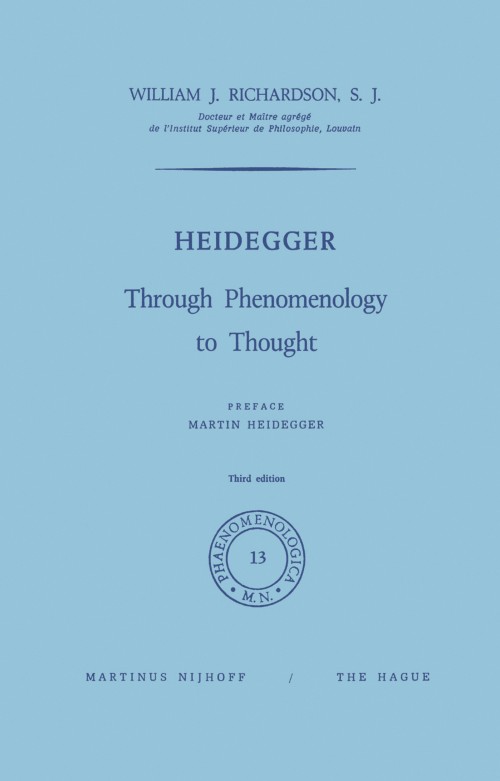
Heidegger [electronic resource] : Through Phenomenology to Thought / by W.J. Richardson.
Erişim Adresi
ISBN
9789401019767
Dil Kodu
İngilizce
Yer Numarası
DK/15666
Yazar
Basım Bildirimi
1st ed. 1974.
Yayın Bilgisi
Dordrecht : Springer Netherlands : Imprint: Springer, 1974.
Fiziksel Niteleme
XXXIV, 768 p. online resource.
Dizi
Phaenomenologica, Series Founded by H. L. Van Breda and Published Under the Auspices of the Husserl-Archives, 2215-0331 ; 13
İçindekiler Notu
I: From There to Being -- I. Being and Time -- II. Kant and the Problem of Metaphysics -- III. The Essence of Ground -- IV. What is Metaphysics? -- II: Reversal -- I. On the Essence of Truth -- II. The Self-assertion of the German University -- III. Introduction to Metaphysics -- IV: From Being to There -- Section A. The De-volution of Thought 299 -- I. Plato -- II. Aristotle -- III. Descartes -- IV. Hegel -- V. Nietzsche -- VI. Logic -- VII. Humanism -- VIII. Transition: Rilke -- Section B. The Re-trieve of Thought -- I. The Origin of a Work of Art, Hölderlin and the Essence of Poetry -- II. The Time of World-as-Picture -- III. “As when upon a day of rest…” -- IV. Nietzsche’s Word “God is dead” -- V. “Homecoming,” “Recollection” -- VI. What is Metaphysics: Epilogue -- VII. ’’??????? -- VIII. ????? -- IX. Towards an Analysis of Release, Nihilism -- X. The Saying of Anaximander -- XI. Whereunto the Poet? -- XII. Letter on Humanism -- XIII. Interlude -- XIV. What is Metaphysics ?: Introduction. The Essence of Ground: Prologue -- XV. The Thing -- XVI. Language -- XVII. Working, Dwelling, Thinking -- XVIII. “…Poetically doth man dwell…” -- XIX. What E-vokes Thought? -- Conclusion -- Outlines -- Appendix: Courses, Seminars and Lectures of Martin Heidegger -- Bibliography: -- I. Heidegger’s Works -- A. Order of Publication -- B. Order of Composition -- II. Other Works Cited -- III. Selective Bibliography -- IV. English Translations -- Indexes: -- I. Index of Texts Cited -- II. Index of Proper Names -- II. Index of Greek Terms -- IV. General Index.
Özet, vb.
Dear Father Richardson: It is with some hesitation that I attempt to answer the two principal questions you posed in your letter of March I, 1962. The first touches on the initial impetus that determined the way my thought would gO. l The other looks for information about the much discussed "reversal" [in my development]. I hesitate with my answers, for they are necessarily no more than indications [of much more to be said]. The lesson of long experience leads me to surmise that such indications will not be taken as directions for the road of independent reflection on the matter pointed out which each must travel for himself. [Instead they] will gain notice as though they were an opinion I had ex pressed, and will be propagated as such. Every effort to bring what has been thought closer to prevailing modes of (re)presen tation must assimilate what-is-to-be-thought to those (re)presen tations and thereby inevitably deform the matter. 2 This preamble is not the lament of a man misunderstood; it is rather the recognition of an almost insurmountable difficulty in making oneself understood. The first question in your letter reads: "How are we properly to understand your first experience of the Being-question in 1 [Translator's note. With regard to the translati~ of Denken, see below, p. 16, note 43. ] I [Translator's note. For the translation of VorsteUung by "(re)presentation," see below, p. 108, note 5. ] VORWORT Sehr geehrter Herr P.
Konu
Phenomenology .
Phenomenology.
Phenomenology.
Kurum Adı
Eseri Alıntıla
Referansları kullanmadan önce gözden geçirmeniz ve varsa gerekli düzeltmeleri yapmanız önerilir.
Dijital Kaynak
MARC Görünümü
LEADER 05659nam a22005295i 4500
001 814427
003 TR_AnAIT
005 20260130215751
007 cr nn 008mamaa
008 121227s1974 ne | s |||| 0|eng d
020 |a9789401019767|9978-94-010-1976-7
024 7 |a10.1007/978-94-010-1976-7|2doi
041 |aeng
049 |aTürk Tarih Kurumu Kütüphanesi
050 4|aB829.5.A-Z
072 7|aHPCF3|2bicssc
072 7|aPHI018000|2bisacsh
072 7|aQDHR5|2thema
082 04|a142.7|223
090 |aDK/15666
100 1 |aRichardson, W.J.|eauthor.|4aut|4http://id.loc.gov/vocabulary/relators/aut
245 10|aHeidegger|h[electronic resource] :|bThrough Phenomenology to Thought /|cby W.J. Richardson.
250 |a1st ed. 1974.
264 1|aDordrecht :|bSpringer Netherlands :|bImprint: Springer,|c1974.
300 |aXXXIV, 768 p.|bonline resource.
336 |atext|btxt|2rdacontent
337 |acomputer|bc|2rdamedia
338 |aonline resource|bcr|2rdacarrier
347 |atext file|bPDF|2rda
490 1 |aPhaenomenologica, Series Founded by H. L. Van Breda and Published Under the Auspices of the Husserl-Archives,|x2215-0331 ;|v13
505 0 |aI: From There to Being -- I. Being and Time -- II. Kant and the Problem of Metaphysics -- III. The Essence of Ground -- IV. What is Metaphysics? -- II: Reversal -- I. On the Essence of Truth -- II. The Self-assertion of the German University -- III. Introduction to Metaphysics -- IV: From Being to There -- Section A. The De-volution of Thought 299 -- I. Plato -- II. Aristotle -- III. Descartes -- IV. Hegel -- V. Nietzsche -- VI. Logic -- VII. Humanism -- VIII. Transition: Rilke -- Section B. The Re-trieve of Thought -- I. The Origin of a Work of Art, Hölderlin and the Essence of Poetry -- II. The Time of World-as-Picture -- III. “As when upon a day of rest…” -- IV. Nietzsche’s Word “God is dead” -- V. “Homecoming,” “Recollection” -- VI. What is Metaphysics: Epilogue -- VII. ’’??????? -- VIII. ????? -- IX. Towards an Analysis of Release, Nihilism -- X. The Saying of Anaximander -- XI. Whereunto the Poet? -- XII. Letter on Humanism -- XIII. Interlude -- XIV. What is Metaphysics ?: Introduction. The Essence of Ground: Prologue -- XV. The Thing -- XVI. Language -- XVII. Working, Dwelling, Thinking -- XVIII. “…Poetically doth man dwell…” -- XIX. What E-vokes Thought? -- Conclusion -- Outlines -- Appendix: Courses, Seminars and Lectures of Martin Heidegger -- Bibliography: -- I. Heidegger’s Works -- A. Order of Publication -- B. Order of Composition -- II. Other Works Cited -- III. Selective Bibliography -- IV. English Translations -- Indexes: -- I. Index of Texts Cited -- II. Index of Proper Names -- II. Index of Greek Terms -- IV. General Index.
520 |aDear Father Richardson: It is with some hesitation that I attempt to answer the two principal questions you posed in your letter of March I, 1962. The first touches on the initial impetus that determined the way my thought would gO. l The other looks for information about the much discussed "reversal" [in my development]. I hesitate with my answers, for they are necessarily no more than indications [of much more to be said]. The lesson of long experience leads me to surmise that such indications will not be taken as directions for the road of independent reflection on the matter pointed out which each must travel for himself. [Instead they] will gain notice as though they were an opinion I had ex pressed, and will be propagated as such. Every effort to bring what has been thought closer to prevailing modes of (re)presen tation must assimilate what-is-to-be-thought to those (re)presen tations and thereby inevitably deform the matter. 2 This preamble is not the lament of a man misunderstood; it is rather the recognition of an almost insurmountable difficulty in making oneself understood. The first question in your letter reads: "How are we properly to understand your first experience of the Being-question in 1 [Translator's note. With regard to the translati~ of Denken, see below, p. 16, note 43. ] I [Translator's note. For the translation of VorsteUung by "(re)presentation," see below, p. 108, note 5. ] VORWORT Sehr geehrter Herr P.
532 8 |aAccessibility summary: This PDF is not accessible. It is based on scanned pages and does not support features such as screen reader compatibility or described non-text content (images, graphs etc). However, it likely supports searchable and selectable text based on OCR (Optical Character Recognition). Users with accessibility needs may not be able to use this content effectively. Please contact us at accessibilitysupport@springernature.com if you require assistance or an alternative format.
532 8 |aInaccessible, or known limited accessibility
532 8 |aNo reading system accessibility options actively disabled
532 8 |aPublisher contact for further accessibility information: accessibilitysupport@springernature.com
650 0|aPhenomenology .
650 14|aPhenomenology.
710 2 |aSpringerLink (Online service)
773 0 |tSpringer Nature eBook
776 08|iPrinted edition:|z9789024702466
776 08|iPrinted edition:|z9789401019774
776 08|iPrinted edition:|z9789401019781
830 0|aPhaenomenologica, Series Founded by H. L. Van Breda and Published Under the Auspices of the Husserl-Archives,|x2215-0331 ;|v13
856 40|uhttps://doi.org/10.1007/978-94-010-1976-7
912 |aZDB-2-SHU
912 |aZDB-2-SXPR
912 |aZDB-2-BAE
950 |aHumanities, Social Sciences and Law (SpringerNature-11648)
950 |aPhilosophy and Religion (R0) (SpringerNature-43725)
001 814427
003 TR_AnAIT
005 20260130215751
007 cr nn 008mamaa
008 121227s1974 ne | s |||| 0|eng d
020 |a9789401019767|9978-94-010-1976-7
024 7 |a10.1007/978-94-010-1976-7|2doi
041 |aeng
049 |aTürk Tarih Kurumu Kütüphanesi
050 4|aB829.5.A-Z
072 7|aHPCF3|2bicssc
072 7|aPHI018000|2bisacsh
072 7|aQDHR5|2thema
082 04|a142.7|223
090 |aDK/15666
100 1 |aRichardson, W.J.|eauthor.|4aut|4http://id.loc.gov/vocabulary/relators/aut
245 10|aHeidegger|h[electronic resource] :|bThrough Phenomenology to Thought /|cby W.J. Richardson.
250 |a1st ed. 1974.
264 1|aDordrecht :|bSpringer Netherlands :|bImprint: Springer,|c1974.
300 |aXXXIV, 768 p.|bonline resource.
336 |atext|btxt|2rdacontent
337 |acomputer|bc|2rdamedia
338 |aonline resource|bcr|2rdacarrier
347 |atext file|bPDF|2rda
490 1 |aPhaenomenologica, Series Founded by H. L. Van Breda and Published Under the Auspices of the Husserl-Archives,|x2215-0331 ;|v13
505 0 |aI: From There to Being -- I. Being and Time -- II. Kant and the Problem of Metaphysics -- III. The Essence of Ground -- IV. What is Metaphysics? -- II: Reversal -- I. On the Essence of Truth -- II. The Self-assertion of the German University -- III. Introduction to Metaphysics -- IV: From Being to There -- Section A. The De-volution of Thought 299 -- I. Plato -- II. Aristotle -- III. Descartes -- IV. Hegel -- V. Nietzsche -- VI. Logic -- VII. Humanism -- VIII. Transition: Rilke -- Section B. The Re-trieve of Thought -- I. The Origin of a Work of Art, Hölderlin and the Essence of Poetry -- II. The Time of World-as-Picture -- III. “As when upon a day of rest…” -- IV. Nietzsche’s Word “God is dead” -- V. “Homecoming,” “Recollection” -- VI. What is Metaphysics: Epilogue -- VII. ’’??????? -- VIII. ????? -- IX. Towards an Analysis of Release, Nihilism -- X. The Saying of Anaximander -- XI. Whereunto the Poet? -- XII. Letter on Humanism -- XIII. Interlude -- XIV. What is Metaphysics ?: Introduction. The Essence of Ground: Prologue -- XV. The Thing -- XVI. Language -- XVII. Working, Dwelling, Thinking -- XVIII. “…Poetically doth man dwell…” -- XIX. What E-vokes Thought? -- Conclusion -- Outlines -- Appendix: Courses, Seminars and Lectures of Martin Heidegger -- Bibliography: -- I. Heidegger’s Works -- A. Order of Publication -- B. Order of Composition -- II. Other Works Cited -- III. Selective Bibliography -- IV. English Translations -- Indexes: -- I. Index of Texts Cited -- II. Index of Proper Names -- II. Index of Greek Terms -- IV. General Index.
520 |aDear Father Richardson: It is with some hesitation that I attempt to answer the two principal questions you posed in your letter of March I, 1962. The first touches on the initial impetus that determined the way my thought would gO. l The other looks for information about the much discussed "reversal" [in my development]. I hesitate with my answers, for they are necessarily no more than indications [of much more to be said]. The lesson of long experience leads me to surmise that such indications will not be taken as directions for the road of independent reflection on the matter pointed out which each must travel for himself. [Instead they] will gain notice as though they were an opinion I had ex pressed, and will be propagated as such. Every effort to bring what has been thought closer to prevailing modes of (re)presen tation must assimilate what-is-to-be-thought to those (re)presen tations and thereby inevitably deform the matter. 2 This preamble is not the lament of a man misunderstood; it is rather the recognition of an almost insurmountable difficulty in making oneself understood. The first question in your letter reads: "How are we properly to understand your first experience of the Being-question in 1 [Translator's note. With regard to the translati~ of Denken, see below, p. 16, note 43. ] I [Translator's note. For the translation of VorsteUung by "(re)presentation," see below, p. 108, note 5. ] VORWORT Sehr geehrter Herr P.
532 8 |aAccessibility summary: This PDF is not accessible. It is based on scanned pages and does not support features such as screen reader compatibility or described non-text content (images, graphs etc). However, it likely supports searchable and selectable text based on OCR (Optical Character Recognition). Users with accessibility needs may not be able to use this content effectively. Please contact us at accessibilitysupport@springernature.com if you require assistance or an alternative format.
532 8 |aInaccessible, or known limited accessibility
532 8 |aNo reading system accessibility options actively disabled
532 8 |aPublisher contact for further accessibility information: accessibilitysupport@springernature.com
650 0|aPhenomenology .
650 14|aPhenomenology.
710 2 |aSpringerLink (Online service)
773 0 |tSpringer Nature eBook
776 08|iPrinted edition:|z9789024702466
776 08|iPrinted edition:|z9789401019774
776 08|iPrinted edition:|z9789401019781
830 0|aPhaenomenologica, Series Founded by H. L. Van Breda and Published Under the Auspices of the Husserl-Archives,|x2215-0331 ;|v13
856 40|uhttps://doi.org/10.1007/978-94-010-1976-7
912 |aZDB-2-SHU
912 |aZDB-2-SXPR
912 |aZDB-2-BAE
950 |aHumanities, Social Sciences and Law (SpringerNature-11648)
950 |aPhilosophy and Religion (R0) (SpringerNature-43725)
Materyaller
Depodan talep edilen materyal sadece kütüphane içerisinde kullanılmaktadır.
Materyal dışarıya ödünç verilmemektedir.
Materyal dışarıya ödünç verilmemektedir.
