

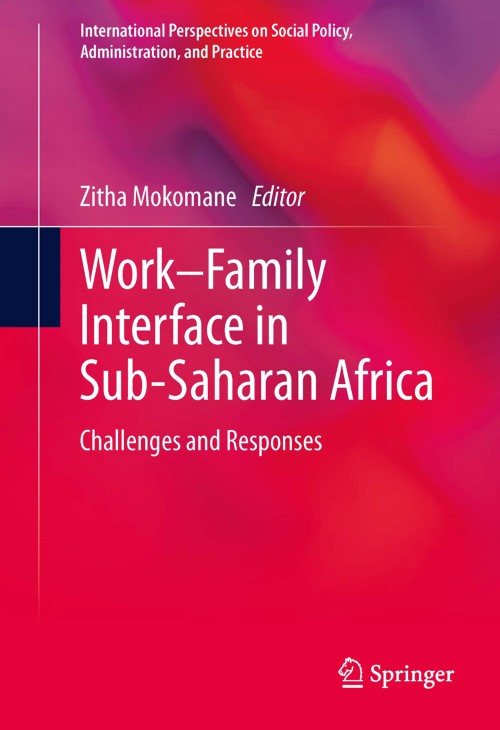
Work–Family Interface in Sub-Saharan Africa [electronic resource] : Challenges and Responses / edited by Zitha Mokomane.
Erişim Adresi
ISBN
9783319012377
Dil Kodu
İngilizce
Yer Numarası
DK/15673
Basım Bildirimi
1st ed. 2014.
Yayın Bilgisi
Cham : Springer International Publishing : Imprint: Springer, 2014.
Fiziksel Niteleme
XI, 216 p. 5 illus. online resource.
Dizi
International Perspectives on Social Policy, Administration, and Practice, 2625-6983
İçindekiler Notu
Part I Work-Family Interface as a Policy Issue in Sub-Saharan Africa -- Chapter 1 Introduction -- Chapter 2 Managing Work and Family Demands: The Perspectives of Employed Parents in Ghana -- Chapter 3 Work and family in a cross-cultural context: A comparative review of work-family experiences of working mothers in Australia and Zimbabwe -- Part II Factors Underlying Work-Family Conflict in Sub-Saharan Africa -- Chapter 4 Working hours and work-family conflict in the institutional context of Nigeria -- Chapter 5 Strain-Based Family Interference with Work: A Theoretical-Empirical Analysis from South-Eastern Nigeria -- Chapter 6 Sexual Harassment as a Contributory Factor in Work-Family Conflict: Implications for Policies in the Workplace.-Part III Impact on the Families -- Chapter 7 The Social Impact of Job Transfer Policy on Dual Career Families in Botswana -- Chapter 8 Workplace Changes and Its Implications for Work-Family Conflict and Gender Asymmetries in South Africa.-Part IV Coping Strategies -- Chapter 9 The Role of House Helps in Work-Family Balance of Women Employed in the Formal Sector in Kenya -- Chapter 10 The Quest for a Family Policy in Zambia -- Chapter 11 State Measures towards Work-Care Integration in South Africa -- Chapter 12 A Review of Work-Family Research in Sub-Saharan Africa.
Özet, vb.
Work-Family Interface in Sub-Saharan Africa Challenges and Responses Zitha Mokomane, editor Problems associated with work-family conflict do not belong to individual families alone, but have a major social and economic impact on the greater community. This scenario also holds true across sub-Saharan Africa, as nations enter the global economy and rising numbers of women enter the workforce. One of the first resources to focus on this region, Work-Family Interface in Sub-Saharan Africa probes rarely-studied dimensions of conflict between paid employment and family responsibilities. It balances theoretical background, empirical findings, and current and emerging interventions for an insightful and practical review of ongoing issues affecting working women with families. Coverage contrasts concepts of work and family between the developing world and the West, and related social concerns such as gender expectations and sexual harassment are examined in the work context. The book describes a range of family strategies for resolving work-family friction, and chapters end with policy recommendations as first steps toward remedying longstanding challenges. Among the thought-provoking dispatches: Ghana: Managing work and family demands Nigeria: Strain-based family interference with work Botswana: The social impact of job transfer policy on dual-career families Kenya: The role of household help in work-family balance South Africa: State measures toward work-care integration Zambia: The quest for a family policy As evinced by these chapters, progress is gradual and far from uniform. As a guide for future study and future policy, Work-Family Interface in Sub-Saharan Africa is a substantial reference for sociologists, public health professionals, public and social policymakers, and administrators.
Konu
Sociology.
Social groups.
Public health.
Demography.
Population.
Social policy.
Sociology of Family, Youth and Aging.
Public Health.
Population and Demography.
Social Policy.
Social groups.
Public health.
Demography.
Population.
Social policy.
Sociology of Family, Youth and Aging.
Public Health.
Population and Demography.
Social Policy.
Diğer Yazarlar
Kurum Adı
Eseri Alıntıla
Referansları kullanmadan önce gözden geçirmeniz ve varsa gerekli düzeltmeleri yapmanız önerilir.
Dijital Kaynak
MARC Görünümü
LEADER 05214nam a22005775i 4500
001 814434
003 TR_AnAIT
005 20260130215732
007 cr nn 008mamaa
008 131101s2014 sz | s |||| 0|eng d
020 |a9783319012377|9978-3-319-01237-7
024 7 |a10.1007/978-3-319-01237-7|2doi
041 |aeng
049 |aTürk Tarih Kurumu Kütüphanesi
050 4|aHM716-753.2
072 7|aJHBK|2bicssc
072 7|aSOC026010|2bisacsh
072 7|aJHBK|2thema
082 04|a305.2|223
082 04|a306.87|223
090 |aDK/15673
245 10|aWork–Family Interface in Sub-Saharan Africa|h[electronic resource] :|bChallenges and Responses /|cedited by Zitha Mokomane.
250 |a1st ed. 2014.
264 1|aCham :|bSpringer International Publishing :|bImprint: Springer,|c2014.
300 |aXI, 216 p. 5 illus.|bonline resource.
336 |atext|btxt|2rdacontent
337 |acomputer|bc|2rdamedia
338 |aonline resource|bcr|2rdacarrier
347 |atext file|bPDF|2rda
490 1 |aInternational Perspectives on Social Policy, Administration, and Practice,|x2625-6983
505 0 |aPart I Work-Family Interface as a Policy Issue in Sub-Saharan Africa -- Chapter 1 Introduction -- Chapter 2 Managing Work and Family Demands: The Perspectives of Employed Parents in Ghana -- Chapter 3 Work and family in a cross-cultural context: A comparative review of work-family experiences of working mothers in Australia and Zimbabwe -- Part II Factors Underlying Work-Family Conflict in Sub-Saharan Africa -- Chapter 4 Working hours and work-family conflict in the institutional context of Nigeria -- Chapter 5 Strain-Based Family Interference with Work: A Theoretical-Empirical Analysis from South-Eastern Nigeria -- Chapter 6 Sexual Harassment as a Contributory Factor in Work-Family Conflict: Implications for Policies in the Workplace.-Part III Impact on the Families -- Chapter 7 The Social Impact of Job Transfer Policy on Dual Career Families in Botswana -- Chapter 8 Workplace Changes and Its Implications for Work-Family Conflict and Gender Asymmetries in South Africa.-Part IV Coping Strategies -- Chapter 9 The Role of House Helps in Work-Family Balance of Women Employed in the Formal Sector in Kenya -- Chapter 10 The Quest for a Family Policy in Zambia -- Chapter 11 State Measures towards Work-Care Integration in South Africa -- Chapter 12 A Review of Work-Family Research in Sub-Saharan Africa.
520 |aWork-Family Interface in Sub-Saharan Africa Challenges and Responses Zitha Mokomane, editor Problems associated with work-family conflict do not belong to individual families alone, but have a major social and economic impact on the greater community. This scenario also holds true across sub-Saharan Africa, as nations enter the global economy and rising numbers of women enter the workforce. One of the first resources to focus on this region, Work-Family Interface in Sub-Saharan Africa probes rarely-studied dimensions of conflict between paid employment and family responsibilities. It balances theoretical background, empirical findings, and current and emerging interventions for an insightful and practical review of ongoing issues affecting working women with families. Coverage contrasts concepts of work and family between the developing world and the West, and related social concerns such as gender expectations and sexual harassment are examined in the work context. The book describes a range of family strategies for resolving work-family friction, and chapters end with policy recommendations as first steps toward remedying longstanding challenges. Among the thought-provoking dispatches: Ghana: Managing work and family demands Nigeria: Strain-based family interference with work Botswana: The social impact of job transfer policy on dual-career families Kenya: The role of household help in work-family balance South Africa: State measures toward work-care integration Zambia: The quest for a family policy As evinced by these chapters, progress is gradual and far from uniform. As a guide for future study and future policy, Work-Family Interface in Sub-Saharan Africa is a substantial reference for sociologists, public health professionals, public and social policymakers, and administrators.
650 0|aSociology.
650 0|aSocial groups.
650 0|aPublic health.
650 0|aDemography.
650 0|aPopulation.
650 0|aSocial policy.
650 14|aSociology of Family, Youth and Aging.
650 24|aPublic Health.
650 24|aPopulation and Demography.
650 24|aSocial Policy.
700 1 |aMokomane, Zitha.|eeditor.|4edt|4http://id.loc.gov/vocabulary/relators/edt
710 2 |aSpringerLink (Online service)
773 0 |tSpringer Nature eBook
776 08|iPrinted edition:|z9783319012360
776 08|iPrinted edition:|z9783319012384
776 08|iPrinted edition:|z9783319342771
830 0|aInternational Perspectives on Social Policy, Administration, and Practice,|x2625-6983
856 40|uhttps://doi.org/10.1007/978-3-319-01237-7
912 |aZDB-2-SHU
912 |aZDB-2-SXS
950 |aHumanities, Social Sciences and Law (SpringerNature-11648)
950 |aSocial Sciences (R0) (SpringerNature-43726)
001 814434
003 TR_AnAIT
005 20260130215732
007 cr nn 008mamaa
008 131101s2014 sz | s |||| 0|eng d
020 |a9783319012377|9978-3-319-01237-7
024 7 |a10.1007/978-3-319-01237-7|2doi
041 |aeng
049 |aTürk Tarih Kurumu Kütüphanesi
050 4|aHM716-753.2
072 7|aJHBK|2bicssc
072 7|aSOC026010|2bisacsh
072 7|aJHBK|2thema
082 04|a305.2|223
082 04|a306.87|223
090 |aDK/15673
245 10|aWork–Family Interface in Sub-Saharan Africa|h[electronic resource] :|bChallenges and Responses /|cedited by Zitha Mokomane.
250 |a1st ed. 2014.
264 1|aCham :|bSpringer International Publishing :|bImprint: Springer,|c2014.
300 |aXI, 216 p. 5 illus.|bonline resource.
336 |atext|btxt|2rdacontent
337 |acomputer|bc|2rdamedia
338 |aonline resource|bcr|2rdacarrier
347 |atext file|bPDF|2rda
490 1 |aInternational Perspectives on Social Policy, Administration, and Practice,|x2625-6983
505 0 |aPart I Work-Family Interface as a Policy Issue in Sub-Saharan Africa -- Chapter 1 Introduction -- Chapter 2 Managing Work and Family Demands: The Perspectives of Employed Parents in Ghana -- Chapter 3 Work and family in a cross-cultural context: A comparative review of work-family experiences of working mothers in Australia and Zimbabwe -- Part II Factors Underlying Work-Family Conflict in Sub-Saharan Africa -- Chapter 4 Working hours and work-family conflict in the institutional context of Nigeria -- Chapter 5 Strain-Based Family Interference with Work: A Theoretical-Empirical Analysis from South-Eastern Nigeria -- Chapter 6 Sexual Harassment as a Contributory Factor in Work-Family Conflict: Implications for Policies in the Workplace.-Part III Impact on the Families -- Chapter 7 The Social Impact of Job Transfer Policy on Dual Career Families in Botswana -- Chapter 8 Workplace Changes and Its Implications for Work-Family Conflict and Gender Asymmetries in South Africa.-Part IV Coping Strategies -- Chapter 9 The Role of House Helps in Work-Family Balance of Women Employed in the Formal Sector in Kenya -- Chapter 10 The Quest for a Family Policy in Zambia -- Chapter 11 State Measures towards Work-Care Integration in South Africa -- Chapter 12 A Review of Work-Family Research in Sub-Saharan Africa.
520 |aWork-Family Interface in Sub-Saharan Africa Challenges and Responses Zitha Mokomane, editor Problems associated with work-family conflict do not belong to individual families alone, but have a major social and economic impact on the greater community. This scenario also holds true across sub-Saharan Africa, as nations enter the global economy and rising numbers of women enter the workforce. One of the first resources to focus on this region, Work-Family Interface in Sub-Saharan Africa probes rarely-studied dimensions of conflict between paid employment and family responsibilities. It balances theoretical background, empirical findings, and current and emerging interventions for an insightful and practical review of ongoing issues affecting working women with families. Coverage contrasts concepts of work and family between the developing world and the West, and related social concerns such as gender expectations and sexual harassment are examined in the work context. The book describes a range of family strategies for resolving work-family friction, and chapters end with policy recommendations as first steps toward remedying longstanding challenges. Among the thought-provoking dispatches: Ghana: Managing work and family demands Nigeria: Strain-based family interference with work Botswana: The social impact of job transfer policy on dual-career families Kenya: The role of household help in work-family balance South Africa: State measures toward work-care integration Zambia: The quest for a family policy As evinced by these chapters, progress is gradual and far from uniform. As a guide for future study and future policy, Work-Family Interface in Sub-Saharan Africa is a substantial reference for sociologists, public health professionals, public and social policymakers, and administrators.
650 0|aSociology.
650 0|aSocial groups.
650 0|aPublic health.
650 0|aDemography.
650 0|aPopulation.
650 0|aSocial policy.
650 14|aSociology of Family, Youth and Aging.
650 24|aPublic Health.
650 24|aPopulation and Demography.
650 24|aSocial Policy.
700 1 |aMokomane, Zitha.|eeditor.|4edt|4http://id.loc.gov/vocabulary/relators/edt
710 2 |aSpringerLink (Online service)
773 0 |tSpringer Nature eBook
776 08|iPrinted edition:|z9783319012360
776 08|iPrinted edition:|z9783319012384
776 08|iPrinted edition:|z9783319342771
830 0|aInternational Perspectives on Social Policy, Administration, and Practice,|x2625-6983
856 40|uhttps://doi.org/10.1007/978-3-319-01237-7
912 |aZDB-2-SHU
912 |aZDB-2-SXS
950 |aHumanities, Social Sciences and Law (SpringerNature-11648)
950 |aSocial Sciences (R0) (SpringerNature-43726)
Materyaller
Depodan talep edilen materyal sadece kütüphane içerisinde kullanılmaktadır.
Materyal dışarıya ödünç verilmemektedir.
Materyal dışarıya ödünç verilmemektedir.
