

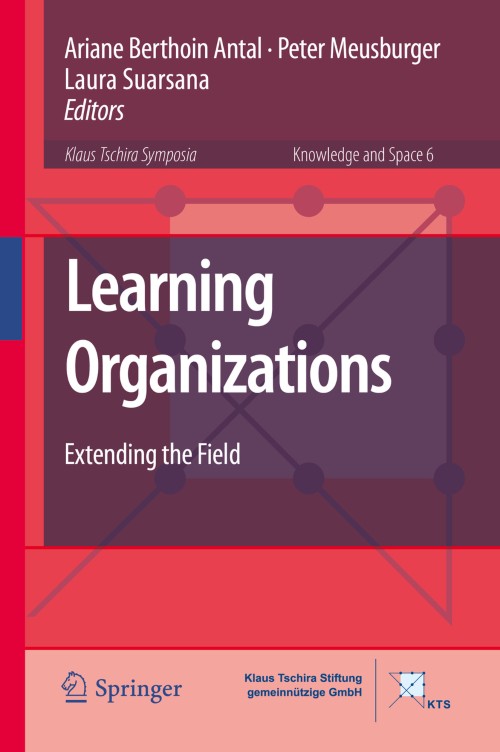
Learning Organizations [electronic resource] : Extending the Field / edited by Ariane Berthoin Antal, Peter Meusburger, Laura Suarsana.
Erişim Adresi
ISBN
9789400772205
Dil Kodu
İngilizce
Yer Numarası
DK/15675
Basım Bildirimi
1st ed. 2014.
Yayın Bilgisi
Dordrecht : Springer Netherlands : Imprint: Springer, 2014.
Fiziksel Niteleme
X, 250 p. 23 illus., 8 illus. in color. online resource.
Dizi
Knowledge and Space, 2543-0580 ; 6
İçindekiler Notu
The Importance of Knowledge Environments and Spatial Relations for Organizational Learning: An Introduction: Ariane Berthoin Antal, Peter Meusburger, and Laura Suarsana -- Learning from Screens: Does Ideology Prevail over Lived Experience? The Example of ERP Systems: François-Régis Puyou -- Organizational Design for Knowledge Exchange: The Hau-Ba Model: Ahmed Bounfour and Gwénaëlle Grefe -- Command or Conviction? Informal Networks and the Diffusion of Controversial Innovations: Johannes Glückler and Robert Panitz -- Collaboration and Knowledge Gains in Organizations: Wolfgang Scholl -- Organizing Relational Distance: Innovation as the Management of Sociocultural and Time-spatial Tensions: Oliver Ibert -- Organizational Learning and Physical Space: How Office Configurations Inform Organizational Behaviors: Kerstin Sailer -- The Unexpected Neighbor: Learning, Space, and the Unconscious in Organizations: Russ Vince -- Can Social Space Provide a Deep Structure for the Theory and Practice of Organizational Learning?: Victor J. Friedman and Israel Sykes -- Learning in Temporary Organizations: The Case of UN Global Conferences: Kathrin Böhling -- When Arts Enter Organizational Spaces: Implications for Organizational Learning: Ariane Berthoin Antal -- Research-based Theater as a Facilitator of Organizational Learning: Anne Pässilä and Tuija Oikarinen -- Creative Space in Organizational Learning and Leadership: 21st-Century Shapeshifting: Shaun McNiff.
Özet, vb.
This book is designed to extend the field of organizational learning in several ways. The contributors from three continents bring different perspectives on processes and outcomes of knowledge creation and sharing in and between organizations in diverse contexts. They use approaches and concepts from numerous disciplines including the arts, economics, geography, organizational studies, psychology, and sociology. The contributions enrich the spatial turn in organization studies by offering fresh insights for researchers who seek to attend to the contextual dimensions of the phenomena they are studying. They provide examples of organizational places and spaces that have not yet received sufficient attention, as diverse as temporary international organizations and computer screens.
Konu
Economic sociology.
Psychology, Industrial.
Economic Sociology.
Work and Organizational Psychology.
Psychology, Industrial.
Economic Sociology.
Work and Organizational Psychology.
Diğer Yazarlar
Kurum Adı
Eseri Alıntıla
Referansları kullanmadan önce gözden geçirmeniz ve varsa gerekli düzeltmeleri yapmanız önerilir.
Dijital Kaynak
MARC Görünümü
LEADER 04240nam a22005175i 4500
001 814436
003 TR_AnAIT
005 20260130215716
007 cr nn 008mamaa
008 131118s2014 ne | s |||| 0|eng d
020 |a9789400772205|9978-94-007-7220-5
024 7 |a10.1007/978-94-007-7220-5|2doi
041 |aeng
049 |aTürk Tarih Kurumu Kütüphanesi
050 4|aHM548
072 7|aJHBL|2bicssc
072 7|aSOC026000|2bisacsh
072 7|aJHBL|2thema
082 04|a306.3|223
090 |aDK/15675
245 10|aLearning Organizations|h[electronic resource] :|bExtending the Field /|cedited by Ariane Berthoin Antal, Peter Meusburger, Laura Suarsana.
250 |a1st ed. 2014.
264 1|aDordrecht :|bSpringer Netherlands :|bImprint: Springer,|c2014.
300 |aX, 250 p. 23 illus., 8 illus. in color.|bonline resource.
336 |atext|btxt|2rdacontent
337 |acomputer|bc|2rdamedia
338 |aonline resource|bcr|2rdacarrier
347 |atext file|bPDF|2rda
490 1 |aKnowledge and Space,|x2543-0580 ;|v6
505 0 |aThe Importance of Knowledge Environments and Spatial Relations for Organizational Learning: An Introduction: Ariane Berthoin Antal, Peter Meusburger, and Laura Suarsana -- Learning from Screens: Does Ideology Prevail over Lived Experience? The Example of ERP Systems: François-Régis Puyou -- Organizational Design for Knowledge Exchange: The Hau-Ba Model: Ahmed Bounfour and Gwénaëlle Grefe -- Command or Conviction? Informal Networks and the Diffusion of Controversial Innovations: Johannes Glückler and Robert Panitz -- Collaboration and Knowledge Gains in Organizations: Wolfgang Scholl -- Organizing Relational Distance: Innovation as the Management of Sociocultural and Time-spatial Tensions: Oliver Ibert -- Organizational Learning and Physical Space: How Office Configurations Inform Organizational Behaviors: Kerstin Sailer -- The Unexpected Neighbor: Learning, Space, and the Unconscious in Organizations: Russ Vince -- Can Social Space Provide a Deep Structure for the Theory and Practice of Organizational Learning?: Victor J. Friedman and Israel Sykes -- Learning in Temporary Organizations: The Case of UN Global Conferences: Kathrin Böhling -- When Arts Enter Organizational Spaces: Implications for Organizational Learning: Ariane Berthoin Antal -- Research-based Theater as a Facilitator of Organizational Learning: Anne Pässilä and Tuija Oikarinen -- Creative Space in Organizational Learning and Leadership: 21st-Century Shapeshifting: Shaun McNiff.
520 |aThis book is designed to extend the field of organizational learning in several ways. The contributors from three continents bring different perspectives on processes and outcomes of knowledge creation and sharing in and between organizations in diverse contexts. They use approaches and concepts from numerous disciplines including the arts, economics, geography, organizational studies, psychology, and sociology. The contributions enrich the spatial turn in organization studies by offering fresh insights for researchers who seek to attend to the contextual dimensions of the phenomena they are studying. They provide examples of organizational places and spaces that have not yet received sufficient attention, as diverse as temporary international organizations and computer screens.
650 0|aEconomic sociology.
650 0|aPsychology, Industrial.
650 14|aEconomic Sociology.
650 24|aWork and Organizational Psychology.
700 1 |aBerthoin Antal, Ariane.|eeditor.|4edt|4http://id.loc.gov/vocabulary/relators/edt
700 1 |aMeusburger, Peter.|eeditor.|4edt|4http://id.loc.gov/vocabulary/relators/edt
700 1 |aSuarsana, Laura.|eeditor.|4edt|4http://id.loc.gov/vocabulary/relators/edt
710 2 |aSpringerLink (Online service)
773 0 |tSpringer Nature eBook
776 08|iPrinted edition:|z9789400772199
776 08|iPrinted edition:|z9789400772212
776 08|iPrinted edition:|z9789402405316
830 0|aKnowledge and Space,|x2543-0580 ;|v6
856 40|uhttps://doi.org/10.1007/978-94-007-7220-5
912 |aZDB-2-SHU
912 |aZDB-2-SXS
950 |aHumanities, Social Sciences and Law (SpringerNature-11648)
950 |aSocial Sciences (R0) (SpringerNature-43726)
001 814436
003 TR_AnAIT
005 20260130215716
007 cr nn 008mamaa
008 131118s2014 ne | s |||| 0|eng d
020 |a9789400772205|9978-94-007-7220-5
024 7 |a10.1007/978-94-007-7220-5|2doi
041 |aeng
049 |aTürk Tarih Kurumu Kütüphanesi
050 4|aHM548
072 7|aJHBL|2bicssc
072 7|aSOC026000|2bisacsh
072 7|aJHBL|2thema
082 04|a306.3|223
090 |aDK/15675
245 10|aLearning Organizations|h[electronic resource] :|bExtending the Field /|cedited by Ariane Berthoin Antal, Peter Meusburger, Laura Suarsana.
250 |a1st ed. 2014.
264 1|aDordrecht :|bSpringer Netherlands :|bImprint: Springer,|c2014.
300 |aX, 250 p. 23 illus., 8 illus. in color.|bonline resource.
336 |atext|btxt|2rdacontent
337 |acomputer|bc|2rdamedia
338 |aonline resource|bcr|2rdacarrier
347 |atext file|bPDF|2rda
490 1 |aKnowledge and Space,|x2543-0580 ;|v6
505 0 |aThe Importance of Knowledge Environments and Spatial Relations for Organizational Learning: An Introduction: Ariane Berthoin Antal, Peter Meusburger, and Laura Suarsana -- Learning from Screens: Does Ideology Prevail over Lived Experience? The Example of ERP Systems: François-Régis Puyou -- Organizational Design for Knowledge Exchange: The Hau-Ba Model: Ahmed Bounfour and Gwénaëlle Grefe -- Command or Conviction? Informal Networks and the Diffusion of Controversial Innovations: Johannes Glückler and Robert Panitz -- Collaboration and Knowledge Gains in Organizations: Wolfgang Scholl -- Organizing Relational Distance: Innovation as the Management of Sociocultural and Time-spatial Tensions: Oliver Ibert -- Organizational Learning and Physical Space: How Office Configurations Inform Organizational Behaviors: Kerstin Sailer -- The Unexpected Neighbor: Learning, Space, and the Unconscious in Organizations: Russ Vince -- Can Social Space Provide a Deep Structure for the Theory and Practice of Organizational Learning?: Victor J. Friedman and Israel Sykes -- Learning in Temporary Organizations: The Case of UN Global Conferences: Kathrin Böhling -- When Arts Enter Organizational Spaces: Implications for Organizational Learning: Ariane Berthoin Antal -- Research-based Theater as a Facilitator of Organizational Learning: Anne Pässilä and Tuija Oikarinen -- Creative Space in Organizational Learning and Leadership: 21st-Century Shapeshifting: Shaun McNiff.
520 |aThis book is designed to extend the field of organizational learning in several ways. The contributors from three continents bring different perspectives on processes and outcomes of knowledge creation and sharing in and between organizations in diverse contexts. They use approaches and concepts from numerous disciplines including the arts, economics, geography, organizational studies, psychology, and sociology. The contributions enrich the spatial turn in organization studies by offering fresh insights for researchers who seek to attend to the contextual dimensions of the phenomena they are studying. They provide examples of organizational places and spaces that have not yet received sufficient attention, as diverse as temporary international organizations and computer screens.
650 0|aEconomic sociology.
650 0|aPsychology, Industrial.
650 14|aEconomic Sociology.
650 24|aWork and Organizational Psychology.
700 1 |aBerthoin Antal, Ariane.|eeditor.|4edt|4http://id.loc.gov/vocabulary/relators/edt
700 1 |aMeusburger, Peter.|eeditor.|4edt|4http://id.loc.gov/vocabulary/relators/edt
700 1 |aSuarsana, Laura.|eeditor.|4edt|4http://id.loc.gov/vocabulary/relators/edt
710 2 |aSpringerLink (Online service)
773 0 |tSpringer Nature eBook
776 08|iPrinted edition:|z9789400772199
776 08|iPrinted edition:|z9789400772212
776 08|iPrinted edition:|z9789402405316
830 0|aKnowledge and Space,|x2543-0580 ;|v6
856 40|uhttps://doi.org/10.1007/978-94-007-7220-5
912 |aZDB-2-SHU
912 |aZDB-2-SXS
950 |aHumanities, Social Sciences and Law (SpringerNature-11648)
950 |aSocial Sciences (R0) (SpringerNature-43726)
Materyaller
Depodan talep edilen materyal sadece kütüphane içerisinde kullanılmaktadır.
Materyal dışarıya ödünç verilmemektedir.
Materyal dışarıya ödünç verilmemektedir.
