

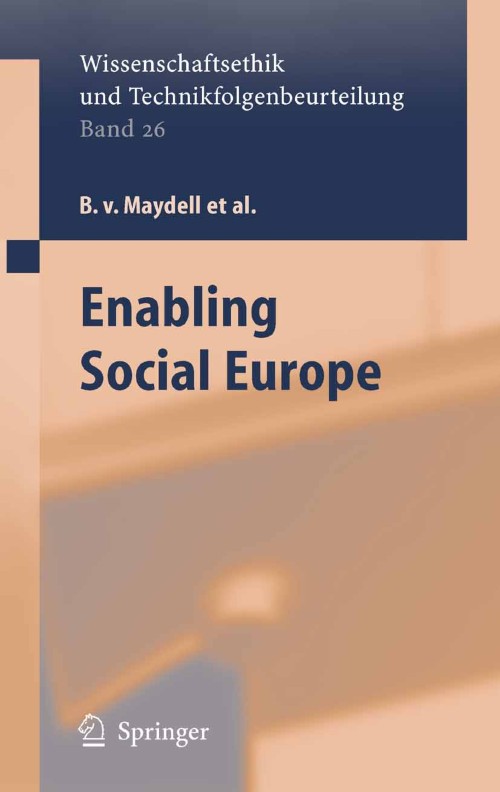
Enabling Social Europe [electronic resource] / by B. Maydell v., K. Borchardt, K.-D. Henke, R. Leitner, R. Muffels, M. Quante, P.-L. Rauhala, G. Verschraegen, M. Zukowski.
Erişim Adresi
ISBN
9783540297727
Dil Kodu
İngilizce
Yer Numarası
DK/15681
Yazar
Basım Bildirimi
1st ed. 2006.
Yayın Bilgisi
Berlin, Heidelberg : Springer Berlin Heidelberg : Imprint: Springer, 2006.
Fiziksel Niteleme
LXXII, 336 p. online resource.
Dizi
Ethics of Science and Technology Assessment, 1860-4811 ; 26
İçindekiler Notu
Social Policy in the 21st Century -- European Union and Social Policy -- National and Supra-national Social Policy: Comparative Case Studies -- Elements of a European Social Policy -- Erratum.
Özet, vb.
‘Enabling Social Europe’ examines how the paradigm of the ‘enabling welfare state’ might offer a new perspective for European social policy in the decades to come. The ‘enabling’ concept is perceived as going beyond that of mere ‘activation’, thus also embracing policies aimed at increasing personal autonomy, individual responsibility and social inclusion by endowing individuals with the resources and capabilities needed to manage and balance their life courses in a better way. The study is distinguished by a unique collaboration of social and economic policy experts coming from a wide range of disciplines: economics, law, sociology, political science, and philosophy. The authors seek to shed new light on whether European social policy ought to play a role in the future and, if so, what sort of role that could be. They convincingly argue that despite an implicit normative consensus on the ‘European social model’, there is still room for a multifaceted world in which welfare regimes can maintain their own path-dependent ways of achieving a fair and just society with a high level of welfare for all. The empirical part of the book contains an appraisal of policies and reforms with a view to the ‘enabling welfare state’ approach in four important policy areas: health care, old-age security, family policy, and poverty prevention. Within each sector, the authors compare the policies and practices of two countries attributable to different regime types: Germany and the United Kingdom, Poland and Germany, Finland and Estonia, and Belgium and Denmark. This book is highly recommendable not only for scholars and policymakers active in this field, but also for students of welfare and labour economics, sociology, social policy, political science and law.
Konu
Social structure.
Equality.
Engineering.
Social Structure.
Technology and Engineering.
Equality.
Engineering.
Social Structure.
Technology and Engineering.
Diğer Yazarlar
Kurum Adı
