LEADER 03989nam a22005415i 4500
001 814446
003 TR_AnAIT
005 20260130215613
007 cr nn 008mamaa
008 150617s2015 ne | s |||| 0|eng d
020 |a9789401795821|9978-94-017-9582-1
024 7 |a10.1007/978-94-017-9582-1|2doi
041 |aeng
049 |aTürk Tarih Kurumu Kütüphanesi
050 4|aQH331
072 7|aHP|2bicssc
072 7|aPS|2bicssc
072 7|aSCI075000|2bisacsh
072 7|aQD|2thema
072 7|aPS|2thema
082 04|a570.1|223
090 |aDK/15685
100 1 |aNickelsen, Kärin.|eauthor.|4aut|4http://id.loc.gov/vocabulary/relators/aut
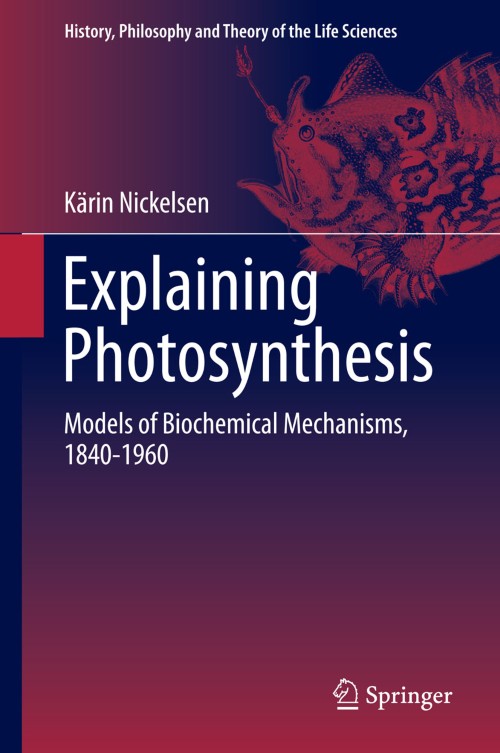
245 10|aExplaining Photosynthesis|h[electronic resource] :|bModels of Biochemical Mechanisms, 1840-1960 /|cby Kärin Nickelsen.
250 |a1st ed. 2015.
264 1|aDordrecht :|bSpringer Netherlands :|bImprint: Springer,|c2015.
300 |aX, 349 p. 62 illus., 6 illus. in color.|bonline resource.
336 |atext|btxt|2rdacontent
337 |acomputer|bc|2rdamedia
338 |aonline resource|bcr|2rdacarrier
347 |atext file|bPDF|2rda
490 1 |aHistory, Philosophy and Theory of the Life Sciences,|x2211-1956 ;|v8
505 0 |aIntroduction -- 1. In Pursuit of a Pathway (1843-1918) -- 2. Otto Warburg and the Turn to Manometry (1912-25) -- 3. Struggling with the Standard Model (1930-41) -- 4. The Maximum Quantum Yield Controversy (1937-55) -- 5. The Path of Carbon in Photosynthesis (1937-1954) -- 6. Elucidating the Light Reactions (1950-1961) -- Epilogue.
520 |aRecounting the compelling story of a scientific discovery that took more than a century to complete, this trail-blazing monograph focuses on methodological issues and is the first to delve into this subject. This book charts how the biochemical and biophysical mechanisms of photosynthesis were teased out by succeeding generations of scientists, and the author highlights the reconstruction of the heuristics of modelling the mechanism—analyzed at both individual and collective levels. Photosynthesis makes for an instructive example. The first tentative ideas were developed by organic chemists around 1840, while by 1960 an elaborate proposal at a molecular level, for both light and dark reactions, was established. The latter is still assumed to be basically correct today. The author makes a persuasive case for a historically informed philosophy of science, especially regarding methodology, and advocates a history of science whose narrative deploys philosophical approaches and categories. She shows how scientists’ attempts to formulate, justify, modify, confirm or criticize their models are best interpreted as series of coordinated research actions, dependent on a network of super- and subordinated epistemic goals, and guided by recurrent heuristic strategies. With dedicated chapters on key figures such as Otto Warburg, who borrowed epistemic fundamentals from other disciplines to facilitate his own work on photosynthesis, and on more general topics relating to the development of the field after Warburg, this new work is both a philosophical reflection on the nature of scientific enquiry and a detailed history of the processes behind one of science’s most important discoveries. .
650 0|aBiology|xPhilosophy.
650 0|aBotanical chemistry.
650 0|aScience|xHistory.
650 14|aPhilosophy of Biology.
650 24|aPlant Biochemistry.
650 24|aHistory of Science.
710 2 |aSpringerLink (Online service)
773 0 |tSpringer Nature eBook
776 08|iPrinted edition:|z9789401795814
776 08|iPrinted edition:|z9789401795838
776 08|iPrinted edition:|z9789402406825
830 0|aHistory, Philosophy and Theory of the Life Sciences,|x2211-1956 ;|v8
856 40|uhttps://doi.org/10.1007/978-94-017-9582-1
912 |aZDB-2-SHU
912 |aZDB-2-SXPR
950 |aHumanities, Social Sciences and Law (SpringerNature-11648)
950 |aPhilosophy and Religion (R0) (SpringerNature-43725)