

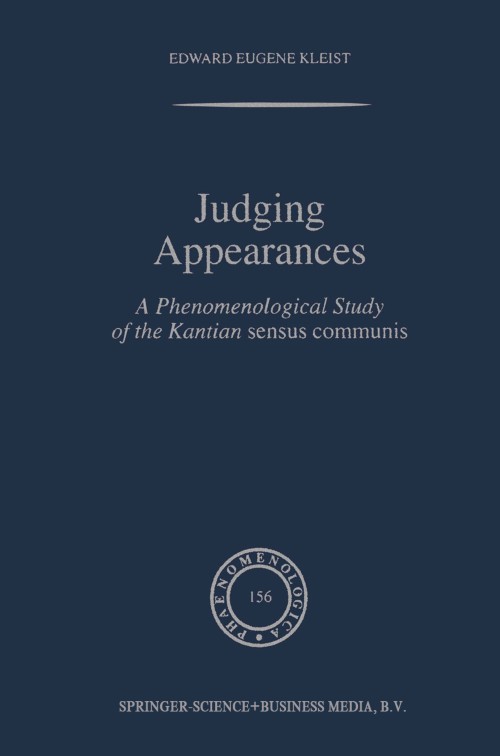
Judging Appearances [electronic resource] : A Phenomenological Study of the Kantian sensus communis / by E.E. Kleist.
Erişim Adresi
ISBN
9789401139311
Dil Kodu
İngilizce
Yer Numarası
DK/15700
Yazar
Basım Bildirimi
1st ed. 2000.
Yayın Bilgisi
Dordrecht : Springer Netherlands : Imprint: Springer, 2000.
Fiziksel Niteleme
X, 164 p. online resource.
Dizi
Phaenomenologica, Series Founded by H. L. Van Breda and Published Under the Auspices of the Husserl-Archives, 2215-0331 ; 156
İçindekiler Notu
I / Introduction: A Phenomenological Approach -- The Problem of Harmony and Ground -- Objections to a Phenomenological Study of Kantian Aesthetics -- Precedents for the Phenomenological Interpretation -- Rationale for a Phenomenological Approach -- II / Phenomenological Reconstruction -- First Moment: Kant’s Analysis of Disinterestedness -- Second Moment: Universality without Concept -- Third Moment: Purposiveness without Purpose -- Fourth Moment: Exemplary Necessity -- III / The Indeterminacy of Grounds (Kant and Leibniz) -- Kant’s Appropriation of Leibniz before the Critique of Judgment -- The Problem of Appearance and Ground in Leibnizian Aesthetics -- Indeterminacy and Appearance in the Critique of Judgment -- Appendix: Excerpts from the Latin Version of the Monadologie -- IV / Being Mindful of Appearance: Receptivity, Neutralization, Discursivity -- Sensibility -- The Faculties of Representation -- Imagination -- Imagination and Neutralization -- The Discursivity of Human Understanding as “Thinking” [Denken]: Kant’s Rejection of Intellectual Intuition/Intuitive Understanding -- The Discursivity of Reason in Thinking, Contemplation and Desire -- V / Conclusion -- Kant and Humanism -- Maxims of Common Human Understanding.
Özet, vb.
Kant's Critique of Judgment accounts for the sharing of a common world, experienced affectively, by a diverse human plurality. In order to appreciate Kant's project, Judging Appearances retrieves the connection between appearance and judgment in the Critique of Judgment. Kleist emphasizes the important but neglected idea of a sensus communis, which provides the indeterminate criterion for judgments regarding appearance. Judging Appearances examines the themes of appearance and judgment against the background of Kant's debt to Leibniz and Shaftesbury. Drawing upon treatments by Husserl, Sartre, Ricoeur and Arendt, Kleist delineates the proto-phenomenological method through which Kant uncovers the idea of a sensus communis. Kleist shows that taste is a discipline of opening oneself to appearance, requiring a subject who dwells in a common world of appearances among a diverse human plurality. This volume will prove valuable for anyone interested in a fresh approach to themes at the heart of Kant's aesthetics.
Konu
Philosophy, Modern.
Phenomenology .
Aesthetics.
Philosophy __ History.
Early Modern Philosophy.
Phenomenology.
Aesthetics.
History of Philosophy.
Phenomenology .
Aesthetics.
Philosophy __ History.
Early Modern Philosophy.
Phenomenology.
Aesthetics.
History of Philosophy.
Kurum Adı
Eseri Alıntıla
Referansları kullanmadan önce gözden geçirmeniz ve varsa gerekli düzeltmeleri yapmanız önerilir.
Dijital Kaynak
MARC Görünümü
LEADER 05102nam a22006015i 4500
001 814461
003 TR_AnAIT
005 20260130215542
007 cr nn 008mamaa
008 121227s2000 ne | s |||| 0|eng d
020 |a9789401139311|9978-94-011-3931-1
024 7 |a10.1007/978-94-011-3931-1|2doi
041 |aeng
049 |aTürk Tarih Kurumu Kütüphanesi
050 4|aB800.2-804
072 7|aHPCD|2bicssc
072 7|aPHI016000|2bisacsh
072 7|aQDH|2thema
082 04|a190.903|223
090 |aDK/15700
100 1 |aKleist, E.E.|eauthor.|4aut|4http://id.loc.gov/vocabulary/relators/aut
245 10|aJudging Appearances|h[electronic resource] :|bA Phenomenological Study of the Kantian sensus communis /|cby E.E. Kleist.
250 |a1st ed. 2000.
264 1|aDordrecht :|bSpringer Netherlands :|bImprint: Springer,|c2000.
300 |aX, 164 p.|bonline resource.
336 |atext|btxt|2rdacontent
337 |acomputer|bc|2rdamedia
338 |aonline resource|bcr|2rdacarrier
347 |atext file|bPDF|2rda
490 1 |aPhaenomenologica, Series Founded by H. L. Van Breda and Published Under the Auspices of the Husserl-Archives,|x2215-0331 ;|v156
505 0 |aI / Introduction: A Phenomenological Approach -- The Problem of Harmony and Ground -- Objections to a Phenomenological Study of Kantian Aesthetics -- Precedents for the Phenomenological Interpretation -- Rationale for a Phenomenological Approach -- II / Phenomenological Reconstruction -- First Moment: Kant’s Analysis of Disinterestedness -- Second Moment: Universality without Concept -- Third Moment: Purposiveness without Purpose -- Fourth Moment: Exemplary Necessity -- III / The Indeterminacy of Grounds (Kant and Leibniz) -- Kant’s Appropriation of Leibniz before the Critique of Judgment -- The Problem of Appearance and Ground in Leibnizian Aesthetics -- Indeterminacy and Appearance in the Critique of Judgment -- Appendix: Excerpts from the Latin Version of the Monadologie -- IV / Being Mindful of Appearance: Receptivity, Neutralization, Discursivity -- Sensibility -- The Faculties of Representation -- Imagination -- Imagination and Neutralization -- The Discursivity of Human Understanding as “Thinking” [Denken]: Kant’s Rejection of Intellectual Intuition/Intuitive Understanding -- The Discursivity of Reason in Thinking, Contemplation and Desire -- V / Conclusion -- Kant and Humanism -- Maxims of Common Human Understanding.
520 |aKant's Critique of Judgment accounts for the sharing of a common world, experienced affectively, by a diverse human plurality. In order to appreciate Kant's project, Judging Appearances retrieves the connection between appearance and judgment in the Critique of Judgment. Kleist emphasizes the important but neglected idea of a sensus communis, which provides the indeterminate criterion for judgments regarding appearance. Judging Appearances examines the themes of appearance and judgment against the background of Kant's debt to Leibniz and Shaftesbury. Drawing upon treatments by Husserl, Sartre, Ricoeur and Arendt, Kleist delineates the proto-phenomenological method through which Kant uncovers the idea of a sensus communis. Kleist shows that taste is a discipline of opening oneself to appearance, requiring a subject who dwells in a common world of appearances among a diverse human plurality. This volume will prove valuable for anyone interested in a fresh approach to themes at the heart of Kant's aesthetics.
532 8 |aAccessibility summary: This PDF is not accessible. It is based on scanned pages and does not support features such as screen reader compatibility or described non-text content (images, graphs etc). However, it likely supports searchable and selectable text based on OCR (Optical Character Recognition). Users with accessibility needs may not be able to use this content effectively. Please contact us at accessibilitysupport@springernature.com if you require assistance or an alternative format.
532 8 |aInaccessible, or known limited accessibility
532 8 |aNo reading system accessibility options actively disabled
532 8 |aPublisher contact for further accessibility information: accessibilitysupport@springernature.com
650 0|aPhilosophy, Modern.
650 0|aPhenomenology .
650 0|aAesthetics.
650 0|aPhilosophy|xHistory.
650 14|aEarly Modern Philosophy.
650 24|aPhenomenology.
650 24|aAesthetics.
650 24|aHistory of Philosophy.
710 2 |aSpringerLink (Online service)
773 0 |tSpringer Nature eBook
776 08|iPrinted edition:|z9780792363101
776 08|iPrinted edition:|z9781402002588
776 08|iPrinted edition:|z9789401139328
830 0|aPhaenomenologica, Series Founded by H. L. Van Breda and Published Under the Auspices of the Husserl-Archives,|x2215-0331 ;|v156
856 40|uhttps://doi.org/10.1007/978-94-011-3931-1
912 |aZDB-2-SHU
912 |aZDB-2-SXPR
912 |aZDB-2-BAE
950 |aHumanities, Social Sciences and Law (SpringerNature-11648)
950 |aPhilosophy and Religion (R0) (SpringerNature-43725)
001 814461
003 TR_AnAIT
005 20260130215542
007 cr nn 008mamaa
008 121227s2000 ne | s |||| 0|eng d
020 |a9789401139311|9978-94-011-3931-1
024 7 |a10.1007/978-94-011-3931-1|2doi
041 |aeng
049 |aTürk Tarih Kurumu Kütüphanesi
050 4|aB800.2-804
072 7|aHPCD|2bicssc
072 7|aPHI016000|2bisacsh
072 7|aQDH|2thema
082 04|a190.903|223
090 |aDK/15700
100 1 |aKleist, E.E.|eauthor.|4aut|4http://id.loc.gov/vocabulary/relators/aut
245 10|aJudging Appearances|h[electronic resource] :|bA Phenomenological Study of the Kantian sensus communis /|cby E.E. Kleist.
250 |a1st ed. 2000.
264 1|aDordrecht :|bSpringer Netherlands :|bImprint: Springer,|c2000.
300 |aX, 164 p.|bonline resource.
336 |atext|btxt|2rdacontent
337 |acomputer|bc|2rdamedia
338 |aonline resource|bcr|2rdacarrier
347 |atext file|bPDF|2rda
490 1 |aPhaenomenologica, Series Founded by H. L. Van Breda and Published Under the Auspices of the Husserl-Archives,|x2215-0331 ;|v156
505 0 |aI / Introduction: A Phenomenological Approach -- The Problem of Harmony and Ground -- Objections to a Phenomenological Study of Kantian Aesthetics -- Precedents for the Phenomenological Interpretation -- Rationale for a Phenomenological Approach -- II / Phenomenological Reconstruction -- First Moment: Kant’s Analysis of Disinterestedness -- Second Moment: Universality without Concept -- Third Moment: Purposiveness without Purpose -- Fourth Moment: Exemplary Necessity -- III / The Indeterminacy of Grounds (Kant and Leibniz) -- Kant’s Appropriation of Leibniz before the Critique of Judgment -- The Problem of Appearance and Ground in Leibnizian Aesthetics -- Indeterminacy and Appearance in the Critique of Judgment -- Appendix: Excerpts from the Latin Version of the Monadologie -- IV / Being Mindful of Appearance: Receptivity, Neutralization, Discursivity -- Sensibility -- The Faculties of Representation -- Imagination -- Imagination and Neutralization -- The Discursivity of Human Understanding as “Thinking” [Denken]: Kant’s Rejection of Intellectual Intuition/Intuitive Understanding -- The Discursivity of Reason in Thinking, Contemplation and Desire -- V / Conclusion -- Kant and Humanism -- Maxims of Common Human Understanding.
520 |aKant's Critique of Judgment accounts for the sharing of a common world, experienced affectively, by a diverse human plurality. In order to appreciate Kant's project, Judging Appearances retrieves the connection between appearance and judgment in the Critique of Judgment. Kleist emphasizes the important but neglected idea of a sensus communis, which provides the indeterminate criterion for judgments regarding appearance. Judging Appearances examines the themes of appearance and judgment against the background of Kant's debt to Leibniz and Shaftesbury. Drawing upon treatments by Husserl, Sartre, Ricoeur and Arendt, Kleist delineates the proto-phenomenological method through which Kant uncovers the idea of a sensus communis. Kleist shows that taste is a discipline of opening oneself to appearance, requiring a subject who dwells in a common world of appearances among a diverse human plurality. This volume will prove valuable for anyone interested in a fresh approach to themes at the heart of Kant's aesthetics.
532 8 |aAccessibility summary: This PDF is not accessible. It is based on scanned pages and does not support features such as screen reader compatibility or described non-text content (images, graphs etc). However, it likely supports searchable and selectable text based on OCR (Optical Character Recognition). Users with accessibility needs may not be able to use this content effectively. Please contact us at accessibilitysupport@springernature.com if you require assistance or an alternative format.
532 8 |aInaccessible, or known limited accessibility
532 8 |aNo reading system accessibility options actively disabled
532 8 |aPublisher contact for further accessibility information: accessibilitysupport@springernature.com
650 0|aPhilosophy, Modern.
650 0|aPhenomenology .
650 0|aAesthetics.
650 0|aPhilosophy|xHistory.
650 14|aEarly Modern Philosophy.
650 24|aPhenomenology.
650 24|aAesthetics.
650 24|aHistory of Philosophy.
710 2 |aSpringerLink (Online service)
773 0 |tSpringer Nature eBook
776 08|iPrinted edition:|z9780792363101
776 08|iPrinted edition:|z9781402002588
776 08|iPrinted edition:|z9789401139328
830 0|aPhaenomenologica, Series Founded by H. L. Van Breda and Published Under the Auspices of the Husserl-Archives,|x2215-0331 ;|v156
856 40|uhttps://doi.org/10.1007/978-94-011-3931-1
912 |aZDB-2-SHU
912 |aZDB-2-SXPR
912 |aZDB-2-BAE
950 |aHumanities, Social Sciences and Law (SpringerNature-11648)
950 |aPhilosophy and Religion (R0) (SpringerNature-43725)
Materyaller
Depodan talep edilen materyal sadece kütüphane içerisinde kullanılmaktadır.
Materyal dışarıya ödünç verilmemektedir.
Materyal dışarıya ödünç verilmemektedir.
