

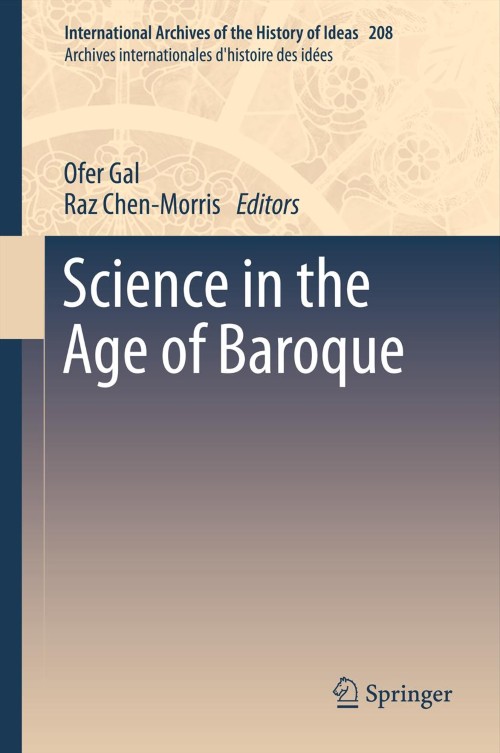
Science in the Age of Baroque [electronic resource] / edited by Ofer Gal, Raz Chen-Morris.
Erişim Adresi
ISBN
9789400748071
Dil Kodu
İngilizce
Yer Numarası
DK/15722
Basım Bildirimi
1st ed. 2013.
Yayın Bilgisi
Dordrecht : Springer Netherlands : Imprint: Springer, 2013.
Fiziksel Niteleme
VI, 314 p. online resource.
Dizi
International Archives of the History of Ideas Archives internationales d'histoire des idées, 2215-0307 ; 208
İçindekiler Notu
1. Ofer Gal and Raz Chen Morris: Baroque Modes and the Production of Knowledge -- A. Order -- 2. John Schuster: What Was the Relation of Baroque Culture to the Trajectory of Early Modern Natural Philosophy? -- 3. Koen Vermeir: “Bent And Directed Towards Him:” A Baroque Perspective on Kircher’s Sunflower Clock -- 4. Ofer Gal: From Divine Order to Human Approximation: Mathematics in Baroque Science -- B. Vision -- 5. Raz Chen-Morris: “The Quality of Nothing,” Or Kepler's Visual Economy of Science -- 6. Paula Findlen: Agostino Scilla: A Baroque Painter in Pursuit of Science -- 7. J.B. Shank: What Exactly Was “Torricelli’s Barometer?” -- 8. Alan Salter: William Harvey and the Way of the Artisan -- C. Excess -- 9. John Gascoigne: Crossing the Pillars of Hercules: Francis Bacon, the Scientific Revolution and the New World -- 10. Nicholas Dew: The Hive and the Pendulum: Universal Metrology and Baroque Science.-11. Victor Boantza: Chymical Philosophy and Boyle’s Incongruous Philosophical Chymistry.-12 Rivka Feldhay: The Simulation of Nature and the Dissimulation of the Law on a Baroque Stage: Galileo and the Church Revisited .
Özet, vb.
This volume examines the New Science of the 17th century in the context of Baroque culture, analysing its emergence as an integral part of the high culture of the period. The collected essays explore themes common to the new practices of knowledge production and the rapidly changing culture surrounding them, as well as the obsessions, anxieties and aspirations they share, such as the foundations of order, the power and peril of mediation and the conflation of the natural and the artificial. The essays also take on the historiographical issues involved: the characterization of culture in general and culture of knowledge in particular; the use of generalizations like ‘Baroque’ and the status of such categories; and the role of these in untangling the historical complexities of the tumultuous 17th century. The canonical protagonists of the ‘Scientific Revolution’ are considered, and so are some obscure and suppressed figures: Galileo side by side with Scheiner;Torricelli together with Kircher; Newton as well as Scilla. The coupling of Baroque and Science defies both the still-triumphalist historiographies of the Scientific Revolution and the slight embarrassment that the Baroque represents for most cultural-national histories of Western Europe. It signals a methodological interest in tensions and dilemmas rather than self-affirming narratives of success and failure, and provides an opportunity for reflective critique of our historical categories which is valuable in its own right.
Konu
Philosophy __ History.
History.
Science __ History.
Science __ Philosophy.
History of Philosophy.
History.
History of Science.
Philosophy of Science.
History.
Science __ History.
Science __ Philosophy.
History of Philosophy.
History.
History of Science.
Philosophy of Science.
Diğer Yazarlar
Kurum Adı
Eseri Alıntıla
Referansları kullanmadan önce gözden geçirmeniz ve varsa gerekli düzeltmeleri yapmanız önerilir.
Dijital Kaynak
MARC Görünümü
LEADER 04736nam a22005535i 4500
001 814483
003 TR_AnAIT
005 20260130215438
007 cr nn 008mamaa
008 121204s2013 ne | s |||| 0|eng d
020 |a9789400748071|9978-94-007-4807-1
024 7 |a10.1007/978-94-007-4807-1|2doi
041 |aeng
049 |aTürk Tarih Kurumu Kütüphanesi
050 4|aB1-5802
072 7|aHPC|2bicssc
072 7|aPHI009000|2bisacsh
072 7|aQDH|2thema
082 04|a109|223
090 |aDK/15722
245 10|aScience in the Age of Baroque|h[electronic resource] /|cedited by Ofer Gal, Raz Chen-Morris.
250 |a1st ed. 2013.
264 1|aDordrecht :|bSpringer Netherlands :|bImprint: Springer,|c2013.
300 |aVI, 314 p.|bonline resource.
336 |atext|btxt|2rdacontent
337 |acomputer|bc|2rdamedia
338 |aonline resource|bcr|2rdacarrier
347 |atext file|bPDF|2rda
490 1 |aInternational Archives of the History of Ideas Archives internationales d'histoire des idées,|x2215-0307 ;|v208
505 0 |a1. Ofer Gal and Raz Chen Morris: Baroque Modes and the Production of Knowledge -- A. Order -- 2. John Schuster: What Was the Relation of Baroque Culture to the Trajectory of Early Modern Natural Philosophy? -- 3. Koen Vermeir: “Bent And Directed Towards Him:” A Baroque Perspective on Kircher’s Sunflower Clock -- 4. Ofer Gal: From Divine Order to Human Approximation: Mathematics in Baroque Science -- B. Vision -- 5. Raz Chen-Morris: “The Quality of Nothing,” Or Kepler's Visual Economy of Science -- 6. Paula Findlen: Agostino Scilla: A Baroque Painter in Pursuit of Science -- 7. J.B. Shank: What Exactly Was “Torricelli’s Barometer?” -- 8. Alan Salter: William Harvey and the Way of the Artisan -- C. Excess -- 9. John Gascoigne: Crossing the Pillars of Hercules: Francis Bacon, the Scientific Revolution and the New World -- 10. Nicholas Dew: The Hive and the Pendulum: Universal Metrology and Baroque Science.-11. Victor Boantza: Chymical Philosophy and Boyle’s Incongruous Philosophical Chymistry.-12 Rivka Feldhay: The Simulation of Nature and the Dissimulation of the Law on a Baroque Stage: Galileo and the Church Revisited .
520 |aThis volume examines the New Science of the 17th century in the context of Baroque culture, analysing its emergence as an integral part of the high culture of the period. The collected essays explore themes common to the new practices of knowledge production and the rapidly changing culture surrounding them, as well as the obsessions, anxieties and aspirations they share, such as the foundations of order, the power and peril of mediation and the conflation of the natural and the artificial. The essays also take on the historiographical issues involved: the characterization of culture in general and culture of knowledge in particular; the use of generalizations like ‘Baroque’ and the status of such categories; and the role of these in untangling the historical complexities of the tumultuous 17th century. The canonical protagonists of the ‘Scientific Revolution’ are considered, and so are some obscure and suppressed figures: Galileo side by side with Scheiner;Torricelli together with Kircher; Newton as well as Scilla. The coupling of Baroque and Science defies both the still-triumphalist historiographies of the Scientific Revolution and the slight embarrassment that the Baroque represents for most cultural-national histories of Western Europe. It signals a methodological interest in tensions and dilemmas rather than self-affirming narratives of success and failure, and provides an opportunity for reflective critique of our historical categories which is valuable in its own right.
650 0|aPhilosophy|xHistory.
650 0|aHistory.
650 0|aScience|xHistory.
650 0|aScience|xPhilosophy.
650 14|aHistory of Philosophy.
650 24|aHistory.
650 24|aHistory of Science.
650 24|aPhilosophy of Science.
700 1 |aGal, Ofer.|eeditor.|4edt|4http://id.loc.gov/vocabulary/relators/edt
700 1 |aChen-Morris, Raz.|eeditor.|4edt|4http://id.loc.gov/vocabulary/relators/edt
710 2 |aSpringerLink (Online service)
773 0 |tSpringer Nature eBook
776 08|iPrinted edition:|z9789400748064
776 08|iPrinted edition:|z9789400748088
776 08|iPrinted edition:|z9789400795136
830 0|aInternational Archives of the History of Ideas Archives internationales d'histoire des idées,|x2215-0307 ;|v208
856 40|uhttps://doi.org/10.1007/978-94-007-4807-1
912 |aZDB-2-SHU
912 |aZDB-2-SXPR
950 |aHumanities, Social Sciences and Law (SpringerNature-11648)
950 |aPhilosophy and Religion (R0) (SpringerNature-43725)
001 814483
003 TR_AnAIT
005 20260130215438
007 cr nn 008mamaa
008 121204s2013 ne | s |||| 0|eng d
020 |a9789400748071|9978-94-007-4807-1
024 7 |a10.1007/978-94-007-4807-1|2doi
041 |aeng
049 |aTürk Tarih Kurumu Kütüphanesi
050 4|aB1-5802
072 7|aHPC|2bicssc
072 7|aPHI009000|2bisacsh
072 7|aQDH|2thema
082 04|a109|223
090 |aDK/15722
245 10|aScience in the Age of Baroque|h[electronic resource] /|cedited by Ofer Gal, Raz Chen-Morris.
250 |a1st ed. 2013.
264 1|aDordrecht :|bSpringer Netherlands :|bImprint: Springer,|c2013.
300 |aVI, 314 p.|bonline resource.
336 |atext|btxt|2rdacontent
337 |acomputer|bc|2rdamedia
338 |aonline resource|bcr|2rdacarrier
347 |atext file|bPDF|2rda
490 1 |aInternational Archives of the History of Ideas Archives internationales d'histoire des idées,|x2215-0307 ;|v208
505 0 |a1. Ofer Gal and Raz Chen Morris: Baroque Modes and the Production of Knowledge -- A. Order -- 2. John Schuster: What Was the Relation of Baroque Culture to the Trajectory of Early Modern Natural Philosophy? -- 3. Koen Vermeir: “Bent And Directed Towards Him:” A Baroque Perspective on Kircher’s Sunflower Clock -- 4. Ofer Gal: From Divine Order to Human Approximation: Mathematics in Baroque Science -- B. Vision -- 5. Raz Chen-Morris: “The Quality of Nothing,” Or Kepler's Visual Economy of Science -- 6. Paula Findlen: Agostino Scilla: A Baroque Painter in Pursuit of Science -- 7. J.B. Shank: What Exactly Was “Torricelli’s Barometer?” -- 8. Alan Salter: William Harvey and the Way of the Artisan -- C. Excess -- 9. John Gascoigne: Crossing the Pillars of Hercules: Francis Bacon, the Scientific Revolution and the New World -- 10. Nicholas Dew: The Hive and the Pendulum: Universal Metrology and Baroque Science.-11. Victor Boantza: Chymical Philosophy and Boyle’s Incongruous Philosophical Chymistry.-12 Rivka Feldhay: The Simulation of Nature and the Dissimulation of the Law on a Baroque Stage: Galileo and the Church Revisited .
520 |aThis volume examines the New Science of the 17th century in the context of Baroque culture, analysing its emergence as an integral part of the high culture of the period. The collected essays explore themes common to the new practices of knowledge production and the rapidly changing culture surrounding them, as well as the obsessions, anxieties and aspirations they share, such as the foundations of order, the power and peril of mediation and the conflation of the natural and the artificial. The essays also take on the historiographical issues involved: the characterization of culture in general and culture of knowledge in particular; the use of generalizations like ‘Baroque’ and the status of such categories; and the role of these in untangling the historical complexities of the tumultuous 17th century. The canonical protagonists of the ‘Scientific Revolution’ are considered, and so are some obscure and suppressed figures: Galileo side by side with Scheiner;Torricelli together with Kircher; Newton as well as Scilla. The coupling of Baroque and Science defies both the still-triumphalist historiographies of the Scientific Revolution and the slight embarrassment that the Baroque represents for most cultural-national histories of Western Europe. It signals a methodological interest in tensions and dilemmas rather than self-affirming narratives of success and failure, and provides an opportunity for reflective critique of our historical categories which is valuable in its own right.
650 0|aPhilosophy|xHistory.
650 0|aHistory.
650 0|aScience|xHistory.
650 0|aScience|xPhilosophy.
650 14|aHistory of Philosophy.
650 24|aHistory.
650 24|aHistory of Science.
650 24|aPhilosophy of Science.
700 1 |aGal, Ofer.|eeditor.|4edt|4http://id.loc.gov/vocabulary/relators/edt
700 1 |aChen-Morris, Raz.|eeditor.|4edt|4http://id.loc.gov/vocabulary/relators/edt
710 2 |aSpringerLink (Online service)
773 0 |tSpringer Nature eBook
776 08|iPrinted edition:|z9789400748064
776 08|iPrinted edition:|z9789400748088
776 08|iPrinted edition:|z9789400795136
830 0|aInternational Archives of the History of Ideas Archives internationales d'histoire des idées,|x2215-0307 ;|v208
856 40|uhttps://doi.org/10.1007/978-94-007-4807-1
912 |aZDB-2-SHU
912 |aZDB-2-SXPR
950 |aHumanities, Social Sciences and Law (SpringerNature-11648)
950 |aPhilosophy and Religion (R0) (SpringerNature-43725)
Materyaller
Depodan talep edilen materyal sadece kütüphane içerisinde kullanılmaktadır.
Materyal dışarıya ödünç verilmemektedir.
Materyal dışarıya ödünç verilmemektedir.
