

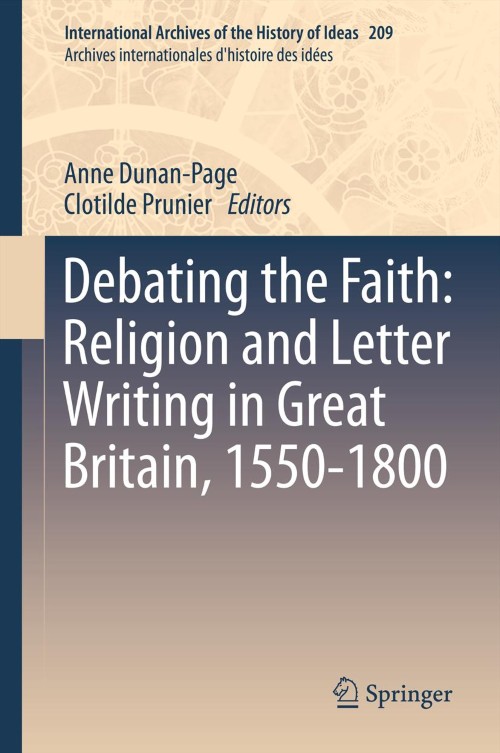
Debating the Faith: Religion and Letter Writing in Great Britain, 1550-1800 [electronic resource] / edited by Anne Dunan-Page, Clotilde Prunier.
Erişim Adresi
ISBN
9789400752160
Dil Kodu
İngilizce
Yer Numarası
DK/15733
Basım Bildirimi
1st ed. 2013.
Yayın Bilgisi
Dordrecht : Springer Netherlands : Imprint: Springer, 2013.
Fiziksel Niteleme
X, 218 p. online resource.
Dizi
International Archives of the History of Ideas Archives internationales d'histoire des idées, 2215-0307 ; 209
İçindekiler Notu
Introduction -- Religion and letter writing, 1550-1800, G. Schneider -- Part I Protestant Identities -- Scribal Networks and sustainers in Protestant martyrology, M. Greengrass -- Thomas Browne, the Quakers, and a Letter from a Judicious Friend, R. Barbour -- Writing authority in the Interregnum: The pastoral letters of Richard Baxter, A. Searle -- Letters and records of the dissenting congregations: David Crosley,Cripplegate and Baptist Church life, A. Dunan-Page -- Part II Representations of British Catholicism -- ‘For the Greater Glory’: Irish Jesuit letters and the Irish Counter-Reformation,1598-1626, D. Finnegan -- James ‘III and VIII’ and Catholic Kingship, 1702-1718, D. Szechi -- Every time I receive a Letter from you it gives me new vigour’: The correspondence of Scalan masters, 1762-1783, C. Prunier -- Part III Religion, Science and Philosophy -- Debating the faith: Damaris Masham (1658-1708) and religious controversy, S. Hutton -- Dining out in the Republic of Letters: The rhetoric of scientific correspondence, C. Preston -- Evangelical Calvinists versus the Hutcheson Circle: Debating the faith in Scotland, 1738-1739, J. Moore -- Questioning church doctrine in private correspondence in the eighteenth century: Jean Bouhier’s doubts concerning the soul, A. Thomson -- Index.
Özet, vb.
The first book to address the role of correspondence in the study of religion, Debating the Faith: Religion and Letter Writing in Great Britain, 1550-1800 shows how letters shaped religious debate in early-modern and Enlightenment Britain, and discusses the materiality of the letters as well as questions of form and genre. Particular attention is paid to the contexts in which letters were composed, sent, read, distributed, and then destroyed, copied or printed, in periods of religious tolerance or persecution. The opening section, ‘Protestant identities’, examines the importance of letters in the shaping of British protestantism from the underground correspondence of Protestant martyrs in the reign of Mary I to dissident letters after the Act of Toleration. ‘Representations of British Catholicism’, explores the way English, Irish and Scottish Catholics, whether in exile or at home, defined their faith, established epistolary networks, and addressed political and religious allegiances in the face of adversity. The last part, ‘Religion, science and philosophy’, focuses on the religious content of correspondence between natural scientists and philosophers.
Konu
Philosophy __ History.
Religion.
Science __ History.
History of Philosophy.
Religion.
History of Science.
Religion.
Science __ History.
History of Philosophy.
Religion.
History of Science.
Diğer Yazarlar
Kurum Adı
Eseri Alıntıla
Referansları kullanmadan önce gözden geçirmeniz ve varsa gerekli düzeltmeleri yapmanız önerilir.
Dijital Kaynak
MARC Görünümü
LEADER 04548nam a22005295i 4500
001 814494
003 TR_AnAIT
005 20260130215410
007 cr nn 008mamaa
008 121116s2013 ne | s |||| 0|eng d
020 |a9789400752160|9978-94-007-5216-0
024 7 |a10.1007/978-94-007-5216-0|2doi
041 |aeng
049 |aTürk Tarih Kurumu Kütüphanesi
050 4|aB1-5802
072 7|aHPC|2bicssc
072 7|aPHI009000|2bisacsh
072 7|aQDH|2thema
082 04|a109|223
090 |aDK/15733
245 10|aDebating the Faith: Religion and Letter Writing in Great Britain, 1550-1800|h[electronic resource] /|cedited by Anne Dunan-Page, Clotilde Prunier.
250 |a1st ed. 2013.
264 1|aDordrecht :|bSpringer Netherlands :|bImprint: Springer,|c2013.
300 |aX, 218 p.|bonline resource.
336 |atext|btxt|2rdacontent
337 |acomputer|bc|2rdamedia
338 |aonline resource|bcr|2rdacarrier
347 |atext file|bPDF|2rda
490 1 |aInternational Archives of the History of Ideas Archives internationales d'histoire des idées,|x2215-0307 ;|v209
505 0 |aIntroduction -- Religion and letter writing, 1550-1800, G. Schneider -- Part I Protestant Identities -- Scribal Networks and sustainers in Protestant martyrology, M. Greengrass -- Thomas Browne, the Quakers, and a Letter from a Judicious Friend, R. Barbour -- Writing authority in the Interregnum: The pastoral letters of Richard Baxter, A. Searle -- Letters and records of the dissenting congregations: David Crosley,Cripplegate and Baptist Church life, A. Dunan-Page -- Part II Representations of British Catholicism -- ‘For the Greater Glory’: Irish Jesuit letters and the Irish Counter-Reformation,1598-1626, D. Finnegan -- James ‘III and VIII’ and Catholic Kingship, 1702-1718, D. Szechi -- Every time I receive a Letter from you it gives me new vigour’: The correspondence of Scalan masters, 1762-1783, C. Prunier -- Part III Religion, Science and Philosophy -- Debating the faith: Damaris Masham (1658-1708) and religious controversy, S. Hutton -- Dining out in the Republic of Letters: The rhetoric of scientific correspondence, C. Preston -- Evangelical Calvinists versus the Hutcheson Circle: Debating the faith in Scotland, 1738-1739, J. Moore -- Questioning church doctrine in private correspondence in the eighteenth century: Jean Bouhier’s doubts concerning the soul, A. Thomson -- Index.
520 |aThe first book to address the role of correspondence in the study of religion, Debating the Faith: Religion and Letter Writing in Great Britain, 1550-1800 shows how letters shaped religious debate in early-modern and Enlightenment Britain, and discusses the materiality of the letters as well as questions of form and genre. Particular attention is paid to the contexts in which letters were composed, sent, read, distributed, and then destroyed, copied or printed, in periods of religious tolerance or persecution. The opening section, ‘Protestant identities’, examines the importance of letters in the shaping of British protestantism from the underground correspondence of Protestant martyrs in the reign of Mary I to dissident letters after the Act of Toleration. ‘Representations of British Catholicism’, explores the way English, Irish and Scottish Catholics, whether in exile or at home, defined their faith, established epistolary networks, and addressed political and religious allegiances in the face of adversity. The last part, ‘Religion, science and philosophy’, focuses on the religious content of correspondence between natural scientists and philosophers.
650 0|aPhilosophy|xHistory.
650 0|aReligion.
650 0|aScience|xHistory.
650 14|aHistory of Philosophy.
650 24|aReligion.
650 24|aHistory of Science.
700 1 |aDunan-Page, Anne.|eeditor.|4edt|4http://id.loc.gov/vocabulary/relators/edt
700 1 |aPrunier, Clotilde.|eeditor.|4edt|4http://id.loc.gov/vocabulary/relators/edt
710 2 |aSpringerLink (Online service)
773 0 |tSpringer Nature eBook
776 08|iPrinted edition:|z9789400752153
776 08|iPrinted edition:|z9789400752177
776 08|iPrinted edition:|z9789401782227
830 0|aInternational Archives of the History of Ideas Archives internationales d'histoire des idées,|x2215-0307 ;|v209
856 40|uhttps://doi.org/10.1007/978-94-007-5216-0
912 |aZDB-2-SHU
912 |aZDB-2-SXPR
950 |aHumanities, Social Sciences and Law (SpringerNature-11648)
950 |aPhilosophy and Religion (R0) (SpringerNature-43725)
001 814494
003 TR_AnAIT
005 20260130215410
007 cr nn 008mamaa
008 121116s2013 ne | s |||| 0|eng d
020 |a9789400752160|9978-94-007-5216-0
024 7 |a10.1007/978-94-007-5216-0|2doi
041 |aeng
049 |aTürk Tarih Kurumu Kütüphanesi
050 4|aB1-5802
072 7|aHPC|2bicssc
072 7|aPHI009000|2bisacsh
072 7|aQDH|2thema
082 04|a109|223
090 |aDK/15733
245 10|aDebating the Faith: Religion and Letter Writing in Great Britain, 1550-1800|h[electronic resource] /|cedited by Anne Dunan-Page, Clotilde Prunier.
250 |a1st ed. 2013.
264 1|aDordrecht :|bSpringer Netherlands :|bImprint: Springer,|c2013.
300 |aX, 218 p.|bonline resource.
336 |atext|btxt|2rdacontent
337 |acomputer|bc|2rdamedia
338 |aonline resource|bcr|2rdacarrier
347 |atext file|bPDF|2rda
490 1 |aInternational Archives of the History of Ideas Archives internationales d'histoire des idées,|x2215-0307 ;|v209
505 0 |aIntroduction -- Religion and letter writing, 1550-1800, G. Schneider -- Part I Protestant Identities -- Scribal Networks and sustainers in Protestant martyrology, M. Greengrass -- Thomas Browne, the Quakers, and a Letter from a Judicious Friend, R. Barbour -- Writing authority in the Interregnum: The pastoral letters of Richard Baxter, A. Searle -- Letters and records of the dissenting congregations: David Crosley,Cripplegate and Baptist Church life, A. Dunan-Page -- Part II Representations of British Catholicism -- ‘For the Greater Glory’: Irish Jesuit letters and the Irish Counter-Reformation,1598-1626, D. Finnegan -- James ‘III and VIII’ and Catholic Kingship, 1702-1718, D. Szechi -- Every time I receive a Letter from you it gives me new vigour’: The correspondence of Scalan masters, 1762-1783, C. Prunier -- Part III Religion, Science and Philosophy -- Debating the faith: Damaris Masham (1658-1708) and religious controversy, S. Hutton -- Dining out in the Republic of Letters: The rhetoric of scientific correspondence, C. Preston -- Evangelical Calvinists versus the Hutcheson Circle: Debating the faith in Scotland, 1738-1739, J. Moore -- Questioning church doctrine in private correspondence in the eighteenth century: Jean Bouhier’s doubts concerning the soul, A. Thomson -- Index.
520 |aThe first book to address the role of correspondence in the study of religion, Debating the Faith: Religion and Letter Writing in Great Britain, 1550-1800 shows how letters shaped religious debate in early-modern and Enlightenment Britain, and discusses the materiality of the letters as well as questions of form and genre. Particular attention is paid to the contexts in which letters were composed, sent, read, distributed, and then destroyed, copied or printed, in periods of religious tolerance or persecution. The opening section, ‘Protestant identities’, examines the importance of letters in the shaping of British protestantism from the underground correspondence of Protestant martyrs in the reign of Mary I to dissident letters after the Act of Toleration. ‘Representations of British Catholicism’, explores the way English, Irish and Scottish Catholics, whether in exile or at home, defined their faith, established epistolary networks, and addressed political and religious allegiances in the face of adversity. The last part, ‘Religion, science and philosophy’, focuses on the religious content of correspondence between natural scientists and philosophers.
650 0|aPhilosophy|xHistory.
650 0|aReligion.
650 0|aScience|xHistory.
650 14|aHistory of Philosophy.
650 24|aReligion.
650 24|aHistory of Science.
700 1 |aDunan-Page, Anne.|eeditor.|4edt|4http://id.loc.gov/vocabulary/relators/edt
700 1 |aPrunier, Clotilde.|eeditor.|4edt|4http://id.loc.gov/vocabulary/relators/edt
710 2 |aSpringerLink (Online service)
773 0 |tSpringer Nature eBook
776 08|iPrinted edition:|z9789400752153
776 08|iPrinted edition:|z9789400752177
776 08|iPrinted edition:|z9789401782227
830 0|aInternational Archives of the History of Ideas Archives internationales d'histoire des idées,|x2215-0307 ;|v209
856 40|uhttps://doi.org/10.1007/978-94-007-5216-0
912 |aZDB-2-SHU
912 |aZDB-2-SXPR
950 |aHumanities, Social Sciences and Law (SpringerNature-11648)
950 |aPhilosophy and Religion (R0) (SpringerNature-43725)
Materyaller
Depodan talep edilen materyal sadece kütüphane içerisinde kullanılmaktadır.
Materyal dışarıya ödünç verilmemektedir.
Materyal dışarıya ödünç verilmemektedir.
