

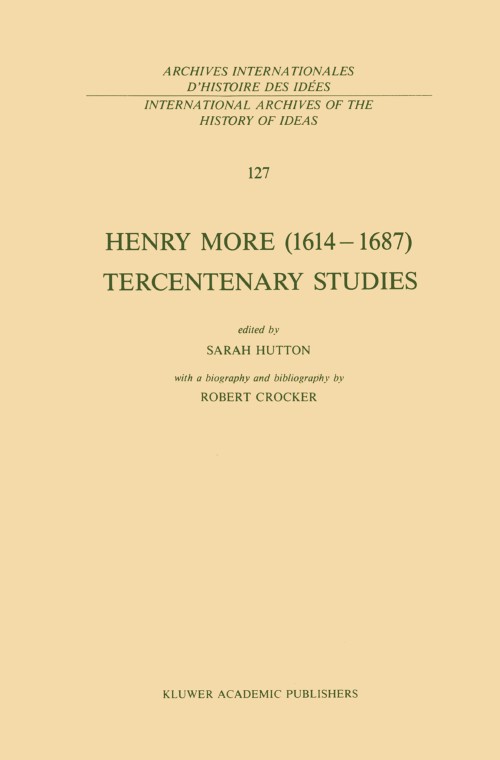
Henry More (1614–1687) Tercentenary Studies [electronic resource] : with a biography and bibliography by Robert Crocker / edited by S. Hutton.
Erişim Adresi
ISBN
9789400922679
Dil Kodu
İngilizce
Yer Numarası
DK/15739
Basım Bildirimi
1st ed. 1990.
Yayın Bilgisi
Dordrecht : Springer Netherlands : Imprint: Springer, 1990.
Fiziksel Niteleme
XII, 254 p. online resource.
Dizi
International Archives of the History of Ideas Archives internationales d'histoire des idées, 2215-0307 ; 127
İçindekiler Notu
Henry More: a biographical essay -- Henry More and the limits of mechanism -- Henry More and the scientific revolution -- Henry More versus Robert Boyle: the spirit of nature and the nature of providence -- Leibniz and More’s Cabbalistic circle -- The spiritualistic cosmologies of Henry More and Anne Conway -- Henry More and witchcraft -- Mysticism and enthusiasm in Henry More -- Henry More and Jacob Boehme -- Appendix: A commendatory poem by Henry More -- Henry More and the Jews -- More, Locke and the issue of liberty -- Reason and toleration: Henry More and Philip van Limborch -- A bibliography of Henry More compiled by Robert Crocker.
Özet, vb.
Of all the Cambridge Platonists, Henry More has attracted the most scholar ly interest in recent years, as the nature and significance of his contribution to the history of thought has come to be better understood. This revival of interest is in marked contrast to the neglect of More's writings lamented even by his first biographer, Richard Ward, a regret echoed two centuries after his 1 death. Since then such attention as there has been to More has not always served him well. He has been dismissed as credulous on account of his belief in witchcraft while his reputation as the most mystical of the Cambridge 2 school has undermined his reputation as a philosopher. Much of the interest in More in the present century has tended to focus on one particular aspect of his writing. There has been considerable interest in his poems. And he has come to the attention of philosophers thanks to his having corresponded with Descartes. Latterly, however, interest in More has been rekindled by renewed interest in the intellectual history of the seventeenth century and Renaissance. And More has been studied in the context of seventeenth-cen tury science and the wider context of seventeenth-century philosophy. Since More is a figure who belongs to the Renaissance tradition of unified sapientia he is not easily compartmentalised in the categories of modern disciplines. Inevitably discussion of anyone aspect of his thought involves other aspects.
Konu
Philosophy, Modern.
History.
Early Modern Philosophy.
History.
History.
Early Modern Philosophy.
History.
Diğer Yazarlar
Kurum Adı
Eseri Alıntıla
Referansları kullanmadan önce gözden geçirmeniz ve varsa gerekli düzeltmeleri yapmanız önerilir.
Dijital Kaynak
MARC Görünümü
LEADER 04779nam a22005535i 4500
001 814500
003 TR_AnAIT
005 20260130215348
007 cr nn 008mamaa
008 121227s1990 ne | s |||| 0|eng d
020 |a9789400922679|9978-94-009-2267-9
024 7 |a10.1007/978-94-009-2267-9|2doi
041 |aeng
049 |aTürk Tarih Kurumu Kütüphanesi
050 4|aB800.2-804
072 7|aHPCD|2bicssc
072 7|aPHI016000|2bisacsh
072 7|aQDH|2thema
082 04|a190.903|223
090 |aDK/15739
245 10|aHenry More (1614–1687) Tercentenary Studies|h[electronic resource] :|bwith a biography and bibliography by Robert Crocker /|cedited by S. Hutton.
250 |a1st ed. 1990.
264 1|aDordrecht :|bSpringer Netherlands :|bImprint: Springer,|c1990.
300 |aXII, 254 p.|bonline resource.
336 |atext|btxt|2rdacontent
337 |acomputer|bc|2rdamedia
338 |aonline resource|bcr|2rdacarrier
347 |atext file|bPDF|2rda
490 1 |aInternational Archives of the History of Ideas Archives internationales d'histoire des idées,|x2215-0307 ;|v127
505 0 |aHenry More: a biographical essay -- Henry More and the limits of mechanism -- Henry More and the scientific revolution -- Henry More versus Robert Boyle: the spirit of nature and the nature of providence -- Leibniz and More’s Cabbalistic circle -- The spiritualistic cosmologies of Henry More and Anne Conway -- Henry More and witchcraft -- Mysticism and enthusiasm in Henry More -- Henry More and Jacob Boehme -- Appendix: A commendatory poem by Henry More -- Henry More and the Jews -- More, Locke and the issue of liberty -- Reason and toleration: Henry More and Philip van Limborch -- A bibliography of Henry More compiled by Robert Crocker.
520 |aOf all the Cambridge Platonists, Henry More has attracted the most scholar ly interest in recent years, as the nature and significance of his contribution to the history of thought has come to be better understood. This revival of interest is in marked contrast to the neglect of More's writings lamented even by his first biographer, Richard Ward, a regret echoed two centuries after his 1 death. Since then such attention as there has been to More has not always served him well. He has been dismissed as credulous on account of his belief in witchcraft while his reputation as the most mystical of the Cambridge 2 school has undermined his reputation as a philosopher. Much of the interest in More in the present century has tended to focus on one particular aspect of his writing. There has been considerable interest in his poems. And he has come to the attention of philosophers thanks to his having corresponded with Descartes. Latterly, however, interest in More has been rekindled by renewed interest in the intellectual history of the seventeenth century and Renaissance. And More has been studied in the context of seventeenth-cen tury science and the wider context of seventeenth-century philosophy. Since More is a figure who belongs to the Renaissance tradition of unified sapientia he is not easily compartmentalised in the categories of modern disciplines. Inevitably discussion of anyone aspect of his thought involves other aspects.
532 8 |aAccessibility summary: This PDF is not accessible. It is based on scanned pages and does not support features such as screen reader compatibility or described non-text content (images, graphs etc). However, it likely supports searchable and selectable text based on OCR (Optical Character Recognition). Users with accessibility needs may not be able to use this content effectively. Please contact us at accessibilitysupport@springernature.com if you require assistance or an alternative format.
532 8 |aInaccessible, or known limited accessibility
532 8 |aNo reading system accessibility options actively disabled
532 8 |aPublisher contact for further accessibility information: accessibilitysupport@springernature.com
650 0|aPhilosophy, Modern.
650 0|aHistory.
650 14|aEarly Modern Philosophy.
650 24|aHistory.
700 1 |aHutton, S.|eeditor.|4edt|4http://id.loc.gov/vocabulary/relators/edt
710 2 |aSpringerLink (Online service)
773 0 |tSpringer Nature eBook
776 08|iPrinted edition:|z9780792300953
776 08|iPrinted edition:|z9789400922686
776 08|iPrinted edition:|z9789401075169
830 0|aInternational Archives of the History of Ideas Archives internationales d'histoire des idées,|x2215-0307 ;|v127
856 40|uhttps://doi.org/10.1007/978-94-009-2267-9
912 |aZDB-2-SHU
912 |aZDB-2-SXPR
912 |aZDB-2-BAE
950 |aHumanities, Social Sciences and Law (SpringerNature-11648)
950 |aPhilosophy and Religion (R0) (SpringerNature-43725)
001 814500
003 TR_AnAIT
005 20260130215348
007 cr nn 008mamaa
008 121227s1990 ne | s |||| 0|eng d
020 |a9789400922679|9978-94-009-2267-9
024 7 |a10.1007/978-94-009-2267-9|2doi
041 |aeng
049 |aTürk Tarih Kurumu Kütüphanesi
050 4|aB800.2-804
072 7|aHPCD|2bicssc
072 7|aPHI016000|2bisacsh
072 7|aQDH|2thema
082 04|a190.903|223
090 |aDK/15739
245 10|aHenry More (1614–1687) Tercentenary Studies|h[electronic resource] :|bwith a biography and bibliography by Robert Crocker /|cedited by S. Hutton.
250 |a1st ed. 1990.
264 1|aDordrecht :|bSpringer Netherlands :|bImprint: Springer,|c1990.
300 |aXII, 254 p.|bonline resource.
336 |atext|btxt|2rdacontent
337 |acomputer|bc|2rdamedia
338 |aonline resource|bcr|2rdacarrier
347 |atext file|bPDF|2rda
490 1 |aInternational Archives of the History of Ideas Archives internationales d'histoire des idées,|x2215-0307 ;|v127
505 0 |aHenry More: a biographical essay -- Henry More and the limits of mechanism -- Henry More and the scientific revolution -- Henry More versus Robert Boyle: the spirit of nature and the nature of providence -- Leibniz and More’s Cabbalistic circle -- The spiritualistic cosmologies of Henry More and Anne Conway -- Henry More and witchcraft -- Mysticism and enthusiasm in Henry More -- Henry More and Jacob Boehme -- Appendix: A commendatory poem by Henry More -- Henry More and the Jews -- More, Locke and the issue of liberty -- Reason and toleration: Henry More and Philip van Limborch -- A bibliography of Henry More compiled by Robert Crocker.
520 |aOf all the Cambridge Platonists, Henry More has attracted the most scholar ly interest in recent years, as the nature and significance of his contribution to the history of thought has come to be better understood. This revival of interest is in marked contrast to the neglect of More's writings lamented even by his first biographer, Richard Ward, a regret echoed two centuries after his 1 death. Since then such attention as there has been to More has not always served him well. He has been dismissed as credulous on account of his belief in witchcraft while his reputation as the most mystical of the Cambridge 2 school has undermined his reputation as a philosopher. Much of the interest in More in the present century has tended to focus on one particular aspect of his writing. There has been considerable interest in his poems. And he has come to the attention of philosophers thanks to his having corresponded with Descartes. Latterly, however, interest in More has been rekindled by renewed interest in the intellectual history of the seventeenth century and Renaissance. And More has been studied in the context of seventeenth-cen tury science and the wider context of seventeenth-century philosophy. Since More is a figure who belongs to the Renaissance tradition of unified sapientia he is not easily compartmentalised in the categories of modern disciplines. Inevitably discussion of anyone aspect of his thought involves other aspects.
532 8 |aAccessibility summary: This PDF is not accessible. It is based on scanned pages and does not support features such as screen reader compatibility or described non-text content (images, graphs etc). However, it likely supports searchable and selectable text based on OCR (Optical Character Recognition). Users with accessibility needs may not be able to use this content effectively. Please contact us at accessibilitysupport@springernature.com if you require assistance or an alternative format.
532 8 |aInaccessible, or known limited accessibility
532 8 |aNo reading system accessibility options actively disabled
532 8 |aPublisher contact for further accessibility information: accessibilitysupport@springernature.com
650 0|aPhilosophy, Modern.
650 0|aHistory.
650 14|aEarly Modern Philosophy.
650 24|aHistory.
700 1 |aHutton, S.|eeditor.|4edt|4http://id.loc.gov/vocabulary/relators/edt
710 2 |aSpringerLink (Online service)
773 0 |tSpringer Nature eBook
776 08|iPrinted edition:|z9780792300953
776 08|iPrinted edition:|z9789400922686
776 08|iPrinted edition:|z9789401075169
830 0|aInternational Archives of the History of Ideas Archives internationales d'histoire des idées,|x2215-0307 ;|v127
856 40|uhttps://doi.org/10.1007/978-94-009-2267-9
912 |aZDB-2-SHU
912 |aZDB-2-SXPR
912 |aZDB-2-BAE
950 |aHumanities, Social Sciences and Law (SpringerNature-11648)
950 |aPhilosophy and Religion (R0) (SpringerNature-43725)
Materyaller
Depodan talep edilen materyal sadece kütüphane içerisinde kullanılmaktadır.
Materyal dışarıya ödünç verilmemektedir.
Materyal dışarıya ödünç verilmemektedir.
