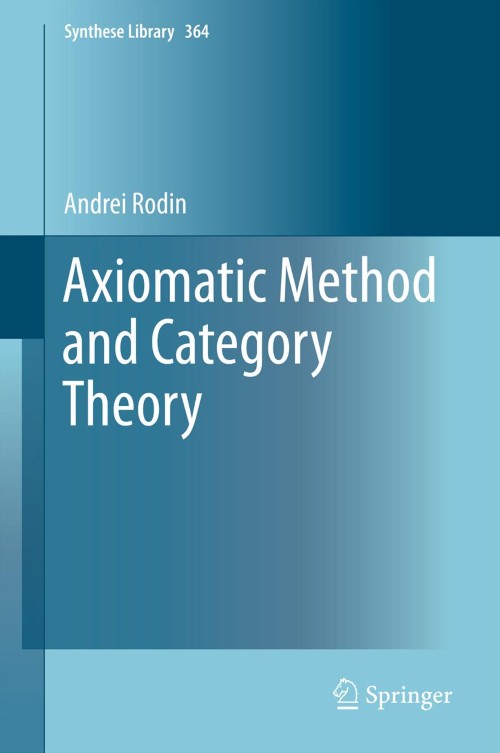
Axiomatic Method and Category Theory [electronic resource] / by Andrei Rodin.
Erişim Adresi
ISBN
9783319004044
Dil Kodu
İngilizce
Yer Numarası
DK/15747
Yazar
Basım Bildirimi
1st ed. 2014.
Yayın Bilgisi
Cham : Springer International Publishing : Imprint: Springer, 2014.
Fiziksel Niteleme
XI, 285 p. 63 illus. online resource.
Dizi
Synthese Library, Studies in Epistemology, Logic, Methodology, and Philosophy of Science, 2542-8292 ; 364
İçindekiler Notu
Introduction -- Part I A Brief History of the Axiomatic Method -- Chapter 1. Euclid: Doing and Showing -- Chapter 2. Hilbert: Making It Formal -- Chapter 3. Formal Axiomatic Method and the 20th Century Mathematics -- Chapter. 4 Lawvere: Pursuit of Objectivity -- Conclusion of Part 1 -- Part II. Identity and Categorification -- Chapter 5. Identity in Classical and Constructive Mathematics -- Chapter 6. Identity Through Change, Category Theory and Homotopy Theory -- Conclusion of Part 2 -- Part III. Subjective Intuitions and Objective Structures -- Chapter 7. How Mathematical Concepts Get Their Bodies. Chapter 8. Categories versus Structures -- Chapter 9. New Axiomatic Method (instead of conclusion) -- Bibliography.
Özet, vb.
This volume explores the many different meanings of the notion of the axiomatic method, offering an insightful historical and philosophical discussion about how these notions changed over the millennia. The author, a well-known philosopher and historian of mathematics, first examines Euclid, who is considered the father of the axiomatic method, before moving onto Hilbert and Lawvere. He then presents a deep textual analysis of each writer and describes how their ideas are different and even how their ideas progressed over time. Next, the book explores category theory and details how it has revolutionized the notion of the axiomatic method. It considers the question of identity/equality in mathematics as well as examines the received theories of mathematical structuralism. In the end, Rodin presents a hypothetical New Axiomatic Method, which establishes closer relationships between mathematics and physics. Lawvere's axiomatization of topos theory and Voevodsky's axiomatization of higher homotopy theory exemplify a new way of axiomatic theory building, which goes beyond the classical Hilbert-style Axiomatic Method. The new notion of Axiomatic Method that emerges in categorical logic opens new possibilities for using this method in physics and other natural sciences. This volume offers readers a coherent look at the past, present and anticipated future of the Axiomatic Method.
Konu
Knowledge, Theory of.
Algebra, Homological.
Mathematical logic.
Epistemology.
Category Theory, Homological Algebra.
Mathematical Logic and Foundations.
Algebra, Homological.
Mathematical logic.
Epistemology.
Category Theory, Homological Algebra.
Mathematical Logic and Foundations.
Kurum Adı

Eseri Alıntıla
Referansları kullanmadan önce gözden geçirmeniz ve varsa gerekli düzeltmeleri yapmanız önerilir.
Dijital Kaynak
MARC Görünümü
LEADER 04070nam a22005175i 4500
001 814508
003 TR_AnAIT
005 20260130215319
007 cr nn 008mamaa
008 131014s2014 sz | s |||| 0|eng d
020 |a9783319004044|9978-3-319-00404-4
024 7 |a10.1007/978-3-319-00404-4|2doi
041 |aeng
049 |aTürk Tarih Kurumu Kütüphanesi
050 4|aBD143-237
072 7|aHPK|2bicssc
072 7|aPHI004000|2bisacsh
072 7|aQDTK|2thema
082 04|a120|223
090 |aDK/15747
100 1 |aRodin, Andrei.|eauthor.|4aut|4http://id.loc.gov/vocabulary/relators/aut
245 10|aAxiomatic Method and Category Theory|h[electronic resource] /|cby Andrei Rodin.
250 |a1st ed. 2014.
264 1|aCham :|bSpringer International Publishing :|bImprint: Springer,|c2014.
300 |aXI, 285 p. 63 illus.|bonline resource.
336 |atext|btxt|2rdacontent
337 |acomputer|bc|2rdamedia
338 |aonline resource|bcr|2rdacarrier
347 |atext file|bPDF|2rda
490 1 |aSynthese Library, Studies in Epistemology, Logic, Methodology, and Philosophy of Science,|x2542-8292 ;|v364
505 0 |aIntroduction -- Part I A Brief History of the Axiomatic Method -- Chapter 1. Euclid: Doing and Showing -- Chapter 2. Hilbert: Making It Formal -- Chapter 3. Formal Axiomatic Method and the 20th Century Mathematics -- Chapter. 4 Lawvere: Pursuit of Objectivity -- Conclusion of Part 1 -- Part II. Identity and Categorification -- Chapter 5. Identity in Classical and Constructive Mathematics -- Chapter 6. Identity Through Change, Category Theory and Homotopy Theory -- Conclusion of Part 2 -- Part III. Subjective Intuitions and Objective Structures -- Chapter 7. How Mathematical Concepts Get Their Bodies. Chapter 8. Categories versus Structures -- Chapter 9. New Axiomatic Method (instead of conclusion) -- Bibliography.
520 |aThis volume explores the many different meanings of the notion of the axiomatic method, offering an insightful historical and philosophical discussion about how these notions changed over the millennia. The author, a well-known philosopher and historian of mathematics, first examines Euclid, who is considered the father of the axiomatic method, before moving onto Hilbert and Lawvere. He then presents a deep textual analysis of each writer and describes how their ideas are different and even how their ideas progressed over time. Next, the book explores category theory and details how it has revolutionized the notion of the axiomatic method. It considers the question of identity/equality in mathematics as well as examines the received theories of mathematical structuralism. In the end, Rodin presents a hypothetical New Axiomatic Method, which establishes closer relationships between mathematics and physics. Lawvere's axiomatization of topos theory and Voevodsky's axiomatization of higher homotopy theory exemplify a new way of axiomatic theory building, which goes beyond the classical Hilbert-style Axiomatic Method. The new notion of Axiomatic Method that emerges in categorical logic opens new possibilities for using this method in physics and other natural sciences. This volume offers readers a coherent look at the past, present and anticipated future of the Axiomatic Method.
650 0|aKnowledge, Theory of.
650 0|aAlgebra, Homological.
650 0|aMathematical logic.
650 14|aEpistemology.
650 24|aCategory Theory, Homological Algebra.
650 24|aMathematical Logic and Foundations.
710 2 |aSpringerLink (Online service)
773 0 |tSpringer Nature eBook
776 08|iPrinted edition:|z9783319004037
776 08|iPrinted edition:|z9783319004051
776 08|iPrinted edition:|z9783319375519
830 0|aSynthese Library, Studies in Epistemology, Logic, Methodology, and Philosophy of Science,|x2542-8292 ;|v364
856 40|uhttps://doi.org/10.1007/978-3-319-00404-4
912 |aZDB-2-SHU
912 |aZDB-2-SXPR
950 |aHumanities, Social Sciences and Law (SpringerNature-11648)
950 |aPhilosophy and Religion (R0) (SpringerNature-43725)
001 814508
003 TR_AnAIT
005 20260130215319
007 cr nn 008mamaa
008 131014s2014 sz | s |||| 0|eng d
020 |a9783319004044|9978-3-319-00404-4
024 7 |a10.1007/978-3-319-00404-4|2doi
041 |aeng
049 |aTürk Tarih Kurumu Kütüphanesi
050 4|aBD143-237
072 7|aHPK|2bicssc
072 7|aPHI004000|2bisacsh
072 7|aQDTK|2thema
082 04|a120|223
090 |aDK/15747
100 1 |aRodin, Andrei.|eauthor.|4aut|4http://id.loc.gov/vocabulary/relators/aut
245 10|aAxiomatic Method and Category Theory|h[electronic resource] /|cby Andrei Rodin.
250 |a1st ed. 2014.
264 1|aCham :|bSpringer International Publishing :|bImprint: Springer,|c2014.
300 |aXI, 285 p. 63 illus.|bonline resource.
336 |atext|btxt|2rdacontent
337 |acomputer|bc|2rdamedia
338 |aonline resource|bcr|2rdacarrier
347 |atext file|bPDF|2rda
490 1 |aSynthese Library, Studies in Epistemology, Logic, Methodology, and Philosophy of Science,|x2542-8292 ;|v364
505 0 |aIntroduction -- Part I A Brief History of the Axiomatic Method -- Chapter 1. Euclid: Doing and Showing -- Chapter 2. Hilbert: Making It Formal -- Chapter 3. Formal Axiomatic Method and the 20th Century Mathematics -- Chapter. 4 Lawvere: Pursuit of Objectivity -- Conclusion of Part 1 -- Part II. Identity and Categorification -- Chapter 5. Identity in Classical and Constructive Mathematics -- Chapter 6. Identity Through Change, Category Theory and Homotopy Theory -- Conclusion of Part 2 -- Part III. Subjective Intuitions and Objective Structures -- Chapter 7. How Mathematical Concepts Get Their Bodies. Chapter 8. Categories versus Structures -- Chapter 9. New Axiomatic Method (instead of conclusion) -- Bibliography.
520 |aThis volume explores the many different meanings of the notion of the axiomatic method, offering an insightful historical and philosophical discussion about how these notions changed over the millennia. The author, a well-known philosopher and historian of mathematics, first examines Euclid, who is considered the father of the axiomatic method, before moving onto Hilbert and Lawvere. He then presents a deep textual analysis of each writer and describes how their ideas are different and even how their ideas progressed over time. Next, the book explores category theory and details how it has revolutionized the notion of the axiomatic method. It considers the question of identity/equality in mathematics as well as examines the received theories of mathematical structuralism. In the end, Rodin presents a hypothetical New Axiomatic Method, which establishes closer relationships between mathematics and physics. Lawvere's axiomatization of topos theory and Voevodsky's axiomatization of higher homotopy theory exemplify a new way of axiomatic theory building, which goes beyond the classical Hilbert-style Axiomatic Method. The new notion of Axiomatic Method that emerges in categorical logic opens new possibilities for using this method in physics and other natural sciences. This volume offers readers a coherent look at the past, present and anticipated future of the Axiomatic Method.
650 0|aKnowledge, Theory of.
650 0|aAlgebra, Homological.
650 0|aMathematical logic.
650 14|aEpistemology.
650 24|aCategory Theory, Homological Algebra.
650 24|aMathematical Logic and Foundations.
710 2 |aSpringerLink (Online service)
773 0 |tSpringer Nature eBook
776 08|iPrinted edition:|z9783319004037
776 08|iPrinted edition:|z9783319004051
776 08|iPrinted edition:|z9783319375519
830 0|aSynthese Library, Studies in Epistemology, Logic, Methodology, and Philosophy of Science,|x2542-8292 ;|v364
856 40|uhttps://doi.org/10.1007/978-3-319-00404-4
912 |aZDB-2-SHU
912 |aZDB-2-SXPR
950 |aHumanities, Social Sciences and Law (SpringerNature-11648)
950 |aPhilosophy and Religion (R0) (SpringerNature-43725)
Materyaller
Depodan talep edilen materyal sadece kütüphane içerisinde kullanılmaktadır.
Materyal dışarıya ödünç verilmemektedir.
