

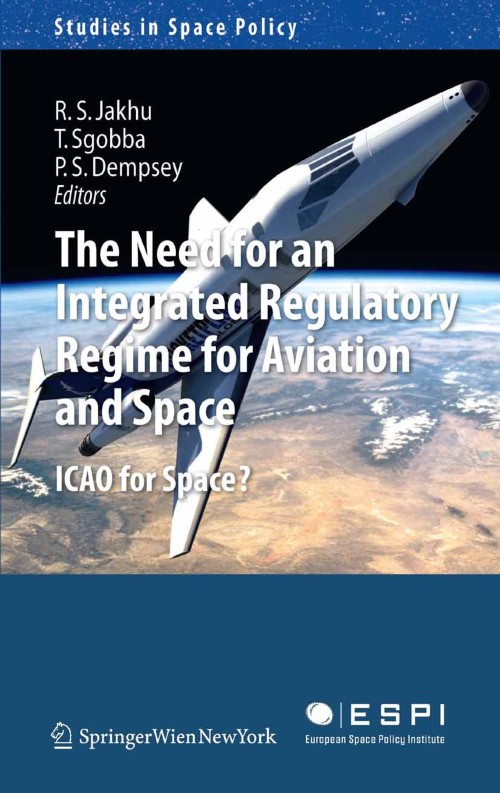
The Need for an Integrated Regulatory Regime for Aviation and Space [electronic resource] : ICAO for Space? / edited by Ram S. Jakhu, Tommaso Sgobba, Paul Stephen Dempsey.
Erişim Adresi
ISBN
9783709107188
Dil Kodu
İngilizce
Yer Numarası
DK/15750
Basım Bildirimi
1st ed. 2011.
Yayın Bilgisi
Vienna : Springer Vienna : Imprint: Springer, 2011.
Fiziksel Niteleme
XXIV, 188 p. online resource.
Dizi
Studies in Space Policy, 1868-5315 ; 7
İçindekiler Notu
Acknowledgements -- foreword,- about the editors -- executive summary -- list of acronyms -- list of exhibits -- introduction -- chapter 1: background -- chapter 2: legal and regulatory regimes -- chapter 3: safety issues -- chapter 4: need for international space safety regulations -- chapter 5: proposal for a new regulatory regime -- appendix a -- appendix b -- appendix c.
Özet, vb.
In the new space age after the end of the Cold War, orbit and frequency allocations, traffic control, safety, and a number of support services such as space weather forecast and orbital debris monitoring need to be coordinated transparently and effectively by clear rules at an international level. The establishment of an international civil space regulatory framework is the central theme of this book, in particular, the possible extension to space of the international regulatory framework model adopted for aviation more than 60 years ago with the establishment of the International Civil Aviation Organization (ICAO). The book also highlights the increased reliance of aviation safety on space-based navigation and communication systems, the increasing space systems traffic through the international airspace under the jurisdiction of the ICAO, and the emerging hybrid systems such as aero-spacecraft and space planes, to advocate the practical benefits of directly expanding the ICAO Convention domain beyond the airspace to include outer space up to the geosynchronous orbit.
Konu
Law of the sea.
International law.
Aeronautics __ Law and legislation.
Aerospace engineering.
Astronautics.
Technological innovations.
Law of the Sea, Air and Outer Space.
Aerospace Technology and Astronautics.
Innovation and Technology Management.
International law.
Aeronautics __ Law and legislation.
Aerospace engineering.
Astronautics.
Technological innovations.
Law of the Sea, Air and Outer Space.
Aerospace Technology and Astronautics.
Innovation and Technology Management.
Diğer Yazarlar
Kurum Adı
