

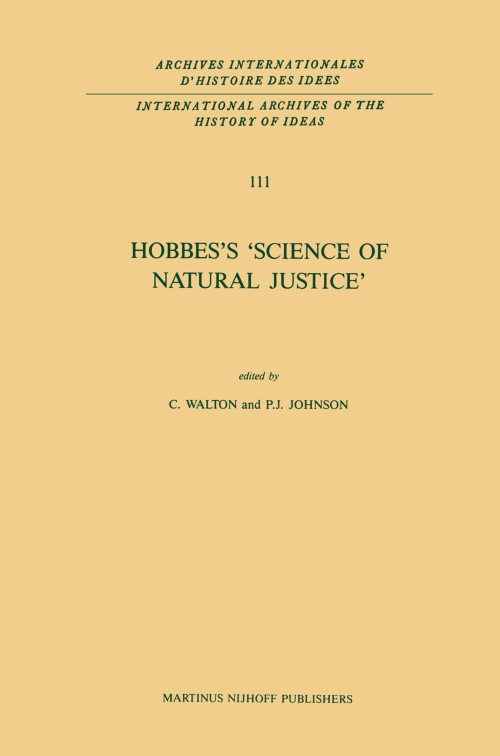
Hobbes’s ‘Science of Natural Justice’ [electronic resource] / edited by C. Walton, Paul J. Johnson.
Erişim Adresi
ISBN
9789400934856
Dil Kodu
İngilizce
Yer Numarası
DK/15751
Basım Bildirimi
1st ed. 1987.
Yayın Bilgisi
Dordrecht : Springer Netherlands : Imprint: Springer, 1987.
Fiziksel Niteleme
XIV, 314 p. online resource.
Dizi
International Archives of the History of Ideas Archives internationales d'histoire des idées, 2215-0307 ; 111
İçindekiler Notu
Editor’s Introduction -- I. Task of the ‘Science of Natural Justice’ -- 1. The Philosophical Implications of Hobbes’s State of Nature -- 2. Hobbes’s Theory of Natural and Social Sciences -- 3. Obligations: Science and Philosophy in the Political Writings of Hobbes -- II. Logic and Language of this Science -- 4. Hobbes on the Natural and the Artificial -- 5. Hobbes’s Entanglement with the Excluded Middle in his Theory of Man and Politics -- 6. Hobbes: Language and the Is-Ought -- 7. ‘Insinuations to the Will’: Hobbes’s Style and Intention in Leviathan Compared to his Earlier Political Works -- III. Natural Right and the State of Nature -- 8. Hobbes’s Conatus and the Roots of Character -- 9. Hobbes and the Wolf-man -- 10. Metamorphosis of the Idea of Right in Thomas Hobbes’s Philosophy -- 11. The Peculiarity of Hobbes’s Concept of Natural Right -- 12. Thomas Hobbes: The Mediation of Right -- IV. Generating the Commonwealth -- 13. Hobbes, Revolution and the Philosophy of History -- 14. Thomas Hobbes from Behemoth to Leviathan -- 15. Covenant: Hobbes’s Philosophy of Religion and his Political System ‘More Geometrico’ -- V. Justice and Equity in the Commonwealth -- 16. Hobbes on Equity and Justice -- 17. Commentary on Professor May’s ‘Hobbes on Equity and Justice’ -- 18. Justice and Equity: an Inquiry into the Meaning and Role of Equity in the Hobbesian Account of Justice and Politics -- VI. Hobbes Today -- 19. The Leviathan, Old and New -- 20. Hobbes and Macroethics: the Theory of Peace and Natural Justice.
Özet, vb.
Unlike many major figures in Western intellectual history, Hobbes has refused to become dated and quietly take his appointed place in the museum of historical scholarship. Whether by way of adoption or reaction, his ideas have remained vibrant forces in mankind's attempts to understand the problems and dilemmas of living peaceably with one another. As Richard Ashcraft said a few years ago: One of the standards by which the greatness of political theorists is measured, is their ability to evoke in us new insights into 'the human condition'. Only a few political writers have risen Dionysus-like from the titanic assaults of their critics to become even more formidable forces in the shaping of our destiny. One of these giants is surely the irascible l and irrepressible Thomas Hobbes . Given the power of Hobbes's thought, it is not then perhaps surprising to find that his writings have generated seemingly endless scholarly controversy and an astonishing range of imcompatible interpretations. Among other things, he has been interpreted as a theist and an atheist, as a utilitarian and a deontologist, a humanist and a scientist, as a traditional natural law theorist and a legal positivist, a contractualist and an absolutist - indeed, as Professor Morris notes in his contribution to the present volume, 'as almost any kind of philosophical 'ist except Platonist or Aristotelist'.
Konu
History.
Law __ Philosophy.
History.
Philosophy of Law.
Law __ Philosophy.
History.
Philosophy of Law.
Diğer Yazarlar
Kurum Adı
Eseri Alıntıla
Referansları kullanmadan önce gözden geçirmeniz ve varsa gerekli düzeltmeleri yapmanız önerilir.
Dijital Kaynak
MARC Görünümü
LEADER 05704nam a22005895i 4500
001 814512
003 TR_AnAIT
005 20260130215300
007 cr nn 008mamaa
008 121227s1987 ne | s |||| 0|eng d
020 |a9789400934856|9978-94-009-3485-6
024 7 |a10.1007/978-94-009-3485-6|2doi
041 |aeng
049 |aTürk Tarih Kurumu Kütüphanesi
050 4|aD1-2027
072 7|aHB|2bicssc
072 7|aHBAH|2bicssc
072 7|aHIS000000|2bisacsh
072 7|aNH|2thema
072 7|aNHAH|2thema
082 04|a900|223
090 |aDK/15751
245 10|aHobbes’s ‘Science of Natural Justice’|h[electronic resource] /|cedited by C. Walton, Paul J. Johnson.
250 |a1st ed. 1987.
264 1|aDordrecht :|bSpringer Netherlands :|bImprint: Springer,|c1987.
300 |aXIV, 314 p.|bonline resource.
336 |atext|btxt|2rdacontent
337 |acomputer|bc|2rdamedia
338 |aonline resource|bcr|2rdacarrier
347 |atext file|bPDF|2rda
490 1 |aInternational Archives of the History of Ideas Archives internationales d'histoire des idées,|x2215-0307 ;|v111
505 0 |aEditor’s Introduction -- I. Task of the ‘Science of Natural Justice’ -- 1. The Philosophical Implications of Hobbes’s State of Nature -- 2. Hobbes’s Theory of Natural and Social Sciences -- 3. Obligations: Science and Philosophy in the Political Writings of Hobbes -- II. Logic and Language of this Science -- 4. Hobbes on the Natural and the Artificial -- 5. Hobbes’s Entanglement with the Excluded Middle in his Theory of Man and Politics -- 6. Hobbes: Language and the Is-Ought -- 7. ‘Insinuations to the Will’: Hobbes’s Style and Intention in Leviathan Compared to his Earlier Political Works -- III. Natural Right and the State of Nature -- 8. Hobbes’s Conatus and the Roots of Character -- 9. Hobbes and the Wolf-man -- 10. Metamorphosis of the Idea of Right in Thomas Hobbes’s Philosophy -- 11. The Peculiarity of Hobbes’s Concept of Natural Right -- 12. Thomas Hobbes: The Mediation of Right -- IV. Generating the Commonwealth -- 13. Hobbes, Revolution and the Philosophy of History -- 14. Thomas Hobbes from Behemoth to Leviathan -- 15. Covenant: Hobbes’s Philosophy of Religion and his Political System ‘More Geometrico’ -- V. Justice and Equity in the Commonwealth -- 16. Hobbes on Equity and Justice -- 17. Commentary on Professor May’s ‘Hobbes on Equity and Justice’ -- 18. Justice and Equity: an Inquiry into the Meaning and Role of Equity in the Hobbesian Account of Justice and Politics -- VI. Hobbes Today -- 19. The Leviathan, Old and New -- 20. Hobbes and Macroethics: the Theory of Peace and Natural Justice.
520 |aUnlike many major figures in Western intellectual history, Hobbes has refused to become dated and quietly take his appointed place in the museum of historical scholarship. Whether by way of adoption or reaction, his ideas have remained vibrant forces in mankind's attempts to understand the problems and dilemmas of living peaceably with one another. As Richard Ashcraft said a few years ago: One of the standards by which the greatness of political theorists is measured, is their ability to evoke in us new insights into 'the human condition'. Only a few political writers have risen Dionysus-like from the titanic assaults of their critics to become even more formidable forces in the shaping of our destiny. One of these giants is surely the irascible l and irrepressible Thomas Hobbes . Given the power of Hobbes's thought, it is not then perhaps surprising to find that his writings have generated seemingly endless scholarly controversy and an astonishing range of imcompatible interpretations. Among other things, he has been interpreted as a theist and an atheist, as a utilitarian and a deontologist, a humanist and a scientist, as a traditional natural law theorist and a legal positivist, a contractualist and an absolutist - indeed, as Professor Morris notes in his contribution to the present volume, 'as almost any kind of philosophical 'ist except Platonist or Aristotelist'.
532 8 |aAccessibility summary: This PDF is not accessible. It is based on scanned pages and does not support features such as screen reader compatibility or described non-text content (images, graphs etc). However, it likely supports searchable and selectable text based on OCR (Optical Character Recognition). Users with accessibility needs may not be able to use this content effectively. Please contact us at accessibilitysupport@springernature.com if you require assistance or an alternative format.
532 8 |aInaccessible, or known limited accessibility
532 8 |aNo reading system accessibility options actively disabled
532 8 |aPublisher contact for further accessibility information: accessibilitysupport@springernature.com
650 0|aHistory.
650 0|aLaw|xPhilosophy.
650 14|aHistory.
650 24|aPhilosophy of Law.
700 1 |aWalton, C.|eeditor.|4edt|4http://id.loc.gov/vocabulary/relators/edt
700 1 |aJohnson, Paul J.|eeditor.|4edt|4http://id.loc.gov/vocabulary/relators/edt
710 2 |aSpringerLink (Online service)
773 0 |tSpringer Nature eBook
776 08|iPrinted edition:|z9789024732265
776 08|iPrinted edition:|z9789400934863
776 08|iPrinted edition:|z9789401080606
830 0|aInternational Archives of the History of Ideas Archives internationales d'histoire des idées,|x2215-0307 ;|v111
856 40|uhttps://doi.org/10.1007/978-94-009-3485-6
912 |aZDB-2-SHU
912 |aZDB-2-SXH
912 |aZDB-2-BAE
950 |aHumanities, Social Sciences and Law (SpringerNature-11648)
950 |aHistory (R0) (SpringerNature-43722)
001 814512
003 TR_AnAIT
005 20260130215300
007 cr nn 008mamaa
008 121227s1987 ne | s |||| 0|eng d
020 |a9789400934856|9978-94-009-3485-6
024 7 |a10.1007/978-94-009-3485-6|2doi
041 |aeng
049 |aTürk Tarih Kurumu Kütüphanesi
050 4|aD1-2027
072 7|aHB|2bicssc
072 7|aHBAH|2bicssc
072 7|aHIS000000|2bisacsh
072 7|aNH|2thema
072 7|aNHAH|2thema
082 04|a900|223
090 |aDK/15751
245 10|aHobbes’s ‘Science of Natural Justice’|h[electronic resource] /|cedited by C. Walton, Paul J. Johnson.
250 |a1st ed. 1987.
264 1|aDordrecht :|bSpringer Netherlands :|bImprint: Springer,|c1987.
300 |aXIV, 314 p.|bonline resource.
336 |atext|btxt|2rdacontent
337 |acomputer|bc|2rdamedia
338 |aonline resource|bcr|2rdacarrier
347 |atext file|bPDF|2rda
490 1 |aInternational Archives of the History of Ideas Archives internationales d'histoire des idées,|x2215-0307 ;|v111
505 0 |aEditor’s Introduction -- I. Task of the ‘Science of Natural Justice’ -- 1. The Philosophical Implications of Hobbes’s State of Nature -- 2. Hobbes’s Theory of Natural and Social Sciences -- 3. Obligations: Science and Philosophy in the Political Writings of Hobbes -- II. Logic and Language of this Science -- 4. Hobbes on the Natural and the Artificial -- 5. Hobbes’s Entanglement with the Excluded Middle in his Theory of Man and Politics -- 6. Hobbes: Language and the Is-Ought -- 7. ‘Insinuations to the Will’: Hobbes’s Style and Intention in Leviathan Compared to his Earlier Political Works -- III. Natural Right and the State of Nature -- 8. Hobbes’s Conatus and the Roots of Character -- 9. Hobbes and the Wolf-man -- 10. Metamorphosis of the Idea of Right in Thomas Hobbes’s Philosophy -- 11. The Peculiarity of Hobbes’s Concept of Natural Right -- 12. Thomas Hobbes: The Mediation of Right -- IV. Generating the Commonwealth -- 13. Hobbes, Revolution and the Philosophy of History -- 14. Thomas Hobbes from Behemoth to Leviathan -- 15. Covenant: Hobbes’s Philosophy of Religion and his Political System ‘More Geometrico’ -- V. Justice and Equity in the Commonwealth -- 16. Hobbes on Equity and Justice -- 17. Commentary on Professor May’s ‘Hobbes on Equity and Justice’ -- 18. Justice and Equity: an Inquiry into the Meaning and Role of Equity in the Hobbesian Account of Justice and Politics -- VI. Hobbes Today -- 19. The Leviathan, Old and New -- 20. Hobbes and Macroethics: the Theory of Peace and Natural Justice.
520 |aUnlike many major figures in Western intellectual history, Hobbes has refused to become dated and quietly take his appointed place in the museum of historical scholarship. Whether by way of adoption or reaction, his ideas have remained vibrant forces in mankind's attempts to understand the problems and dilemmas of living peaceably with one another. As Richard Ashcraft said a few years ago: One of the standards by which the greatness of political theorists is measured, is their ability to evoke in us new insights into 'the human condition'. Only a few political writers have risen Dionysus-like from the titanic assaults of their critics to become even more formidable forces in the shaping of our destiny. One of these giants is surely the irascible l and irrepressible Thomas Hobbes . Given the power of Hobbes's thought, it is not then perhaps surprising to find that his writings have generated seemingly endless scholarly controversy and an astonishing range of imcompatible interpretations. Among other things, he has been interpreted as a theist and an atheist, as a utilitarian and a deontologist, a humanist and a scientist, as a traditional natural law theorist and a legal positivist, a contractualist and an absolutist - indeed, as Professor Morris notes in his contribution to the present volume, 'as almost any kind of philosophical 'ist except Platonist or Aristotelist'.
532 8 |aAccessibility summary: This PDF is not accessible. It is based on scanned pages and does not support features such as screen reader compatibility or described non-text content (images, graphs etc). However, it likely supports searchable and selectable text based on OCR (Optical Character Recognition). Users with accessibility needs may not be able to use this content effectively. Please contact us at accessibilitysupport@springernature.com if you require assistance or an alternative format.
532 8 |aInaccessible, or known limited accessibility
532 8 |aNo reading system accessibility options actively disabled
532 8 |aPublisher contact for further accessibility information: accessibilitysupport@springernature.com
650 0|aHistory.
650 0|aLaw|xPhilosophy.
650 14|aHistory.
650 24|aPhilosophy of Law.
700 1 |aWalton, C.|eeditor.|4edt|4http://id.loc.gov/vocabulary/relators/edt
700 1 |aJohnson, Paul J.|eeditor.|4edt|4http://id.loc.gov/vocabulary/relators/edt
710 2 |aSpringerLink (Online service)
773 0 |tSpringer Nature eBook
776 08|iPrinted edition:|z9789024732265
776 08|iPrinted edition:|z9789400934863
776 08|iPrinted edition:|z9789401080606
830 0|aInternational Archives of the History of Ideas Archives internationales d'histoire des idées,|x2215-0307 ;|v111
856 40|uhttps://doi.org/10.1007/978-94-009-3485-6
912 |aZDB-2-SHU
912 |aZDB-2-SXH
912 |aZDB-2-BAE
950 |aHumanities, Social Sciences and Law (SpringerNature-11648)
950 |aHistory (R0) (SpringerNature-43722)
Materyaller
Depodan talep edilen materyal sadece kütüphane içerisinde kullanılmaktadır.
Materyal dışarıya ödünç verilmemektedir.
Materyal dışarıya ödünç verilmemektedir.
