LEADER 04383nam a22005895i 4500
001 814529
003 TR_AnAIT
005 20260130215132
007 cr nn 008mamaa
008 130125s1994 ne | s |||| 0|eng d
020 |a9789401732499|9978-94-017-3249-9
024 7 |a10.1007/978-94-017-3249-9|2doi
041 |aeng
049 |aTürk Tarih Kurumu Kütüphanesi
050 4|aHM623
072 7|aJFC|2bicssc
072 7|aSOC002010|2bisacsh
072 7|aJBCC|2thema
082 04|a306|223
090 |aDK/15767
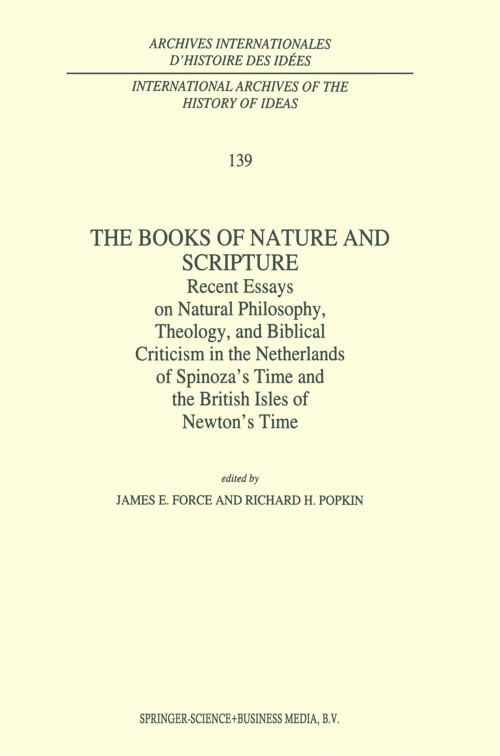
245 14|aThe Books of Nature and Scripture|h[electronic resource] :|bRecent Essays on Natural Philosophy, Theology and Biblical Criticism in the Netherlands of Spinoza’s Time and the British Isles of Newton’s Time /|cedited by J.E. Force, R.H. Popkin.
250 |a1st ed. 1994.
264 1|aDordrecht :|bSpringer Netherlands :|bImprint: Springer,|c1994.
300 |aXVIII, 230 p.|bonline resource.
336 |atext|btxt|2rdacontent
337 |acomputer|bc|2rdamedia
338 |aonline resource|bcr|2rdacarrier
347 |atext file|bPDF|2rda
490 1 |aInternational Archives of the History of Ideas Archives internationales d'histoire des idées,|x2215-0307 ;|v139
505 0 |a1. Spinoza and Bible Scholarship -- 2. Comments on R. Popkin’s Paper -- 3. Irrationality With or Without Reason: An Analysis of Chapter XV of the Tractatus Theologico-politicus -- 4. More, Newton, and the Language of Biblical Prophecy -- 5. “Making a Shew”: Apocalyptic Hermeneutics and the Sociology of Christian Idolatry in the Work of Isaac Newton and Henry More -- 6. Newton on Kabbalah -- 7. One Prophet Interprets Another: Sir Isaac Newton and Daniel -- 8. “Pray Do Not Ascribe that Notion to Me”: God and Newton’s Gravity -- 9. Isaac Newton and Thomas Burnet: Biblical Criticism and the Crisis of Late Seventeenth-Century England -- 10. The God of Abraham and Isaac (Newton) -- 11. “Moses’s Principia”: Hutchinsonianism and Newton’s Critics.
520 |aDick Popkin and James Force have attended a number of recent conferences where it was apparent that much new and important research was being done in the fields of interpreting Newton's and Spinoza's contributions as biblical scholars and of the relationship between their biblical scholarship and other aspects of their particular philosophies. This collection represents the best current research in this area. It stands alone as the only work to bring together the best current work on these topics. Its primary audience is specialised scholars of the thought of Newton and Spinoza as well as historians of the philosophical ideas of the late seventeenth and early eighteenth centuries.
532 8 |aAccessibility summary: This PDF is not accessible. It is based on scanned pages and does not support features such as screen reader compatibility or described non-text content (images, graphs etc). However, it likely supports searchable and selectable text based on OCR (Optical Character Recognition). Users with accessibility needs may not be able to use this content effectively. Please contact us at accessibilitysupport@springernature.com if you require assistance or an alternative format.
532 8 |aInaccessible, or known limited accessibility
532 8 |aNo reading system accessibility options actively disabled
532 8 |aPublisher contact for further accessibility information: accessibilitysupport@springernature.com
650 0|aCulture|xStudy and teaching.
650 0|aPhilosophy|xHistory.
650 0|aHistory.
650 14|aCultural Studies.
650 24|aHistory of Philosophy.
650 24|aHistory.
700 1 |aForce, J.E.|eeditor.|4edt|4http://id.loc.gov/vocabulary/relators/edt
700 1 |aPopkin, R.H.|eeditor.|4edt|4http://id.loc.gov/vocabulary/relators/edt
710 2 |aSpringerLink (Online service)
773 0 |tSpringer Nature eBook
776 08|iPrinted edition:|z9780792324676
776 08|iPrinted edition:|z9789048143214
776 08|iPrinted edition:|z9789401732505
830 0|aInternational Archives of the History of Ideas Archives internationales d'histoire des idées,|x2215-0307 ;|v139
856 40|uhttps://doi.org/10.1007/978-94-017-3249-9
912 |aZDB-2-SHU
912 |aZDB-2-SXS
912 |aZDB-2-BAE
950 |aHumanities, Social Sciences and Law (SpringerNature-11648)
950 |aSocial Sciences (R0) (SpringerNature-43726)