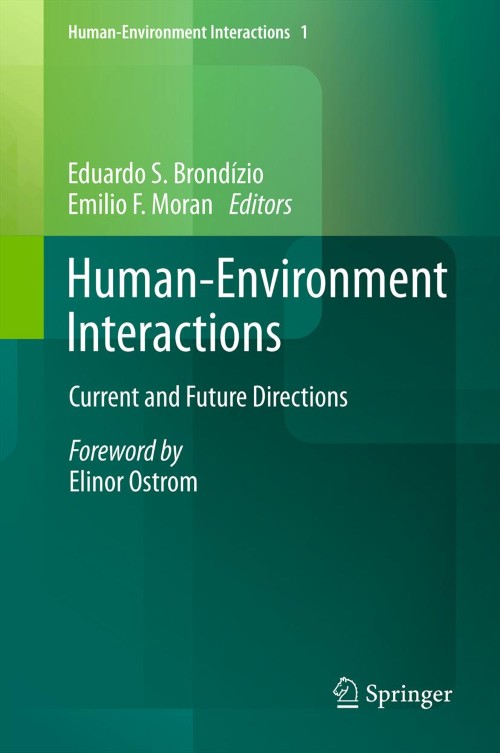
Human-Environment Interactions [electronic resource] : Current and Future Directions / edited by Eduardo S. Brondízio, Emilio F. Moran.
Erişim Adresi
ISBN
9789400747807
Dil Kodu
İngilizce
Yer Numarası
DK/15783
Basım Bildirimi
1st ed. 2013.
Yayın Bilgisi
Dordrecht : Springer Netherlands : Imprint: Springer, 2013.
Fiziksel Niteleme
XXX, 406 p. online resource.
Dizi
Human-Environment Interactions, 2452-1744 ; 1
İçindekiler Notu
Foreword by Elinor Ostrom -- Introduction -- Part I: Health and Adaptation Approaches -- 1. A Half-Century Portrait: Health Transition in the Xavante Indians from Central Brazil -- 2. Balancing People, Politics, and Resources in Rural Tibet -- 3. Human-Wildlife Contact and Emerging Infectious Diseases -- Part II: Land Change and Landscape Management Approaches -- 4. Change in Natural Resource Management: An Experiment with ‘Participatory GIS’ -- 5. Peopled Parks: Forest Change in India’s Protected Landscapes -- 6. Public-Private Interactions in the Conservation of Private Forests in the United States -- 7. The Monitoring of Land-Cover Change and Management across Gradient Landscapes in Africa -- Part III: Institutional and Political Ecology Approaches -- 8. Between Cooperation and Conflict: The Implementation of Agro-Extractive Settlements in the Lower Amazonian Floodplain -- 9. Conservation of Natural Resources: Which Matters –Having a Regulation or the Size of the Penalty Imposed?- 10. Small-Scale Farmers and the Challenges of Environmental Conservation and Rural Development: Case Studies from the State of São Paulo and the Amazon Region -- 11. Institutional Evolution, Forest Conservation, and Rapid Change in Rural Honduras -- 12. Land-Use Institutions and Natural Resources in Fast-Growing Communities at the Urban-Rural Fringe -- Part IV: Historical and Archeological Approaches -- 13. Agroforestry in Tomé-Açu—An Alternative to Pasture in the Amazon -- 14. Changing Driving Forces, Imposed Tenure Regimes, and Tree-Cover Change on Village Landscapes in the West Mengo Region of Uganda, 1890 to 2002 -- 15. Was Agriculture a Key Productive Activity in Precolonial Amazonia? The Stable Productive Basis for Social Equality in the Central Amazon -- Part V. Future Directions -- 16. Human-Environment Research: Past Trends, Current Challenges and Future Directions -- Index.
Özet, vb.
Human-environment interaction (HEI) provides a framework that brings together scholarship sharing both disciplinary depth and interdisciplinary scope to examine past, present, and future social and environmental change in different parts of the world. This volume brings senior and junior scholars together, and in so doing connects these historically influential traditions to new and cutting-edge approaches that give us a glimpse into current and future trends in interdisciplinary science of human-environment interaction. The volume offers a microcosm of contemporary HEI research in terms of thematic, theory and methodology, level of analysis, and regional coverage. Drawing on research from eleven countries across four continents, the 16 chapters in the volume bring perspectives from various specialties in anthropology and human ecology, institutional analysis, historical and political ecology, geography, archaeology, and land change sciences. The four sections of the volume reflect complementary approaches to HEI: health and adaptation approaches, land change and landscape management approaches, institutional and political-ecology approaches, and historical and archaeological approaches.
Konu
Anthropology.
Sustainability.
Human geography.
Earth sciences.
Social sciences.
Humanities.
Medical sciences.
Anthropology.
Sustainability.
Human Geography.
Earth Sciences.
Humanities and Social Sciences.
Health Sciences.
Sustainability.
Human geography.
Earth sciences.
Social sciences.
Humanities.
Medical sciences.
Anthropology.
Sustainability.
Human Geography.
Earth Sciences.
Humanities and Social Sciences.
Health Sciences.
Diğer Yazarlar
Kurum Adı

Eseri Alıntıla
Referansları kullanmadan önce gözden geçirmeniz ve varsa gerekli düzeltmeleri yapmanız önerilir.
Dijital Kaynak
MARC Görünümü
LEADER 05254nam a22006135i 4500
001 814545
003 TR_AnAIT
005 20260130215057
007 cr nn 008mamaa
008 121116s2013 ne | s |||| 0|eng d
020 |a9789400747807|9978-94-007-4780-7
024 7 |a10.1007/978-94-007-4780-7|2doi
041 |aeng
049 |aTürk Tarih Kurumu Kütüphanesi
050 4|aGN
072 7|aJHM|2bicssc
072 7|aSOC002000|2bisacsh
072 7|aJHM|2thema
082 04|a301|223
090 |aDK/15783
245 10|aHuman-Environment Interactions|h[electronic resource] :|bCurrent and Future Directions /|cedited by Eduardo S. Brondízio, Emilio F. Moran.
250 |a1st ed. 2013.
264 1|aDordrecht :|bSpringer Netherlands :|bImprint: Springer,|c2013.
300 |aXXX, 406 p.|bonline resource.
336 |atext|btxt|2rdacontent
337 |acomputer|bc|2rdamedia
338 |aonline resource|bcr|2rdacarrier
347 |atext file|bPDF|2rda
490 1 |aHuman-Environment Interactions,|x2452-1744 ;|v1
505 0 |aForeword by Elinor Ostrom -- Introduction -- Part I: Health and Adaptation Approaches -- 1. A Half-Century Portrait: Health Transition in the Xavante Indians from Central Brazil -- 2. Balancing People, Politics, and Resources in Rural Tibet -- 3. Human-Wildlife Contact and Emerging Infectious Diseases -- Part II: Land Change and Landscape Management Approaches -- 4. Change in Natural Resource Management: An Experiment with ‘Participatory GIS’ -- 5. Peopled Parks: Forest Change in India’s Protected Landscapes -- 6. Public-Private Interactions in the Conservation of Private Forests in the United States -- 7. The Monitoring of Land-Cover Change and Management across Gradient Landscapes in Africa -- Part III: Institutional and Political Ecology Approaches -- 8. Between Cooperation and Conflict: The Implementation of Agro-Extractive Settlements in the Lower Amazonian Floodplain -- 9. Conservation of Natural Resources: Which Matters –Having a Regulation or the Size of the Penalty Imposed?- 10. Small-Scale Farmers and the Challenges of Environmental Conservation and Rural Development: Case Studies from the State of São Paulo and the Amazon Region -- 11. Institutional Evolution, Forest Conservation, and Rapid Change in Rural Honduras -- 12. Land-Use Institutions and Natural Resources in Fast-Growing Communities at the Urban-Rural Fringe -- Part IV: Historical and Archeological Approaches -- 13. Agroforestry in Tomé-Açu—An Alternative to Pasture in the Amazon -- 14. Changing Driving Forces, Imposed Tenure Regimes, and Tree-Cover Change on Village Landscapes in the West Mengo Region of Uganda, 1890 to 2002 -- 15. Was Agriculture a Key Productive Activity in Precolonial Amazonia? The Stable Productive Basis for Social Equality in the Central Amazon -- Part V. Future Directions -- 16. Human-Environment Research: Past Trends, Current Challenges and Future Directions -- Index.
520 |aHuman-environment interaction (HEI) provides a framework that brings together scholarship sharing both disciplinary depth and interdisciplinary scope to examine past, present, and future social and environmental change in different parts of the world. This volume brings senior and junior scholars together, and in so doing connects these historically influential traditions to new and cutting-edge approaches that give us a glimpse into current and future trends in interdisciplinary science of human-environment interaction. The volume offers a microcosm of contemporary HEI research in terms of thematic, theory and methodology, level of analysis, and regional coverage. Drawing on research from eleven countries across four continents, the 16 chapters in the volume bring perspectives from various specialties in anthropology and human ecology, institutional analysis, historical and political ecology, geography, archaeology, and land change sciences. The four sections of the volume reflect complementary approaches to HEI: health and adaptation approaches, land change and landscape management approaches, institutional and political-ecology approaches, and historical and archaeological approaches.
650 0|aAnthropology.
650 0|aSustainability.
650 0|aHuman geography.
650 0|aEarth sciences.
650 0|aSocial sciences.
650 0|aHumanities.
650 0|aMedical sciences.
650 14|aAnthropology.
650 24|aSustainability.
650 24|aHuman Geography.
650 24|aEarth Sciences.
650 24|aHumanities and Social Sciences.
650 24|aHealth Sciences.
700 1 |aBrondízio, Eduardo S.|eeditor.|4edt|4http://id.loc.gov/vocabulary/relators/edt
700 1 |aMoran, Emilio F.|eeditor.|4edt|4http://id.loc.gov/vocabulary/relators/edt
710 2 |aSpringerLink (Online service)
773 0 |tSpringer Nature eBook
776 08|iPrinted edition:|z9789400747791
776 08|iPrinted edition:|z9789400747814
776 08|iPrinted edition:|z9789400799370
830 0|aHuman-Environment Interactions,|x2452-1744 ;|v1
856 40|uhttps://doi.org/10.1007/978-94-007-4780-7
912 |aZDB-2-SHU
912 |aZDB-2-SXS
950 |aHumanities, Social Sciences and Law (SpringerNature-11648)
950 |aSocial Sciences (R0) (SpringerNature-43726)
001 814545
003 TR_AnAIT
005 20260130215057
007 cr nn 008mamaa
008 121116s2013 ne | s |||| 0|eng d
020 |a9789400747807|9978-94-007-4780-7
024 7 |a10.1007/978-94-007-4780-7|2doi
041 |aeng
049 |aTürk Tarih Kurumu Kütüphanesi
050 4|aGN
072 7|aJHM|2bicssc
072 7|aSOC002000|2bisacsh
072 7|aJHM|2thema
082 04|a301|223
090 |aDK/15783
245 10|aHuman-Environment Interactions|h[electronic resource] :|bCurrent and Future Directions /|cedited by Eduardo S. Brondízio, Emilio F. Moran.
250 |a1st ed. 2013.
264 1|aDordrecht :|bSpringer Netherlands :|bImprint: Springer,|c2013.
300 |aXXX, 406 p.|bonline resource.
336 |atext|btxt|2rdacontent
337 |acomputer|bc|2rdamedia
338 |aonline resource|bcr|2rdacarrier
347 |atext file|bPDF|2rda
490 1 |aHuman-Environment Interactions,|x2452-1744 ;|v1
505 0 |aForeword by Elinor Ostrom -- Introduction -- Part I: Health and Adaptation Approaches -- 1. A Half-Century Portrait: Health Transition in the Xavante Indians from Central Brazil -- 2. Balancing People, Politics, and Resources in Rural Tibet -- 3. Human-Wildlife Contact and Emerging Infectious Diseases -- Part II: Land Change and Landscape Management Approaches -- 4. Change in Natural Resource Management: An Experiment with ‘Participatory GIS’ -- 5. Peopled Parks: Forest Change in India’s Protected Landscapes -- 6. Public-Private Interactions in the Conservation of Private Forests in the United States -- 7. The Monitoring of Land-Cover Change and Management across Gradient Landscapes in Africa -- Part III: Institutional and Political Ecology Approaches -- 8. Between Cooperation and Conflict: The Implementation of Agro-Extractive Settlements in the Lower Amazonian Floodplain -- 9. Conservation of Natural Resources: Which Matters –Having a Regulation or the Size of the Penalty Imposed?- 10. Small-Scale Farmers and the Challenges of Environmental Conservation and Rural Development: Case Studies from the State of São Paulo and the Amazon Region -- 11. Institutional Evolution, Forest Conservation, and Rapid Change in Rural Honduras -- 12. Land-Use Institutions and Natural Resources in Fast-Growing Communities at the Urban-Rural Fringe -- Part IV: Historical and Archeological Approaches -- 13. Agroforestry in Tomé-Açu—An Alternative to Pasture in the Amazon -- 14. Changing Driving Forces, Imposed Tenure Regimes, and Tree-Cover Change on Village Landscapes in the West Mengo Region of Uganda, 1890 to 2002 -- 15. Was Agriculture a Key Productive Activity in Precolonial Amazonia? The Stable Productive Basis for Social Equality in the Central Amazon -- Part V. Future Directions -- 16. Human-Environment Research: Past Trends, Current Challenges and Future Directions -- Index.
520 |aHuman-environment interaction (HEI) provides a framework that brings together scholarship sharing both disciplinary depth and interdisciplinary scope to examine past, present, and future social and environmental change in different parts of the world. This volume brings senior and junior scholars together, and in so doing connects these historically influential traditions to new and cutting-edge approaches that give us a glimpse into current and future trends in interdisciplinary science of human-environment interaction. The volume offers a microcosm of contemporary HEI research in terms of thematic, theory and methodology, level of analysis, and regional coverage. Drawing on research from eleven countries across four continents, the 16 chapters in the volume bring perspectives from various specialties in anthropology and human ecology, institutional analysis, historical and political ecology, geography, archaeology, and land change sciences. The four sections of the volume reflect complementary approaches to HEI: health and adaptation approaches, land change and landscape management approaches, institutional and political-ecology approaches, and historical and archaeological approaches.
650 0|aAnthropology.
650 0|aSustainability.
650 0|aHuman geography.
650 0|aEarth sciences.
650 0|aSocial sciences.
650 0|aHumanities.
650 0|aMedical sciences.
650 14|aAnthropology.
650 24|aSustainability.
650 24|aHuman Geography.
650 24|aEarth Sciences.
650 24|aHumanities and Social Sciences.
650 24|aHealth Sciences.
700 1 |aBrondízio, Eduardo S.|eeditor.|4edt|4http://id.loc.gov/vocabulary/relators/edt
700 1 |aMoran, Emilio F.|eeditor.|4edt|4http://id.loc.gov/vocabulary/relators/edt
710 2 |aSpringerLink (Online service)
773 0 |tSpringer Nature eBook
776 08|iPrinted edition:|z9789400747791
776 08|iPrinted edition:|z9789400747814
776 08|iPrinted edition:|z9789400799370
830 0|aHuman-Environment Interactions,|x2452-1744 ;|v1
856 40|uhttps://doi.org/10.1007/978-94-007-4780-7
912 |aZDB-2-SHU
912 |aZDB-2-SXS
950 |aHumanities, Social Sciences and Law (SpringerNature-11648)
950 |aSocial Sciences (R0) (SpringerNature-43726)
Materyaller
Depodan talep edilen materyal sadece kütüphane içerisinde kullanılmaktadır.
Materyal dışarıya ödünç verilmemektedir.
