

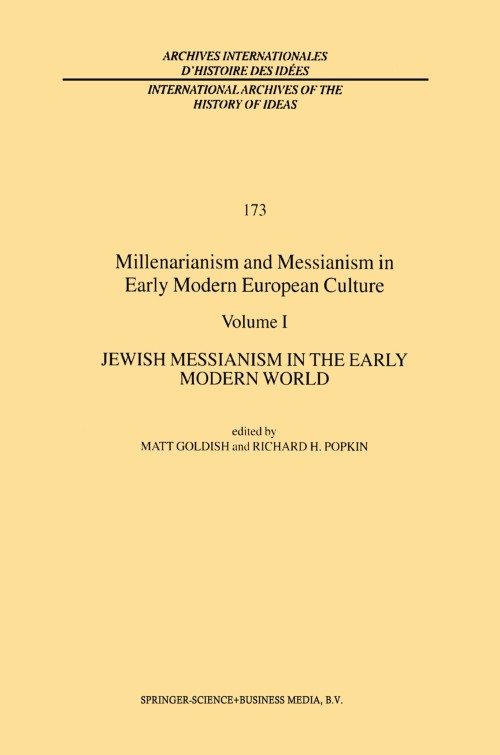
Millenarianism and Messianism in Early Modern European Culture [electronic resource] : Volume I: Jewish Messianism in the Early Modern World / edited by M. Goldish, R.H. Popkin.
Erişim Adresi
ISBN
9789401722780
Dil Kodu
İngilizce
Yer Numarası
DK/15787
Basım Bildirimi
1st ed. 2001.
Yayın Bilgisi
Dordrecht : Springer Netherlands : Imprint: Springer, 2001.
Fiziksel Niteleme
XX, 246 p. online resource.
Dizi
International Archives of the History of Ideas Archives internationales d'histoire des idées, 2215-0307 ; 173
İçindekiler Notu
1. The Messianism of Isaac Abarbanel, ‘Father of the [Jewish] Messianic Movements of the Sixteenth and Seventeenth Centuries’ -- 2. Patterns in Converso Messianism -- 3. Syncretism and Millennium in Herrera’s Kabbalah -- 4. Some Social Aspects of the Polemics between Sabbatians and their Opponents -- 5. Christian Interest and Concerns about Sabbatai Zevi -- 6. Kabbalistic Messianism versus Kabbalistic Enlightenment -- 7. The Last Deception: Failed Messiahs and Jewish Conversion in Early Modern German Lands -- 8. Messianism in the Christian Kabbalah of Johann Kemper -- 9. The Charlatan at the Gottes Haus in Offenbach -- 10. Dr. Samuel Jacob Falk: A Sabbatian Adventurer in the Masonic Underground.
Özet, vb.
The earliest scientific studies of Jewish messianism were conducted by the scholars of the Wissenschaft des Judentums school, particularly Heinrich Graetz, the first great Jewish historian of the Jews since Josephus. These researches were invaluable because they utilized primary sources in print and manuscript which had been previously unknown or used only in polemics. The Wissenschaft studies themselves, however, prove to be polemics as well on closer inspection. Among the goals of this group was to demonstrate that Judaism is a rational and logical faith whose legitimacy and historical progress deserve recognition by the nations of Europe. Mystical and messianic beliefs which might undermine this image were presented as aberrations or the result of corrosive foreign influences on the Jews. Gershom Scholem took upon himself the task of returning mysticism and messianism to their rightful central place in the panorama of Jewish thought. Jewish messianism was, for Scholem, a central theme in the philosophy and life of the Jews throughout their history, shaped anew by each generation to fit its specific hopes and needs. Scholem emphasized that this phenomenon was essentially independent of messianic or millenarian trends among other peoples. For example, in discussing messianism in the early modern era Scholem describes a trunk of influence on the Jewish psyche set off by the expulsion from Spain in 1492.
Konu
Religion __ Philosophy.
History.
Religion.
Philosophy __ History.
Philosophy, Modern.
Philosophy of Religion.
History.
Religion.
History of Philosophy.
Early Modern Philosophy.
History.
Religion.
Philosophy __ History.
Philosophy, Modern.
Philosophy of Religion.
History.
Religion.
History of Philosophy.
Early Modern Philosophy.
Diğer Yazarlar
Kurum Adı
Eseri Alıntıla
Referansları kullanmadan önce gözden geçirmeniz ve varsa gerekli düzeltmeleri yapmanız önerilir.
Dijital Kaynak
MARC Görünümü
LEADER 05130nam a22006375i 4500
001 814549
003 TR_AnAIT
005 20260130215049
007 cr nn 008mamaa
008 130129s2001 ne | s |||| 0|eng d
020 |a9789401722780|9978-94-017-2278-0
024 7 |a10.1007/978-94-017-2278-0|2doi
041 |aeng
049 |aTürk Tarih Kurumu Kütüphanesi
050 4|aBL51
072 7|aHRAB|2bicssc
072 7|aPHI022000|2bisacsh
072 7|aQRAB|2thema
082 04|a210|223
090 |aDK/15787
245 10|aMillenarianism and Messianism in Early Modern European Culture|h[electronic resource] :|bVolume I: Jewish Messianism in the Early Modern World /|cedited by M. Goldish, R.H. Popkin.
250 |a1st ed. 2001.
264 1|aDordrecht :|bSpringer Netherlands :|bImprint: Springer,|c2001.
300 |aXX, 246 p.|bonline resource.
336 |atext|btxt|2rdacontent
337 |acomputer|bc|2rdamedia
338 |aonline resource|bcr|2rdacarrier
347 |atext file|bPDF|2rda
490 1 |aInternational Archives of the History of Ideas Archives internationales d'histoire des idées,|x2215-0307 ;|v173
505 0 |a1. The Messianism of Isaac Abarbanel, ‘Father of the [Jewish] Messianic Movements of the Sixteenth and Seventeenth Centuries’ -- 2. Patterns in Converso Messianism -- 3. Syncretism and Millennium in Herrera’s Kabbalah -- 4. Some Social Aspects of the Polemics between Sabbatians and their Opponents -- 5. Christian Interest and Concerns about Sabbatai Zevi -- 6. Kabbalistic Messianism versus Kabbalistic Enlightenment -- 7. The Last Deception: Failed Messiahs and Jewish Conversion in Early Modern German Lands -- 8. Messianism in the Christian Kabbalah of Johann Kemper -- 9. The Charlatan at the Gottes Haus in Offenbach -- 10. Dr. Samuel Jacob Falk: A Sabbatian Adventurer in the Masonic Underground.
520 |aThe earliest scientific studies of Jewish messianism were conducted by the scholars of the Wissenschaft des Judentums school, particularly Heinrich Graetz, the first great Jewish historian of the Jews since Josephus. These researches were invaluable because they utilized primary sources in print and manuscript which had been previously unknown or used only in polemics. The Wissenschaft studies themselves, however, prove to be polemics as well on closer inspection. Among the goals of this group was to demonstrate that Judaism is a rational and logical faith whose legitimacy and historical progress deserve recognition by the nations of Europe. Mystical and messianic beliefs which might undermine this image were presented as aberrations or the result of corrosive foreign influences on the Jews. Gershom Scholem took upon himself the task of returning mysticism and messianism to their rightful central place in the panorama of Jewish thought. Jewish messianism was, for Scholem, a central theme in the philosophy and life of the Jews throughout their history, shaped anew by each generation to fit its specific hopes and needs. Scholem emphasized that this phenomenon was essentially independent of messianic or millenarian trends among other peoples. For example, in discussing messianism in the early modern era Scholem describes a trunk of influence on the Jewish psyche set off by the expulsion from Spain in 1492.
532 8 |aAccessibility summary: This PDF is not accessible. It is based on scanned pages and does not support features such as screen reader compatibility or described non-text content (images, graphs etc). However, it likely supports searchable and selectable text based on OCR (Optical Character Recognition). Users with accessibility needs may not be able to use this content effectively. Please contact us at accessibilitysupport@springernature.com if you require assistance or an alternative format.
532 8 |aInaccessible, or known limited accessibility
532 8 |aNo reading system accessibility options actively disabled
532 8 |aPublisher contact for further accessibility information: accessibilitysupport@springernature.com
650 0|aReligion|xPhilosophy.
650 0|aHistory.
650 0|aReligion.
650 0|aPhilosophy|xHistory.
650 0|aPhilosophy, Modern.
650 14|aPhilosophy of Religion.
650 24|aHistory.
650 24|aReligion.
650 24|aHistory of Philosophy.
650 24|aEarly Modern Philosophy.
700 1 |aGoldish, M.|eeditor.|4edt|4http://id.loc.gov/vocabulary/relators/edt
700 1 |aPopkin, R.H.|eeditor.|4edt|4http://id.loc.gov/vocabulary/relators/edt
710 2 |aSpringerLink (Online service)
773 0 |tSpringer Nature eBook
776 08|iPrinted edition:|z9780792368502
776 08|iPrinted edition:|z9789048156665
776 08|iPrinted edition:|z9789401722797
830 0|aInternational Archives of the History of Ideas Archives internationales d'histoire des idées,|x2215-0307 ;|v173
856 40|uhttps://doi.org/10.1007/978-94-017-2278-0
912 |aZDB-2-SHU
912 |aZDB-2-SXPR
912 |aZDB-2-BAE
950 |aHumanities, Social Sciences and Law (SpringerNature-11648)
950 |aPhilosophy and Religion (R0) (SpringerNature-43725)
001 814549
003 TR_AnAIT
005 20260130215049
007 cr nn 008mamaa
008 130129s2001 ne | s |||| 0|eng d
020 |a9789401722780|9978-94-017-2278-0
024 7 |a10.1007/978-94-017-2278-0|2doi
041 |aeng
049 |aTürk Tarih Kurumu Kütüphanesi
050 4|aBL51
072 7|aHRAB|2bicssc
072 7|aPHI022000|2bisacsh
072 7|aQRAB|2thema
082 04|a210|223
090 |aDK/15787
245 10|aMillenarianism and Messianism in Early Modern European Culture|h[electronic resource] :|bVolume I: Jewish Messianism in the Early Modern World /|cedited by M. Goldish, R.H. Popkin.
250 |a1st ed. 2001.
264 1|aDordrecht :|bSpringer Netherlands :|bImprint: Springer,|c2001.
300 |aXX, 246 p.|bonline resource.
336 |atext|btxt|2rdacontent
337 |acomputer|bc|2rdamedia
338 |aonline resource|bcr|2rdacarrier
347 |atext file|bPDF|2rda
490 1 |aInternational Archives of the History of Ideas Archives internationales d'histoire des idées,|x2215-0307 ;|v173
505 0 |a1. The Messianism of Isaac Abarbanel, ‘Father of the [Jewish] Messianic Movements of the Sixteenth and Seventeenth Centuries’ -- 2. Patterns in Converso Messianism -- 3. Syncretism and Millennium in Herrera’s Kabbalah -- 4. Some Social Aspects of the Polemics between Sabbatians and their Opponents -- 5. Christian Interest and Concerns about Sabbatai Zevi -- 6. Kabbalistic Messianism versus Kabbalistic Enlightenment -- 7. The Last Deception: Failed Messiahs and Jewish Conversion in Early Modern German Lands -- 8. Messianism in the Christian Kabbalah of Johann Kemper -- 9. The Charlatan at the Gottes Haus in Offenbach -- 10. Dr. Samuel Jacob Falk: A Sabbatian Adventurer in the Masonic Underground.
520 |aThe earliest scientific studies of Jewish messianism were conducted by the scholars of the Wissenschaft des Judentums school, particularly Heinrich Graetz, the first great Jewish historian of the Jews since Josephus. These researches were invaluable because they utilized primary sources in print and manuscript which had been previously unknown or used only in polemics. The Wissenschaft studies themselves, however, prove to be polemics as well on closer inspection. Among the goals of this group was to demonstrate that Judaism is a rational and logical faith whose legitimacy and historical progress deserve recognition by the nations of Europe. Mystical and messianic beliefs which might undermine this image were presented as aberrations or the result of corrosive foreign influences on the Jews. Gershom Scholem took upon himself the task of returning mysticism and messianism to their rightful central place in the panorama of Jewish thought. Jewish messianism was, for Scholem, a central theme in the philosophy and life of the Jews throughout their history, shaped anew by each generation to fit its specific hopes and needs. Scholem emphasized that this phenomenon was essentially independent of messianic or millenarian trends among other peoples. For example, in discussing messianism in the early modern era Scholem describes a trunk of influence on the Jewish psyche set off by the expulsion from Spain in 1492.
532 8 |aAccessibility summary: This PDF is not accessible. It is based on scanned pages and does not support features such as screen reader compatibility or described non-text content (images, graphs etc). However, it likely supports searchable and selectable text based on OCR (Optical Character Recognition). Users with accessibility needs may not be able to use this content effectively. Please contact us at accessibilitysupport@springernature.com if you require assistance or an alternative format.
532 8 |aInaccessible, or known limited accessibility
532 8 |aNo reading system accessibility options actively disabled
532 8 |aPublisher contact for further accessibility information: accessibilitysupport@springernature.com
650 0|aReligion|xPhilosophy.
650 0|aHistory.
650 0|aReligion.
650 0|aPhilosophy|xHistory.
650 0|aPhilosophy, Modern.
650 14|aPhilosophy of Religion.
650 24|aHistory.
650 24|aReligion.
650 24|aHistory of Philosophy.
650 24|aEarly Modern Philosophy.
700 1 |aGoldish, M.|eeditor.|4edt|4http://id.loc.gov/vocabulary/relators/edt
700 1 |aPopkin, R.H.|eeditor.|4edt|4http://id.loc.gov/vocabulary/relators/edt
710 2 |aSpringerLink (Online service)
773 0 |tSpringer Nature eBook
776 08|iPrinted edition:|z9780792368502
776 08|iPrinted edition:|z9789048156665
776 08|iPrinted edition:|z9789401722797
830 0|aInternational Archives of the History of Ideas Archives internationales d'histoire des idées,|x2215-0307 ;|v173
856 40|uhttps://doi.org/10.1007/978-94-017-2278-0
912 |aZDB-2-SHU
912 |aZDB-2-SXPR
912 |aZDB-2-BAE
950 |aHumanities, Social Sciences and Law (SpringerNature-11648)
950 |aPhilosophy and Religion (R0) (SpringerNature-43725)
Materyaller
Depodan talep edilen materyal sadece kütüphane içerisinde kullanılmaktadır.
Materyal dışarıya ödünç verilmemektedir.
Materyal dışarıya ödünç verilmemektedir.
