

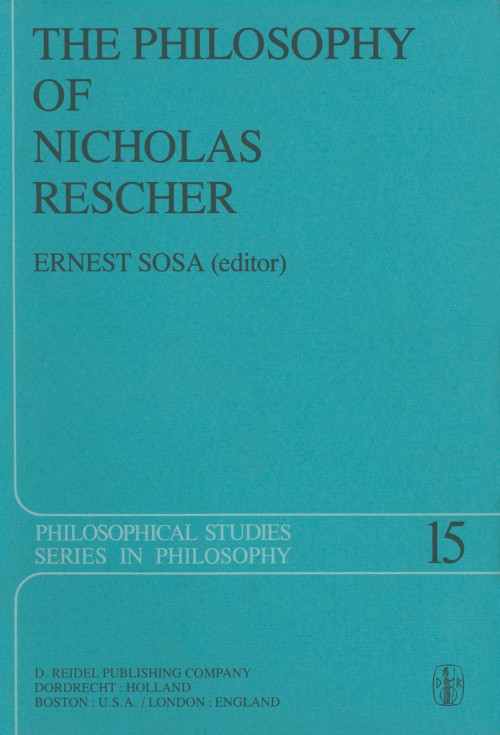
The Philosophy of Nicholas Rescher [electronic resource] : Discussion and Replies / edited by E. Sosa.
Erişim Adresi
ISBN
9789400994072
Dil Kodu
İngilizce
Yer Numarası
DK/15891
Basım Bildirimi
1st ed. 1979.
Yayın Bilgisi
Dordrecht : Springer Netherlands : Imprint: Springer, 1979.
Fiziksel Niteleme
XI, 237 p. online resource.
Dizi
Philosophical Studies Series, 2542-8349 ; 15
İçindekiler Notu
The Method of Applied Logic: Some Philosophical Considerations -- Reply -- Rescher’s Hypothetical Reasoning: An Amendment -- Reply -- Hypothetical Reasoning and Conditionals -- Reply -- Rescher’s Theory of Plausible Reasoning -- Reply -- A Modal Logic of Place -- Reply -- Familiar Mental Phenomena -- Reply -- Toward a Theory of Attributes -- Reply -- Potentiality from Aristotle to Rescher and Back -- Reply -- Substances and Individual Notions -- Reply -- Utilitarianism and the Vicarious Affects -- Reply -- Rescher’s Epistemological System -- Reply -- How Is Knowledge of the World Possible? -- Reply -- Rescher and Kant: Some Common Themes in Philosophy of Science -- Reply -- Nicholas Rescher: A Biographical Précis -- List of Publications by Nicholas Rescher -- Nicholas Rescher’s Metabibliography -- Index of Names -- Index of Subjects.
Özet, vb.
When I entered the graduate program in philosophy at the University of Pittsburgh in 1961, Nicholas Rescher had just joined the department of philosophy' to begin, with Adolf Grunbaum, the building of what is now a philosophy center of worldwide renown. Very soon his exceptional energy and versatility were in evidence, as he founded the American Philosophical Quarterly, generated a constantly rising stack of preprints, pursued impor tant scholarly research in Arabic logic, taught a staggering diversity of histori cal and thematic courses, and obtained, in cooperation with Kurt Baier, a major grant for work in value theory. That is all part of the record. What may come as a surprise is that none of it was accomplished at the expense of his students. Papers were returned in a matter of days, often the next class meet ing. And so easily accessible was he for philosophical discussion that, since (inevitably) we shared many philosophical interests, I asked him to serve as my dissertation advisor. My work in connection with this project led to a couple of journal articles while his, characteristically, led to a book. Our dis cussions certainly helped me, and while they may also have had some small influence on him, in the end our views were quite distinct. I was not only allowed complete independence, but was positively encouraged to think of my own ideas and to develop them independently. The length and breadth of Rescher's bibliography defy belief.
Konu
Philosophy, Modern.
Early Modern Philosophy.
Early Modern Philosophy.
Diğer Yazarlar
Kurum Adı
Eseri Alıntıla
Referansları kullanmadan önce gözden geçirmeniz ve varsa gerekli düzeltmeleri yapmanız önerilir.
Dijital Kaynak
MARC Görünümü
LEADER 04781nam a22005295i 4500
001 814653
003 TR_AnAIT
005 20260130214739
007 cr nn 008mamaa
008 121227s1979 ne | s |||| 0|eng d
020 |a9789400994072|9978-94-009-9407-2
024 7 |a10.1007/978-94-009-9407-2|2doi
041 |aeng
049 |aTürk Tarih Kurumu Kütüphanesi
050 4|aB800.2-804
072 7|aHPCD|2bicssc
072 7|aPHI016000|2bisacsh
072 7|aQDH|2thema
082 04|a190.903|223
090 |aDK/15891
245 14|aThe Philosophy of Nicholas Rescher|h[electronic resource] :|bDiscussion and Replies /|cedited by E. Sosa.
250 |a1st ed. 1979.
264 1|aDordrecht :|bSpringer Netherlands :|bImprint: Springer,|c1979.
300 |aXI, 237 p.|bonline resource.
336 |atext|btxt|2rdacontent
337 |acomputer|bc|2rdamedia
338 |aonline resource|bcr|2rdacarrier
347 |atext file|bPDF|2rda
490 1 |aPhilosophical Studies Series,|x2542-8349 ;|v15
505 0 |aThe Method of Applied Logic: Some Philosophical Considerations -- Reply -- Rescher’s Hypothetical Reasoning: An Amendment -- Reply -- Hypothetical Reasoning and Conditionals -- Reply -- Rescher’s Theory of Plausible Reasoning -- Reply -- A Modal Logic of Place -- Reply -- Familiar Mental Phenomena -- Reply -- Toward a Theory of Attributes -- Reply -- Potentiality from Aristotle to Rescher and Back -- Reply -- Substances and Individual Notions -- Reply -- Utilitarianism and the Vicarious Affects -- Reply -- Rescher’s Epistemological System -- Reply -- How Is Knowledge of the World Possible? -- Reply -- Rescher and Kant: Some Common Themes in Philosophy of Science -- Reply -- Nicholas Rescher: A Biographical Précis -- List of Publications by Nicholas Rescher -- Nicholas Rescher’s Metabibliography -- Index of Names -- Index of Subjects.
520 |aWhen I entered the graduate program in philosophy at the University of Pittsburgh in 1961, Nicholas Rescher had just joined the department of philosophy' to begin, with Adolf Grunbaum, the building of what is now a philosophy center of worldwide renown. Very soon his exceptional energy and versatility were in evidence, as he founded the American Philosophical Quarterly, generated a constantly rising stack of preprints, pursued impor tant scholarly research in Arabic logic, taught a staggering diversity of histori cal and thematic courses, and obtained, in cooperation with Kurt Baier, a major grant for work in value theory. That is all part of the record. What may come as a surprise is that none of it was accomplished at the expense of his students. Papers were returned in a matter of days, often the next class meet ing. And so easily accessible was he for philosophical discussion that, since (inevitably) we shared many philosophical interests, I asked him to serve as my dissertation advisor. My work in connection with this project led to a couple of journal articles while his, characteristically, led to a book. Our dis cussions certainly helped me, and while they may also have had some small influence on him, in the end our views were quite distinct. I was not only allowed complete independence, but was positively encouraged to think of my own ideas and to develop them independently. The length and breadth of Rescher's bibliography defy belief.
532 8 |aAccessibility summary: This PDF is not accessible. It is based on scanned pages and does not support features such as screen reader compatibility or described non-text content (images, graphs etc). However, it likely supports searchable and selectable text based on OCR (Optical Character Recognition). Users with accessibility needs may not be able to use this content effectively. Please contact us at accessibilitysupport@springernature.com if you require assistance or an alternative format.
532 8 |aInaccessible, or known limited accessibility
532 8 |aNo reading system accessibility options actively disabled
532 8 |aPublisher contact for further accessibility information: accessibilitysupport@springernature.com
650 0|aPhilosophy, Modern.
650 14|aEarly Modern Philosophy.
700 1 |aSosa, E.|eeditor.|4edt|4http://id.loc.gov/vocabulary/relators/edt
710 2 |aSpringerLink (Online service)
773 0 |tSpringer Nature eBook
776 08|iPrinted edition:|z9789027709622
776 08|iPrinted edition:|z9789400994089
776 08|iPrinted edition:|z9789400994096
830 0|aPhilosophical Studies Series,|x2542-8349 ;|v15
856 40|uhttps://doi.org/10.1007/978-94-009-9407-2
912 |aZDB-2-SHU
912 |aZDB-2-SXPR
912 |aZDB-2-BAE
950 |aHumanities, Social Sciences and Law (SpringerNature-11648)
950 |aPhilosophy and Religion (R0) (SpringerNature-43725)
001 814653
003 TR_AnAIT
005 20260130214739
007 cr nn 008mamaa
008 121227s1979 ne | s |||| 0|eng d
020 |a9789400994072|9978-94-009-9407-2
024 7 |a10.1007/978-94-009-9407-2|2doi
041 |aeng
049 |aTürk Tarih Kurumu Kütüphanesi
050 4|aB800.2-804
072 7|aHPCD|2bicssc
072 7|aPHI016000|2bisacsh
072 7|aQDH|2thema
082 04|a190.903|223
090 |aDK/15891
245 14|aThe Philosophy of Nicholas Rescher|h[electronic resource] :|bDiscussion and Replies /|cedited by E. Sosa.
250 |a1st ed. 1979.
264 1|aDordrecht :|bSpringer Netherlands :|bImprint: Springer,|c1979.
300 |aXI, 237 p.|bonline resource.
336 |atext|btxt|2rdacontent
337 |acomputer|bc|2rdamedia
338 |aonline resource|bcr|2rdacarrier
347 |atext file|bPDF|2rda
490 1 |aPhilosophical Studies Series,|x2542-8349 ;|v15
505 0 |aThe Method of Applied Logic: Some Philosophical Considerations -- Reply -- Rescher’s Hypothetical Reasoning: An Amendment -- Reply -- Hypothetical Reasoning and Conditionals -- Reply -- Rescher’s Theory of Plausible Reasoning -- Reply -- A Modal Logic of Place -- Reply -- Familiar Mental Phenomena -- Reply -- Toward a Theory of Attributes -- Reply -- Potentiality from Aristotle to Rescher and Back -- Reply -- Substances and Individual Notions -- Reply -- Utilitarianism and the Vicarious Affects -- Reply -- Rescher’s Epistemological System -- Reply -- How Is Knowledge of the World Possible? -- Reply -- Rescher and Kant: Some Common Themes in Philosophy of Science -- Reply -- Nicholas Rescher: A Biographical Précis -- List of Publications by Nicholas Rescher -- Nicholas Rescher’s Metabibliography -- Index of Names -- Index of Subjects.
520 |aWhen I entered the graduate program in philosophy at the University of Pittsburgh in 1961, Nicholas Rescher had just joined the department of philosophy' to begin, with Adolf Grunbaum, the building of what is now a philosophy center of worldwide renown. Very soon his exceptional energy and versatility were in evidence, as he founded the American Philosophical Quarterly, generated a constantly rising stack of preprints, pursued impor tant scholarly research in Arabic logic, taught a staggering diversity of histori cal and thematic courses, and obtained, in cooperation with Kurt Baier, a major grant for work in value theory. That is all part of the record. What may come as a surprise is that none of it was accomplished at the expense of his students. Papers were returned in a matter of days, often the next class meet ing. And so easily accessible was he for philosophical discussion that, since (inevitably) we shared many philosophical interests, I asked him to serve as my dissertation advisor. My work in connection with this project led to a couple of journal articles while his, characteristically, led to a book. Our dis cussions certainly helped me, and while they may also have had some small influence on him, in the end our views were quite distinct. I was not only allowed complete independence, but was positively encouraged to think of my own ideas and to develop them independently. The length and breadth of Rescher's bibliography defy belief.
532 8 |aAccessibility summary: This PDF is not accessible. It is based on scanned pages and does not support features such as screen reader compatibility or described non-text content (images, graphs etc). However, it likely supports searchable and selectable text based on OCR (Optical Character Recognition). Users with accessibility needs may not be able to use this content effectively. Please contact us at accessibilitysupport@springernature.com if you require assistance or an alternative format.
532 8 |aInaccessible, or known limited accessibility
532 8 |aNo reading system accessibility options actively disabled
532 8 |aPublisher contact for further accessibility information: accessibilitysupport@springernature.com
650 0|aPhilosophy, Modern.
650 14|aEarly Modern Philosophy.
700 1 |aSosa, E.|eeditor.|4edt|4http://id.loc.gov/vocabulary/relators/edt
710 2 |aSpringerLink (Online service)
773 0 |tSpringer Nature eBook
776 08|iPrinted edition:|z9789027709622
776 08|iPrinted edition:|z9789400994089
776 08|iPrinted edition:|z9789400994096
830 0|aPhilosophical Studies Series,|x2542-8349 ;|v15
856 40|uhttps://doi.org/10.1007/978-94-009-9407-2
912 |aZDB-2-SHU
912 |aZDB-2-SXPR
912 |aZDB-2-BAE
950 |aHumanities, Social Sciences and Law (SpringerNature-11648)
950 |aPhilosophy and Religion (R0) (SpringerNature-43725)
Materyaller
Depodan talep edilen materyal sadece kütüphane içerisinde kullanılmaktadır.
Materyal dışarıya ödünç verilmemektedir.
Materyal dışarıya ödünç verilmemektedir.
