

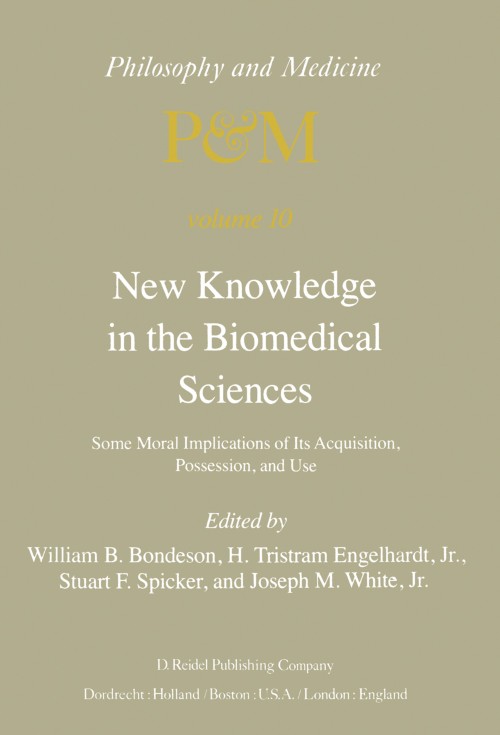
New Knowledge in the Biomedical Sciences [electronic resource] : Some Moral Implications of Its Acquisition, Possession, and Use / edited by W.B. Bondeson, H. Tristram Engelhardt Jr., S.F. Spicker, J.M. White.
Erişim Adresi
ISBN
9789400977235
Dil Kodu
İngilizce
Yer Numarası
DK/15915
Basım Bildirimi
1st ed. 1982.
Yayın Bilgisi
Dordrecht : Springer Netherlands : Imprint: Springer, 1982.
Fiziksel Niteleme
XVIII, 225 p. online resource.
Dizi
Philosophy and Medicine, 2215-0080 ; 10
İçindekiler Notu
Section I / The Physician as Moral Arbiter -- The Physician as a Moral Force in American History -- The Physician as Moral Arbiter -- Section II / The Costs of New Knowledge -- Moral Issues Relating to the Economics of New Knowledge in the Biomedical Sciences -- Only the Best is Good Enough? -- Section III / Costs, Benefits, and the Responsibilities of Medical Science -- Morality and the Social Control of Biomedical Technology -- Rights and Responsibilities in Medical Science -- Health, Justice, and Responsibility -- Section IV / Biomedical Knowledge: Libertarian vs. Socialist Models -- The Need to Know: Utilitarian and Esthetic Values of Biomedical Science -- Medical Knowledge as a Social Product: Rights, Risks, and Responsibilities -- Biomedical Knowledge: Progress and Priorities -- Section V / Biomedical Ethics and Advances in Biomedical Science -- Applying Morality to Advances in Biomedicine: Can and Should This be Done? -- Biomedicine, Health Care Policy, and the Adequacy of Ethical Theory -- Section VI / Conclusions and Reflections: Present and Future Problems -- Why New Technology is More Problematic than Old Technology -- The Uses of Biomedical Knowledge: The End of the Era of Optimism? -- The Best is Yet to Come -- Scientific Advance, Technological Development, and Society -- The Life-World and the Patient’s Expectations of New Knowledge -- Epilogue -- Notes on Contributors.
Özet, vb.
The spectacular development of medical knowledge over the last two centuries has brought intrusive advances in the capabilities of medical technology. These advances have been remarkable over the last century, but especially over the last few decades, culminating in such high technology interventions as heart transplants and renal dialysis. These increases in medical powers have attracted societal interest in acquiring more such knowledge. They have also spawned concerns regarding the use of human subjects in research and regarding the byproducts of basic research as in the recent recombinant DNA debate. As a consequence of the development of new biomedical knowledge, physicians and biomedical scientists have been placed in positions of new power and responsibility. The emergence of this group of powerful and knowledgeable experts has occasioned debates regarding the accountability of physicians and biomedical scientists. But beyond that, the very investment of resources in the acquisition of new knowledge has been questioned. Societies must decide whether finite resources would not be better invested at this juncture, or in general, in the alleviation of the problems of hunger or in raising general health standards through interventions which are less dependent on the intensive use of high technology. To put issues in this fashion touches on philosophical notions concerning the claims of distributive justice and the ownership of biomedical knowledge.
Konu
Ethics.
Moral Philosophy and Applied Ethics.
Moral Philosophy and Applied Ethics.
Kurum Adı
Eseri Alıntıla
Referansları kullanmadan önce gözden geçirmeniz ve varsa gerekli düzeltmeleri yapmanız önerilir.
Dijital Kaynak
MARC Görünümü
LEADER 05708nam a22005655i 4500
001 814677
003 TR_AnAIT
005 20260130214650
007 cr nn 008mamaa
008 121227s1982 ne | s |||| 0|eng d
020 |a9789400977235|9978-94-009-7723-5
024 7 |a10.1007/978-94-009-7723-5|2doi
041 |aeng
049 |aTürk Tarih Kurumu Kütüphanesi
050 4|aBJ1-1725
072 7|aHPQ|2bicssc
072 7|aPHI005000|2bisacsh
072 7|aQDTQ|2thema
082 04|a170|223
090 |aDK/15915
245 10|aNew Knowledge in the Biomedical Sciences|h[electronic resource] :|bSome Moral Implications of Its Acquisition, Possession, and Use /|cedited by W.B. Bondeson, H. Tristram Engelhardt Jr., S.F. Spicker, J.M. White.
250 |a1st ed. 1982.
264 1|aDordrecht :|bSpringer Netherlands :|bImprint: Springer,|c1982.
300 |aXVIII, 225 p.|bonline resource.
336 |atext|btxt|2rdacontent
337 |acomputer|bc|2rdamedia
338 |aonline resource|bcr|2rdacarrier
347 |atext file|bPDF|2rda
490 1 |aPhilosophy and Medicine,|x2215-0080 ;|v10
505 0 |aSection I / The Physician as Moral Arbiter -- The Physician as a Moral Force in American History -- The Physician as Moral Arbiter -- Section II / The Costs of New Knowledge -- Moral Issues Relating to the Economics of New Knowledge in the Biomedical Sciences -- Only the Best is Good Enough? -- Section III / Costs, Benefits, and the Responsibilities of Medical Science -- Morality and the Social Control of Biomedical Technology -- Rights and Responsibilities in Medical Science -- Health, Justice, and Responsibility -- Section IV / Biomedical Knowledge: Libertarian vs. Socialist Models -- The Need to Know: Utilitarian and Esthetic Values of Biomedical Science -- Medical Knowledge as a Social Product: Rights, Risks, and Responsibilities -- Biomedical Knowledge: Progress and Priorities -- Section V / Biomedical Ethics and Advances in Biomedical Science -- Applying Morality to Advances in Biomedicine: Can and Should This be Done? -- Biomedicine, Health Care Policy, and the Adequacy of Ethical Theory -- Section VI / Conclusions and Reflections: Present and Future Problems -- Why New Technology is More Problematic than Old Technology -- The Uses of Biomedical Knowledge: The End of the Era of Optimism? -- The Best is Yet to Come -- Scientific Advance, Technological Development, and Society -- The Life-World and the Patient’s Expectations of New Knowledge -- Epilogue -- Notes on Contributors.
520 |aThe spectacular development of medical knowledge over the last two centuries has brought intrusive advances in the capabilities of medical technology. These advances have been remarkable over the last century, but especially over the last few decades, culminating in such high technology interventions as heart transplants and renal dialysis. These increases in medical powers have attracted societal interest in acquiring more such knowledge. They have also spawned concerns regarding the use of human subjects in research and regarding the byproducts of basic research as in the recent recombinant DNA debate. As a consequence of the development of new biomedical knowledge, physicians and biomedical scientists have been placed in positions of new power and responsibility. The emergence of this group of powerful and knowledgeable experts has occasioned debates regarding the accountability of physicians and biomedical scientists. But beyond that, the very investment of resources in the acquisition of new knowledge has been questioned. Societies must decide whether finite resources would not be better invested at this juncture, or in general, in the alleviation of the problems of hunger or in raising general health standards through interventions which are less dependent on the intensive use of high technology. To put issues in this fashion touches on philosophical notions concerning the claims of distributive justice and the ownership of biomedical knowledge.
532 8 |aAccessibility summary: This PDF is not accessible. It is based on scanned pages and does not support features such as screen reader compatibility or described non-text content (images, graphs etc). However, it likely supports searchable and selectable text based on OCR (Optical Character Recognition). Users with accessibility needs may not be able to use this content effectively. Please contact us at accessibilitysupport@springernature.com if you require assistance or an alternative format.
532 8 |aInaccessible, or known limited accessibility
532 8 |aNo reading system accessibility options actively disabled
532 8 |aPublisher contact for further accessibility information: accessibilitysupport@springernature.com
650 0|aEthics.
650 14|aMoral Philosophy and Applied Ethics.
700 1 |aBondeson, W.B.|eeditor.|4edt|4http://id.loc.gov/vocabulary/relators/edt
700 1 |aEngelhardt Jr., H. Tristram.|eeditor.|4edt|4http://id.loc.gov/vocabulary/relators/edt
700 1 |aSpicker, S.F.|eeditor.|4edt|4http://id.loc.gov/vocabulary/relators/edt
700 1 |aWhite, J.M.|eeditor.|4edt|4http://id.loc.gov/vocabulary/relators/edt
710 2 |aSpringerLink (Online service)
773 0 |tSpringer Nature eBook
776 08|iPrinted edition:|z9789027713193
776 08|iPrinted edition:|z9789400977242
776 08|iPrinted edition:|z9789400977259
830 0|aPhilosophy and Medicine,|x2215-0080 ;|v10
856 40|uhttps://doi.org/10.1007/978-94-009-7723-5
912 |aZDB-2-SHU
912 |aZDB-2-SXPR
912 |aZDB-2-BAE
950 |aHumanities, Social Sciences and Law (SpringerNature-11648)
950 |aPhilosophy and Religion (R0) (SpringerNature-43725)
001 814677
003 TR_AnAIT
005 20260130214650
007 cr nn 008mamaa
008 121227s1982 ne | s |||| 0|eng d
020 |a9789400977235|9978-94-009-7723-5
024 7 |a10.1007/978-94-009-7723-5|2doi
041 |aeng
049 |aTürk Tarih Kurumu Kütüphanesi
050 4|aBJ1-1725
072 7|aHPQ|2bicssc
072 7|aPHI005000|2bisacsh
072 7|aQDTQ|2thema
082 04|a170|223
090 |aDK/15915
245 10|aNew Knowledge in the Biomedical Sciences|h[electronic resource] :|bSome Moral Implications of Its Acquisition, Possession, and Use /|cedited by W.B. Bondeson, H. Tristram Engelhardt Jr., S.F. Spicker, J.M. White.
250 |a1st ed. 1982.
264 1|aDordrecht :|bSpringer Netherlands :|bImprint: Springer,|c1982.
300 |aXVIII, 225 p.|bonline resource.
336 |atext|btxt|2rdacontent
337 |acomputer|bc|2rdamedia
338 |aonline resource|bcr|2rdacarrier
347 |atext file|bPDF|2rda
490 1 |aPhilosophy and Medicine,|x2215-0080 ;|v10
505 0 |aSection I / The Physician as Moral Arbiter -- The Physician as a Moral Force in American History -- The Physician as Moral Arbiter -- Section II / The Costs of New Knowledge -- Moral Issues Relating to the Economics of New Knowledge in the Biomedical Sciences -- Only the Best is Good Enough? -- Section III / Costs, Benefits, and the Responsibilities of Medical Science -- Morality and the Social Control of Biomedical Technology -- Rights and Responsibilities in Medical Science -- Health, Justice, and Responsibility -- Section IV / Biomedical Knowledge: Libertarian vs. Socialist Models -- The Need to Know: Utilitarian and Esthetic Values of Biomedical Science -- Medical Knowledge as a Social Product: Rights, Risks, and Responsibilities -- Biomedical Knowledge: Progress and Priorities -- Section V / Biomedical Ethics and Advances in Biomedical Science -- Applying Morality to Advances in Biomedicine: Can and Should This be Done? -- Biomedicine, Health Care Policy, and the Adequacy of Ethical Theory -- Section VI / Conclusions and Reflections: Present and Future Problems -- Why New Technology is More Problematic than Old Technology -- The Uses of Biomedical Knowledge: The End of the Era of Optimism? -- The Best is Yet to Come -- Scientific Advance, Technological Development, and Society -- The Life-World and the Patient’s Expectations of New Knowledge -- Epilogue -- Notes on Contributors.
520 |aThe spectacular development of medical knowledge over the last two centuries has brought intrusive advances in the capabilities of medical technology. These advances have been remarkable over the last century, but especially over the last few decades, culminating in such high technology interventions as heart transplants and renal dialysis. These increases in medical powers have attracted societal interest in acquiring more such knowledge. They have also spawned concerns regarding the use of human subjects in research and regarding the byproducts of basic research as in the recent recombinant DNA debate. As a consequence of the development of new biomedical knowledge, physicians and biomedical scientists have been placed in positions of new power and responsibility. The emergence of this group of powerful and knowledgeable experts has occasioned debates regarding the accountability of physicians and biomedical scientists. But beyond that, the very investment of resources in the acquisition of new knowledge has been questioned. Societies must decide whether finite resources would not be better invested at this juncture, or in general, in the alleviation of the problems of hunger or in raising general health standards through interventions which are less dependent on the intensive use of high technology. To put issues in this fashion touches on philosophical notions concerning the claims of distributive justice and the ownership of biomedical knowledge.
532 8 |aAccessibility summary: This PDF is not accessible. It is based on scanned pages and does not support features such as screen reader compatibility or described non-text content (images, graphs etc). However, it likely supports searchable and selectable text based on OCR (Optical Character Recognition). Users with accessibility needs may not be able to use this content effectively. Please contact us at accessibilitysupport@springernature.com if you require assistance or an alternative format.
532 8 |aInaccessible, or known limited accessibility
532 8 |aNo reading system accessibility options actively disabled
532 8 |aPublisher contact for further accessibility information: accessibilitysupport@springernature.com
650 0|aEthics.
650 14|aMoral Philosophy and Applied Ethics.
700 1 |aBondeson, W.B.|eeditor.|4edt|4http://id.loc.gov/vocabulary/relators/edt
700 1 |aEngelhardt Jr., H. Tristram.|eeditor.|4edt|4http://id.loc.gov/vocabulary/relators/edt
700 1 |aSpicker, S.F.|eeditor.|4edt|4http://id.loc.gov/vocabulary/relators/edt
700 1 |aWhite, J.M.|eeditor.|4edt|4http://id.loc.gov/vocabulary/relators/edt
710 2 |aSpringerLink (Online service)
773 0 |tSpringer Nature eBook
776 08|iPrinted edition:|z9789027713193
776 08|iPrinted edition:|z9789400977242
776 08|iPrinted edition:|z9789400977259
830 0|aPhilosophy and Medicine,|x2215-0080 ;|v10
856 40|uhttps://doi.org/10.1007/978-94-009-7723-5
912 |aZDB-2-SHU
912 |aZDB-2-SXPR
912 |aZDB-2-BAE
950 |aHumanities, Social Sciences and Law (SpringerNature-11648)
950 |aPhilosophy and Religion (R0) (SpringerNature-43725)
Materyaller
Depodan talep edilen materyal sadece kütüphane içerisinde kullanılmaktadır.
Materyal dışarıya ödünç verilmemektedir.
Materyal dışarıya ödünç verilmemektedir.
