

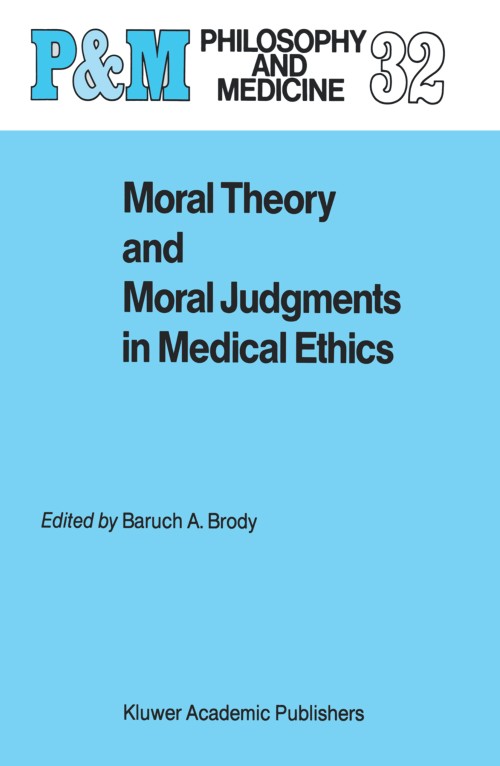
Moral Theory and Moral Judgments in Medical Ethics [electronic resource] / edited by B.A. Brody.
Erişim Adresi
ISBN
9789400927155
Dil Kodu
İngilizce
Yer Numarası
DK/15919
Basım Bildirimi
1st ed. 1988.
Yayın Bilgisi
Dordrecht : Springer Netherlands : Imprint: Springer, 1988.
Fiziksel Niteleme
VI, 232 p. online resource.
Dizi
Philosophy and Medicine, 2215-0080 ; 32
İçindekiler Notu
— Moral Theory and Moral Judgments in Biomedical Ethics -- Section I / Deriving Utilitarian Consequences -- Utilitarian Goals and Kantian Constraints (or: Always True to You, Darling, in my Fashion) -- Utilitarians Among the Optimists -- Utilitarianism and the Informed Consent Requirement (or: Should Utilitarians be Allowed on Medical Research Ethical Review Boards?) -- Reply to Ruddick and Reiman -- Section II / Natural Right Casuistry -- Moral Rights and Causal Casuistry -- Death by Omission -- Coffee and Casuistry: It Doesn’t Matter Who Caused What -- Section III / Marx’s Theory: Deriving Moral Implications -- Marxism and Moral Judgment -- Marx, Moral Judgment, and Medical Ethics: Commentary on Buchanan -- Section IV / Christian Casuistry -- Reconciling the Practice of Reason: Casuistry in a Christian Context -- Christianity in a Social Context: Practical Reasoning and Forgiveness -- Section V / From Theory to Praxis -- The Relation of Moral Theory to Moral Judgments: A Kantian View -- Justification in Ethics -- Theory and Practice in Ethics -- Notes on Contributors.
Özet, vb.
principles. A second solution to this problem is to develop a scale for weighing the significance of the conflicting principles in a given case and for concluding which action should be adopted because it is supported by the weightier considerations in that case. Such a solution seems more realistic than the lexical ordering approach, but the development of such a scale is a problematic task. Still other, more complex solutions are possible. Which is the best solution to this problem of conflicting principles of bioethics? We need a moral theory to answer that question. This is the first reason for concluding that the principles of bioethics are not the true foundations of justified judgment in bioethics. What is the problem of the unclear scope and implications of the principles of bioethics and how can an appeal to moral theory help deal with that problem? The scope of a bioethical principle is the range of cases in which it applies. The implications of a bioethical principle are the conclusions to be derived from that principle in those cases in which it applies. It is clear from a review of the discussions in bioethics that there are major unclarities about the scope and implications of each of the principles. Consider, for example, the principle of autonomy.
Konu
Ethics.
Moral Philosophy and Applied Ethics.
Moral Philosophy and Applied Ethics.
Diğer Yazarlar
Kurum Adı
Eseri Alıntıla
Referansları kullanmadan önce gözden geçirmeniz ve varsa gerekli düzeltmeleri yapmanız önerilir.
Dijital Kaynak
MARC Görünümü
LEADER 04806nam a22005295i 4500
001 814681
003 TR_AnAIT
005 20260130214634
007 cr nn 008mamaa
008 121227s1988 ne | s |||| 0|eng d
020 |a9789400927155|9978-94-009-2715-5
024 7 |a10.1007/978-94-009-2715-5|2doi
041 |aeng
049 |aTürk Tarih Kurumu Kütüphanesi
050 4|aBJ1-1725
072 7|aHPQ|2bicssc
072 7|aPHI005000|2bisacsh
072 7|aQDTQ|2thema
082 04|a170|223
090 |aDK/15919
245 10|aMoral Theory and Moral Judgments in Medical Ethics|h[electronic resource] /|cedited by B.A. Brody.
250 |a1st ed. 1988.
264 1|aDordrecht :|bSpringer Netherlands :|bImprint: Springer,|c1988.
300 |aVI, 232 p.|bonline resource.
336 |atext|btxt|2rdacontent
337 |acomputer|bc|2rdamedia
338 |aonline resource|bcr|2rdacarrier
347 |atext file|bPDF|2rda
490 1 |aPhilosophy and Medicine,|x2215-0080 ;|v32
505 0 |a— Moral Theory and Moral Judgments in Biomedical Ethics -- Section I / Deriving Utilitarian Consequences -- Utilitarian Goals and Kantian Constraints (or: Always True to You, Darling, in my Fashion) -- Utilitarians Among the Optimists -- Utilitarianism and the Informed Consent Requirement (or: Should Utilitarians be Allowed on Medical Research Ethical Review Boards?) -- Reply to Ruddick and Reiman -- Section II / Natural Right Casuistry -- Moral Rights and Causal Casuistry -- Death by Omission -- Coffee and Casuistry: It Doesn’t Matter Who Caused What -- Section III / Marx’s Theory: Deriving Moral Implications -- Marxism and Moral Judgment -- Marx, Moral Judgment, and Medical Ethics: Commentary on Buchanan -- Section IV / Christian Casuistry -- Reconciling the Practice of Reason: Casuistry in a Christian Context -- Christianity in a Social Context: Practical Reasoning and Forgiveness -- Section V / From Theory to Praxis -- The Relation of Moral Theory to Moral Judgments: A Kantian View -- Justification in Ethics -- Theory and Practice in Ethics -- Notes on Contributors.
520 |aprinciples. A second solution to this problem is to develop a scale for weighing the significance of the conflicting principles in a given case and for concluding which action should be adopted because it is supported by the weightier considerations in that case. Such a solution seems more realistic than the lexical ordering approach, but the development of such a scale is a problematic task. Still other, more complex solutions are possible. Which is the best solution to this problem of conflicting principles of bioethics? We need a moral theory to answer that question. This is the first reason for concluding that the principles of bioethics are not the true foundations of justified judgment in bioethics. What is the problem of the unclear scope and implications of the principles of bioethics and how can an appeal to moral theory help deal with that problem? The scope of a bioethical principle is the range of cases in which it applies. The implications of a bioethical principle are the conclusions to be derived from that principle in those cases in which it applies. It is clear from a review of the discussions in bioethics that there are major unclarities about the scope and implications of each of the principles. Consider, for example, the principle of autonomy.
532 8 |aAccessibility summary: This PDF is not accessible. It is based on scanned pages and does not support features such as screen reader compatibility or described non-text content (images, graphs etc). However, it likely supports searchable and selectable text based on OCR (Optical Character Recognition). Users with accessibility needs may not be able to use this content effectively. Please contact us at accessibilitysupport@springernature.com if you require assistance or an alternative format.
532 8 |aInaccessible, or known limited accessibility
532 8 |aNo reading system accessibility options actively disabled
532 8 |aPublisher contact for further accessibility information: accessibilitysupport@springernature.com
650 0|aEthics.
650 14|aMoral Philosophy and Applied Ethics.
700 1 |aBrody, B.A.|eeditor.|4edt|4http://id.loc.gov/vocabulary/relators/edt
710 2 |aSpringerLink (Online service)
773 0 |tSpringer Nature eBook
776 08|iPrinted edition:|z9781556080609
776 08|iPrinted edition:|z9789400927162
776 08|iPrinted edition:|z9789401077231
830 0|aPhilosophy and Medicine,|x2215-0080 ;|v32
856 40|uhttps://doi.org/10.1007/978-94-009-2715-5
912 |aZDB-2-SHU
912 |aZDB-2-SXPR
912 |aZDB-2-BAE
950 |aHumanities, Social Sciences and Law (SpringerNature-11648)
950 |aPhilosophy and Religion (R0) (SpringerNature-43725)
001 814681
003 TR_AnAIT
005 20260130214634
007 cr nn 008mamaa
008 121227s1988 ne | s |||| 0|eng d
020 |a9789400927155|9978-94-009-2715-5
024 7 |a10.1007/978-94-009-2715-5|2doi
041 |aeng
049 |aTürk Tarih Kurumu Kütüphanesi
050 4|aBJ1-1725
072 7|aHPQ|2bicssc
072 7|aPHI005000|2bisacsh
072 7|aQDTQ|2thema
082 04|a170|223
090 |aDK/15919
245 10|aMoral Theory and Moral Judgments in Medical Ethics|h[electronic resource] /|cedited by B.A. Brody.
250 |a1st ed. 1988.
264 1|aDordrecht :|bSpringer Netherlands :|bImprint: Springer,|c1988.
300 |aVI, 232 p.|bonline resource.
336 |atext|btxt|2rdacontent
337 |acomputer|bc|2rdamedia
338 |aonline resource|bcr|2rdacarrier
347 |atext file|bPDF|2rda
490 1 |aPhilosophy and Medicine,|x2215-0080 ;|v32
505 0 |a— Moral Theory and Moral Judgments in Biomedical Ethics -- Section I / Deriving Utilitarian Consequences -- Utilitarian Goals and Kantian Constraints (or: Always True to You, Darling, in my Fashion) -- Utilitarians Among the Optimists -- Utilitarianism and the Informed Consent Requirement (or: Should Utilitarians be Allowed on Medical Research Ethical Review Boards?) -- Reply to Ruddick and Reiman -- Section II / Natural Right Casuistry -- Moral Rights and Causal Casuistry -- Death by Omission -- Coffee and Casuistry: It Doesn’t Matter Who Caused What -- Section III / Marx’s Theory: Deriving Moral Implications -- Marxism and Moral Judgment -- Marx, Moral Judgment, and Medical Ethics: Commentary on Buchanan -- Section IV / Christian Casuistry -- Reconciling the Practice of Reason: Casuistry in a Christian Context -- Christianity in a Social Context: Practical Reasoning and Forgiveness -- Section V / From Theory to Praxis -- The Relation of Moral Theory to Moral Judgments: A Kantian View -- Justification in Ethics -- Theory and Practice in Ethics -- Notes on Contributors.
520 |aprinciples. A second solution to this problem is to develop a scale for weighing the significance of the conflicting principles in a given case and for concluding which action should be adopted because it is supported by the weightier considerations in that case. Such a solution seems more realistic than the lexical ordering approach, but the development of such a scale is a problematic task. Still other, more complex solutions are possible. Which is the best solution to this problem of conflicting principles of bioethics? We need a moral theory to answer that question. This is the first reason for concluding that the principles of bioethics are not the true foundations of justified judgment in bioethics. What is the problem of the unclear scope and implications of the principles of bioethics and how can an appeal to moral theory help deal with that problem? The scope of a bioethical principle is the range of cases in which it applies. The implications of a bioethical principle are the conclusions to be derived from that principle in those cases in which it applies. It is clear from a review of the discussions in bioethics that there are major unclarities about the scope and implications of each of the principles. Consider, for example, the principle of autonomy.
532 8 |aAccessibility summary: This PDF is not accessible. It is based on scanned pages and does not support features such as screen reader compatibility or described non-text content (images, graphs etc). However, it likely supports searchable and selectable text based on OCR (Optical Character Recognition). Users with accessibility needs may not be able to use this content effectively. Please contact us at accessibilitysupport@springernature.com if you require assistance or an alternative format.
532 8 |aInaccessible, or known limited accessibility
532 8 |aNo reading system accessibility options actively disabled
532 8 |aPublisher contact for further accessibility information: accessibilitysupport@springernature.com
650 0|aEthics.
650 14|aMoral Philosophy and Applied Ethics.
700 1 |aBrody, B.A.|eeditor.|4edt|4http://id.loc.gov/vocabulary/relators/edt
710 2 |aSpringerLink (Online service)
773 0 |tSpringer Nature eBook
776 08|iPrinted edition:|z9781556080609
776 08|iPrinted edition:|z9789400927162
776 08|iPrinted edition:|z9789401077231
830 0|aPhilosophy and Medicine,|x2215-0080 ;|v32
856 40|uhttps://doi.org/10.1007/978-94-009-2715-5
912 |aZDB-2-SHU
912 |aZDB-2-SXPR
912 |aZDB-2-BAE
950 |aHumanities, Social Sciences and Law (SpringerNature-11648)
950 |aPhilosophy and Religion (R0) (SpringerNature-43725)
Materyaller
Depodan talep edilen materyal sadece kütüphane içerisinde kullanılmaktadır.
Materyal dışarıya ödünç verilmemektedir.
Materyal dışarıya ödünç verilmemektedir.
