

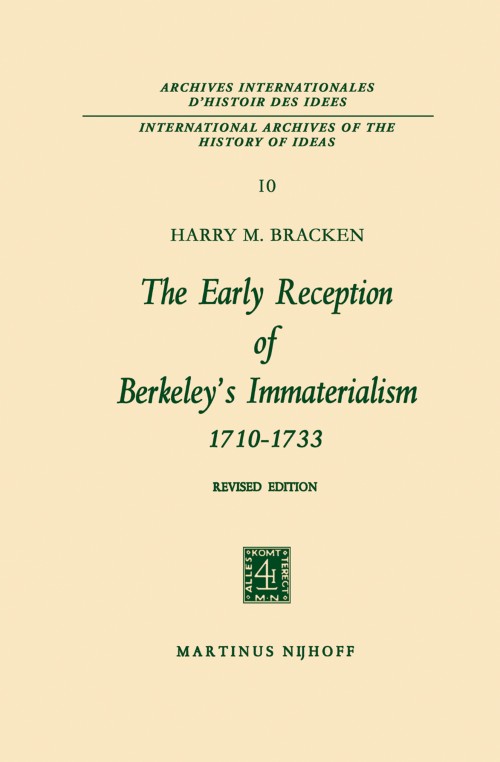
The Early Reception of Berkeley’s Immaterialism 1710–1733 [electronic resource] / by Harry M. Bracken.
Erişim Adresi
ISBN
9789401035675
Dil Kodu
İngilizce
Yer Numarası
DK/15929
Yazar
Basım Bildirimi
2nd ed. 1965.
Yayın Bilgisi
Dordrecht : Springer Netherlands : Imprint: Springer, 1965.
Fiziksel Niteleme
XIV, 130 p. online resource.
Dizi
International Archives of the History of Ideas Archives internationales d'histoire des idées, 2215-0307 ; 10
İçindekiler Notu
I. The Early Reception of Berkeley’s Immaterialism -- The London Wits. — Acta Eruditorum. — Bibliothèque Italique. — Jean Pierre de Crousaz. — Pierre Desfontaines. — Voltaire. — Journal des Sçavans. — Journal Litéraire. — Michael de la Roche and Memoirs of Literature. — Malebranche, the Jesuits and the Mémoires de Trévoux. — Egomism. — Christian Wolff. — Christoph Pfaff. — Arthur Collier. -- II. A Continuation -- Fénelon. — Tournemine and the Jesuits again. — L’Europe Savante. — Chevalier Ramsay. — David Hume. — The Rankenian Club. — Samuel Johnson of Connecticut. — Ephraim Chambers. — Andrew Baxter. -- III. The Journal Litéraire Review of Berkeley’s Three Dialogues -- Thémiseul de Saint-Hyacinthe. — Justus van Effen. -- IV. Berkeley and Chambers -- Chambers’ Cyclopaedia. — Abstract Ideas. — L’Encyclopédie. -- V. Andrew Baxter: Critic of Berkeley -- Pyrrhonism. — Pierre Bayle. — Ephraim Chambers. -- Conclusion.
Özet, vb.
By the time of Immanuel Kant, Berkeley had been called, among other things, a sceptic, an atheist, a solipsist, and an idealist. In our own day, however, the suggestion has been advanced that Berkeley is better understood if interpreted as a realist and man of common sense. Regardless of whether in the end one decides to treat him as a sub jective idealist or as a realist, I think it has become appropriate to inquire how Berkeley's own contemporaries viewed his philosophy. Heretofore the generally accepted account has been that they ignored him, roughly from the time he published the Principles of Human Knowledge until 1733 when Andrew Baxter's criticism appeared. The aim of the present study is to correct that account as well as to give some indication not only of the extent, but more importantly, the role and character of several of the earliest discussions. Secondarily, I have tried to give some clues as to the influence this early material may have had in forming the image of the "good" Bishop that emerged in the second half of the eighteenth century. For it is my hope that such clues may prove helpful in freeing us from the more severe strictures of the traditional interpretive dogmas.
Konu
History.
Philosophy, Modern.
History.
Early Modern Philosophy.
Philosophy, Modern.
History.
Early Modern Philosophy.
Kurum Adı
Eseri Alıntıla
Referansları kullanmadan önce gözden geçirmeniz ve varsa gerekli düzeltmeleri yapmanız önerilir.
Dijital Kaynak
MARC Görünümü
LEADER 04880nam a22005775i 4500
001 814691
003 TR_AnAIT
005 20260130214558
007 cr nn 008mamaa
008 121227s1965 ne | s |||| 0|eng d
020 |a9789401035675|9978-94-010-3567-5
024 7 |a10.1007/978-94-010-3567-5|2doi
041 |aeng
049 |aTürk Tarih Kurumu Kütüphanesi
050 4|aD1-2027
072 7|aHB|2bicssc
072 7|aHBAH|2bicssc
072 7|aHIS000000|2bisacsh
072 7|aNH|2thema
072 7|aNHAH|2thema
082 04|a900|223
090 |aDK/15929
100 1 |aBracken, Harry M.|eauthor.|4aut|4http://id.loc.gov/vocabulary/relators/aut
245 14|aThe Early Reception of Berkeley’s Immaterialism 1710–1733|h[electronic resource] /|cby Harry M. Bracken.
250 |a2nd ed. 1965.
264 1|aDordrecht :|bSpringer Netherlands :|bImprint: Springer,|c1965.
300 |aXIV, 130 p.|bonline resource.
336 |atext|btxt|2rdacontent
337 |acomputer|bc|2rdamedia
338 |aonline resource|bcr|2rdacarrier
347 |atext file|bPDF|2rda
490 1 |aInternational Archives of the History of Ideas Archives internationales d'histoire des idées,|x2215-0307 ;|v10
505 0 |aI. The Early Reception of Berkeley’s Immaterialism -- The London Wits. — Acta Eruditorum. — Bibliothèque Italique. — Jean Pierre de Crousaz. — Pierre Desfontaines. — Voltaire. — Journal des Sçavans. — Journal Litéraire. — Michael de la Roche and Memoirs of Literature. — Malebranche, the Jesuits and the Mémoires de Trévoux. — Egomism. — Christian Wolff. — Christoph Pfaff. — Arthur Collier. -- II. A Continuation -- Fénelon. — Tournemine and the Jesuits again. — L’Europe Savante. — Chevalier Ramsay. — David Hume. — The Rankenian Club. — Samuel Johnson of Connecticut. — Ephraim Chambers. — Andrew Baxter. -- III. The Journal Litéraire Review of Berkeley’s Three Dialogues -- Thémiseul de Saint-Hyacinthe. — Justus van Effen. -- IV. Berkeley and Chambers -- Chambers’ Cyclopaedia. — Abstract Ideas. — L’Encyclopédie. -- V. Andrew Baxter: Critic of Berkeley -- Pyrrhonism. — Pierre Bayle. — Ephraim Chambers. -- Conclusion.
520 |aBy the time of Immanuel Kant, Berkeley had been called, among other things, a sceptic, an atheist, a solipsist, and an idealist. In our own day, however, the suggestion has been advanced that Berkeley is better understood if interpreted as a realist and man of common sense. Regardless of whether in the end one decides to treat him as a sub jective idealist or as a realist, I think it has become appropriate to inquire how Berkeley's own contemporaries viewed his philosophy. Heretofore the generally accepted account has been that they ignored him, roughly from the time he published the Principles of Human Knowledge until 1733 when Andrew Baxter's criticism appeared. The aim of the present study is to correct that account as well as to give some indication not only of the extent, but more importantly, the role and character of several of the earliest discussions. Secondarily, I have tried to give some clues as to the influence this early material may have had in forming the image of the "good" Bishop that emerged in the second half of the eighteenth century. For it is my hope that such clues may prove helpful in freeing us from the more severe strictures of the traditional interpretive dogmas.
532 8 |aAccessibility summary: This PDF is not accessible. It is based on scanned pages and does not support features such as screen reader compatibility or described non-text content (images, graphs etc). However, it likely supports searchable and selectable text based on OCR (Optical Character Recognition). Users with accessibility needs may not be able to use this content effectively. Please contact us at accessibilitysupport@springernature.com if you require assistance or an alternative format.
532 8 |aInaccessible, or known limited accessibility
532 8 |aNo reading system accessibility options actively disabled
532 8 |aPublisher contact for further accessibility information: accessibilitysupport@springernature.com
650 0|aHistory.
650 0|aPhilosophy, Modern.
650 14|aHistory.
650 24|aEarly Modern Philosophy.
710 2 |aSpringerLink (Online service)
773 0 |tSpringer Nature eBook
776 08|iPrinted edition:|z9789024701865
776 08|iPrinted edition:|z9789401035682
776 08|iPrinted edition:|z9789401035699
830 0|aInternational Archives of the History of Ideas Archives internationales d'histoire des idées,|x2215-0307 ;|v10
856 40|uhttps://doi.org/10.1007/978-94-010-3567-5
912 |aZDB-2-SHU
912 |aZDB-2-SXH
912 |aZDB-2-BAE
950 |aHumanities, Social Sciences and Law (SpringerNature-11648)
950 |aHistory (R0) (SpringerNature-43722)
001 814691
003 TR_AnAIT
005 20260130214558
007 cr nn 008mamaa
008 121227s1965 ne | s |||| 0|eng d
020 |a9789401035675|9978-94-010-3567-5
024 7 |a10.1007/978-94-010-3567-5|2doi
041 |aeng
049 |aTürk Tarih Kurumu Kütüphanesi
050 4|aD1-2027
072 7|aHB|2bicssc
072 7|aHBAH|2bicssc
072 7|aHIS000000|2bisacsh
072 7|aNH|2thema
072 7|aNHAH|2thema
082 04|a900|223
090 |aDK/15929
100 1 |aBracken, Harry M.|eauthor.|4aut|4http://id.loc.gov/vocabulary/relators/aut
245 14|aThe Early Reception of Berkeley’s Immaterialism 1710–1733|h[electronic resource] /|cby Harry M. Bracken.
250 |a2nd ed. 1965.
264 1|aDordrecht :|bSpringer Netherlands :|bImprint: Springer,|c1965.
300 |aXIV, 130 p.|bonline resource.
336 |atext|btxt|2rdacontent
337 |acomputer|bc|2rdamedia
338 |aonline resource|bcr|2rdacarrier
347 |atext file|bPDF|2rda
490 1 |aInternational Archives of the History of Ideas Archives internationales d'histoire des idées,|x2215-0307 ;|v10
505 0 |aI. The Early Reception of Berkeley’s Immaterialism -- The London Wits. — Acta Eruditorum. — Bibliothèque Italique. — Jean Pierre de Crousaz. — Pierre Desfontaines. — Voltaire. — Journal des Sçavans. — Journal Litéraire. — Michael de la Roche and Memoirs of Literature. — Malebranche, the Jesuits and the Mémoires de Trévoux. — Egomism. — Christian Wolff. — Christoph Pfaff. — Arthur Collier. -- II. A Continuation -- Fénelon. — Tournemine and the Jesuits again. — L’Europe Savante. — Chevalier Ramsay. — David Hume. — The Rankenian Club. — Samuel Johnson of Connecticut. — Ephraim Chambers. — Andrew Baxter. -- III. The Journal Litéraire Review of Berkeley’s Three Dialogues -- Thémiseul de Saint-Hyacinthe. — Justus van Effen. -- IV. Berkeley and Chambers -- Chambers’ Cyclopaedia. — Abstract Ideas. — L’Encyclopédie. -- V. Andrew Baxter: Critic of Berkeley -- Pyrrhonism. — Pierre Bayle. — Ephraim Chambers. -- Conclusion.
520 |aBy the time of Immanuel Kant, Berkeley had been called, among other things, a sceptic, an atheist, a solipsist, and an idealist. In our own day, however, the suggestion has been advanced that Berkeley is better understood if interpreted as a realist and man of common sense. Regardless of whether in the end one decides to treat him as a sub jective idealist or as a realist, I think it has become appropriate to inquire how Berkeley's own contemporaries viewed his philosophy. Heretofore the generally accepted account has been that they ignored him, roughly from the time he published the Principles of Human Knowledge until 1733 when Andrew Baxter's criticism appeared. The aim of the present study is to correct that account as well as to give some indication not only of the extent, but more importantly, the role and character of several of the earliest discussions. Secondarily, I have tried to give some clues as to the influence this early material may have had in forming the image of the "good" Bishop that emerged in the second half of the eighteenth century. For it is my hope that such clues may prove helpful in freeing us from the more severe strictures of the traditional interpretive dogmas.
532 8 |aAccessibility summary: This PDF is not accessible. It is based on scanned pages and does not support features such as screen reader compatibility or described non-text content (images, graphs etc). However, it likely supports searchable and selectable text based on OCR (Optical Character Recognition). Users with accessibility needs may not be able to use this content effectively. Please contact us at accessibilitysupport@springernature.com if you require assistance or an alternative format.
532 8 |aInaccessible, or known limited accessibility
532 8 |aNo reading system accessibility options actively disabled
532 8 |aPublisher contact for further accessibility information: accessibilitysupport@springernature.com
650 0|aHistory.
650 0|aPhilosophy, Modern.
650 14|aHistory.
650 24|aEarly Modern Philosophy.
710 2 |aSpringerLink (Online service)
773 0 |tSpringer Nature eBook
776 08|iPrinted edition:|z9789024701865
776 08|iPrinted edition:|z9789401035682
776 08|iPrinted edition:|z9789401035699
830 0|aInternational Archives of the History of Ideas Archives internationales d'histoire des idées,|x2215-0307 ;|v10
856 40|uhttps://doi.org/10.1007/978-94-010-3567-5
912 |aZDB-2-SHU
912 |aZDB-2-SXH
912 |aZDB-2-BAE
950 |aHumanities, Social Sciences and Law (SpringerNature-11648)
950 |aHistory (R0) (SpringerNature-43722)
Materyaller
Depodan talep edilen materyal sadece kütüphane içerisinde kullanılmaktadır.
Materyal dışarıya ödünç verilmemektedir.
Materyal dışarıya ödünç verilmemektedir.
